Birth in Lushan
Born into a farming family in Lushan County, Ruzhou; displayed immense physical prowess and mastered archery and equestrian skills from early youth.
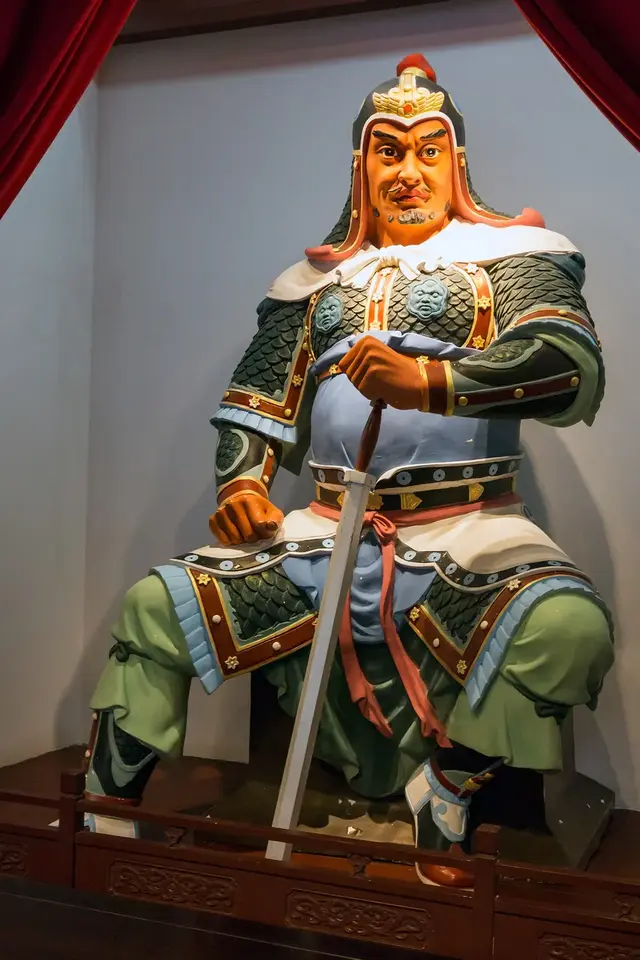
牛皋
Niu Gao (牛皋, 1087 – April 5, 1147), courtesy name Boyuan (伯远), was a native of Lushan County, Ruzhou (present-day Lushan County, Pingdingshan, Henan Province). He was an illustrious patriotic military commander of the Southern Song dynasty, celebrated as a national hero and a premier stalwart of the legendary Yue Family Army, in which he served as the Commander of the Left Army. Hailing from a modest background, Niu Gao…
Niu Gao (牛皋, 1087 – April 5, 1147), courtesy name Boyuan (伯远), was a native of Lushan County, Ruzhou (present-day Lushan County, Pingdingshan, Henan Province). He was an illustrious patriotic military commander of the Southern Song dynasty, celebrated as a national hero and a premier stalwart of the legendary Yue Family Army, in which he served as the Commander of the Left Army. Hailing from a modest background, Niu Gao possessed formidable physical strength and exceptional proficiency in horsemanship and archery. On the battlefield, he was renowned for wielding heavy iron dual maces and a spear with deadly precision. Following the Jingkang Incident of 1127, when Jurchen Jin armies invaded the Central Plains, Niu rallied local militia in Ruzhou and Dengzhou to defend civilian communities, inflicting multiple defeats on Jin raiding columns. In 1130 (the 4th year of the Jianyan era), as Jurchen forces retreated northward across the Yangtze River, Niu engineered a devastating ambush near Baofeng and Lushan against the Jin general Yelü Mawu, routing the enemy, slaying and capturing over ten thousand troops, and capturing immense military baggage, an exploit that shook the Central Plains. In 1133 (the 3rd year of the Shaoxing era), Niu officially incorporated his elite forces into the Shenwu Rear Army commanded by Yue Fei, serving successively as the Commander of the Central Army and Commander of the Left Army. In 1134 (the 4th year of the Shaoxing era), Niu participated in the triumphant campaign to recover the Six Prefectures of Xiangyang and the Han River basin. Under Yue Fei's direction, he vanquished the puppet Qi general Li Cheng and Jin commander Liu Yi, liberating Xiangyang, Suizhou, and Dengzhou. Immediately afterward, Niu launched a solo expedition across several hundred li in three days to relieve the Jin siege of Luzhou (present-day Hefei, Anhui), capturing a Jin battalion commander in person and dispersing the forces of Wanyan Zongbi. In 1135, during the campaign to pacify the water bandit rebellion of Yang Yao at Dongting Lake, Niu spearheaded naval assaults, stormed the insurgent fortress on light skiffs, and personally seized Yang Yao in hand-to-hand combat. During Yue Fei's grand Northern Expedition of 1140 (the 10th year of the Shaoxing era), Niu led the Left Army across the Central Plains, liberating Zhengzhou and Xuzhou, and fought with valor during the historic battles of Yancheng and Yingchang to shatter the elite Jurchen Iron Pagoda heavy cavalry. Following the tragic execution of Yue Fei and his son Yue Yun on fabricated charges in early 1142, Niu was reassigned as Assistant Commander-in-Chief of Infantry and Cavalry of Jinghu South Circuit. Stationed along the Yangtze River defense line, he remained steadfastly committed to the cause of northern reconquest and openly denounced Grand Chancellor Qin Hui's humiliating policy of appeasement and territorial concessions. Fearing Niu's immense prestige among veteran troops and his uncompromising spirit, Qin Hui secretly instructed his loyal confidant Tian Shizhong to poison Niu at a military banquet in Hanyang. On April 5, 1147 (the 3rd day of the 3rd lunar month, 17th year of the Shaoxing era), Niu drank the poisoned wine and died a martyr at the age of sixty-one. In his dying moments, he cried aloud with grief and indignation: "I regret only that I cannot die in battle wrapped in horsehide upon the northern plains to serve my sovereign, but must perish at the hands of treacherous sycophants!" His indomitable loyalty and battlefield heroism have been revered throughout Chinese history.
Born into a farming family in Lushan County, Ruzhou; displayed immense physical prowess and mastered archery and equestrian skills from early youth.
After the fall of Bianjing during the Jingkang Catastrophe, organized local volunteer militia in Lushan to resist Jin incursions and protect local civilians.
Intercepted the retreating northern army of Jin commander Yelü Mawu at Baofeng, winning ten successive engagements and routing ten thousand enemy soldiers.
Officially placed his forces under the command of Yue Fei by imperial order, appointed Commander of the Central Army, forging a deep military brotherhood with Yue.
Spearheaded the campaign to recover the Six Prefectures of the Xiang-Han region; advanced across several hundred li in three days to relieve the siege of Luzhou.
Joined the Dongting Lake naval campaign against the Yang Yao insurgency; stormed the water fortress and personally captured rebel chieftain Yang Yao.
Commanded the Left Army in Yue Fei's northern campaign, recovering Lushan and Xuzhou, and flanking the Jurchen Iron Pagoda cavalry at Yancheng.
Deeply grieved over the judicial murder of Yue Fei and Yue Yun; reassigned as Assistant Commander-in-Chief of Infantry and Cavalry of Jinghu South Circuit.
Murdered with poisoned wine by Qin Hui's henchman Tian Shizhong during a banquet in Hanyang on April 5; died courageously at sixty-one.
Niu Gao was born into a common farming family in Lushan County, Ruzhou (in modern Pingdingshan, Henan Province). He possessed an imposing physique, an unyielding temperament, and extraordinary strength, capable of drawing powerful bows with either hand and wielding twin heavy iron maces alongside a lance with formidable skill.
When the Jingkang Incident of 1127 brought the collapse of the Northern Song capital of Bianjing and the captivity of Emperors Huizong and Qinzong, Jurchen cavalry swept across the Central Plains, leaving civilian populations vulnerable to roaming bands of invaders and local bandits. In response, Niu organized a local self-defense militia in his native Lushan, leveraging the rugged mountainous terrain of Mount Funiu to mount surprise attacks against raiding Jin detachments. His steadfast defense of the local population earned him widespread acclaim, and he was chosen as the paramount leader of the local regional resistance.
In the spring of 1130 (the 4th year of the Jianyan era), after Jin general Wanyan Zongbi was checked at Huangtiandang and forced to retreat northward, Jurchen commander Yelü Mawu led his elite columns from Jiangxi back toward the north, traversing the corridors of Ruzhou and Baofeng. Discerning that the enemy was exhausted by long marches and eager to reach home, Niu coordinated with local imperial forces and laid multi-layered ambushes along the densely forested defiles of Baofeng County.
As Yelü Mawu's vanguard entered the narrow mountain passes, Niu led his hidden warriors in a devastating concentric assault, striking with lethal volleys of arrows and crushing blows from his iron maces. In ten successive engagements, Niu's forces routed the Jin column, slaying several thousand soldiers, taking over ten thousand prisoners, and seizing immense quantities of warhorses, gold, and supplies plundered from Jiangnan. This resounding triumph at Baofeng established Niu's reputation throughout the empire, prompting the imperial court to grant him commissions as Regional Pacification Commissioner for Western Circuit and Prefectural Pacification Commissioner for Cai, Tang, Deng, and Jun Prefectures.
In 1133 (the 3rd year of the Shaoxing era), as Emperor Gaozong and Grand Councilor Zhang Jun consolidated the southern defense framework, the court issued an imperial decree attaching Niu's troops to the Shenwu Rear Army commanded by Yue Fei at Ezhou. Long an admirer of Yue Fei's incorruptible patriotism and discipline, Niu willingly accepted the integration, and Yue Fei appointed him Commander of the Central Army. Niu quickly emerged alongside Zhang Xian as one of the two most trusted senior generals in the Yue Family Army.
In May 1134 (the 4th year of the Shaoxing era), Yue Fei launched the campaign to recover the Six Prefectures of the Xiang-Han region, which had fallen under the control of puppet Qi general Li Cheng and Jurchen auxiliary forces. Yue Fei designated Niu to lead the vanguard. Crossing the Han River with elite shock cavalry and infantry, Niu assaulted Suizhou, engaging puppet commander Wang Song under severe projectile fire and reclaiming the city within three days. He then linked up with Yue Fei's main body to surround Xiangyang, driving Li Cheng into headlong flight and restoring all six lost prefectures to Song administration.
Shortly after the victory at Xiangyang, Wanyan Zongbi joined forces with the puppet Qi regime of Liu Yu to besiege the strategic Huai River gateway of Luzhou (present-day Hefei, Anhui). With the city facing imminent collapse, Yue Fei ordered Niu to lead a relief force. Niu rode non-stop for three days across hundreds of li to reach the battlefield. When the Jin troops deployed to block him, Niu spearheaded a charge directly into the enemy lines, single-handedly capturing a Jin thousand-household commander (qianhu) and decapitating hundreds of enemy soldiers. Disheartened by this sudden defeat, the besiegers lifted the siege and retreated. Emperor Gaozong issued an imperial commendation and promoted Niu to Militia Commissioner of Chengzhou.
In 1135 (the 5th year of the Shaoxing era), the insurgent leader Yang Yao established an entrenched naval stronghold on Dongting Lake, commanding tens of thousands of waterborne combatants and armored paddle-wheel warships. The court appointed Yue Fei to extinguish the rebellion. The treacherous topography and underwater timber obstacles favored the rebels, but Yue Fei and Niu devised a tactic of clogging the lake surface with weeds and floating lumber to immobilize the enemy paddle wheels.
In the final offensive, Niu served as Commander of the Left Army, leading a boarding squad on agile skiffs straight into the inner sanctuary of Yang Yao's fortress. As the stronghold collapsed, Yang Yao, clad in heavy armor, leapt into the lake attempting to swim away. Niu dived directly into the water, subdued the rebel chieftain in close-quarters wrestling, and dragged him ashore alive. The destruction of Yang Yao's fleet yielded hundreds of vessels and tens of thousands of recruits for the Yue Family Army, and Niu was elevated to Grand General of the Center Guard for his extraordinary combat capture.
In 1140 (the 10th year of the Shaoxing era), the Jin dynasty abrogated the peace treaty and invaded south across four fronts. Yue Fei launched his fourth northern counter-offensive, sending Niu and the Left Army northward through western Jingxi. Niu advanced relentlessly, recapturing Lushan, Yexian, and Wuyang. During the pivotal engagements of Yancheng and Yingchang, Niu deployed the Left Army's heavy cavalry to protect the flanks and mount devastating charges against Wanyan Zongbi's armored Iron Pagoda cavalry, playing an indispensable role in routing the elite Jurchen host. For his distinguished service, he was promoted to Defense Commissioner of Ningguo Commandery.
In late 1141, Emperor Gaozong and Grand Chancellor Qin Hui capitulated to Jin peace overtures, dispatching twelve gold-embossed tablets ordering Yue Fei to withdraw his armies. In early 1142, Qin Hui engineered the judicial murder of Yue Fei, his son Yue Yun, and Zhang Xian on groundless charges, systematically dismantling the Yue Family Army.
Following Yue Fei's tragic execution, Niu was overcome with anguish and openly wept in grief. Qin Hui and Zhang Jun, acutely aware of Niu's immense stature among veteran soldiers and his uncompromising rectitude, feared he might mobilize troops in rebellion against the peace treaty. Consequently, they removed him from the Ezhou frontline and reassigned him as Assistant Commander-in-Chief of Infantry and Cavalry of Jinghu South Circuit stationed at Hanyang, placing him under rigorous surveillance.
In Hanyang, Niu continually voiced fierce opposition to the territorial concessions and tribute payments made to the Jin empire, delivering impassioned speeches at military gatherings condemning the appeasement clique. Qin Hui became deeply alarmed and instructed his confidant Tian Shizhong, then Commander of the Imperial Vanguard at Ezhou, to eliminate the veteran warrior.
On April 5, 1147 (the 3rd day of the 3rd lunar month, 17th year of the Shaoxing era), during the Shangsi Festival, Tian hosted an elaborate banquet for general officers in Hanyang. Niu was invited as the guest of honor, and Tian arranged for a lethal dose of poison to be placed into Niu's wine cup. After returning home from the banquet, Niu suffered violent abdominal hemorrhaging.
On his deathbed, the sixty-one-year-old veteran general sat upright, looked toward the sky, and gave voice to a celebrated dying lament: "I am sixty-one years old and have attained the rank of Defense Commissioner; my personal ambitions are fully fulfilled! My only regret is that north and south have made peace, so that I cannot wrap my corpse in horsehide upon the northern battlefields to repay my sovereign, but must perish at the hands of treacherous sycophants over banquet wine!" With these words, he expired. His soldiers and the populace of the region wept openly. Qin Hui's agents suppressed the news, burying him simply at the foot of Qixia Ridge near West Lake in Hangzhou, facing Yue Fei's tomb across the road, where he has been honored by subsequent generations.
During the retreat of Jin forces across the Yangtze in 1130, Niu demonstrated mastery of guerrilla and ambush warfare. Leveraging the crags of Baofeng and Lushan, he established concentric ambushes, fought ten consecutive engagements, and utterly shattered the seasoned vanguard of Jin commander Yelü Mawu, capturing over ten thousand enemy troops and proving that southern forces could decisively defeat northern armies in open terrain.
During the defense of Luzhou in 1134, Niu covered several hundred li in three days of forced marches. Confronted by superior Jin and puppet Qi siege forces, Niu charged straight into the enemy lines, single-handedly captured a Jin battalion commander, broke the enemy's front lines, and lifted the siege, earning direct imperial accolades from Emperor Gaozong.
During the 1135 campaign against Yang Yao's rebel naval confederation, Niu led the assault force in light skiffs to penetrate the barrier-strewn rebel base. In the final confrontation, he dived into the waters of Dongting Lake to grapple with Yang Yao, capturing the rebel chieftain alive and extinguishing a multi-year rebellion that had devastated the middle Yangtze basin.
During Yue Fei's 1140 Northern Expedition, Niu led the Left Army through Jingxi to liberate Lushan and Xuzhou. At Yancheng and Yingchang, he held the defensive flanks against Wanyan Zongbi's heavy cavalry and spearheaded the counter-thrust that crushed the legendary Jurchen Iron Pagoda shock cavalry.
In the dark years following Yue Fei's execution, Niu refused to conform to Qin Hui's appeasement regime. Faced with assassination by poisoned wine, he chose death over submission, immortalizing his lifelong dedication to Chinese sovereignty with his famous declaration of sorrow over not dying on the battlefield.
FIGURES ASSOCIATED WITH THIS DYNASTY