Birth in Chang'an
Born into a modest scholarly family in Jingzhao, experiencing early poverty and rigorous study.
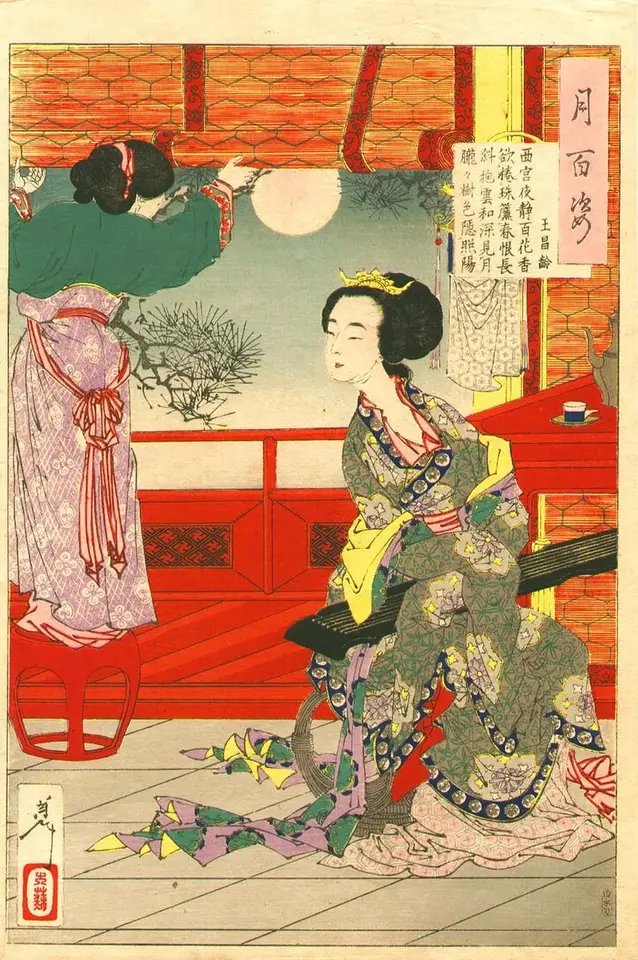
王昌龄
Wang Changling (王昌龄, 698–757), courtesy name Shaobo (少伯), was a native of Chang'an, Jingzhao (present-day Xi'an, Shaanxi Province), with ancestral ties to Taiyuan and later associated with Jiangning (modern Nanjing, Jiangsu Province). He stands as one of the foremost poetic titans of the high Tang Dynasty, hailed across generations as the "Sage of Seven-Character Quatrains" (Qijue Shengshou) and venerated by…
Wang Changling (王昌龄, 698–757), courtesy name Shaobo (少伯), was a native of Chang'an, Jingzhao (present-day Xi'an, Shaanxi Province), with ancestral ties to Taiyuan and later associated with Jiangning (modern Nanjing, Jiangsu Province). He stands as one of the foremost poetic titans of the high Tang Dynasty, hailed across generations as the "Sage of Seven-Character Quatrains" (Qijue Shengshou) and venerated by contemporaries as the "Poetic Master" (Shijia Fuzi). Raised in penury, he devoted his early youth to ascetic study and agricultural labor in the valleys of Mount Song and Mount Zhongnan. Around 724, he answered the heroic spirit of the era by journeying across the northwestern frontier, traveling through the Hexi Corridor, Yumen Pass, and Juyan, observing firsthand the stark desolation of the deserts and the courage of garrison soldiers, which provided the emotional bedrock for his frontier poetry. In 727, Wang Changling passed the imperial civil service examinations (jinshi examination) and was appointed Collator in the Palace Library. In 734, he succeeded in the rigorous Examination of Extensive Learning and Grand Composition (boxue hongci), receiving an appointment as Sheriff of Fanshui. However, his proud temperament and disregard for petty administrative decorum provoked conservative hostility, resulting in his demotion to Lingnan in 738. Following an imperial amnesty in 740, he traveled north through Xiangyang to visit Meng Haoran, where their celebratory reunion inadvertently provoked a fatal recurrence of Meng's carbuncles. Assigned as Vice Magistrate of Jiangning in 744, he was demoted again in 748 to the remote frontier post of Longbiao in western Hunan, prompting Li Bai to compose his celebrated elegy Wen Wang Changling Zuoqian Longbiao Yao You Ci Ji. During the An Lushan Rebellion in 757, as he journeyed northward through Bozhou, he was ruthlessly murdered by the envious local governor Lüqiu Xiao. Later that year, imperial commander Zhang Hao executed Lüqiu Xiao under military law, famously avenging the slain poet. Renowned for majestic resonance, patriotic fervor, and emotional clarity, Wang Changling's masterpieces—including Chu Sai, Congjun Xing, Furong Lou Song Xin Jian, and Gui Yuan—represent the aesthetic summit of the seven-character quatrain, while his theoretical treatise Shi Ge established the foundational "three realms" (san jing) theory in Chinese literary criticism.
Born into a modest scholarly family in Jingzhao, experiencing early poverty and rigorous study.
Dwelt on Mount Song and Mount Zhongnan, studying classics, military strategy, and practicing farming.
Journeyed across the Hexi Corridor to Yumen Pass and Juyan, gaining firsthand experience of border garrison warfare.
Returned to Chang'an and passed the jinshi examination, receiving appointment as Collator in the Palace Library.
Triumphed in the elite Examination of Extensive Learning and Grand Composition, appointed Sheriff of Fanshui.
Targeted by bureaucratic slander for alleged lapses in petty conduct; banished to remote southern Lingnan.
Pardoned by imperial amnesty; visited Meng Haoran in Xiangyang, where festive indulgence led to Meng's death.
Reassigned to Jiangning in modern Nanjing, interacting with contemporary poets including Li Bai and Gao Shi.
Slandered by political adversaries and exiled to remote Longbiao in western Hunan; comforted by Li Bai's famous poem.
An Lushan launched his rebellion; Wang Changling departed Longbiao to return northward to protect his family.
Murdered by jealous Bozhou Governor Lüqiu Xiao; commander Zhang Hao subsequently executed Lüqiu Xiao to avenge the poet.
Wang Changling was born in 698 in Chang'an, Jingzhao (modern Xi'an, Shaanxi Province), during the reign of Wu Zetian. Traditional historical accounts record varying ancestral origins: the Old History of the Tang identifies him as a native of Chang'an, the New History of the Tang links him to Jiangning, and Yin Fan's Heyue Yingling Ji designates him as originating from Taiyuan. Epigraphical evidence confirms that his household belonged to a cadet branch of the Taiyuan Wang clan that had settled in the Guanzhong region, cultivating Confucian learning across generations amid severe economic penury.
During the early Kaiyuan era, young Wang Changling recognized that personal merit and academic distinction were his only means to overcome low birth. Around 720, he retreated to Mount Song in Henan and later secluded himself in the Zhongnan Mountains south of Chang'an. Living in a rustic hut, he combined rigorous study of classical canons and military strategy with physical farming, gaining deep sympathy for laboring peasants. In 723, he traveled through Bingzhou and Luzhou in Shanxi, studying ancient fortifications along the Fen River.
Around 724, twenty-seven-year-old Wang Changling resolved to follow the heroic zeitgeist of the high Tang, setting aside his brush to seek military experience on the northwestern frontier. Crossing the Xiao Pass on horseback, he journeyed through the Hexi Corridor, visiting Liangzhou, Ganzhou, and Suzhou before pushing toward Yumen Pass and the desert outpost of Juyan. In these arid expanses, he lived alongside garrison soldiers, witnessing nighttime patrols, signal fires, and the desolate bones of fallen warriors.
This multi-year frontier expedition transformed his poetic vision. The stark majesty of the desert and the unyielding patriotism of ordinary soldiers replaced conventional courtly mannerisms with raw emotional vitality, providing the inspiration for his immortal frontier quatrains. In 726, after returning from the border, he briefly stayed in the Shimen Valley of Lantian, composing verses that balanced martial vigor with contemplative solitude.
In 727, Wang Changling returned to Chang'an to sit for the metropolitan civil service examinations (jinshi examination). Demonstrating exceptional analytical clarity and literary brilliance, he passed the examination with distinction, receiving an appointment as Collator in the Palace Library (Zheng Jiupin Shang). In the imperial archives, he reviewed classical canons alongside young peers including Wang Wei and Chu Guangxi.
Seeking substantive administrative responsibility, Wang Changling sat in 734 for the demanding Examination of Extensive Learning and Grand Composition (boxue hongci), which tested high-level political memorials and statecraft. He triumphed once again, securing appointment as Sheriff of Fanshui (Zheng Jiupin Xia) in Henan Prefecture. Situated along critical communication routes between Luoyang and the Yellow River, Fanshui demanded active adjudication of civil lawsuits and defense patrols. Wang governed with diligence and integrity, earning deep affection from local residents while his poetic fame spread throughout the empire.
During this period, Chang'an popular culture celebrated the famous anecdote of "Painting on the Tavern Wall" (Qiting Huabi). On a snowy winter day, Wang Changling, Gao Shi, and Wang Zhihuan gathered in a Chang'an tavern to drink wine. When several celebrated Pear Garden courtesans arrived to sing contemporary verses, the three poets agreed to determine their literary standing by observing whose poems were performed. The first singer sang Wang Changling's quatrain on the jade flagon; the second sang Gao Shi's frontier verse; the third repeated another of Wang's court verses. Finally, the preeminent songstress sang Wang Zhihuan's verse on the Yellow River, prompting the three poets to embrace in joyful laughter, exemplifying the generous camaraderie of high Tang poets.
Despite his literary triumphs, Wang Changling possessed an outspoken, unbending character that clashed with bureaucratic convention. Unwilling to court powerful courtiers, he was slandered by conservative officials for alleged lapses in petty decorum (bu hu xihang). In the autumn of 738, he was stripped of his post in Fanshui and banished to the remote southern reaches of Lingnan.
Facing unjust demotion, Wang Changling displayed admirable equanimity, traversing the rugged passes of the Five Ridges and composing reflective verses on regional flora. In the summer of 740, an imperial amnesty pardoned his sentence, permitting him to journey northward.
Traveling through the middle Yangtze basin, Wang Changling took a detour to Xiangyang to visit his admired friend, pastoral poet Meng Haoran. Meng had spent the past year recovering from a severe back carbuncle, and his physicians had strictly warned him to abstain from alcohol and seafood. Overjoyed by Wang's arrival from southern exile, Meng disregarded medical advice, throwing a banquet where both consumed potent local wine and freshwater fish. The festive excess triggered a catastrophic recurrence of Meng's carbuncle, causing his sudden death within days. Shattered by guilt and sorrow, Wang wept bitterly at Meng's graveside before resuming his journey north.
In 744, Wang Changling was appointed Vice Magistrate of Jiangning in modern Nanjing. Serving in Jiangning for several years, he composed numerous celebrated parting poems, most famously Furong Lou Song Xin Jian, earning the affectionate epithet "Wang Jiangning". In Jiangning, he associated with contemporary masters including Li Bai and He Zhizhang.
However, the political environment deteriorated under Chancellor Li Linfu's autocratic rule. Wang Changling's upright nature and satirical verses once again offended court grandees. Around 748, the fifty-year-old poet suffered a second demotion, banished to the remote outpost of Longbiao in western Hunan (modern Qianyang).
Situated within the mountainous river valleys of the "Five Creeks" (Wuxi), Longbiao was regarded as an inhospitable, fever-ridden frontier. Upon learning of his friend's banishment, Li Bai was filled with indignant sorrow, composing his immortal parting quatrain Wen Wang Changling Zuoqian Longbiao Yao You Ci Ji: "As poplar blossoms fall and the cuckoo cries, I hear you pass through the Five Creeks toward Longbiao. I entrust my sorrowful heart to the bright moon, to follow the wind straight to the west of Yelang!"
During seven years in Longbiao, Wang Changling governed with remarkable compassion. Rejecting despondency, he established classical academies, mediated disputes between Han and ethnic Miao communities, and promoted agricultural improvements. His humane administration won deep devotion from local residents, who subsequently constructed ancestral shrines in his honor, celebrating his transformation of a remote border into a cultured community.
In November 755, An Lushan launched his rebellion in Fanyang, overrunning the central plains and capturing Luoyang and Chang'an. Hearing of the catastrophe and the flight of Emperor Xuanzong to Sichuan, sixty-year-old Wang Changling resolved to leave isolated Longbiao, traveling northward toward the Huai River basin to aid dynastic resistance and secure his ancestral graves.
In the spring of 757, Wang Changling arrived in Bozhou (modern Bozhou, Anhui Province). The regional governor of Bozhou, Lüqiu Xiao, was a petty, jealous bureaucrat who had long resented Wang's national literary fame. Exploiting wartime chaos, Lüqiu Xiao fabricated charges against the defenseless poet, arresting Wang Changling and having him secretly executed, bringing an abrupt and tragic end to one of China's greatest poetic masters.
Justice was swiftly executed. Later that year, imperial chancellor and Henan Military Commissioner Zhang Hao arrived to relieve the siege of Suiyang. Zhang ordered Lüqiu Xiao to advance his forces to relieve loyalist commanders Zhang Xun and Xu Yuan. Paralyzed by cowardice, Lüqiu Xiao delayed mobilization, directly causing Suiyang to fall and Zhang Xun to perish.
Upon occupying Bozhou, Zhang Hao summoned Lüqiu Xiao before his headquarters, ordering him executed under military law for dereliction of duty. Facing the headsman, Lüqiu Xiao wept and begged for mercy: "Spare my life, I beseech you! I have an eighty-year-old mother at home who will have no one to support her!" Zhang Hao gripped his sword and bellowed with righteous wrath: "And who will support the aged kin of Wang Changling?" Zhang Hao ordered Lüqiu Xiao immediately beaten to death with heavy cudgels, avenging Wang Changling and winning widespread acclaim across the empire.
Wang Changling occupies an unrivaled summit in the history of Chinese lyric poetry, universally acknowledged as the "Sage of Seven-Character Quatrains" (Qijue Shengshou). While five-character regulated verse excels in structural symmetry, the seven-character quatrain (qiyan jueju) demands absolute economy, requiring emotional progression within twenty-eight characters. Wang Changling elevated this form to perfection, blending resonant musical cadences with transcendent thematic breadth.
His immortal masterpiece Chu Sai ("Qin dynasty moon, Han dynasty passes; the myriad-li long campaign has seen no one return. If only the Flying General of Longcheng were present, he would never permit barbarian horses to cross Mount Yin") was designated by Ming dynasty critics Li Panlong and Wang Shimao as the greatest seven-character quatrain of the Tang Dynasty. Beginning with a cosmic fusion of Qin and Han history, the poem moves seamlessly from timeless sorrow to a powerful longing for peace.
Wang Changling was a founding pioneer of the high Tang frontier poetry school (biansai shi). Drawing upon his northwestern travels, his verses avoided external exoticism, exploring instead the psychology of garrison soldiers and their dedication to national survival.
His seven-poem cycle Congjun Xing represents the pinnacle of Tang frontier verse. In the celebrated fourth quatrain—"Clouds over Lake Qinghai darken the snowy peaks; the lonely citadel gazes from afar upon Yumen Pass. Through a hundred desert battles our golden armor is worn through, yet until we break Loulan we will never return"—the poem contrasts desolate mountain horizons with an indomitable oath of duty, capturing the heroic spirit of the high Tang.
In boudoir (guiyuan) and palace lament (gongyuan) verse, Wang Changling brought profound psychological depth to traditional courtly themes. Purging the genre of erotic superficiality, he portrayed the inner turmoil of women separated from their husbands by distant military service.
His renowned quatrain Gui Yuan ("The young maiden in her chamber knows no sorrow; on a spring day in fine attire she climbs the jade pavilion. Suddenly seeing the green willows along the path, she regrets having urged her husband to seek noble rank") captures a psychological transformation within four lines. Through the juxtaposition of innocent springtime joy and sudden regret, Wang exposed the human cost of military glory.
In parting verse, Wang Changling's Furong Lou Song Xin Jian created an enduring symbol of moral integrity in Chinese culture: "Cold rain blankets the river entering Wu by night; at dawn I bid farewell to my guest, with Chu mountains standing solitary. If my kin in Luoyang should ask of me, tell them a slice of ice heart rests within the jade flagon."
Rather than succumbing to sorrow, the poet employed the crystalline image of "ice within a jade flagon" (yuhu bingxin) to affirm his uncorrupted virtue amid political persecution, establishing a definitive emblem of scholar-official integrity.
In literary criticism, Wang Changling authored the foundational treatise Shi Ge (Forms of Poetry), which systematized classical poetic aesthetics. His most revolutionary contribution was the formulation of the "Three Realms" (san jing) theory: the "Object Realm" (wujing), the "Affective Realm" (qingjing), and the "Meaning Realm" (yijing).
Wang defined the Object Realm as mastering the physical form and vitality of nature; the Affective Realm as articulating emotional sorrow and joy; and the Meaning Realm as achieving deep philosophical resonance where spirit and matter merge. By formalizing the concept of yijing, Wang Changling established the central aesthetic category that guided Chinese literature, painting, and garden design across subsequent dynasties.
FIGURES ASSOCIATED WITH THIS DYNASTY