Birth in Ninghai
Born in Dajiahe Town, Ninghai, Zhejiang; displayed remarkable precocity, reading books an inch thick daily, praised as "Little Han Yu."
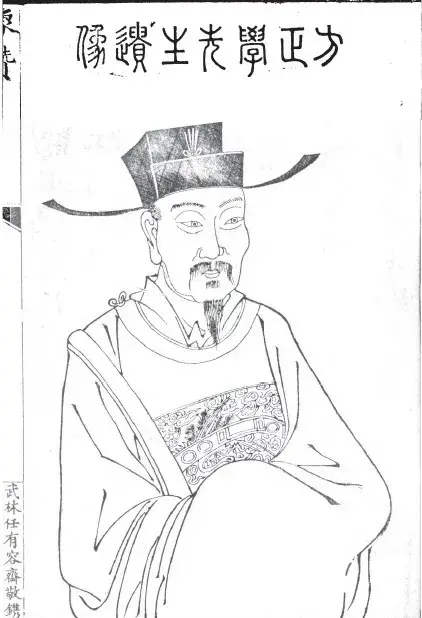
方孝孺
Fang Xiaoru (1357 – July 25, 1402), styled Xizhi and Xigu, was a native of Ninghai County, Taizhou Prefecture, Zhejiang Province (modern Ninghai County, Ningbo City). He was an outstanding Neo-Confucian scholar, prose master, and ministerial leader of the Jianwen court in the early Ming dynasty, respectfully revered by contemporary and later scholars as "Master Zhengxue." Mentored by Song Lian, the preeminent founding scholar…
Fang Xiaoru (1357 – July 25, 1402), styled Xizhi and Xigu, was a native of Ninghai County, Taizhou Prefecture, Zhejiang Province (modern Ninghai County, Ningbo City). He was an outstanding Neo-Confucian scholar, prose master, and ministerial leader of the Jianwen court in the early Ming dynasty, respectfully revered by contemporary and later scholars as "Master Zhengxue." Mentored by Song Lian, the preeminent founding scholar of the Ming dynasty, Fang was renowned nationwide for his mastery of Confucian classics, majestic prose style, and unyielding moral rectitude, being acclaimed across the realm as "the seed of scholars under Heaven." During the Hongwu era, Fang was twice summoned to court by Emperor Taizu of Ming (Zhu Yuanzhang) on account of his erudition and moral integrity. Impressed by his dignified composure and integrity, Emperor Taizu instructed Crown Prince Zhu Biao to preserve and cultivate Fang's talents as a foundational statesman for future governance. He successively served as Professor in the Hanzhong Prefectural School and tutor to the princely heir of King Xian of Shu, commanding profound intellectual respect throughout the empire. Following the accession of the Jianwen Emperor (Zhu Yunwen), who was dedicated to institutional revival and benevolent rule, Fang was summoned to court and appointed Hanlin Expositor-in-waiting, quickly advancing to Academician and Reader-in-waiting of the Hanlin Academy and Erudite of Literature. He directed state deliberations, the restructuring of official systems, imperial lectures, and the compilation of the Veritable Records of Ming Taizu, serving as the emperor's most trusted confidant. In 1399 (the first year of the Jianwen era), Zhu Di, Prince of Yan, launched the Jingnan Campaign under the pretext of clearing evil ministers from the sovereign's court. Fang Xiaoru staunchly advocated suppressing the rebellion, personally authoring the imperial proclamations and rallying manifestos condemning the Yan forces. In 1402 (the fourth year of the Jianwen era), the Yan army breached the Jinchuan Gate of Nanjing, the Jianwen Emperor disappeared amidst palace flames, and Zhu Di seized the throne, ordering Fang Xiaoru to draft the inaugural accession edict. Wearing mourning garments, Fang wept aloud in the palace hall, rejected Zhu Di's demands, threw his brush to the floor, and fiercely denounced the usurpation, swearing he would never draft the treasonous decree. Enraged, Zhu Di had Fang dismembered by chariots at the Jubao Gate in Nanjing and ordered the horrific extermination of his family and associates across ten degrees of kinship, resulting in hundreds of executions. Meeting his death with serene courage, Fang's unyielding moral fortitude became an eternal symbol of intellectual integrity and Confucian martyrdom.
Born in Dajiahe Town, Ninghai, Zhejiang; displayed remarkable precocity, reading books an inch thick daily, praised as "Little Han Yu."
Studied under the founding Confucian master Song Lian, mastering classical canonical philosophy beyond all peers.
Recommended to Emperor Taizu of Ming, who admired his gravity and advised Crown Prince Zhu Biao to employ him in later years.
Summoned to court again; appointed Professor of Hanzhong Prefectural School, subsequently hired by King Xian of Shu as heir apparent tutor.
Jianwen Emperor ascended the throne and immediately summoned Fang to the capital, conferring the title of Hanlin Expositor-in-waiting.
Promoted to Academician and Reader-in-waiting of the Hanlin Academy; directed state drafts and the Veritable Records of Ming Taizu.
As the Jingnan Campaign intensified, drafted all imperial punitive edicts and manifestos against Zhu Di.
Proposed joint encircling offensives, sow discord between the Prince of Yan's sons, and defend crucial supply lines.
Yan troops captured Nanjing in June; refused to draft Zhu Di's accession edict, dismembered at Jubao Gate at age 46.
Emperor Renzong (Zhu Gaochi) declared Fang and other Jianwen ministers loyal martyrs, pardoning surviving exiled kin.
Emperor Shenzong granted full pardons to over a thousand descendants and established the Biaozhong Shrine in Nanjing to honor Fang.
Emperor An of the Southern Ming formally rehabilitated Jianwen martyrs, conferring the supreme posthumous name "Wenzheng."
Fang Xiaoru was born in 1357 (the seventeenth year of the Zhizheng era under the Yuan dynasty) in Dajiahe Town, Ninghai County, Taizhou Prefecture, Zhejiang Province. His father, Fang Keqin, served as Prefect of Jining in Shandong during the early Hongwu era, earning broad acclaim as an incorruptible, compassionate official who was later commemorated in the Draft History of Ming within the Biographies of Upright Officials. From early childhood, Fang Xiaoru exhibited exceptional intellectual brilliance, penetrating gaze, and astonishing memory, reading stacks of historical and philosophical texts more than an inch thick every day. He composed essays with effortless elegance, earning the affectionate nickname "Little Han Yu" from elders in his home prefecture.
In his youth, Fang journeyed to Jinhua to study under Song Lian, the preeminent founding scholar and foremost literary figure of the early Ming dynasty. Song Lian's academy teemed with brilliant scholars from across the empire, yet none could match Fang's depth of canonical interpretation and rhetorical grandeur. Even senior literary luminaries such as Hu Han and Su Boheng acknowledged their inferiority before his genius. Despite his towering literary reputation, Fang never viewed ornate rhetoric as an end in itself; rather, he dismissed mere stylistic polish as trivial craft, dedicating his life wholly to illuminating the benevolent principles of Confucius and Mencius, rectifying moral standards, and realizing peace and moral order across the realm.
In private life, Fang steadfastly embraced poverty and valued familial harmony. During a severe illness in his youth, his household ran out of grain and had nothing to eat for days. When servants reported the dire situation with great anxiety, Fang laughed heartily from his bed, remarking: "The ancients only ate nine times in thirty days. Hardship and poverty are the common lot of true scholars; why should my family be an exception!" During the Hongwu era, when his father Fang Keqin was unjustly implicated in the Blank Seals Case and executed, Fang was devastated with grief, escorting his father's coffin on foot over thousands of miles back to their hometown for burial, his heart-wrenching lamentations moving passersby to tears.
In 1382 (the fifteenth year of the Hongwu era), recommended by senior court ministers such as Hanlin Academician Wu Chen and Chief Minister of the Court of Imperial Sacrifices Jie Shu, Fang Xiaoru was summoned to Nanjing for an imperial audience with Emperor Taizu of Ming (Zhu Yuanzhang). Emperor Taizu personally evaluated his classical understanding and policy responses in the Fengtian Hall. Observing Fang's dignified and reverent deportment, rigorous observance of ritual decorum, and lucid, profound answers, Emperor Taizu recognized his rare brilliance and remarked to Crown Prince Zhu Biao: "This is a man of austere virtue and extraordinary caliber; you must carefully protect and employ his talents throughout your reign until old age." To shield the young scholar from turbulent factional strife at court, Emperor Taizu bestowed generous travel provisions upon him and permitted him to return home to deepen his learning.
In 1392 (the twenty-fifth year of the Hongwu era), after repeated recommendations from senior officials, Emperor Taizu summoned Fang to the imperial palace once more. Upon careful consideration of imperial administrative needs, Emperor Taizu remarked to his courtiers: "It is not yet the proper time to deploy Fang Xiaoru's full administrative capacities." Consequently, the emperor appointed him Professor in the Hanzhong Prefectural School, entrusting him with the task of educating scholars and exploring statecraft in the northwestern frontier. Fang accepted the post cheerfully, lecturing students daily on Confucian canonical doctrines without flagging through winter cold or summer heat, invigorating the scholarly atmosphere across the northwest.
During this period, Zhu Chun, King Xian of Shu (eleventh son of Emperor Taizu), who governed Sichuan with a devotion to Confucian learning, heard of Fang's moral preeminence and dispatched envoys with lavish ceremonial gifts to invite Fang to Chengdu to serve as tutor to the princely heir. In every encounter with the young heir, Fang concentrated exclusively on lecturing on moral righteousness and benevolent kingship, entirely eschewing expediency and scheming. King Xian treated him with singular deference, naming Fang's study pavilion in the palace "Zhengxue" (Orthodox Learning), from which contemporary scholars came to revere him as "Master Zhengxue."
In the fifth intercalary month of 1398 (the thirty-first year of the Hongwu era), Emperor Taizu passed away, and his grandson Zhu Yunwen succeeded to the throne as the Jianwen Emperor. Dedicated to Confucian benevolence and eager to moderate martial severity with civil refinement, the new sovereign sought to build an orderly, enlightened administration. Among his first imperial edicts was a dispatch commanding Fang Xiaoru to ride post-haste to the capital to assist governance, appointing him Hanlin Expositor-in-waiting. The following year, the emperor promoted him to Academician and Reader-in-waiting of the Hanlin Academy, treating him with boundless intimacy and trust. In all matters concerning military strategy, civil institutions, and ministerial appointments, the Jianwen Emperor invariably consulted Fang before rendering decisions.
The Jianwen Emperor was an ardent reader of historical records. Whenever he encountered difficult textual passages or divergent classical commentaries during his imperial studies, he immediately summoned Fang into the palace halls to expound upon them. During court audiences, when ministers submitted memorials on complex administrative problems and disagreements arose, the emperor frequently instructed Fang to step behind the imperial throne screen to review the memorials and draft imperial endorsements. During this period, Fang was appointed Chief Director for the compilation of the authoritative official history Veritable Records of Ming Taizu and the extensive administrative encyclopedia Leiyao.
When the court restructured official titles and institutions based on the classical blueprint of the Rites of Zhou, emphasizing civil governance, Fang's post was retitled Erudite of Literature. Throughout this era, Fang served not only as the intellectual architect and administrative soul of the Jianwen reforms, but also, through his lofty moral authority, as the spiritual leader of the civil officialdom assembled around the young monarch.
In the autumn of 1399 (the first year of the Jianwen era), Zhu Di, Prince of Yan, revolted in Beiping under the slogan of "clearing evil ministers from the sovereign's court," initiating the devastating civil conflict known as the Jingnan Campaign. Confronted with this rebellion by an imperial prince against the central throne, Fang was consumed with indignation, resolutely arguing that the court must mobilize imperial forces to crush the insurrection and preserve unified sovereign rule. Virtually all imperial proclamations, manifestos, and denunciations issued by the Jianwen court to mobilize provincial garrisons were composed by Fang's eloquent brush. His proclamations laid bare the fundamental moral duties between ruler and subject, their impassioned phrasing and righteous fervor invigorating imperial troops across the empire.
In 1401 (the third year of the Jianwen era), when the Yan army raided Daming Prefecture, Zhu Di submitted memorials seeking peace and requesting a cessation of hostilities, as Qi Tai and Huang Zicheng had temporarily been dismissed from the capital. Fang saw through the maneuver, pointing out that the Yan army was isolated and weary, and implored the emperor not to be deceived. Fang proposed a multi-pronged strategy: dispatching an edict of clemency via Xue Yan, Vice Minister of the Court of Judicial Review, along with thousands of secret imperial proclamations to be covertly distributed among the Yan troops to undermine their morale; while concurrently ordering Liaodong armies to march through Shanhaiguan to attack Yongping, and Zhending forces to cross Lugou Bridge and strike Beiping directly, forcing Zhu Di to retreat while imperial armies pursued him. Regrettably, Xue Yan was timid, hiding the secret edicts upon arrival in the Yan camp, causing the strategy to falter.
In May of the same year, noting that Beiping's garrison was sparse and recognizing that Zhu Di's eldest son, Zhu Gaochi, was mild and bookish, whereas his second son, Zhu Gaoxu, was crafty and ambitious, Fang proposed sowing discord between them. He suggested dispatching an imperial envoy, Imperial Guard Commander Zhang An, to deliver an imperial seal letter to Zhu Gaochi, promising him succession if he submitted. However, Zhu Gaochi detected the scheme, forwarding the unsealed letter and envoy Zhang An directly to Zhu Di's frontline command, which thwarted the plan. In the summer of 1402 (the fourth year of the Jianwen era), Yan forces breached the Huai River and approached the Yangtze. When the naval commander Chen Xuan surrendered his fleet, Yan troops crossed the river and laid siege to the capital.
On July 13, 1402 (the thirteenth day of the sixth month of the fourth year of the Jianwen era), imperial commanders Li Jinglong and the Prince of Gu opened the Jinchuan Gate to admit the Yan army into Nanjing. Concurrently, flames engulfed the Fengtian Hall, and the Jianwen Emperor disappeared. Fang Xiaoru stood firm at his post, refusing to flee, and was captured and imprisoned. Earlier, when Zhu Di's forces had set out from Beiping, his principal advisor, the monk Yao Guangxiao, had knelt before Zhu Di and earnestly pleaded: "When Nanjing falls, Fang Xiaoru will surely not submit. I pray Your Highness will not kill him. If Fang Xiaoru is killed, the seed of scholars under Heaven will be extinguished!" Impressed by Fang's fame, Zhu Di had consented.
Upon capturing Nanjing, Zhu Di sought to legitimize his usurpation before the empire by having Fang Xiaoru draft his inaugural accession edict. Summoned from his cell into the palace hall, Fang arrived in coarse mourning sackcloth, his grief-stricken weeping echoing throughout the palace chambers. Disconcerted, Zhu Di stepped down from the dais and attempted to console him: "Master, do not torment yourself so. My intentions were merely to emulate the Duke of Zhou aiding King Cheng." Fang wiped his tears and sharply interrogated: "If you emulate the Duke of Zhou, where is King Cheng?" Zhu Di replied lamely: "He perished in the flames." Fang pressed further: "Why not enthrone King Cheng's son?" Zhu Di evaded: "The state requires a mature sovereign." Fang demanded again: "King Cheng had younger brothers; why not enthrone his brother?" At a loss for words, Zhu Di flushed with anger and muttered: "This is my family affair; why must the master interfere!"
Zhu Di then commanded attendants to press a brush and paper into Fang's hands, urging: "The proclamation to the empire cannot be drafted by any hand but yours!" Infuriated, Fang hurled the brush to the palace stones, shouting defiantly: "Death is nothing to me, but I shall never draft your edict!" Zhu Di growled in fury: "Do you not care about the extermination of your nine kinships?" Fang retorted with icy contempt: "Even if you exterminate ten kinships, what can you do to me!" Livid with rage, Zhu Di ordered guards to slit Fang's mouth from ear to ear with daggers and cast him into the death cell.
On July 25, 1402 (the twenty-fifth day of the sixth month of the fourth year of Jianwen), Zhu Di ordered Fang Xiaoru to be drawn and quartered at the Jubao Gate. At the execution grounds, Fang remained calm and composed, chanting his final farewell poem: "Heaven sends down turmoil, who knows the cause? Traitorous ministers achieve their scheme, plotting state power with deceit. Loyal ministers burn with righteous grief, blood and tears mingle and flow; sacrificing this life for my sovereign, what more could I ask? Alas and alack, let no blame fall upon me!" He was forty-six years old. Zhu Di unleashed an unprecedented wave of vengeance, rounding up Fang's paternal, maternal, and conjugal kin, along with his students and close friends as a fabricated "tenth kinship." A total of 847 people (some records say 873) were executed or dismembered, and thousands more were exiled to remote borders. Fang's wife Lady Zheng and his two sons, Fang Zhongxian and Fang Zhongyu, hanged themselves in grief, and his two daughters drowned themselves in the Qinhuai River, cementing their household's immortal legacy of loyalty.
Fang Xiaoru's principal intellectual contribution lay in developing the core tenets of Song Neo-Confucianism, transforming the abstract inner cultivation of "illuminating heavenly principle and extinguishing human selfish desire" into concrete political ethics and statecraft. In the turbulent transition between Yuan and Ming, Fang upheld the Confucian benevolent way as the sole standard for evaluating sovereign legitimacy. He maintained that the moral bond between ruler and subject was not merely feudal hierarchy, but an eternal manifestation of Heavenly Principle, insisting that ministers must serve the sovereign with moral autonomy rather than cowering before despotic force.
While assisting the Jianwen Emperor, Fang put these ideals into practice, advocating benevolent governance characterized by leniency, education, and moral suasion. He championed the abolition of harsh penal laws from the Hongwu reign, reduced heavy land tax burdens on agricultural lands in Jiangnan, revived light taxation policies, and restored local academies and civil service examinations. His thought transcended Legalist machinations, establishing a principled Confucian framework to moderate absolute imperial power, standing as a towering landmark of Confucian orthodoxy prior to the rise of late-Ming practical learning.
As the leading intellectual figure of the Jianwen court, Fang was entrusted with guiding significant administrative restructuring and compiling major state compendia. To address the administrative paralysis and unchecked autocracy resulting from the abolition of the Central Secretariat under Emperor Taizu, Fang advocated adapting the six ministerial offices of the Rites of Zhou, elevating the policy-deliberation role of Grand Secretaries, strengthening the Hanlin Academy, raising the rank of the Six Ministers to first rank, and establishing scholarly advisory mechanisms in the Wenyuan and Wenhua Pavilions.
In official historiography, Fang was the chief architect and final arbiter of early Ming scholarship. From 1398 through the early Jianwen reign, he served as Chief Director for the compilation of the Veritable Records of Ming Taizu, establishing the definitive historical record of the dynasty's founding heroes and imperial ancestral injunctions. He subsequently presided over the compilation of the comprehensive administrative compendium Leiyao, analyzing institutional evolution and statecraft across successive dynasties. His rigorous scholarship and stately prose contributed substantially to institutional standardization in the early Ming.
Following the outbreak of the Jingnan Campaign, Fang wielded his unmatched literary prowess to defend central dynastic authority against frontier princely insurrection. Throughout the three years of civil war, in his roles as Erudite of Literature and Academician and Reader-in-waiting, he drafted every imperial edict, manifesto, and public declaration issued by the court to expose the rebellion and rally loyalist garrisons across the empire.
Fang's manifestos were celebrated for their majestic syntax, profound legal and canonical grounding, and stirring emotional resonance. He not only articulated the sacred nature of dynastic legitimacy and political allegiance, but also highlighted the devastation inflicted upon commoners by the rebellious armies, summoning loyalist commanders to defend the capital. These manifestos shook the resolve of the rebel forces and inspired loyalist armies across the realm, being revered in Chinese literary history as supreme models of political declamation.
Fang Xiaoru's serene defiance before torture and death after the fall of the Jinchuan Gate represents one of the loftiest pinnacles of moral integrity in Chinese history. Confronted with Zhu Di's threats and blandishments, and amid widespread capitulation among court officials, Fang stood alone against armed tyranny. He denounced the usurpation, threw his brush to the floor, defied the slaughter of ten kinships, and refused to write a single word of legitimization for the rebel throne, sacrificing his life to embody the Confucian ideal of dying for righteousness.
Fang's martyrdom shattered the tyrant's expectation that slaughter could compel intellectual submission. Although Zhu Di executed his relatives and disciples, banned his writings, and punished those possessing his books with death, scholars across the realm risked their lives to preserve his manuscripts—such as the Xunzhi Zhai Collection and Houcheng Collection—concealing them in walls and underground caches. Fang's sacrifice became an enduring spiritual beacon for Chinese intellectuals, commanding reverence across generations.
FIGURES ASSOCIATED WITH THIS DYNASTY