Birth into Aristocracy
Born into the Shunyang Fan clan; received the childhood name Zhuan after accidentally injuring his forehead on a brick at birth; later adopted by his uncle Fan Hongzhi.
范晔
Fan Ye (398–446 CE), courtesy name Weizong and childhood name Zhuan, was a native of Shanyang County, Shunyang Commandery (west of present-day Biyang, Henan). He was an illustrious historian, man of letters, and high-ranking minister of the Southern Dynasties Liu Song. Born into the eminent aristocratic Shunyang Fan lineage, he was the grandson of the revered Confucian classicist Fan Ning and the fourth son of Senior General…
Fan Ye (398–446 CE), courtesy name Weizong and childhood name Zhuan, was a native of Shanyang County, Shunyang Commandery (west of present-day Biyang, Henan). He was an illustrious historian, man of letters, and high-ranking minister of the Southern Dynasties Liu Song. Born into the eminent aristocratic Shunyang Fan lineage, he was the grandson of the revered Confucian classicist Fan Ning and the fourth son of Senior General of Chariots and Cavalry Fan Tai. Adopted early by his paternal uncle Fan Hongzhi, he inherited the noble title of Fifth-rank Marquis of Wuxing County. Endowed with extraordinary erudition, Fan Ye was widely renowned for his encyclopedic knowledge of classics and histories, mastery of calligraphy and parallel prose, and exceptional talent in musical theory and lute performance. During his early career, Fan Ye served in successive offices including Assistant in the Palace Library, Major to Senior General Conquering the South Tan Daoji, and Governor of Xincai. In 432 CE (ninth year of Yuanjia), he was demoted to Governor of Xuanxing after drinking through the night and listening to funerary dirges from his window during the state mourning for Dowager Consort Wang. In Xuanxing, Fan Ye synthesized over a dozen disparate historical accounts of the Later Han written since the Wei and Jin dynasties. Eliminating redundancies and supplying critical insights, he composed the ninety volumes of Annals and Biographies comprising the Book of Later Han, a masterpiece of biographical historiography acclaimed alongside the Records of the Grand Historian, Book of Han, and Records of the Three Kingdoms as one of the Four Early Histories. In his later years, Fan Ye returned to imperial favor, serving as Senior Clerk to the Army of the Rear, General of the Left Guard, and Master of the Household for the Crown Prince, wielding substantial control over palace guards and participating in the central court. In 445 CE (twenty-second year of Yuanjia), he was drawn by Kong Xixian and Xie Zong into a clandestine palace coup aimed at enthroning Liu Yikang. Following the betrayal of the conspiracy by Xu Zhanzhi, Fan Ye was executed for treason in the capital market of Jiankang in early 446 CE at the age of forty-eight, leaving the Treatise section of his magnum opus unfinished.
Born into the Shunyang Fan clan; received the childhood name Zhuan after accidentally injuring his forehead on a brick at birth; later adopted by his uncle Fan Hongzhi.
Upon Liu Yu's founding of the Song Dynasty, Fan Ye entered service as Chief Clerk to Liu Yikang, subsequently rising to Assistant in the Palace Library before taking leave for his father's funeral.
Appointed Major to Senior General Conquering the South Tan Daoji and Governor of Xincai, later promoted to Director in the Ministry of Personnel for his literary reputation.
Drinking and listening to funerary dirges for amusement on the eve of Dowager Consort Wang's burial enraged Liu Yikang, resulting in his demotion to Governor of Xuanxing.
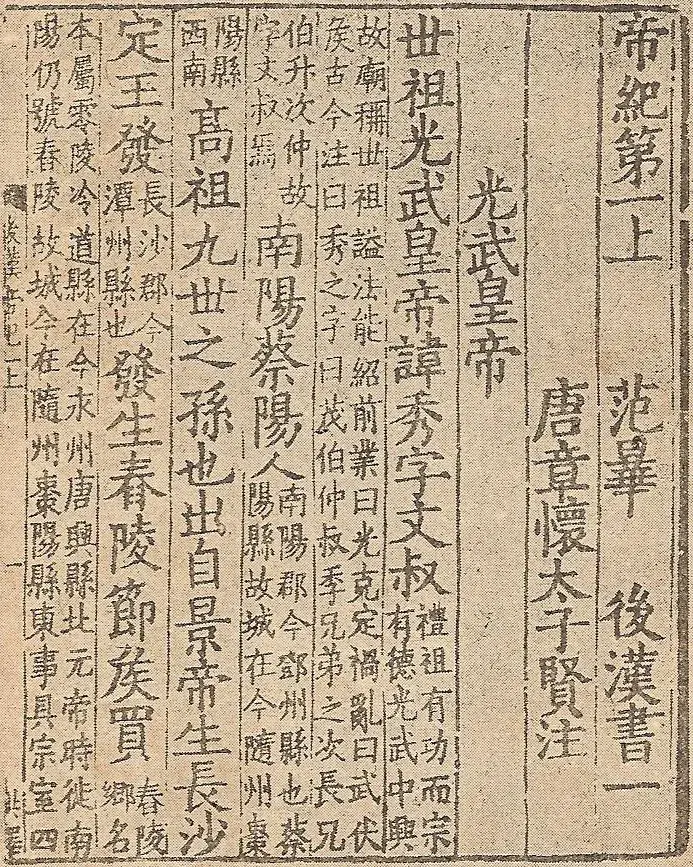
Researched and compiled the Book of Later Han, establishing new historiographical paradigms such as the Annals of Empresses and collective biographies for literati and women.
Concluded mourning for his stepmother and entered the service of Liu Jun; swiftly promoted to General of the Left Guard and Master of the Household for the Crown Prince.
Persuaded by Kong Xixian to lead a plot to depose Emperor Wen and enthrone Liu Yikang; aborted the plot at Wuzhang Ridge; subsequently betrayed by Xu Zhanzhi.
Executed at the capital marketplace alongside his sons and co-conspirators; met his death with equanimity, while his draft manuscripts were later annotated and supplemented by Liu Zhao during the Liang Dynasty.
Fan Ye traced his descent from the illustrious Shunyang Fan clan, one of the foremost aristocratic families across the Eastern Jin and Southern Dynasties, famous for alternating generations of military commanders and Confucian scholars. His great-grandfather Fan Wang had served as Eastern Jin General Pacifying the North and Governor of Xu and Yan provinces, authoring medical and classical commentaries while winning the hereditary title of Marquis of Wuxing County. His grandfather Fan Ning was an intellectual titan of the late Eastern Jin, serving as Governor of Yuzhang and composing authoritative commentaries on the Spring and Autumn Annals with Guliang Commentary. His father Fan Tai navigated the dynastic transition from Eastern Jin to Liu Song with immense political skill, becoming a trusted minister of Emperor Wu of Song and attaining the high rank of General of Chariots and Cavalry.
Fan Ye was the fourth son of Fan Tai, but because his birth mother was a concubine, his standing in the rigid status hierarchy of late Jin aristocracy was initially modest. Historical texts recount that his birth occurred under dramatic circumstances: his mother went into labor while using the latrine, and the infant fell onto the tiled floor, scarring his forehead. Family elders accordingly bestowed on him the childhood diminutive name Zhuan (meaning "brick"). Because Fan Tai's cousin Fan Hongzhi had no male issue, Fan Ye was formally adopted into his household during early childhood. Through this adoption, Fan Ye lawfully inherited the hereditary five-rank peerage of Marquis of Wuxing County, securing an unassailable legal status within the southern nobility.
From his earliest youth, Fan Ye displayed phenomenal intellectual gifts and an unquenchable passion for reading. Immersed in his clan's vast family library, he devoured philosophical, historical, and literary classics. He developed exceptional skill in crafting refined parallel prose, wrote powerful clerical script calligraphy, and thoroughly comprehended the subtleties of harmonics and instrumental music. In 414 CE, when he was just seventeen, regional commanders repeatedly summoned him to serve as Commandery Staff Officer, but Fan Ye declined the invitations to continue his scholarly pursuits in private.
In 420 CE, Emperor Wu of Song (Liu Yu) founded the Liu Song Dynasty, and Fan Ye entered official service upon imperial summon. He served initially as Senior Clerk to Prince of Pengcheng Liu Yikang in his capacity as General of the Chariots and Cavalry, managing administrative affairs. His literary eloquence soon prompted the court to appoint him Assistant in the Palace Library, tasked with collating and classifying imperial manuscripts. When his father Fan Tai passed away in 428 CE, Fan Ye retired from official duties according to ancestral rites to observe three years of mourning.
Upon concluding the mourning period, Fan Ye returned to imperial governance, receiving an appointment as Major to Senior General Conquering the South Tan Daoji, simultaneously governing Xincai Commandery. Working within the headquarters of the dynasty's most prestigious military commander, Fan Ye handled military documents and regional administration with effortless efficiency. Soon afterward, he was recalled to the capital and appointed Director in the Ministry of Personnel, placing him in control of official evaluations, recommendations, and appointments throughout the empire.
Fan Ye was endowed with immense brilliance, yet his temperament was fiercely arrogant and irreverent toward Confucian moral formalism. In the winter of 432 CE, Wang Xiurong, birth mother of Prince of Pengcheng Liu Yikang, died. On the eve of her state interment, imperial princes, court dignitaries, and palace colleagues assembled at the Eastern Mansion to participate in solemn funerary vigils. Fan Ye's younger brother Fan Guangyuan was on duty as Libationer in the Chancellor's Ministry. Fan Ye joined his brother along with Senior Clerk Wang Shen in their quarters, where they drank heavily throughout the night.
Past midnight, in an advanced state of intoxication, Fan Ye ordered the north windows opened so that they could listen to the mournful funerary dirges echoing down the street, rhythmically tapping their cups and treating the procession as musical entertainment. News of this transgression leaked immediately to imperial censors. Liu Yikang, then prime minister of the empire, felt profoundly humiliated and outraged by this insult to his mother's memory. Emperor Wen was similarly furious at Fan Ye's reckless insolence, issuing an imperial decree stripping him of his capital posts and demoting him to Governor of Xuanxing Commandery.
This abrupt demotion from the imperial nerve center to a distant administrative outpost dealt a crushing blow to Fan Ye's ambitions. Arriving in Xuanxing, he withdrew from frivolous socializing, adopting an austere and contemplative posture to reflect upon his life and the course of history. He observed that while historical records of the Eastern Han were abundant—including the official Dongguan Hanji and works by Yuan Hong, Sima Biao, Hua Qiao, and Xie Cheng—these texts were riddled with contradictions, factual redundancies, and stylistic crudity. Fan Ye gathered all available historical records and resolved to distill them into a single, comprehensive masterwork.
In 438 CE, having completed his tenure in Xuanxing, Fan Ye returned to the capital and was appointed Senior Clerk to Prince of Changsha Liu Yixin, receiving the concurrent title General Who Pacifies the North. The following year, his father's legal wife died. Although Fan Ye was a concubine's son, ritual propriety mandated his attendance at the funeral, yet he pleaded severe illness and delayed his departure for months, provoking sharp rebuke and official impeachment from ritualist officials. In 440 CE, Fan Ye joined the household of Prince of Shixing Liu Jun, serving as Senior Clerk to the Army of the Rear and Governor of South Xiapi. Liu Jun simultaneously governed Yangzhou, but being young and disinclined toward administrative burdens, he entrusted all political and financial affairs entirely to Fan Ye.
Fan Ye managed the affairs of Yangzhou with remarkable administrative acumen and decisive clarity, earning great acclaim from Emperor Wen. The emperor soon promoted him to General of the Left Guard and concurrently appointed him Master of the Household for the Crown Prince. These two postings placed Fan Ye in command of the elite imperial palace garrison and at the heart of the Crown Prince's palace administration, elevating him to the pinnacle of political power and military influence.
However, dangerous undercurrents were surging through the court. Emperor Wen had grown deeply suspicious of the expanding faction around Prince of Pengcheng Liu Yikang, culminating in 440 CE when the emperor purged key supporters and exiled Liu Yikang to Jiangzhou. Kong Xixian, a brilliant scholar whose father had once been saved from capital punishment through Liu Yikang's personal intervention, resolved to execute a daring coup d'etat to depose Emperor Wen and enthrone Liu Yikang. Kong Xixian, who studied celestial astrology and divination, asserted that Emperor Wen would meet an untimely end through dynastic fratricide, and that Jiangzhou would produce a new Son of Heaven.
Kong Xixian recognized that executing a palace coup required control over the capital garrison, making Fan Ye his primary objective. Through Fan Ye's nephew Xie Zong, whose brother was married to Liu Yikang's daughter, Kong Xixian ingratiated himself with Fan Ye. He lavished hospitality upon the general, purposely lost large sums of money to him in gambling, and played upon Fan Ye's deep-seated resentment toward the court for refusing imperial marital alliances on account of his wild temperament. Kong Xixian promised Fan Ye that upon Liu Yikang's accession, he would be elevated to Senior General of the Central Army and Commander-in-Chief of South Xuzhou.
Seduced by Kong Xixian's prophetic assertions and grand political promises, Fan Ye agreed to become the figurehead and military director of the conspiracy. The plotters recruited Xu Zhanzhi, Governor of Danyang and maternal grandson of Emperor Wu, along with Palace Guard Commander Xu Yao as internal confederates. Fan Ye personally penned a rallying manifesto in Liu Yikang's name, preparing hit lists of court opponents to be purged once the coup succeeded.
In October 445 CE, Emperor Wen traveled to Wuzhang Ridge outside Jiankang to host a farewell banquet for his younger brothers Liu Yiji and Liu Shuo as they departed for regional governorships. Fan Ye and Kong Xixian intended to strike at the banquet, using the lax security outside the capital to assassinate the emperor. During the gathering, Xu Yao repeatedly tapped his sword hilt and signaled Fan Ye to initiate the ambush. However, confronted with the terrifying reality of regicide, Fan Ye froze in panic, staring downward and refusing to meet Xu Yao's eyes. The golden opportunity vanished, and the banquet concluded without incident.
Paralyzed by hesitation, the conspiracy quickly unraveled. In December 445 CE, terrified of imminent discovery and desperate to preserve his own life, Xu Zhanzhi submitted a secret memorial to Emperor Wen detailing the entire plot and submitting Fan Ye's handwritten manifesto and conspiratorial rosters. Stunned by the scale of the betrayal, Emperor Wen immediately deployed imperial troops to surround the Eastern Pavilion of Hualin Park, arresting Fan Ye and capturing Kong Xixian and Xie Zong across the capital.
The following morning, Fan Ye was transferred to the Ministry of Justice, where he learned that Xu Zhanzhi had betrayed the conspiracy. In early 446 CE, Emperor Wen ordered the execution of Fan Ye, his three sons Fan Ai, Fan Yao, and Fan Shulou, the Kong brothers, and Xie Zong in the capital market of Jiankang. On the execution cart, Fan Ye laughed and chatted with unbroken composure, urging his frightened nephew to eat his final meal and reciting verses contemplating fate and mortality. He was beheaded at the age of forty-eight. His estate was confiscated, while his unfinished manuscripts survived to be rediscovered and annotated by Liu Zhao in the Liang Dynasty.
Fan Ye's greatest and most enduring contribution to Chinese civilization was his authorship of the ninety-volume Book of Later Han (Hou Han Shu). The Eastern Han spanned one hundred and ninety-six years, from Emperor Guangwu's restoration in 25 CE to Emperor Xian's abdication in 220 CE. Before Fan Ye, numerous scholars had attempted to chronicle this era, producing works such as the official Dongguan Hanji and private histories by Yuan Hong, Sima Biao, Hua Qiao, and Xie Cheng. However, these disparate works were fragmented, repetitious, or stylistically uneven.
Armed with profound historical judgment and meticulous editorial discipline, Fan Ye synthesized and compared all existing accounts, stripping away contradictions while harmonizing narratives into an unified epic. He originally planned the work to encompass ten imperial annals, ten treatises, and eighty collective biographies, totaling one hundred chapters. Because his life was cut short by execution at forty-eight, he completed only the ten volumes of Imperial Annals and eighty volumes of Biographies. In the Liang Dynasty, Liu Zhao integrated thirty treatises from Sima Biao's Xuxu Han Shu to create the complete one-hundred-and-twenty-volume edition surviving today.
Upon its dissemination, Fan Ye's Book of Later Han completely superseded preceding works due to its rigorous structural organization and luminous prose. All other private histories of the Later Han gradually vanished from transmission, leaving only Fan Ye's work and Yuan Hong's Annals of Later Han to endure. Later historians elevated Fan Ye's text alongside Sima Qian's Records of the Grand Historian, Ban Gu's Book of Han, and Chen Shou's Records of the Three Kingdoms as one of the Four Early Histories, celebrating it as an unexcelled landmark of imperial historiography.
While maintaining the classical biographical annalistic form established by Sima Qian and Ban Gu, Fan Ye introduced revolutionary historiographical innovations. In the later half of the Eastern Han, beginning with Emperor He, successive emperors ascended the throne as infants, leading to the continuous regency of six dowager empresses including Empress Yan, Empress Deng, and Empress Liang. Recognizing the centrality of imperial consorts to court politics, Fan Ye pioneered two specialized volumes of Annals of Empresses, establishing a vital precedent followed by subsequent official dynastic histories.
Furthermore, Fan Ye vastly expanded the thematic scope of official biographies, inventing several new categorical sections. He instituted the Biographies of Partisans (Danggu Liezhuan), celebrating scholar-officials such as Li Ying and Chen Fan who sacrificed their lives resisting corrupt eunuchs and despotic regents. He created the Biographies of Literati (Wenyuan Liezhuan), honoring figures celebrated solely for artistic and poetic brilliance rather than military or ministerial rank. He instituted Biographies of Uncompromising Scholars (Duxing Liezhuan) and Biographies of Recluses (Yimin Liezhuan), honoring recluses such as Yan Guang who maintained pristine moral integrity away from political power. Finally, his Biographies of Exemplary Women (Lienü Zhuan) presented an expansive portrayal of female intellect and moral agency.
In his narrative technique, Fan Ye perfected the "comparative clustering method," grouping together historical figures sharing identical philosophical convictions or moral temperaments regardless of chronological separation. For instance, he grouped philosophers Wang Chong, Wang Fu, and Zhongchang Tong into a single collective biography, spotlighting their trenchant criticism of contemporary political hypocrisy. This approach produced thematic clarity and ideological cohesion throughout his history.
Fan Ye united the precision of a classical historian with the refined aesthetic sensibilities of a Southern Dynasties literary virtuoso. The critical treatises (Lun) and appraisal verses (Zan) appended to each chapter represent the crowning synthesis of his intellectual depth and rhetorical elegance. Versed in musical harmony and vocal cadences, Fan Ye embedded the rhythmic cadence and sonic parallelism of Six Dynasties prose directly into his historical commentary, achieving an unmatched harmony of intellectual rigor and lyrical beauty.
In his historical philosophy, Fan Ye exhibited profound critical courage and progressive moral judgment. Having witnessed the deadening monopolization of power by aristocratic clans and the autocratic violence of southern monarchs, he directed severe critiques against historical despotism. He castigated the arrogance of imperial in-laws and the rapacity of eunuchs, championing upright officials and courageous dissidents. Qing Dynasty historian Wang Mingsheng summarized his legacy as "honoring moral virtue and suppressing cynical opportunism, elevating recluses and condemning treacherous schemers," identifying the profound moral conviction animating Fan Ye's historical pen.
Beyond his achievements in historiography and literature, Fan Ye was celebrated throughout southern society as a multi-talented artistic genius. He possessed supreme mastery over the pipa lute and was renowned for composing completely original musical melodies. Emperor Wen repeatedly expressed a desire to hear Fan Ye perform, yet Fan Ye feigned ignorance to avoid transforming his art into servile court flatteries. Only on one ceremonial occasion, when the emperor explicitly commanded accompaniment for an imperial song, did Fan Ye play, instantly setting aside the lute the moment the song ended.
In his personal aesthetic life, Fan Ye pursued immaculate elegance. He applied his discerning eye to daily utensils and aristocratic apparel, personally modifying traditional proportions and tailoring patterns to create garments of unmatched grace that inspired widespread imitation across Jiankang. Moreover, he systematically researched the science of perfumery, authoring the classic treatise He Xiang Fang (Formulas for Blending Incense). His preface masterfully compared the properties of aromatic resins to the cultivated virtues of the gentleman, leaving behind a cherished classic in Chinese incense culture.
FIGURES ASSOCIATED WITH THIS DYNASTY