Life and Career
Early Ordination and Unyielding Monastic Vow
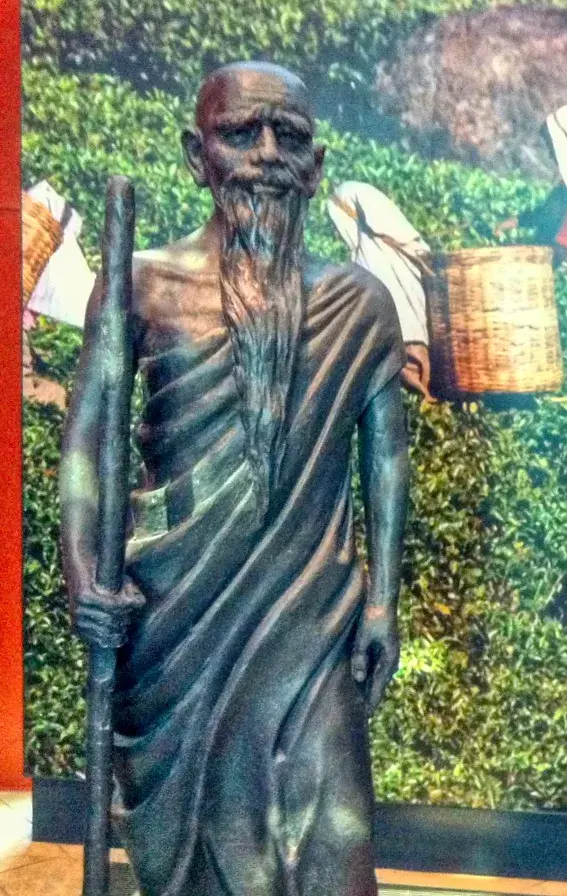
Faxian, whose secular surname was Gong, was born in Wuyang County of Pingyang Commandery (present-day Xiangyuan County, Shanxi Province). Growing up amidst the continuous dynastic warfare of the Sixteen Kingdoms period in northern China, he witnessed firsthand the immense suffering inflicted upon ordinary people. Faxian had three elder brothers who all tragically succumbed to illnesses in their early childhood. Plagued by anxiety that their only surviving son would share the same fate, his parents dedicated him as a Buddhist novice (śrāmaṇera) at the tender age of three, trusting that the divine protection of the Sangha would preserve his life. After residing in the monastery for several years, Faxian fell critically ill at his family home; his parents rushed him back to the temple, where he miraculously recovered overnight. Thenceforth, Faxian adamantly refused to live in the secular world. Longing for her young son, his mother constructed a small cottage outside the monastic gates so she could catch occasional glimpses of him.
When Faxian was ten years old, his father passed away. Observing that his widowed mother lived in extreme hardship without support, his paternal uncle urgently pressured Faxian to return to secular life. Though still a boy, Faxian demonstrated extraordinary clarity of purpose, declaring: "I did not abandon secular life because of my father's existence; rather, it was out of an earnest desire to transcend mundane entanglements and seek the truth that I entered this path." His uncle was so moved by his conviction that he ceased his demands. Soon afterward, his mother also died. Faxian carried out her funeral rites with profound filial piety before returning permanently to the monastic sanctuary. At twenty, Faxian formally received the full monastic precepts (upasampadā). Known for his spotless moral discipline, rigorous observance of liturgical protocol, and magnanimous demeanor, he was held in high esteem by his teachers and peers. On one occasion, while harvesting grain in the fields with fellow novices, a band of starving brigands attempted to pillage their crop. While the other novices fled in terror, Faxian calmly stood his ground, admonishing the thieves that their present poverty was the result of a lack of generosity in past lives and that further robbery would only deepen their misery in rebirths to come. Shamed by his compassionate composure, the thieves abandoned the grain and departed.
Lamenting Missing Precepts and Embarking Westward
During the Long'an era of the Eastern Jin dynasty, Buddhism flourished rapidly across central and southern China, yet the translation of canonical texts lagged significantly behind monastic expansion. Most crucially, authentic and systematic monastic codes (Vinaya) governing the daily discipline of the Sangha were almost entirely absent. Lacking standardized rules, monastic communities acted without consistency, leading to laxity and decadence among high-ranking monks. Faxian continually lamented the fragmented condition of the Vinaya, recognizing that without a comprehensive regulatory canon, the Buddhist Dharma could not take permanent root in Chinese civilization. In 399, at the age of sixty-two, Faxian made a solemn vow to journey westward to India, the cradle of the Dharma, to acquire the authentic root vinaya texts.
In the spring of that year, Faxian set out from Chang'an alongside four fellow monks: Huijing, Daozheng, Huiying, and Huiwei. Traversing the Hexi Corridor through the territories of Later Liang and Western Qin, they encountered other pilgrims in Zhangye, including Zhiyan, Huijian, Sengshao, Baoyun, and Sengjing, combining forces to form a formidable party of over ten monks. Upon reaching Dunhuang, they received generous provisions and logistical backing from Li Hao, the Governor of Dunhuang. From the Yang Pass, Faxian and his companions plunged into the White Dragon Dunes, an expanse known as the Desert of Flowing Sands. The climate was scorching and brutally arid, with gale-force winds whipping sand dunes across the wasteland. There were neither birds above nor beasts below; the only markers directing travelers across the wastes were the bleached bones of perished caravans. After seventeen harrowing days covering fifteen hundred leagues, Faxian and his companions successfully crossed the sands to arrive in Shan-shan, the ancient territory of Loulan.
Scaling the Pamirs and Touring Northern India
After brief sojourns in Shan-shan and Karasahr, Faxian traveled west to Khotan, where he witnessed the grand pageantry of Mahayana Buddhist festivals, including the magnificent annual procession of colossal Buddhist statues. Subsequently, Faxian and Huijing negotiated the perilous trails of Zihe before beginning their ascent of the Congling range—the towering Pamir Plateau. The mountainous paths were nearly sheer vertical cliffs draped in perpetual snow, where freezing blizzards and poisonous vapors threatened travelers at every step, with a single slip sending climbers into bottomless abysses. Armed with unshakeable fortitude, Faxian negotiated suspended footbridges and carved rock stairways to safely descend into the small kingdom of Darel in northern India, where he marveled at an eighty-foot wooden image of Maitreya Bodhisattva crafted in early classical styles.
Crossing the Indus River, the party arrived in Udyāna to complete their summer monastic retreat, where Faxian closely observed local legal customs and Brahmanical social hierarchies. In 402, he visited Suvāstu and Gandhāra, arriving at Puruṣapura (modern Peshawar), the ancient seat of the Kushan Empire. There, Faxian worshipped at the towering Great Stupa of King Kaniṣka and viewed the sacred alms bowl of the Buddha. At this point, companions Huidan, Baoyun, and Sengjing chose to return to China, while Huiying succumbed to fatal illness at the Alms Bowl Monastery. Left with only Huijing and Daozheng, Faxian pushed westward to Nagarahāra, visiting the shrine of the Buddha's cranial relic at Hadda along with other venerable sanctuaries.
Tragic Losses and Traversing the Indian Heartland
Leaving Nagarahāra, Faxian, Huijing, and Daozheng traversed the freezing heights of the Little Snow Mountains (the Safed Koh range in modern Afghanistan). While ascending the northern shadowed slope, a sudden, merciless blizzard engulfed them. Exhausted and chilled to the bone, Huijing collapsed into the snow. In his final moments, Faxian wept bitterly over his fallen companion: "Our vow to retrieve the scriptures remains unfulfilled, yet you depart this life so soon! What can we do against fate?" Gathering his remaining strength, Faxian wiped away his tears and pressed onward with Daozheng, scaling the pass and reaching the warmer valleys of Rohi.
In 403, Faxian observed his fifth summer retreat in Rohi before proceeding south to Bannu, crossing the Indus once more into the Punjab and advancing into the lush heartland of Central India. Entering the fertile Ganges River basin, Faxian found a gentle climate, mild legal systems that eschewed capital punishment, and thriving monasteries sustained by land grants. He journeyed through Mathurā, Saṅkāśya, and the celebrated Jetavana Monastery in Śrāvastī, where the Buddha had resided for decades. Monks in Śrāvastī expressed awe upon discovering that Faxian had journeyed on foot from the remote eastern borders of China, exclaiming that no Chinese ascetic had ever reached their sanctuary before. Faxian subsequently visited Kapilavastu, the birthplace of the Buddha at Lumbini, the site of the Great Parinirvāṇa amidst the sal trees of Kuśinagara, and the ancient city of Vaiśālī.
Throughout his travels in Central India, Faxian traced the sacred course of the Ganges, visiting the New City of Rājagṛha, Vulture Peak (Gṛdhrakūṭa), and the Kukkuṭapāda Mountain where Mahākāśyapa was believed to reside in deep samādhi. He proceeded to Sārnāth near Varanasi, reverently visiting the Deer Park where the Buddha had first turned the Wheel of the Dharma, before examining the monastic codes across Kauśāmbī and Dakṣiṇa Kosala. Across every realm, he compiled meticulous notes detailing monastic protocols, local customs, and historical legends, amassing an authoritative record of classical Indian civilization.
Scholarly Residence at Pāṭaliputra
Crossing the Ganges once more, Faxian entered Pāṭaliputra, the grand metropolis of Magadha and former imperial capital of Emperor Aśoka. The city bustled with thriving commerce, grand seasonal chariot processions, and charitable dispensaries providing free medicine and shelter to the sick and destitute. In Pāṭaliputra, Faxian forged a fruitful relationship with the eminent Mahayana scholar-priest Romasvāmin, taking up residence in a premier Mahayana monastery. To his frustration, Faxian discovered that across northern India, the Vinaya was transmitted exclusively through oral memorization from master to disciple, with virtually no written manuscripts available. Fortunately, the Mahayana monastery in Pāṭaliputra possessed an authentic Sanskrit manuscript of the Mahāsāṃghika Vinaya.
Determined to transmit authentic codes to China, Faxian remained in Pāṭaliputra for three years (405–407). Overcoming the language barrier, he mastered spoken Sanskrit and the Indian scripts, hand-copying the complete Mahāsāṃghika Vinaya, excerpting seven thousand verses from the Sarvāstivāda Vinaya, and copying the Mahāparinirvāṇa Sūtra along with the Saṃyuktābhidharmahṛdaya Śāstra. Observing the sublime decorum and spiritual harmony of the Indian monastic order, his companion Daozheng resolved to remain permanently in India, unwilling to return to the fragmented religious landscape of China. Faxian, however, held fast to his original vow: "My singular purpose was to enable the Vinaya to circulate throughout the land of Han." Bidding farewell to his companion, Faxian resolved to undertake the perilous homeward journey entirely alone.
Monastic Quest in Sri Lanka and Oceanic Return
In 408, Faxian traveled down the Ganges to the thriving international port of Tāmralipti on the Bay of Bengal, remaining there for two years to complete textual copies and paint sacred icons. In late 409, he boarded a large oceanic merchant vessel, crossing the Bay of Bengal in fourteen days to reach the island of Sri Lanka (then known as the Kingdom of the Lion). In Sri Lanka, Buddhism enjoyed imperial patronage, with thousands of monks congregated at the Abhayagiri Monastery. Faxian resided in the country for two years, obtaining rare Sanskrit manuscripts unavailable in northern India, including the Mahiśāsaka Vinaya, the Dīrgha Āgama, and the Saṃyukta Āgama. While worshipping the sacred Tooth Relic at the Abhayagiri shrine, Faxian noticed a local merchant offering a delicate white silk fan of Chinese manufacture before the altar; overwhelmed by homesickness and memories of fallen companions, he wept in silence.
In the eighth month of 411, having gathered an immense library of sacred scriptures, Faxian boarded a large, double-hulled Indian merchant ship carrying two hundred passengers and crew to sail eastward across the Indian Ocean. Shortly after departure, the vessel was struck by a catastrophic typhoon. The hull sprang leaks, and passengers hurled their possessions overboard to lighten the load; Faxian held fast to his precious manuscripts and icons, praying fervently for deliverance. After drifting helplessly for over one hundred days, the ship found refuge at Yavadvīpa (modern Java or Sumatra), where Faxian remained for five months. He then boarded another merchant vessel bound for Guangzhou. Once again, a monstrous storm battered the vessel, throwing it off course for over seventy days. With water and food nearly depleted, fearful passengers blamed Faxian's presence for their misfortune and conspired to throw him overboard, but a sympathetic Chinese merchant threatened to denounce them to the imperial authorities upon arrival, shielding the master from harm.
Landfall at Mount Lao and Scriptural Translation in Jiankang
On the fourteenth day of the seventh month in 412, the storm-tossed vessel suddenly grounded near a rocky shore. Unaware of their location, Faxian went ashore to question local hunters, discovering that the tempest had swept them far north of their destination, making landfall at Mount Lao in Changguang Commandery of Qingzhou (modern Qingdao, Shandong Province). Upon hearing that an eminent elder monk had returned from the western lands with sacred treasures, Li Yi, Governor of Changguang, personally traveled to the shore with a ceremonial guard to escort Faxian into the commandery seat. Departing at age sixty-two, Faxian had traveled across thirty kingdoms over thirteen grueling years, returning home as a venerable master of seventy-eight.
After resting in Shandong, Faxian traveled through Pengcheng and Jingkou to the Eastern Jin capital of Jiankang, residing at the prestigious Daochang Monastery. Beginning in 413, Faxian collaborated with the renowned Indian translation master Buddhabhadra and scholar Baoyun to render his Sanskrit manuscripts into Chinese. Over several years of intensive labor, Faxian produced translations of the forty-volume Mahāsāṃghika Vinaya, the Bhikṣu Prātimokṣa, the Bhikṣuṇī Prātimokṣa, the six-volume Mahāparinirvāṇa Sūtra, and the Saṃyuktābhidharmahṛdaya Śāstra, comprising six works across sixty-three volumes. In 414, drawing upon his detailed diaries, he authored the immortal travelogue A Record of Buddhist Kingdoms. Around 420, Faxian moved to Xin Monastery in Jingzhou to pursue secluded contemplation, passing away peacefully in 422 at the age of eighty-six.
Key Achievements
Transcontinental Quest for the Monastic Vinaya
Prior to Faxian's epic undertaking, Chinese Buddhist masters had traveled only as far as Khotan along the western rim of the Tarim Basin. Faxian was the pioneer who boldly penetrated the geographical heart of ancient India by overland routes and returned along maritime lanes with an extensive collection of root Sanskrit Vinaya manuscripts. Undaunted by extreme age, he endured shifting desert sands, glacial precipices, and maritime tempests, securing both the Mahāsāṃghika Vinaya and the Mahiśāsaka Vinaya. His heroic venture provided the Chinese Sangha with its first complete, systematic monastic disciplinary codes, transforming Chinese Buddhism from an unstructured intellectual movement into a fully regulated monastic institution and blazing the trail for subsequent pilgrimages by Xuanzang and Yijing.
Throughout his travels, Faxian combined unwavering spiritual devotion with precise ethnographic and doctrinal inquiry. Across northern and central India, he investigated the coexistence of Mahayana and Hinayana schools, recording the architecture, economic endowments, and ritual calendars of ancient Buddhist monasteries. His steadfast dedication was demonstrated in Pāṭaliputra, where he spent three years laboriously transcribing Sanskrit texts by hand. Even when his companion Daozheng succumbed to the tranquility of Indian monastic life and refused to return, Faxian insisted on bringing the teachings back to China, exemplifying the highest standard of self-sacrifice for the propagation of the Dharma.
Authorship of A Record of Buddhist Kingdoms
In 414, Faxian composed A Record of Buddhist Kingdoms (Foguo Ji, also preserved under the titles The Travel Records of Faxian and Record of Pilgrimage to Central Asia and India). Spanning roughly fourteen thousand characters, this concise yet densely detailed masterpiece records the geography, road networks, urban dimensions, natural products, local customs, and Buddhist sanctuaries of more than thirty ancient states across Central Asia, Afghanistan, Pakistan, India, Sri Lanka, and Indonesia. Characterized by plain, unvarnished prose and rigorous empirical observation, the work captured Indian society under the reign of Candragupta II (Vikramāditya) during the golden age of the Gupta Empire. In the absence of contemporaneous indigenous Indian historiography, Faxian's work provides an indispensable chronological foundation for modern international scholarship on classical Indian history.
Beyond its immense value for Central and South Asian history, A Record of Buddhist Kingdoms stands as a seminal document in the history of global navigation and geography. The text offers the earliest systematic accounts of the monsoon wind patterns and ocean currents governing maritime voyages across the Bay of Bengal, the Strait of Malacca, and the South China Sea. Faxian meticulously described the dimensions, crew capacities, and emergency protocols of fifth-century merchant vessels designed to carry hundreds of voyagers across the ocean. His eyewitness descriptions of Sri Lankan sacred sites and Southeast Asian trade hubs constitute some of the most precious primary evidence available for reconstructing the historical Maritime Silk Road.
Translating the Vinaya and the Buddha-Nature Canon
At Daochang Monastery in Jiankang, Faxian established one of the premier scriptural translation workshops of early medieval China. Working alongside Buddhabhadra, he produced the monumental forty-volume translation of the Mahāsāṃghika Vinaya, which established definitive disciplinary procedures and ordination rituals for the Chinese Sangha. Crucially, Faxian also produced the first Chinese translation of the six-volume Mahāparinirvāṇa Sūtra. This seminal text articulated the revolutionary doctrine that all sentient beings possess the Buddha-nature and are capable of attaining liberation, igniting fervent debates in southern intellectual circles and providing the theoretical foundation for Daosheng's doctrine of sudden enlightenment and universal salvation.
Throughout his years at Daochang Monastery, Faxian applied uncompromising rigor to his translations, comparing Sanskrit originals with Chinese linguistic nuances. His translations of the Bhikṣu Prātimokṣa, the Bhikṣuṇī Prātimokṣa, and foundational Abhidharma treatises finally brought an end to centuries of monastic ambiguity in China. By providing the institutional and theoretical scaffolding for the Sangha, his scholarship catalyzed the development of the Vinaya school and laid the doctrinal groundwork for the blossoming of indigenous Buddhist traditions during the Sui and Tang dynasties.
Pioneering the Overland and Maritime Silk Roads
As the first historical figure to successfully traverse both the continental and oceanic arteries connecting China with South Asia, Faxian vastly expanded the geographic and cosmological horizon of Chinese civilization. By scaling the Pamir Plateau, he pioneered an overland route that directly linked the Central Plains of China with the Ganges River valley. In returning by sea, he demonstrated the viability of utilizing seasonal monsoons to navigate the Indian Ocean and the South China Sea, creating a template for diplomatic and commercial exchanges between China and maritime kingdoms. Faxian's journey stands as an enduring monument to early cross-cultural exploration and global interconnectivity.