Birth in Sichuan
Born into a literate lineage; achieved examination success in youth, deeply influenced by Wen Tong's ink bamboo.
法常
Fachang (法常, 1207–1291), secular surname Li, monastic name Fachang, pseudonym Muxi, native to Sichuan, was an illustrious Buddhist monk-painter and supreme master of Chan ink painting of the late Southern Song and early Yuan dynasties. Renowned globally as one of the most transformative figures in East Asian art history, he was initially a successful examination candidate in Sichuan before fleeing the Mongol invasions down…
Fachang (法常, 1207–1291), secular surname Li, monastic name Fachang, pseudonym Muxi, native to Sichuan, was an illustrious Buddhist monk-painter and supreme master of Chan ink painting of the late Southern Song and early Yuan dynasties. Renowned globally as one of the most transformative figures in East Asian art history, he was initially a successful examination candidate in Sichuan before fleeing the Mongol invasions down the Yangtze River to Hangzhou. Renouncing secular ambition, he was ordained under the eminent Linji Chan master Wuzhun Shifan at Jingshan Temple. He subsequently presided over Liutong Temple on West Lake, establishing the Liutong Temple painter-monk tradition. An unyielding and righteous monk, Fachang was forced into fugitive hiding in Shaoxing after publicly denouncing the tyrannical grand councilor Jia Sidao in 1269, returning to Hangzhou only after Jia's downfall. Rejecting decorative formalism, Fachang utilized sugarcane fibers, dried reeds, and uninhibited splashed ink to evoke spontaneous Buddhist awakening and profound natural tranquility. Transported to Japan by his fellow disciple Enni Ben'en (Shoichi Kokushi), his masterpieces were canonized as supreme treasures during the Muromachi shogunate, inspiring Japanese masters like Sesshu, forging the \"Muxi style\" (Mokkei-yo), and fundamentally shaping the Japanese aesthetic of wabi-sabi. He died in 1291 at eighty-five.
Born into a literate lineage; achieved examination success in youth, deeply influenced by Wen Tong's ink bamboo.
Following Mongol incursions into northern Sichuan, fled to Hangzhou and took monastic vows under Wuzhun Shifan at Jingshan Temple.
Bid farewell to his Japanese fellow monk Enni Ben'en, presenting him with triptychs of Guanyin, Gibbon, and Crane.
Restored and presided over Liutong Temple on West Lake, inaugurating the influential Liutong Temple school of monk-painters.
Openly condemned the powerful grand councilor Jia Sidao; escaped arrest by hiding in Shaoxing under assumed identity.
Following Jia Sidao's execution, resurfaced in Hangzhou to continue his monastic contemplation and artistic creation.
Passed away peacefully at West Lake at the age of eighty-five.
Fachang, whose secular surname was Li, was born in Sichuan in 1207 during the Kaixi era of Emperor Ningzong. Possessing agile intellect and literary gift, he succeeded in local provincial examinations as a young man. Passionate about brush painting from his formative years, his early style was shaped by the ink bamboo lineage of Northern Song Sichuanese master Wen Tong. In 1231 (Shaoding 4), Mongol cavalry breached northern Sichuan defenses, devastating commanderies along the frontier. Confronting the horrors of war, Fachang joined thousands of refugees traveling down the Yangtze River to the Southern Song provisional capital at Lin'an (modern Hangzhou).
Disillusioned by widespread court factionalism and imperial decay, Fachang severed worldly ambitions and entered the Buddhist sangha. He traveled to the venerable Wannian Chan Monastery on Mount Jingshan in Yuhang, taking refuge under the eminent Chan patriarch Wuzhun Shifan of the Linji school. Under Wuzhun's dynamic pedagogical guidance, Fachang attained deep enlightenment, receiving full monastic ordination under the dharma name Fachang and adopting the style Muxi.
In 1235 (Duanping 2), the Japanese monk Enni Ben'en (Shoichi Kokushi) crossed the East China Sea to study pure Chan Buddhism at Jingshan Temple under Wuzhun Shifan. During his years of intensive monastic practice, Enni formed an enduring spiritual brotherhood with Fachang.
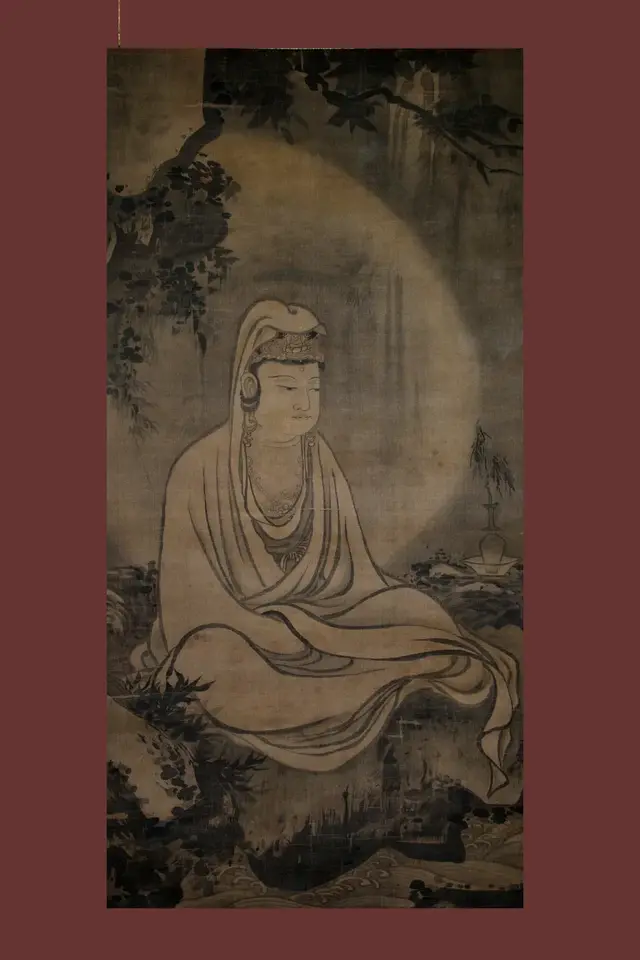
In 1241 (Chunyou 1), as Enni prepared to return to Japan, Fachang brushed three magnificent ink hanging scrolls depicting the White-Robed Guanyin, Gibbons in a Pine, and a Crane in Bamboo Groves as a parting gift. Enni brought these spiritual paintings along with master portraits and sacred texts back to Kyoto, enshrining them in Tofuku-ji. This maritime transmission not only established an enduring cultural bridge between Song China and Japan, but also inaugurated seven centuries of Japanese veneration for Fachang's brushwork.
In 1256 (Baoyou 4), the fifty-year-old Fachang was appointed to rebuild and preside over Liutong Temple south of West Lake. There, Fachang gathered monastic disciples, establishing a unique tradition of Chan painter-monks. He maintained intimate intellectual exchanges with literati including Ma Zhen and poet-monks such as Wuwen Daocan and Shi Wenxiang, giving birth to what art historians designate as the \"Liutong Temple School.\"
Fachang was naturally upright and fearless. Despite wearing monk's robes, he retained intense ethical concern for the imperiled realm. In 1269 (Xianchun 5), Grand Councilor Jia Sidao monopolized supreme authority while Song armies were beleaguered at Xiangyang. Fachang publicly denounced Jia Sidao's treasonous misrule before scholars and citizens. Infuriated, Jia issued secret arrest warrants to seize the outspoken monk. Aided by loyal companions, Fachang fled south to Yuezhou (modern Shaoxing), adopting an assumed identity and finding sanctuary in the secluded estate of a literatus surnamed Qiu. Due to the intense police hunt, artistic circles believed Fachang had perished.
In 1275 (Deyou 1), following the crushing defeat of Song forces at Dingjiazhou, Jia Sidao was disgraced and executed on his road to exile. The warrant against Fachang was lifted. Approaching seventy years of age, Fachang returned to West Lake. Having survived the cataclysmic fall of the Song Dynasty and the Mongol conquest, he lived in serene seclusion, painting tea bowls, withered boughs, and mountain mist with transcendent detachment.
In 1291 (Zhiyuan 28), Fachang passed away peacefully at Liutong Temple at the age of eighty-five. His commemorative portrait was preserved in Faxiang Temple near West Lake, venerated by generations of Chan practitioners.
Fachang is universally celebrated as the consummate master of classical Chan painting. He severed connections with both the meticulous, ornate conventions of the Southern Song Imperial Painting Academy and the refined calligraphic play of secular literati painters, pioneering a direct, unmediated visual language that pointed straight to the original mind. Rejecting conventional brushes, Fachang frequently used bundles of straw, sugarcane pulp, or frayed reed stems, splashing wet and dry inks across absorbent paper to capture natural forms with spontaneous vitality.
In compositional architecture, Fachang pushed the Southern Song \"one-corner\" framing device to metaphysical heights, utilizing expansive voids of untouched paper to evoke infinite atmospheric resonance. While Yuan critic Tang Hou dismissed his ink bamboo as rough and devoid of ancient rules from a traditionalist stance, Ming connoisseur Xiang Yuanbian celebrated his ability to capture natural forms as approaching divine ingenuity, and Shen Zhou praised his ink splashing as miraculously lifelike. Fachang's spontaneous ink play marked the definitive milestone in Chinese art's evolution from descriptive realism to expressive spiritual minimalism.
Genuine surviving works by Fachang are exceptionally rare in China, preserved almost exclusively as National Treasures and Important Cultural Properties in Japanese temples and museums. His iconic Six Persimmons, preserved in the Ryoko-in sub-temple of Daitoku-ji in Kyoto, depicts six persimmons brushed with variations of wet, dry, dark, and light ink; this work is internationally acclaimed as a supreme monument of global visual minimalism and intuitive Chan contemplation.
His monumental handscroll Eight Views of Xiao and Xiang, later cut into separate hanging scrolls in Japan, includes four extant masterpieces designated as Japanese National Treasures and Important Cultural Properties, notably Evening Bell from Mist-Shrouded Temple and Sunset over a Fishing Village. His subtle washes of mist and water capture the humid ambiance of the Yangtze basin with ethereal perfection. Concurrently, the Guanyin, Crane, and Gibbon triptych at Daitoku-ji unites maternal compassion with primordial wildness, representing a pinnacle of Buddhist ink figuration.
In international cultural history, Fachang's impact upon Japanese civilization remains peerless. From the Kamakura and Muromachi periods onward, Japanese Chan and tea masters elevated Fachang to supreme veneration. In the collection of Shogun Ashikaga Yoshimasa, nearly forty percent of Chinese paintings were works by Fachang. The shogunate's official connoisseurship manual Kundaikan Sayuchoki ranked him in the highest class (\"Upper-Upper Grade\"). His style gave birth to the \"Muxi style\" across Japanese art, inspiring masters including Shubun, Josetsu, and Sesshu Toyo. The austere, tranquil, and unadorned atmosphere of his brushwork served as a direct spiritual fountainhead for Japan's quintessential aesthetic of wabi-sabi.
FIGURES ASSOCIATED WITH THIS DYNASTY