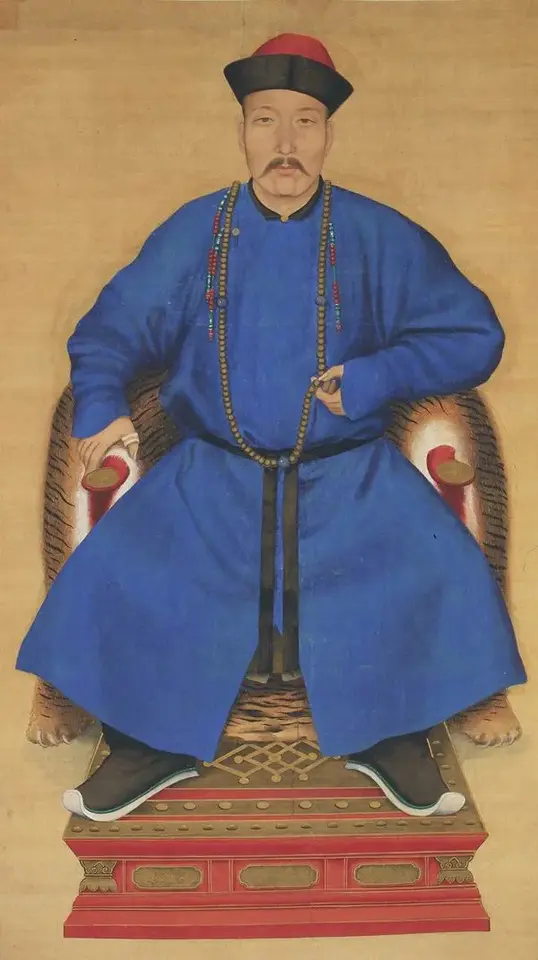
Life and Career
Lineage Origins and Palace Upbringing
Celeng was born in 1672 during the eleventh year of the Kangxi reign on the northern steppes of Khalkha Mongolia. As a direct twentieth-generation descendant of Genghis Khan, his pedigree stood among the most exalted across inner Asia. His great-grandfather Tumengken had been a towering chieftain in Outer Mongolia, honored with the title "Sain Noyan" (Wise Lord) by the Fifth Dalai Lama of Tibet for his fervent patronage and protection of the Gelug school of Tibetan Buddhism. Tumengken's eighth son Danjin begot Namjil, who fathered Celeng.
In 1688, the Dzungar warlord Galdan Boshugtu Khan led thirty thousand mounted warriors across the Altai Mountains, devastating Khalkha tribal camps and driving hundreds of thousands of nomads southward toward the Great Wall. In 1692, following the death of his grandfather and father, Celeng's grandmother Gechule Khatun resolved to lead ten-year-old Celeng and his younger brother Gonggerabtan from their ancestral pastures along the Tamir River to submit to the Qing court in Beijing. Emperor Kangxi extended an exceptional reception, conferring upon Celeng the third-rank noble title Adaha Hafan (light chariot officer), granting a sprawling residential estate in the capital, and issuing an unprecedented decree commanding that the young prince be brought into the Forbidden City to be educated alongside imperial princes. Reared under Kangxi's direct supervision, Celeng mastered Manchu and Mongolian horsemanship while assimilating Confucian statecraft and historical treatises, blending steppe ferocity with refined administrative vision.
In 1706, Emperor Kangxi selected Celeng as the consort for his biological tenth daughter (sixth in court seniority), Princess Chunque, granting him the title of Imperial Prince Consort of the First Rank (Heshuo Efu) and the grade of Beizi. Recognizing the strategic necessity of establishing reliable loyalist bulwarks against Dzungar power, Kangxi granted permission for Celeng and his tribal retinue to return to their ancestral grazing lands along the Tamir River on the northern slopes of the Khangai Mountains.
Steppe Frontier Defense and Military Reform
In 1715, as Dzungar ruler Tsewang Rabtan stepped up raids across western Mongolia, Emperor Kangxi ordered Celeng to assume command of mobile cavalry garrisons along the Tui River (modern Tuin River). Operating through the harsh continental weather of the Gobi desert, Celeng oversaw long-range reconnaissance patrols, fortifying key defiles between Khalkha and Dzungaria.
In 1720, the Qing high command launched a coordinated multi-column offensive against Dzungar territories. Celeng commanded the Khalkha auxiliary cavalry attached to the northern army under General Fu'erdan. Marching from Bulagan toward Geler'erge, Celeng repeatedly outmaneuvered Dzungar ambushers, capturing senior Dzungar zaisang commanders and hundreds of prisoners. In the engagement at Ulan Hujir, Celeng led a rapid cavalry raid into the enemy rear, setting fire to the Dzungar reserve grain magazines. During the homeward march, when thousands of fresh Dzungar reinforcements attempted to ambush the rear columns, Celeng deployed an immediate counter-flanking maneuver, completely routing the attackers. For these achievements, the imperial court formally invested him as a ruling Jasak of Khalkha.
Raised amidst the harsh winds of the northern steppes, Celeng possessed an unmatched knowledge of western Mongolian topography, seasonal waterholes, and seasonal passes. Deeply embittered by decades of Dzungar aggression against Khalkha tribes, he recognized that traditional nomadic cavalry lacked the iron cohesion and structured drill required to overcome the Dzungars' disciplined musketry and camel-guns. In response, Celeng instituted comprehensive military reforms within his appanage. He selected several thousand elite young warriors, organizing them into a standing personal guard. He mandated that during hunting expeditions and camp movements, troops must maneuver strictly according to tactical battle drums and signal horns, maintaining full battle readiness even during peacetime. Under his rigorous discipline, the Sain Noyan cavalry emerged as the most formidable strike force across the northern frontier.
The Treaty of Kyakhta and Odengchule Triumph
Upon the accession of Emperor Yongzheng in 1723, the throne elevated Celeng to Prince of the Second Rank (Duoluo Junwang). In 1724, during an imperial audience in Beijing, Yongzheng praised Celeng's strategic maturity, appointing him Vice-General stationed at the Altai frontier alongside Prince Danjin Dorji of the Tusheet Khan Aimag, and granting Celeng the extraordinary privilege of displaying the Plain Yellow Banner dragon pennant.
In 1727, Russian Empress Catherine I dispatched Count Sava Raguzinsky-Vladislavich to Beijing to negotiate a comprehensive settlement of the disputed Russo-Qing central frontier. Mid-negotiation, the chief Qing representative, Grand Councillor Longkodo, was arrested for illicitly transcribing imperial genealogies. In this diplomatic emergency, Emperor Yongzheng turned to Celeng, appointing him chief imperial commissioner. Celeng and Grand Minister Sige traveled to the Chuku River to confront Count Sava. Drawing upon his intimate knowledge of northern geography, Celeng resisted Russian encroachments, successfully negotiating the permanent boundary from the Shabina Pass to the Argun River. The resulting Treaty of Kyakhta and Treaty of Burinsky fixed the frontier and erected permanent boundary markers, securing peace between the two empires for over a century. Although Celeng was initially impeached for firing ceremonial salutes across the frontier to celebrate the signing, Yongzheng commuted his sentence to a minor fine, privately commending his diplomatic firmness.
In 1731, Dzungar leader Galdan Tseren broke all truces, dispatching general Da Tsering Dondup with thirty thousand troops across the Altai Mountains. Moving toward the Kerulen River, Dzungar detachments threatened the entire Khalkha homeland. Celeng advanced alongside Danjin Dorji to intercept the invasion. At Odengchule, Celeng deployed an ingenious ruse, sending Taiji Bahai with six hundred horsemen to stage a nighttime raid into the Dzungar vanguard, feigning panicked retreat. Da Tsering Dondup led his primary formations in reckless pursuit, plunging directly into Celeng's concealed canyon ambush. Celeng led his main cavalry charge from both flanks, killing several enemy generals and scattering thirty thousand invaders. The victory electrified Beijing; Emperor Yongzheng ennobled Celeng as Prince of the First Rank (Heshuo Prince), granted him ten thousand taels of silver, and confirmed him as Grand Jasak of Khalkha.
The Great Battle of Erdene Zuu
In June 1732, seeking vengeance for their defeat at Odengchule, Galdan Tseren dispatched thirty thousand elite cavalrymen under Xiao Tsering Dondup through Qilan toward the central Khalkha plains. Celeng marched to Benbotu Mountain to block the advance. However, the Dzungars executed a lightning bypass, sending detachments southward to ransack Celeng's home base at Tamir, capturing Celeng's two young sons, his extended family, and tens of thousands of livestock.
Receiving news of the destruction of his home and the capture of his sons, Celeng was overcome with grief, yet maintained absolute operational composure. Advised by Vice Minister Cha'erduo to sever the enemy's line of retreat rather than launch a direct chase, Celeng marched day and night to head off the Dzungar host. Unaware of Celeng's movements, the Dzungar army moved eastward along the Orkhon River to sack Erdene Zuu, the most sacred Buddhist monastery in Mongolia. In August, Celeng intercepted the Dzungar columns, fighting ten consecutive running engagements to pin the invaders along the Orkhon basin.
Xiao Tsering Dondup deployed his army at the base of the Khangai Mountains, pressing close against the southern bank of the Orkhon River. Celeng devised an audacious battle plan. He placed the weaker Manchu infantry units south of the river with their backs to the water, giving the illusion of a cornered, demoralized force. The northern Khalkha tribal cavalry held the northern bank, while Celeng personally concealed ten thousand elite Sain Noyan horsemen within the forested ravines of the Khangai slopes.
Observing the imperial troops backed against the roaring river, Xiao Tsering Dondup launched a full-scale frontal assault. As the imperial vanguard simulated retreat, the entire Dzungar army surged forward into the swampy riverbed. At that precise moment, Celeng sounded the war horns. Ten thousand armored Sain Noyan cavalry burst from the mountain slopes like a raging whirlwind, smashing directly into the exposed Dzungar flank. The battle turned into a catastrophic slaughter. Celeng fought at the tip of the spear as imperial horsemen encircled the panic-stricken host. Over ten thousand Dzungars were slain on the field, their bodies carpeting the valley floor. When surviving remnants attempted to flee across the Orkhon River, the northern cavalry struck them in mid-stream; thousands drowned in the raging currents, turning the river crimson with blood.
The triumph at Erdene Zuu completely broke the offensive capacity of the Dzungar Khanate, safeguarding Khalkha Mongolia and forcing Galdan Tseren to abandon all dreams of steppe conquest. General Xibao sent couriers flying to Beijing, declaring Celeng the preeminent hero of the empire. Overjoyed, Emperor Yongzheng bestowed upon Celeng the martial title "Chaoyong" (Superlatively Brave), granted him the imperial yellow girdle, and allocated fifty thousand taels of silver and thousands of cattle to rebuild Tamir. Furthermore, the emperor directed the construction of a permanent stone city and palace at Tamir for Celeng's residence. In December 1732, Celeng was elevated to Guren Prince Consort, and his deceased wife Princess Chunque was posthumously advanced to Guren Eldest Princess.
Founding of Uliastai and Diplomatic Firmness
In 1733, Emperor Yongzheng restructured the military administration of the northern frontier. Establishing the post of Military Governor of Uliastai (Dingbian Zuo Fu Jiangjun) under Prince Fupeng, the throne conferred upon Celeng the seal of Vice-General, directing him to garrison the forward redoubt at Khovd (Kobdo) while confirming him as inaugural League Leader of the newly created Sain Noyan Aimag. Celeng constructed an impenetrable chain of desert garrisons along the Khovd-Altai line, forever barring Dzungar infiltration. When the permanent fortress of Uliastai was completed, it served as the supreme administrative seat over Khalkha Mongolia, with Celeng recognized as its foundational commander.
Beginning in 1735, a weakened Galdan Tseren repeatedly petitioned the Qing throne to delineate permanent pasture boundaries between Dzungaria and Khalkha. Emperor Yongzheng and Emperor Qianlong repeatedly summoned Celeng to the capital to formulate border terms. Celeng adamantly insisted that the Altai Mountains must serve as the natural dividing line, refusing to concede an inch of territory east of the crest. In 1738, Dzungar envoy Haliu arrived in Beijing and covertly approached Celeng, attempting to subvert his loyalty by leveraging his captured sons. Celeng dismissed the overture with absolute contempt: "I was blessed by imperial grace to marry an imperial princess; my only sons are those born of the princess. My master resides in Beijing, and I serve only him! If you return those captured sons, I shall petition the throne to execute them myself!" Stunned by Celeng's incorruptible loyalty, the Dzungars yielded completely, accepting the Altai crest as the permanent boundary. Deeply moved, Emperor Qianlong conferred the rank of Crown Prince (Shizi) on Celeng's eldest son, Chenggunjab.
Twilight and Posthumous Imperial Glory
In 1740, Celeng supervised the definitive demarcation of pasture boundaries across Khalkha Mongolia, establishing permanent cairns at Zavkhan, Qikeshen, and Hasaktu. In 1741, recognizing that the prince was approaching seventy years of age, Emperor Qianlong permitted him to withdraw his main headquarters to his personal estate at Tamir.
In early 1750, seventy-eight-year-old Celeng fell gravely ill at Tamir. Emperor Qianlong dispatched Celeng's second son, Chebudengjab, to care for his father, alongside imperial bodyguards carrying precious palace medicines. Passing away peacefully that spring, Celeng left instructions requesting burial in Beijing beside Princess Chunque. When news of his death reached the capital, Emperor Qianlong personally conducted sacrificial rites at the prince's estate, composing an imperial mourning eulogy. Bestowing the posthumous name Xiang, the emperor decreed that Celeng's spirit tablet be enshrined in the Imperial Ancestral Temple (Taimiao) in the Forbidden City, while his son Chenggunjab inherited the title of Chaoyong Prince and the post of General of Uliastai.
Major Achievements
Annihilation of Dzungar Hosts at Erdene Zuu
Celeng's supreme military masterpiece was the Battle of Erdene Zuu in 1732. Occurring in the shadow of the disastrous imperial defeat at Hoton Nor in 1731, the entire northwestern frontier stood on the verge of systemic collapse. Xiao Tsering Dondup's veteran invasion army was widely considered invincible across the central steppes.
Confronting personal tragedy with unmatched operational brilliance, Celeng orchestrated a textbook synchronized ambush. Deploying weak infantry south of the Orkhon River as bait, he struck with ten thousand concealed heavy cavalry from the Khangai slopes, wiping out over ten thousand elite enemy horsemen and turning the Orkhon River red with blood. The victory preserved the Khalkha homeland, forced the Dzungar Khanate to seek permanent peace, and stands as one of the most decisive cavalry triumphs in Chinese imperial history.
Strategic Border Delimitation along the Altai Crest
In both the diplomatic negotiations with Imperial Russia at Kyakhta and the subsequent border settlements with the Dzungar Khanate, Celeng functioned as the principal architect of China's northern frontier boundaries. Drawing upon his comprehensive grasp of steppe topography, he secured the Altai Mountain crest as the permanent dividing line between Dzungaria and the Qing Empire.
His uncompromising refusal to yield to Dzungar psychological blackmail preserved tens of thousands of square kilometers of territory for the empire. His strategic vision established a geopolitical frontier that stabilized Outer Mongolia for generations, providing the essential staging ground for the final Qianlong conquest of the Western Regions.
Creation of the Sain Noyan Aimag and Uliastai Command
Celeng was the institutional father of the Sain Noyan Aimag, the fourth grand division of Khalkha Mongolia. In recognition of his monumental battlefield victories, Emperor Yongzheng detached nineteen banners from the Tusheet Khan Aimag in 1731 to form the Sain Noyan Aimag under Celeng's hereditary authority.
Furthermore, as the inaugural commander opening the viceregal headquarters at Uliastai, Celeng unified the civil, judicial, and military governance of all eighty-six banners across northern Outer Mongolia. His introduction of structured watchposts, regular garrison supply chains, and centralized administrative accountability transformed Outer Mongolia into a solid defensive bastion of the Qing Empire.
Sole Mongol Prince Enshrined in the Imperial Ancestral Temple
Enshrinement in the Imperial Ancestral Temple (Taimiao) represented the apex of posthumous honor in the Qing Dynasty, reserved almost exclusively for imperial princes of the blood and a handful of paramount Manchu founding statesmen such as Dorgon, Dodo, and Oboi. In nearly three hundred years of dynastic rule, only one Han statesman (Zhang Tingyu) and one Mongol nobleman were ever accorded this supreme honor.
Celeng was that sole Mongol prince. As imperial historian Zhaolian observed in Whistling Pavilion Miscellaneous Records: "Among all Mongol princes and dukes, the Prince was the solitary figure to share in the sacrifices of the Imperial Ancestral Temple!" This unique tribute stands as an eternal testament to his unshakeable loyalty and supreme martial service in preserving the multi-ethnic unity of China.