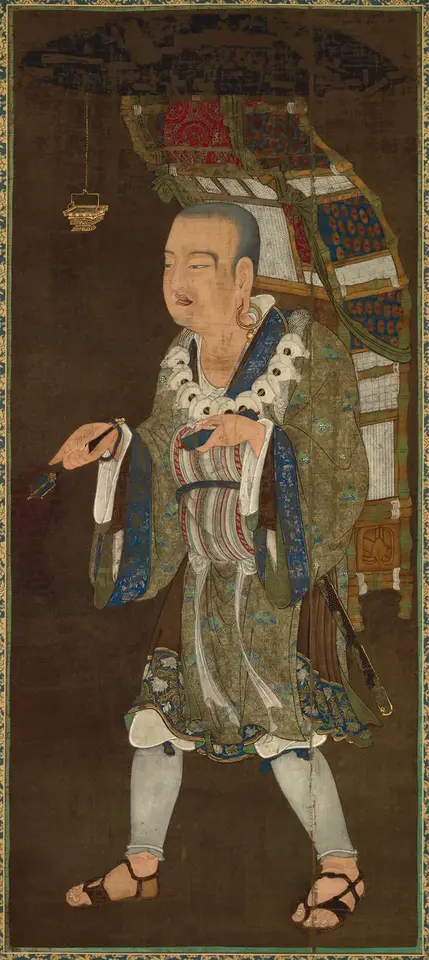
Biography
Illustrious Heritage and Early Ordination
Xuanzang, originally named Chen Wei, was born on April 6, 602 (the ninth day of the third lunar month in the second year of the Renshou reign of Emperor Wen of Sui), in Chenhe Village, Goushi Town, Goushi County, Luozhou (modern Yanshi District, Luoyang, Henan). The Chen lineage was an eminent family of Yingchuan with generations of imperial service. His great-great-grandfather Chen Qin was Governor of Shangdang under the Northern Wei; his great-grandfather Chen Kang was Chancellor of the National University under the Northern Qi; and his grandfather Chen Hui served as Magistrate of Jiangling under the Sui dynasty. His father, Chen Hui, was a dedicated Confucian scholar versed in statecraft who retired from official service as Sui governance decayed. Raised in a strict Confucian household, Xuanzang mastered the Classic of Filial Piety, the Book of Rites, and the Four Books by age eight, demonstrating moral maturity.
During the Daye era, Xuanzang's second elder brother, Master Changjie, was ordained at Jingtu Temple in Luoyang. Xuanzang accompanied him to the monastery, studying Buddhist sutras day and night. In 612, Emperor Yang of Sui dispatched Grand Judge Zheng Shanguo to Luoyang to oversee selective monastic ordinations under rigorous standards. The ten-year-old Xuanzang waited outside the testing hall. Struck by the boy's solemn bearing, Zheng invited him into the hall to inquire about his motives. Xuanzang replied with serene conviction: "My wish is to continue the lineage of the Tathagata afar, and to illuminate the remaining Dharma near at hand!" Astonished by the child's spiritual ambition, Zheng granted him exceptional ordination as a novice monk, admitting him to Jingtu Temple.
At Jingtu Temple, Xuanzang exhibited an astonishing photographic memory. At thirteen, he ascended the lecture seat to expound the Mahaparinirvana Sutra, parsing complex theological concepts with clarity that astonished Luoyang's senior monks. As the Sui dynasty collapsed into civil war, the two brothers fled west to Chengdu, Sichuan, in 618, residing at Konghui Temple to continue their doctrinal studies.
Full Ordination and the Vow to Travel West
In 622, at twenty, Xuanzang received full monastic ordination (upasampada) in Chengdu. In Sichuan, he studied the Abhidharmakosa-sastra and the Mahayanasangraha, earning acclaim across the region. Refusing to rest content with regional scholarship, he left Chengdu, sailing eastward through the Yangzi Gorges to consult masters in Jingzhou, Yangzhou, Xiangzhou, and finally the imperial capital of Chang'an, studying at Da Zhuangyan Temple.
Having surveyed the teachings of diverse Buddhist traditions, Xuanzang was troubled by profound textual contradictions. Circulating Chinese translations diverged on fundamental tenets regarding the nature of enlightenment and universal Buddha-nature. Existing translations were plagued by syntactical obscurities and omissions. Consulting Chang'an's foremost scholars failed to resolve his doubts. Learning that Nalanda Temple in Magadha, India, possessed the complete Sanskrit text of the seventeen-stage Yogacarabhumi-sastra expounded by Bodhisattva Maitreya, Xuanzang resolved to make a perilous pilgrimage to India to retrieve original manuscripts.
In the early Zhenguan era (627 or 629), Xuanzang and several companions petitioned the Tang court for travel permits. However, because the newly established empire faced military threats from the Eastern Turkic Khaganate, the court sealed the frontiers, strictly forbidding private travel abroad. While his companions abandoned the plan, Xuanzang remained resolute. When famine struck the Guanzhong region and authorities permitted refugees to disperse in search of food, Xuanzang slipped out of the western gates of Chang'an unnoticed among the crowds, beginning his solitary journey.
Traversing Deserts and the Journey to India
Xuanzang's overland journey was marked by extraordinary hardship. Traveling through Qinzhou, Lanzhou, and Liangzhou under pursuit by frontier guards, he proceeded by night under the protection of sympathetic believers. With the assistance of his guide Shi Pantuo, he bypassed Yumen Pass at night, slipping past five fortified border watchtowers. Venturing into the 800-li Moheyan Desert (the White Dragon Dunes), his guide deserted him. Shortly thereafter, he accidentally overturned his water skin, remaining without a drop of water for four days and five nights amidst scorching heat. Collapsing near death, he recited the Heart Sutra, making his famous vow: "I would rather take one step toward the West and die, than take one step toward the East to live!" Saved by his horse finding an oasis spring, he survived the desert crossing.
Reaching the Kingdom of Gaochang (modern Turpan, Xinjiang), King Qu Wentai received Xuanzang with royal honors, attempting to detain him as royal preceptor. Xuanzang undertook a three-day hunger strike to demonstrate his determination. Deeply moved, the king pledged brotherhood with Xuanzang, providing him with twenty attendants, thirty horses, and provisions for twenty years, alongside introductory letters to the Tong Yabghu Qaghan of the Western Turks.
Protected by nomadic and oasis rulers, Xuanzang climbed the frozen glaciers of Mount Ling (Muzart Pass) in the Tian Shan, crossed Central Asian oasis cities including Tokmok and Samarkand, passed through the Iron Gate, crossed the Oxus River, and ascended the Hindu Kush. After three years of continuous travel, he entered northern India in 631.
Studies at Nalanda and Triumph at Kanauj
In ancient India, Xuanzang made pilgrimages across Kashmir and Gandhara, visiting Lumbini, the birthplace of the Buddha, and Bodh Gaya, the site of enlightenment. In the autumn of 631, he arrived at Nalanda Temple in Magadha, the supreme academic center of ancient Indian Buddhism housing over ten thousand scholars. The entire monastic assembly welcomed the pilgrim from China with supreme ceremonial honors.
Xuanzang enrolled under Chancellor Silabhadra, the 106-year-old patriarch of the Yogacara tradition. Moved by Xuanzang's pilgrimage from China, Silabhadra broke with precedent to deliver three complete series of lectures on the 100-volume Yogacarabhumi-sastra over fifteen months, alongside foundational treatises of the Middle Way and Consciousness-Only traditions. Studying at Nalanda for five years, Xuanzang mastered Sanskrit linguistics, Indian logic (hetuvidya), and the doctrines of eighteen Buddhist schools, becoming one of only ten masters in the institution certified in fifty treatises.
Subsequently, Xuanzang spent several years traveling across southern, western, and eastern India, surveying dozens of regional kingdoms. In 642, King Harsha (Siladitya), the paramount sovereign of northern India, convened an imperial assembly of religious debate at his capital of Kanauj in Xuanzang's honor. The Kanauj Assembly was attended by eighteen vassal kings, over three thousand Mahayana and Theravada monks, and two thousand Hindu and Jain philosophers. Appointed presiding master, Xuanzang expounded his treatise Establishing Consciousness-Only (Zhen Weishi Liang), posting the thesis at the assembly gates with the declaration: "If any person can find a single word flawed or illogical, I shall forfeit my head in gratitude!"
For eighteen days, thousands of scholars deliberated the thesis, yet none could refute his arguments. King Harsha and regional monarchs bowed before him. Mahayana scholars bestowed upon him the honorific Mahayanadeva ("God of the Great Vehicle"), while Theravada scholars honored him as Moksadeva ("God of Liberation"), his renown spreading across the Indian subcontinent.
Imperial Translation Bureau in Chang'an
In the spring of 645, declining requests from Indian monarchs to remain, Xuanzang departed for China laden with scriptures. Crossing the Pamir Plateau and Khotan, he sent an official memorial to Emperor Taizong reporting his return. On February 25, 645, he reached Chang'an. Taizong dispatched Grand Councilor Fang Xuanling to coordinate a state welcome. Hundreds of thousands of citizens lined the avenues from the southern gate to Hongfu Temple amidst fragrant incenses and chanting.
In March, Emperor Taizong received Xuanzang at the Luoyang Palace. They conferred for days regarding Central Asian and Indian geopolitics, institutions, and customs. Impressed by Xuanzang's stamina and intellect, Taizong urged him to secularize and accept high ministerial office. Xuanzang respectfully declined, requesting permission to dedicate his life to translation. Taizong approved his petition, underwriting all operational costs and designating Hongfu Temple in Chang'an as an imperial translation bureau, assigning scholars from across the empire to serve as scribes, verifiers, and polishers.
In 648, Emperor Taizong composed the celebrated Preface to the Sacred Teachings of the Great Tang Tripitaka, while Crown Prince Li Zhi (later Emperor Gaozong) composed an accompanying commentary. That winter, Gaozong completed Great Ci'en Temple in memory of his mother, Empress Wende, appointing Xuanzang as its first abbot. In 652, to safeguard the collection of Sanskrit manuscripts and sacred relics from fire, Xuanzang directed the construction of the Giant Wild Goose Pagoda at Ci'en Temple, erecting a five-story brick-and-stone stupa modeled on Indian architectural designs.
Translation of the Prajnaparamita and Nirvana
From 645 to 660, Xuanzang directed the imperial translation teams with unrelenting discipline. Concurrently, based upon his oral dictation, his disciple Bianji compiled the twelve-volume geographical and historical work Great Tang Records on the Western Regions in 646, documenting 110 countries visited and twenty-eight heard of.
In the winter of 659, seeking refuge from capital politics to focus upon scripture, the aging master petitioned Emperor Gaozong to transfer his translation bureau to Yuhua Palace in Yijun County (modern Tongchuan, Shaanxi). In his final four years, Xuanzang poured his remaining vitality into translating the supreme canon of Mahayana emptiness philosophy, the Mahaprajnaparamita Sutra. Comprising four assemblies in sixteen sections across six hundred volumes, the translation was completed entirely under Xuanzang's personal direction, standing as an unrivaled monumental achievement in Buddhist translation history.
Decades of arduous labor and frontier travel took a toll on his health. In the winter of 663, upon completing the final volume of the Prajnaparamita, Xuanzang pressed his palms together, declaring to his disciples: "This scripture possesses affinities with China; my strength is exhausted, and my end draws near." In early 664, he suffered a fall while walking in the monastery courtyard, injuring his leg and becoming bedridden. On March 7, 664 (the fifth day of the second lunar month), the master passed away peacefully lying on his right side at the Sucheng Cloister of Yuhua Palace at sixty-three.
When news of his demise reached Chang'an, Emperor Gaozong wept openly, suspending court audiences for three days and lamenting: "I have lost our national treasure!" On April 14, a state funeral was conducted at Bailuyuan outside Chang'an, attended by over a million citizens, with more than thirty thousand mourners camping beside his tomb. In 669, the court reinterred his relics at Shaolingyuan, constructing a five-story pagoda and establishing Xingjiao Temple in his memory.
Major Achievements
Pilgrimage across Fifty Thousand Li and Triumph at Kanauj
In the history of human geographical exploration and cultural exchange, Xuanzang's journey to India for Buddhist scriptures stands as an epic achievement. Over seventeen years, he traversed more than 50,000 li across Central Asia and South Asia on foot and horseback.
Crossing the Moheyan Desert, navigating the Pamir glaciers, and traversing thirty-six oasis city-states, Xuanzang won the respect of rulers like the Western Turkic Qaghan and the King of Gaochang through moral integrity and intellectual depth, enhancing the cultural prestige of the Tang Empire along the Silk Road.
In India, his philosophical mastery eclipsed local scholars at Nalanda, culminating in his victory at the Kanauj Assembly convened by King Harsha. Defending his thesis for eighteen days without defeat, he earned the titles Mahayanadeva and Moksadeva, while prompting King Harsha to dispatch diplomatic missions to Chang'an, inaugurating a golden age of Sino-Indian cultural exchange.
Founding the Imperial Translation Bureau and New Translation Standards
In translation studies and intercultural linguistics, Xuanzang established the zenith of premodern translation practice, honored as the founding master of the "New Translations."
Over nineteen years, supported by imperial patronage, Xuanzang directed a sophisticated translation bureaucracy dividing tasks among ten specialized roles: chief translator, doctrinal verifiers, Sanskrit readers, scribes, polishers, and final collators. Xuanzang translated seventy-five distinct works in 1,335 fascicles totaling over thirteen million characters, exceeding the lifetime outputs of Kumarajiva and Paramartha combined.
Theoretically, Xuanzang eliminated the shortcomings of earlier translations, which oscillated between wooden literalism and loose paraphrase. He formulated the principle of translating with literal fidelity while preserving classical Chinese elegance. Crucially, he established the foundational doctrine of the "Five Types of Untranslated Terms" (preserving Sanskrit phonetically for esoteric mantras, polysemous concepts, unique indigenous terms, established antiquities, and terms designed to inspire reverence), establishing an enduring framework for cross-linguistic translation.
Establishing the Faxiang Weishi School
In philosophy and metaphysics, Xuanzang systematically transplanted Indian Yogacara philosophy into East Asia, establishing the Faxiang Weishi School (Ci'en School), one of the eight major traditions of Chinese Buddhism.
Translating canonical texts including the Yogacarabhumi-sastra and Treatise on the Establishment of Consciousness-Only (Cheng Weishi Lun), Xuanzang and his chief disciple Kuiji integrated the insights of ten prominent Indian commentators into a unified epistemological system. By introducing the eight consciousnesses, the three natures, and formal Indian logic (hetuvidya), Xuanzang enriched Chinese philosophical thought with sophisticated logical analysis and cognitive theory.
His philosophical school flourished throughout the High Tang, influencing the moral psychology of Song-Ming Neo-Confucianism. Disciples including Woncheuk transmitted the teachings to the Korean Peninsula, while Japanese monks Dosho and Gembo carried the texts to Japan to establish the Japanese Hosso School, rendering Xuanzang's philosophy a foundational intellectual heritage across East Asia.
The Great Tang Records and Reconstruction of Ancient Indian History
In historiography, historical geography, and archaeology, Xuanzang bequeathed a global treasure in Great Tang Records on the Western Regions (Great Tang Records on the Western Regions, twelve volumes).
Dictated by Xuanzang and compiled by his disciple Bianji, the work presents detailed records of 110 kingdoms visited and twenty-eight heard of across Central Asia and India. It preserves invaluable data on topographical features, urban perimeters, travel distances, natural resources, seasonal climates, indigenous languages, political dynasties, and religious monuments, marked by extraordinary geographical accuracy.
In modern times, Great Tang Records on the Western Regions served as the essential key enabling nineteenth- and twentieth-century international archaeologists to rediscover ancient Buddhist civilization in South Asia. British archaeologist Sir Alexander Cunningham utilized Xuanzang's texts as an archaeological guide to excavate and identify the ruins of Nalanda, Sarnath, Bodh Gaya, Rajgir, and the Pillars of Ashoka across northern India. Similarly, explorers like Sir Aurel Stein relied upon Xuanzang's records to unearth ancient oasis civilizations across the Tarim Basin. Xuanzang's travelogue remains an immortal beacon illuminating the ancient history of Central and South Asia.