Diligent Labor and Study
Plowed fields with scrolls strapped to his hoe in Qiancheng; traveled to Chang'an to study under Kong Anguo.
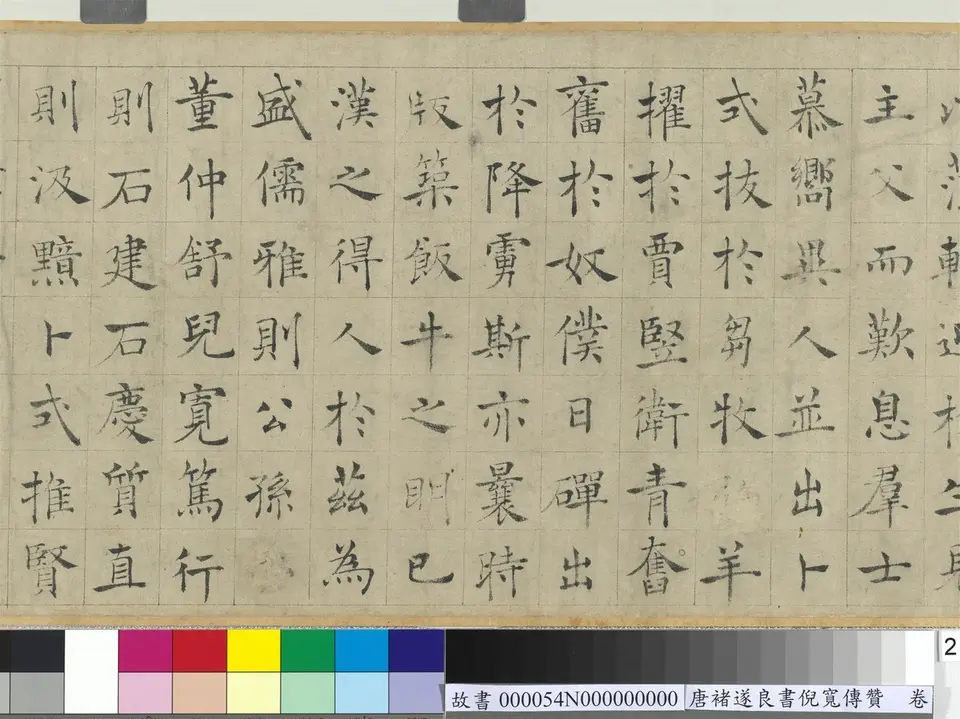
儿宽
Er Kuan (儿宽, died 103 BCE), alternatively written as Ni Kuan, was a native of Qiancheng Commandery (modern Guangrao County, Shandong Province), a prominent Confucian scholar, hydraulic engineer, and senior statesman who served as Censor-in-chief (御史大夫) during the reign of Emperor Wu of Han. Born into extreme poverty, he famously carried Confucian scrolls while plowing the fields, earning food by drafting letters and keeping…
Er Kuan (儿宽, died 103 BCE), alternatively written as Ni Kuan, was a native of Qiancheng Commandery (modern Guangrao County, Shandong Province), a prominent Confucian scholar, hydraulic engineer, and senior statesman who served as Censor-in-chief (御史大夫) during the reign of Emperor Wu of Han. Born into extreme poverty, he famously carried Confucian scrolls while plowing the fields, earning food by drafting letters and keeping accounts for fellow hired laborers. Traveling to Chang'an, he studied the Book of Documents (Shangshu) under the master Kong Anguo, mastering classical hermeneutics and legal jurisprudence. Entering government service as an archival scribe under the harsh commandant of justice Zhang Tang, Er Kuan's refined writing and application of classical ethics to legal petitions won the profound admiration of Emperor Wu. Promoted to Governor of the Left Inland Capital (Zuo Neishi), Er Kuan directed agricultural recovery across the Guanzhong basin. Observing that the ancient Zhengguo Canal failed to reach higher terraces, he surveyed the topography and constructed the Liufu Canals (Six Auxiliary Canals), diverting the Jing River to irrigate tens of thousands of hectares of arid farmland. His benevolent administration and low taxation prompted local farmers to volunteer their tax grains, making his commandery the first in tax collection without coercion. In 110 BCE, he accompanied Emperor Wu to Mount Tai to formulate the liturgical rites for the imperial Feng and Shan sacrifices and collaborated with Grand Astrologer Sima Qian to reform the calendar. Appointed Censor-in-chief in 106 BCE, he served with moral restraint until his death in 103 BCE, remembered as an enduring exemplar of the synthesis between Confucian moral philosophy and pragmatic hydraulic governance.
Plowed fields with scrolls strapped to his hoe in Qiancheng; traveled to Chang'an to study under Kong Anguo.
Appointed literary clerk in the office of the commandant of justice; drafted petitions reconciling law with classical rites.
Administered the northern Guanzhong basin; constructed the Liufu Canals to irrigate thousands of hectares.
Assisted Emperor Wu in the Feng and Shan sacrifices and co-sponsored the compilation of the Taichu Calendar.
Appointed Censor-in-chief (vice chancellor), entering the highest tier of the imperial administration.
Passed away in office; mourned by Emperor Wu and commemorated with shrines built by grateful Guanzhong farmers.
Er Kuan was born into an impoverished household in Qiancheng Commandery in the Qi region. Lacking financial resources to fund formal schooling, he displayed an unyielding passion for classical scholarship from his youth. While laboring as a hired farmhand, he tied scrolls of the Confucian classics to the handle of his hoe, reciting passages whenever he paused for rest beneath field trees—an anecdote celebrated in Chinese history as "carrying the classics while plowing." During labor breaks, he drafted letters and balanced accounts for unlettered co-workers, who reciprocated by helping him complete his plowing quotas so he could read undisturbed.
During the reigns of Emperor Jing and Emperor Wu, classical studies flourished in the eastern commanderies. Determined to expand his knowledge, Er Kuan journeyed to the capital of Chang'an, enrolling as a disciple of Kong Anguo, a direct descendant of Confucius and foremost master of the Book of Documents. Among hundreds of fellow students, Er Kuan distinguished himself by reconciling the Old and Modern Text traditions while acquiring expertise in administrative arithmetic.
In the Yuanshuo era, Er Kuan received an appointment as a literary scribe in the Ministry of Justice under Commandant Zhang Tang. Zhang Tang was renowned for his severe application of dynastic statutes, yet he sought to cloak his harsh verdicts in Confucian moral orthodoxy. The subordinate clerks in the ministry were unlettered legalists whose petitions frequently displeased the literary-minded Emperor Wu.
Recognizing Er Kuan's elegant prose and classical mastery, Zhang Tang entrusted him with drafting complex judicial appeals and memorials to the throne. Er Kuan skillfully wove subtle moral precedents from the Book of Documents and the Spring and Autumn Annals into imperial legal briefs. Upon reviewing these memorials, Emperor Wu expressed astonishment at their erudition, inquiring who had penned them. Zhang Tang truthfully introduced Er Kuan, praising his integrity and scholarship. Emperor Wu summoned Er Kuan for an imperial audience, testing his comprehension of statecraft and classical philosophy. Highly impressed by his practical intellect, the emperor appointed him Grand Palace Grandee (Zhongdafu) and subsequently Palace Attendant (Shizhong).
In 115 BCE, Emperor Wu appointed Er Kuan as Governor of the Left Inland Capital (Zuo Neishi), placing him in charge of the vital northern Guanzhong plain. The ancient Zhengguo Canal, constructed during the late Warring States period, had suffered extensive sedimentation, and its low water level prevented irrigation waters from reaching elevated agricultural plateaus, resulting in chronic drought and displacement among peasant households.
Upon assuming office, Er Kuan conducted comprehensive field surveys across the irrigation networks. Recognizing that low-lying canal streams bypassed upland fields, he submitted a proposal to build elevated feeder canals. Supported by imperial treasury funds, Er Kuan mobilized local labor to excavate six large diversion canals along the upper reaches of the Zhengguo Canal, officially designated as the Liufu Canals (Six Auxiliary Canals). Stretching for dozens of leagues and equipped with sophisticated sluice gates, this hydraulic system lifted water from the Jing River to irrigate over forty thousand hectares of arid alkaline soil across Sanyuan and Gaoling, revitalizing agrarian production throughout the metropolitan territory.
In civilian governance, Er Kuan applied Confucian benevolence, moderating punitive punishments and extending tax deadlines during meager harvests. While neighboring governors extracted grain through coercion, Er Kuan's humane governance inspired spontaneous civic compliance. When imperial levies were assessed to support northern military campaigns against the Xiongnu, Guanzhong elders encouraged one another: "Lord Er treats us with parental kindness; we must never allow our magistrate to face reprimand from the throne!" Peasant families lined the roads to deliver grain, causing the Left Inland Capital to rank first among all commanderies in tax fulfillment without a single flogging.
In 110 BCE, having repelled the Xiongnu and expanded imperial borders, Emperor Wu resolved to perform the ancient Feng and Shan sacrifices atop Mount Tai to proclaim dynastic prosperity to Heaven. As this represented the first performance of the ritual in Western Han history, court scholars engaged in protracted disputes regarding liturgical protocols, sacrificial platforms, and ceremonial robes.
Emperor Wu assembled Er Kuan, Grand Astrologer Sima Qian, and academician Chu Da to draft the imperial liturgy. Drawing upon the Canon of Shun and classical Zhou rituals, Er Kuan emphasized that true sacrifice lay in reverence for Heaven and benevolence toward the people, designing a grand ritual that balanced archaic solemnity with Han imperial majesty. In the third month of that year, Er Kuan accompanied the emperor to Mount Tai, personally supervising the consecration of the Mingtang (Hall of Enlightenment) at the base of the sacred peak.
Following the ceremonies, Er Kuan and Sima Qian submitted a joint memorial arguing that the Han Dynasty had inherited the flawed Zhuanxu calendar from the Qin, which commenced the year in the tenth month and had developed severe seasonal discrepancies. Emperor Wu approved their proposal, commissioning Er Kuan to supervise over twenty leading astronomers, including Deng Ping, Luoxia Hong, and Tang Du. After years of observational verification, the committee completed the Taichu Calendar (Grand Inception Calendar) in 104 BCE, restoring the first month of spring as the beginning of the year and formalizing the twenty-four solar terms that formed the bedrock of the traditional Chinese agrarian calendar.
In 106 BCE, following the dismissal of Bu Shi over taxation disagreements, Emperor Wu elevated Er Kuan to Censor-in-chief, the second-highest post in the central government. In this high office, Er Kuan served alongside Chancellor Shi Qing, advocating moral education and bureaucratic moderation. Although he refrained from confrontational opposition against Emperor Wu's harsh fiscal policies during wars with Dayuan and Chaoxian, Er Kuan utilized his appellate authority to review unjust sentences, shelter principled scholars, and recommend learned Confucian literati to central ministries. Emperor Wu held him in consistent esteem, never subjecting him to the arbitrary punishments common in the late Wu reign.
In 103 BCE, worn down by decades of administrative labor, Er Kuan passed away at his ministerial residence. Emperor Wu mourned his loss deeply, bestowing lavish funeral honors upon his family. Along the banks of the Liufu Canals, local farmers spontaneously erected ancestral shrines to honor his memory, reverently referring to the irrigation waterways as "Lord Er's Canal."
Er Kuan played a seminal role in the historical synthesis of Confucianism and legal administration. Serving in the Ministry of Justice under Zhang Tang, he pioneered the practice of "interpreting the law through Confucian classics," utilizing moral intent from the Book of Documents to temper penal severity. This intellectual approach provided the foundational precedent for the systematic Confucianization of Chinese imperial law.
Er Kuan's most enduring physical achievement was the excavation of the Liufu Canals across northern Guanzhong. By engineering auxiliary channels that diverted Jing River waters to elevated plateaus, he expanded irrigated acreage by tens of thousands of hectares, converting unproductive tracts into fertile grain fields and securing essential logistical supplies for Emperor Wu's external campaigns.
Er Kuan served as a primary architect of Western Han cultural institutions. He co-authored the official ceremonial codes for Emperor Wu's Mount Tai sacrifices and directed the astronomical commission that produced the Taichu Calendar. By establishing the spring new year and celestial coordinates, his work permanently defined the structure of traditional Chinese chronometry.
FIGURES ASSOCIATED WITH THIS DYNASTY