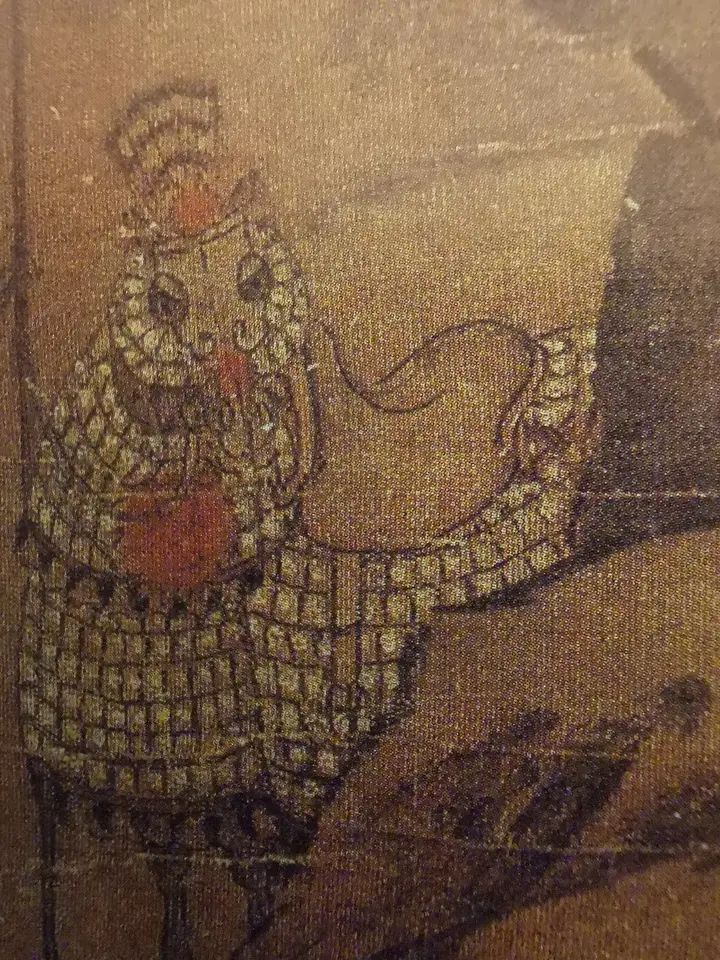
Life and Career
Noble Heritage and Inherited Master Craftsmanship
Yan Lide was born into an illustrious Guanlong aristocratic family originating from Shengle in Yulin. His grandfather, Yan Qing, served as Senior Pillar of State and Area Commander of Ningzhou in the Northern Zhou Dynasty. His father, Yan Pi, married Princess Qinghe, younger sister of Emperor Yang of Sui, and served as Vice Director of the Palace Domestic Service, renowned throughout the Sui Empire as a master of architecture, mechanics, and design who constructed imperial dragon boats, palace complexes in Guanghan, and defensive fortifications along the Great Wall.
Surrounded by this exceptional environment of engineering and fine arts, Yan Lide and his younger brother Yan Liben grew up amidst draft plans and construction yards. The two brothers inherited their father's profound expertise in timber and stone masonry, hydraulic engineering, and metal casting, while also undertaking comprehensive study of classical Confucian rites, historical treatises, and painting masterpieces of the Han, Wei, Jin, and Southern Dynasties. Yan Lide excelled particularly in macro-engineering algorithms and spatial architecture, while Yan Liben specialized in portraiture and expressive rendering.
In 618, when Li Yuan founded the Tang Dynasty, the Yan brothers pledged their service to the new court, and Yan Lide was appointed Groom of the Imperial Wardrobe. In 626, upon Emperor Taizong's ascension, the sovereign observed that court regalia remained crude and disordered. Taizong commissioned Yan to redesign the imperial carriages, crowns, ceremonial robes, and official attire. Drawing upon the Rites of Zhou and Han dynasty rituals while adapting them to contemporary realities, Yan established a comprehensive system of imperial vestments and ceremonial regalia, laying the material and visual foundation for Tang court culture.
Construction of Xianling and the Innovation of Zhaoling
In the fifth month of the ninth year of Zhenguan (635), founding Emperor Gaozu passed away. Emperor Taizong commanded that Xianling Mausoleum be erected in Sanyuan and appointed Yan Lide as Vice Chamberlain for Palace Buildings to oversee the project. Adhering to ancient mound traditions while incorporating innovative stone carvings, Yan established the standard architectural framework for early Tang mausoleums.
In the tenth year of Zhenguan (636), Emperor Taizong's beloved consort, Empress Zhangsun, passed away. Heartbroken, Taizong resolved to bury her at Mount Jiuzong, commanding Yan Lide to oversee the excavation. Yan conducted extensive geological surveys of the mountain's limestone cliffs and devised an audacious design: rather than piling massive earth mounds on flat plains in the Han fashion, he tunneled an underground palace directly into the southern cliff face of Mount Jiuzong, creating the famous system of "utilizing a natural mountain as a tomb."
This revolutionary conception was celebrated for both its imperial grandeur and its practical benefits, discouraging tomb robbers while harmonizing human architecture with cosmic nature. Yan meticulously planned the vast mausoleum precinct, integrating sacrificial halls, administrative offices, and satellite tombs for merit ministers along the foothills. The Zhaoling model became the defining standard for Tang imperial burials and exerted a profound influence on later Chinese imperial tomb architecture.
Palace Construction and Navigating Fleet Operations
In the eleventh year of Zhenguan (637), Yan was promoted to Chamberlain for Palace Buildings, assuming supreme oversight over the empire's master artisans, civil engineering projects, and palace maintenance. In subsequent years, he directed the construction of magnificent imperial mountain retreats, notably Cuiwei Palace and Yuhua Palace, skillfully adapting architectural complexes to rugged mountain terrain and integrating flowing springs into palace pavilions.
In the eighteenth year of Zhenguan (644), Emperor Taizong prepared for his grand eastern expedition against Goguryeo, requiring a powerful naval armada to transport shock troops across the Bohai Sea. Taizong selected Yan Lide to supervise this critical military project, sending him to Hongzhou (modern Nanchang, Jiangxi). Yan organized thousands of shipwrights, harvested timber from mountain forests, and supervised the construction of four hundred large oceangoing combat vessels within months. These towering warships withstood severe maritime storms, transported tens of thousands of Tang soldiers safely into Liaodong, and played a decisive role in the eastern campaign.
Capital Urban Planning and Artistic Renown
Beyond imperial mausoleums and naval armadas, Yan Lide made foundational contributions to early Tang urban planning and hydraulic infrastructure. Early in the Zhenguan era, Emperor Taizong resolved to renovate the Sui-era capital of Chang'an. Yan Lide was appointed to direct the construction of the outer city walls and grand gates, including Mingde Gate and Zhuque Gate. He precisely aligned the central urban axes and market quarters, bestowing upon the Tang capital a solemn and majestic demeanor that commanded the awe of foreign envoys. He subsequently directed the construction of the Tangquan Palace on Mount Li and expansion pavilions at Jiucheng Palace, harmoniously integrating architecture with natural hot springs and mountain geography.
In fine art, Yan Lide and his brother Yan Liben revolutionized traditional figure and landscape painting, pioneering an expansive High Tang style characterized by precise composition and vivid naturalism. When tributary envoys gathered at Chang'an, Emperor Taizong commissioned Yan Lide to paint Tribute Bearers (Zhigong Tu), capturing the distinctive facial features and court attire of central Asian, northern, and southern emissaries. In 641, following the marriage of Princess Wencheng to the Tibetan monarch Songtsen Gampo, he was commissioned to paint Princess Wencheng's Departure for Tibet, visually documenting this historic diplomatic union.
Elevation to Minister of Works and Final Honors
Following the death of Emperor Taizong in 649, Emperor Gaozong ascended the throne and elevated Yan Lide to Minister of Works, the highest administrative post overseeing state infrastructure, hydraulic projects, and ceremonial construction. He was also enfeoffed as Duke of Daping County. During this period, Yan directed major dredging and lock-construction projects on the Wei River and capital canal networks, ensuring the steady transport of Jiangnan grain to Chang'an.
Alongside his monumental engineering achievements, Yan was celebrated as one of the greatest painters of the early Tang Dynasty. Renowned for painting ancient sages, foreign tribute missions, and auspicious omens, he executed celebrated works including Tribute Bearers (Zhigong Tu), Princess Wencheng's Departure for Tibet, and Portraits of Auspicious Omens. Critics noted that his painting possessed elegant brushwork and vivid coloring, capturing the grandeur of the Tang Empire at its height.
In the first year of the Xianqing era (656), Yan Lide passed away in Chang'an. Emperor Gaozong suspended court audiences in mourning and issued an edict posthumously conferring upon him the office of Commander-in-Chief of Youzhou, granting him the posthumous name Xian, and bestowing the supreme honor of burial in a satellite tomb at Zhaoling Mausoleum.