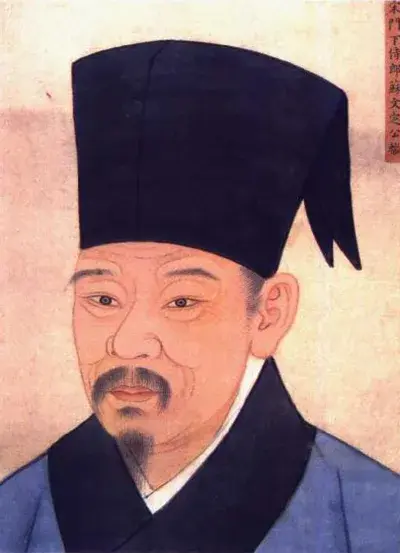
Life Story
Upbringing in a Scholarly Clan and Mentorship under Huang Gan
He Ji was born into a prominent scholar-official family of Jinhua during the reign of Emperor Xiaozong. His grandfather He Song passed the imperial examinations in 1166 and served as Vice Prefect of Huizhou, while his father He Bohui was a respected Confucian who took up the post of Assistant Magistrate of Linchuan in Fuzhou in 1192. Endowed with natural intellect from an early age, He Ji studied classical commentary under local scholar Chen Zhen and practiced examination prose. However, He Bohui recognized that civil examination compositions failed to cultivate genuine moral philosophy and sought a truly profound teacher for his sons.
In 1207, Huang Gan (Master Mianzhai), the son-in-law and foremost disciple of Zhu Xi, was appointed Prefect of Linchuan. Overjoyed by this opportunity, He Bohui brought his elder son He Nan and second son He Ji to pay formal respects and enroll in Huang Gan's school. Huang Gan, who had preserved the comprehensive doctrinal teachings of Zhu Xi's Kaoting School, recognized He Ji's quiet, earnest demeanor and admonished him that authentic scholarship demanded genuine moral conviction and unremitting, painstaking discipline. Moved to the core, He Ji cast aside his examination compositions and devoted his life to mastering the Four Books, the Classic of Changes, ritual canons, and Zhu Xi's extensive commentaries, acquiring a profound understanding of the Cheng-Zhu philosophical system.
Retirement to Mount Beishan and Hermit Teaching
Following Huang Gan's passing, He Ji observed the deepening factional degeneration in the imperial court and resolved to preserve and transmit orthodox learning rather than seek political rank. He abandoned all ambitions for officialdom and returned to his native Jinhua, retreating to the banks of the Panxi stream at the foot of Mount Beishan. There he constructed a modest study surrounded by volumes of classics, naming it the Beishan Lecture Hall and adopting the pseudonym Beishan, which earned him the reverent title Master Beishan among scholars.
In his Panxi retreat, He Ji led an intensely disciplined intellectual life. Rising at cockcrow every morning, he straightened his robes and sat erect, reading the ancient canons with unwavering concentration. He closed his gates to frivolous visitors and never set foot in the bustling city, focusing entirely on explicating the esoteric meanings of the Song Confucian masters. Attracted by his moral purity and profound scholarship, literati from throughout southeastern China traveled hundreds of miles to seek his guidance. He Ji adapted his teaching to each student's temperament, urging them that study must be rooted in unyielding resolve, broad vision, and steadfast practice until death. His refusal to allow superficial debates or examination careerism fostered an exceptionally sober, practical scholarly ethos in the Jinhua region.
Fellowship with Wang Bai and Doctrinal Debates
In 1238, Wuzhou scholar Wang Bai (Master Luzhai), who was already over forty and enjoyed widespread fame in Jiangnan intellectual circles, read He Ji's commentaries and was deeply impressed by their fidelity to Zhu Xi's philosophy. Wang Bai traveled to Panxi to meet He Ji and formally requested to become his disciple. Characteristically humble, He Ji treated Wang Bai as a peer rather than maintaining the aloofness of a master, inviting him to share his study to examine difficult classical passages.
Whenever they encountered ambiguous textual variants or philosophical controversies, the two scholars conducted exhaustive cross-examinations, occasionally exchanging letters more than ten times over the interpretation of a single phrase. In He Ji's surviving writings, dialogues and correspondences with Wang Bai comprise more than sixty percent of the text. He Ji's grounded precision balanced Wang Bai's bold erudition, steering the intellectual climate of eastern Zhejiang from Lu Zuqian's broad institutionalism toward orthodox Cheng-Zhu doctrine. Wang Bai later directed Lize Academy and trained Jin Luxiang and Xu Qian, establishing the influential Jinhua School, celebrated as the Four Masters of Beishan.
Repeated Refusal of Imperial Summons and Upright End
During the reigns of Emperor Lizong and Emperor Duzong, the imperial court elevated Neo-Confucianism to state orthodoxy, and He Ji's reputation for virtue spread throughout the realm. In 1244, upright minister Zhao Ruteng took office as Prefect of Wuzhou, visiting Mount Beishan to invite He Ji to lead Lize Academy and recommending him to the central government, but He Ji politely declined on grounds of poor health. Subsequently, distinguished officials including Cai Kang and Yang Dong served as prefects and repeatedly brought appointment gifts to his hermitage, yet He Ji remained steadfast in his refusal.
In 1264, the imperial court issued a decree appointing He Ji Prefectural Professor of Wuzhou concurrently Head of Lize Academy, but he submitted a memorial firmly declining the honor. In 1265, following Emperor Duzong's coronation, the throne sought to honor prominent recluses by appointing He Ji Historiography Institute Collator, Lecturer of the Chongzheng Hall, and Gentleman for Attendance Supervising the Western Sacred Peak Temple of Huazhou. He Ji declined every appointment, declaring that he was old, frail, and had never enrolled in official registers. He passed away peacefully in his Beishan hermitage in 1269 at the age of eighty-two. In accordance with his wishes, his disciples eschewed official ceremonies, burying him with modest literati rites and conferring the private posthumous title Master Wending. He was subsequently enshrined in the Jinhua Confucian Temple.
Major Achievements
Inheriting the Zhu Xi Lineage and Founding the Beishan School
He Ji occupies an essential transitional position in the history of Song dynasty thought. Following Zhu Xi's synthesis of Neo-Confucianism and Huang Gan's stewardship of the Kaoting School, He Ji became the principal third-generation standard-bearer of the Zhu Xi philosophical lineage. Confronting the contemporary tendencies of late Song scholars to engage in empty speculation or pursue bureaucratic profit, He Ji insisted that the quest for the Dao must begin with reverence and that true learning requires rigorous self-examination and philological mastery of the Four Books. Through decades of teaching at Mount Beishan, he founded the Beishan School (Jinhua School), firmly anchoring Cheng-Zhu orthodoxy in eastern Zhejiang, withstanding the influence of rival schools, and achieving a revitalization of Zhu Xi's thought in southeastern China.
Cultivating Disciple Wang Bai and Ensuring Lineage Continuity
He Ji devoted his entire adult life to nurturing disciples and preserving the intellectual lineage. His acceptance of the prominent scholar Wang Bai as his student, combined with his egalitarian willingness to debate textual nuances as equals, became a celebrated exemplar of pedagogical devotion in Chinese scholarly history. Under He Ji's meticulous instruction, Wang Bai abandoned ornate examination writing to become a preeminent classical master. Together, He Ji and Wang Bai mentored Jin Luxiang and Xu Qian, creating the illustrious Four Masters of Jinhua tradition. During the Yuan and early Ming eras, scholars like Song Lian drew directly upon this intellectual lineage, establishing He Ji as the foundational spiritual ancestor of Ming court Confucianism.
Defiantly Declining Official Appointments as a Moral Paragon
During the late Southern Song, when imperial politics was marred by the authoritarian domination of Jia Sidao and literati circles succumbed to careerism, He Ji's decades of quiet seclusion on Mount Beishan provided a moral beacon for the scholar-gentry. From prefectural invitations by Zhao Ruteng and Cai Kang to imperial appointments as academy head, imperial lecturer, and temple superintendent under Emperor Duzong, He Ji declined every court offer without hesitation. Refusing to let his integrity be compromised by rank or stipend, he never served a single day in government and strictly forbade official funerals upon his death, exemplifying the independent dignity and moral rectitude of the true Confucian recluse.