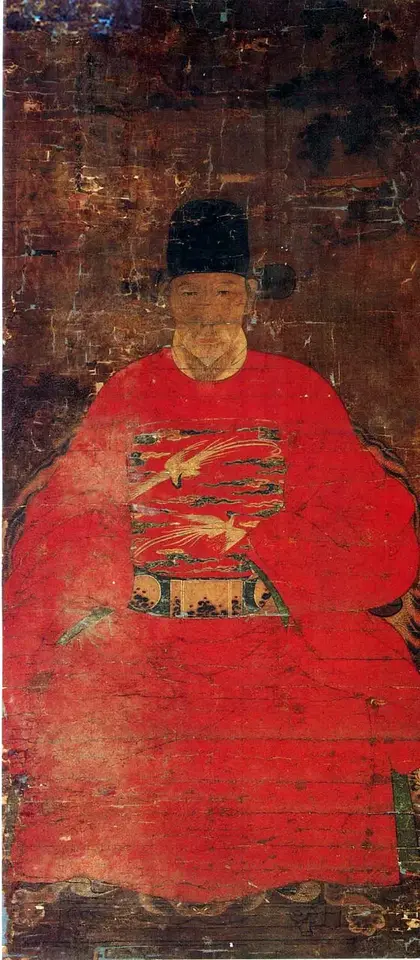
PROFILE
Gu Qiyuan (顾起元, 1565–1628), courtesy name Taichu and pseudonym Dunyuan Jushi, was a native of Jiangning County in Yingtian Prefecture (modern Nanjing, Jiangsu Province). He was a distinguished statesman, historian, and man of letters during the late Ming dynasty across the Wanli, Taichang, Tianqi, and early Chongzhen reigns. In 1598, he achieved third place (Tanhua) in the palace examination and was appointed Senior Compiler in the Hanlin Academy. He subsequently served as Daily Lecturer to the Heir Apparent, Director of Studies of the Imperial Academy, Left Supervisor of the Left Spring Pavilion, and Chancellor of the Nanjing Hanlin Academy, before rising to Left and Right Vice Minister of Personnel in Nanjing. During the Tianqi reign, when the eunuch dictator Wei Zhongxian dominated imperial politics and persecuted upright officials, Gu resolutely preserved his moral integrity by retiring on grounds of illness. He built the renowned Dunyuan Garden west of Nanjing, dedicating his final years to scholarly inquiry and historical research. Gu was deeply versed in Confucian classics, Neo-Confucian metaphysics, institutional traditions, and local historical lore. His magnum opus, Kezuo zhuiyu in ten fascicles, meticulously chronicled the urban geography, administrative structures, civil service examinations, commercial customs, and folklore of Nanjing, while providing one of the earliest objective Chinese accounts of Jesuit missionary Matteo Ricci's introduction of Western cartography and science. Following his passing in 1628 at sixty-four, the Chongzhen court posthumously conferred upon him the title of Minister of Rites and the posthumous name Wenzhuang.
- Courtesy Name
- Taichu (太初)
- Pseudonym
- Dunyuan Jushi (遁园居士)
- Posthumous Name
- Wenzhuang (文庄)
- Ancestral Home
- Jiangning, Yingtian Prefecture
- Birth Date
- 1565 (44th year of the Jiajing reign, Ming)
- Death Date
- 1628 (1st year of the Chongzhen reign, Ming)
- Age at Death
- 64
- Major Offices
- Left Vice Minister of Personnel in Nanjing, Right Vice Minister of Personnel in Nanjing concurrently Hanlin Academician Expositor-in-Waiting, Director of Studies of the Imperial Academy, Senior Compiler in the Hanlin Academy
- Historical Identity
- Late Ming high official, scholar, Tanhua graduate, historian
BIOGRAPHY
Chronology
- 1565 (44th year of the Jiajing reign) | Birth in Jinling | Born into a prominent scholarly lineage in Jiangning County, Yingtian Prefecture.
- 1598 (26th year of the Wanli reign) | Tanhua Honours | Achieved third rank (Tanhua) in the imperial palace examination and appointed Senior Compiler in the Hanlin Academy.
- 1604 (32nd year of the Wanli reign) | Imperial Academy Office | Promoted to Director of Studies of the Imperial Academy, reforming discipline and instructing national scholars.
- 1608 (36th year of the Wanli reign) | Princely Instruction | Appointed Left Companion in the Left Spring Pavilion and Daily Lecturer to Crown Prince Zhu Changluo.
- 1617 (45th year of the Wanli reign) | Compiling Kezuo Zhuiyu | Completed Kezuo zhuiyu in ten fascicles after extensive archival and fieldwork research on Nanjing lore.
- 1620 (1st year of the Taichang reign) | Heading Southern Hanlin | Elevated to Junior Supervisor of the Household of the Heir Apparent and Chancellor of the Nanjing Hanlin Academy.
- 1623 (3rd year of the Tianqi reign) | Ministerial Advancement | Appointed Right Vice Minister of Personnel in Nanjing and subsequently transferred to Left Vice Minister.
- 1624 (4th year of the Tianqi reign) | Retirement to Dunyuan | Resigned office rather than collaborate with the eunuch faction, retiring to Jinling to construct Dunyuan Garden.
- 1628 (1st year of the Chongzhen reign) | Demise and Posthumous Honours | Passed away at Dunyuan at age sixty-four; posthumously gifted Minister of Rites with the posthumous name Wenzhuang.
Life and Career
Academic Mastery and Success as Tanhua
Gu Qiyuan was born in 1565 in Jiangning County into an esteemed literary lineage deeply grounded in classicist tradition. From early youth he displayed formidable intellectual discipline, mastering the ancient classics and dynastic historiographies prior to capping. His elegant literary style was acclaimed among Jiangnan literati circles for its gravitas and precision. In 1597, he earned highest honours in the Yingtian provincial examination, and in the following spring of 1598, he traveled to Beijing for the metropolitan examinations. In the subsequent palace examination, his policy treatise addressing statecraft and fiscal administration impressed the Wanli Emperor, who designated him third overall (Tanhua) in the first class, conferring the post of Senior Compiler in the Hanlin Academy.
While serving in the Hanlin Academy, Gu participated in the compilation of imperial histories and examined rare classical archives in the imperial library. In 1604, he was appointed Director of Studies (Siye) of the Imperial Academy, assisting the Chancellor in overseeing higher education. He strictly curbed nepotistic admissions, introduced rigorous monthly examinations, and regularly lectured students on practical Neo-Confucian statecraft. Later elevated to Left Companion in the Left Spring Pavilion and Hanlin Academician Expositor-in-Waiting, he was assigned as Daily Lecturer to Crown Prince Zhu Changluo (later the Taichang Emperor), winning princely trust through candid textual guidance.
Administering the Nanjing Hanlin and Ministry of Personnel
During the mid-to-late Wanli era, administrative neglect left numerous key central offices vacant. Gu Qiyuan was eventually promoted to Junior Supervisor of the Household of the Heir Apparent concurrently Academician Expositor-in-Waiting and dispatched south to head the Nanjing Hanlin Academy. In the southern auxiliary capital, where superficial literary trends often flourished, Gu advocated rigorous evidential scholarship and classical discipline, substantially improving the intellectual ethos of Jiangnan scholars.
In 1623, Gu was promoted to Right Vice Minister of Personnel in Nanjing and soon elevated to Left Vice Minister. In this capacity, he oversaw the evaluation, promotion, and appointment of officials across the southern capital and southern metropolitan regions. Amid intensifying factional polarization between ministerial factions and imperial courtiers, Gu adhered strictly to fair meritocratic assessment, barring time-servers while advancing incorruptible scholars, earning universal admiration for his integrity.
Preserving Integrity and Constructing Dunyuan Garden
During the Tianqi reign, the eunuch dictator Wei Zhongxian usurped administrative power, purging principled courtiers and demanding obeisance across the bureaucracy. Wei's confederates repeatedly sent overtures to Gu Qiyuan, hinting at imminent grand secretarial appointments in exchange for political compliance. Gu abhorred eunuch encroachment and flatly rebuffed every advance.
Recognizing the escalating peril to principled statesmen, Gu submitted an imperial memorial in 1624 requesting retirement on grounds of recurring infirmity. Upon imperial approval, he severed official ties and retired to the western outskirts of Nanjing near Wulong Lake, where he built his private estate, Dunyuan (Retirement Garden), adopting the sobriquet Dunyuan Jushi. Within this secluded haven of terraces, pavilions, and ancient rocks, he spent his days writing, studying rare books, and conversing with literary companions, successfully avoiding the brutal purges that decimated the capital bureaucracy.
Documenting Local Gazettes and Final Years in Retirement
Throughout his retirement, Gu focused intensely on local history and documentation. Observing that earlier records of Nanjing—ancient capital of the Six Dynasties and cradle of the Ming dynasty—suffered from extensive omissions, he spent years reviewing thousands of family volumes, imperial gazetteers, and interviewing senior municipal figures. His exhaustive efforts culminated in the ten-fascicle Kezuo zhuiyu, alongside other significant works such as Shuolüe and Erya kao.
In 1628, following the fall of Wei Zhongxian's faction, the newly enthroned Chongzhen Emperor initiated reforms and summoned Gu to return to Beijing to supervise the Ministry of Rites and assist the Grand Secretariat. However, before the imperial decree arrived in Nanjing, Gu passed away quietly in Dunyuan at the age of sixty-four. The Chongzhen court expressed deep sorrow, posthumously conferring upon him the rank of Minister of Rites and the posthumous name Wenzhuang, granting imperial funeral rites outside the Jubao Gate of Nanjing.
Major Achievements
Authoring Kezuo Zhuiyu: The Definitive Nanjing Gazetteer
Gu Qiyuan's most enduring scholarly achievement was the compilation of Kezuo zhuiyu in ten fascicles, universally acknowledged as a masterpiece of late Ming urban and institutional historiography. Adopting the literary form of dialogue between a resident scholar and visiting guests, Gu systematically analyzed the historical geography, urban layout, palace architecture, canal systems, examination customs, craft traditions, and colloquial dialect of Nanjing.
Beyond its domestic socio-historical significance, the work holds exceptional value for the history of global science and cross-cultural exchange. In a dedicated entry titled Taixi (The Great West), Gu documented the arrival of Italian Jesuit Matteo Ricci in Nanjing in 1599, providing a balanced, respectful, and firsthand account of Ricci's European world map (Kunyu Wanguo Quantu), mechanical clocks, and astronomical methods. This record remains the earliest credible firsthand documentation by an elite Chinese scholar regarding the initial phase of the transmission of Western learning to China, praised by the compilers of the Siku Quanshu for its extraordinary precision and depth.
Leading the Nanjing Imperial Academy and Educational Reforms
During his tenure as Director of Studies in Beijing and Chancellor of the Nanjing Hanlin Academy, Gu contributed profoundly to late Ming institutional education. He tackled endemic abuses, such as purchased student status, absenteeism, and commercial examination substitution, enforcing monthly tracking and merit-based grading. He mandated that scholars supplement classical examination curricula with substantive instruction in astronomy, arithmetic, water conservancy, and fiscal administration, curbing empty rhetoric and fostering a cadre of competent scholar-administrators.
Constructing Dunyuan and Shaping Late Ming Garden Aesthetics
Gu's private retreat, Dunyuan, represented the pinnacle of late Ming literati landscape aesthetics. Situated along Wulong Lake, the garden avoided ostentatious artificial ornamentation, utilizing natural waterways and undulating terrain to create a contemplative retreat. In his poetic collection Dunyuan baiyong, Gu harmonized garden architecture, native flora, and classical verse, articulating an aesthetic philosophy of seclusion that attracted celebrated contemporaries like Chen Jiru, Wang Siren, and Mi Wanzhong, thereby leaving an enduring mark on Chinese classical garden theory.
Personal Relationships
- Examination Cohort Associate: Zhao Bingzhong, Zhuangyuan of the 1598 metropolitan class, who shared first-class honors with Gu.
- Scholarly Acquaintance: Matteo Ricci, Italian Jesuit missionary whom Gu befriended in Nanjing and documented in Kezuo zhuiyu.
- Literary Colleague: Dong Qichang, eminent late Ming calligrapher and painter, who maintained a close scholarly and artistic correspondence with Gu.
- Factional Opponent Avoided: Wei Zhongxian, powerful eunuch dictator whose patronage Gu resolutely declined before resigning from public life.
- Literary Companion: Wang Siren, late Ming essayist and poet who visited Dunyuan and composed verses commemorating the estate.
- Son: Gu Menggui, late Ming scholar and official who continued the family's literary and classical heritage.
Historical Evaluations
- Ming Shi (History of Ming): "Gu Qiyuan, courtesy name Taichu, was a native of Jiangning. Graduating third in the palace examination of 1598, he was grave, upright, and erudite, deeply conversant with national precedents. His Kezuo zhuiyu was widely celebrated across the realm. He was posthumously gifted Minister of Rites and granted the posthumous name Wenzhuang."
- Qian Qianyi, Liechao Shiji Xiaozhuan: "Master Taichu possessed a dignified bearing and profound learning. Retiring to Dunyuan to escape turmoil, he was revered by scholars nationwide as a consummate classicist."
- Ji Yun et al., Siku Quanshu Zongmu Tiyao: "Gu Qiyuan was exceptionally well-informed. Kezuo zhuiyu verifies Jinling lore and imperial institutions with such rigour that it serves as an indispensable reference for subsequent historical inquiry."
- Zhu Yizun, Jingzhiju Shihua: "Master Taichu was a prolific author; his ten-fascicle Kezuo zhuiyu provides the most comprehensive record of Jinling's local customs and institutions."
Related Entries
- Kezuo zhuiyu
- Tanhua
- Matteo Ricci
- Nanjing Imperial Academy
- Dunyuan
FIGURES ASSOCIATED WITH THIS DYNASTY