Birth in Kaifeng
Born into a sinicized Xianbei lineage in Yangwu, mastering legal codes and administrative administration.
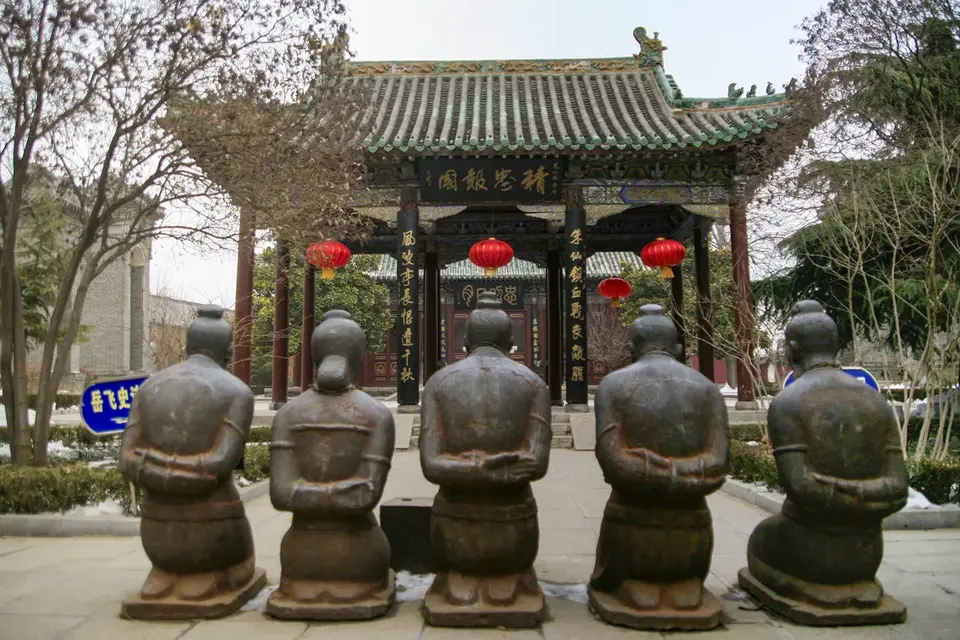
万俟卨
Moqi Xie (万俟卨, 1083–1157), styled Yuanzhong, was a native of Yangwu County, Kaifeng (modern Yuanyang County, Henan Province), tracing ancestral lineage to the Xianbei Moqi clan. He was a Grand Councilor of the Southern Song Dynasty and an infamous collaborator in the faction of Qin Hui. Passing the imperial civil examinations in 1112, he served as Compiler in the Bureau of Military Affairs. During the early Shaoxing era,…
Moqi Xie (万俟卨, 1083–1157), styled Yuanzhong, was a native of Yangwu County, Kaifeng (modern Yuanyang County, Henan Province), tracing ancestral lineage to the Xianbei Moqi clan. He was a Grand Councilor of the Southern Song Dynasty and an infamous collaborator in the faction of Qin Hui. Passing the imperial civil examinations in 1112, he served as Compiler in the Bureau of Military Affairs. During the early Shaoxing era, while serving as Transport Vice-Commissioner in Hubei, he clashed with General Yue Fei over military logistical supplies, harboring enduring personal malice. In 1141, seeking to conclude a humiliating peace treaty with the Jurchen Jin dynasty by liquidating the uncompromising anti-Jin commander Yue Fei, Grand Councilor Qin Hui elevated Moqi Xie to Censor-in-Chief. Functioning as Qin's chief legal inquisitor, Moqi manufactured fabricated charges against Yue Fei and personally supervised the judicial torture of the general in the Court of Judicial Review. Coining the infamous "perhaps there is" justification, he orchestrated the execution of national hero Yue Fei, his son Yue Yun, and commander Zhang Xian. Promoted to Assistant Grand Councilor, he clashed with Qin Hui over political patronage, resulting in his twelve-year exile to remote Gui Prefecture and Yuan Prefecture. Following Qin Hui's death in 1155, Emperor Gaozong recalled Moqi to court, appointing him Right Grand Councilor. Preserving the policy of diplomatic subservience to Jin, he died in office in 1157 at the age of seventy-five, universally condemned by official dynastic chronicles within the History of Song under the "Biographies of Treasonous Ministers."
Born into a sinicized Xianbei lineage in Yangwu, mastering legal codes and administrative administration.
Passed the imperial metropolitan examinations under Emperor Huizong, commencing his bureaucratic career.
Fled south following the Jingkang Incident; served as Transport Vice-Commissioner, clashing with Yue Fei.
Appointed Censor-in-Chief by Qin Hui; directed the kangaroo trial and judicial execution of Yue Fei and his son.
Promoted to Assistant Grand Councilor; purged by Qin Hui after seeking factional autonomy, exiled for twelve years.
Recalled to court following Qin Hui's death, elevated to Right Grand Councilor by Emperor Gaozong.
Passed away in Lin'an at age seventy-five; posthumously titled Zhongjing, later classified as a villainous minister.
Moqi Xie was born in the sixth year of the Yuanfeng reign (1083) in Yangwu County, Kaifeng. He belonged to the distinguished compound-surname Moqi clan of Xianbei origin that had integrated into Han Chinese society for generations. Ambitious and legally astute, Moqi excelled in bureaucratic composition and judicial precedent. In 1112, he passed the highest imperial civil service examination (jinshi) under Emperor Huizong, embarking on an official career as a local magistrate and Compiler in the Bureau of Military Affairs.
Following the fall of Northern Song in the Jingkang Incident of 1127, Moqi fled south to join Emperor Gaozong's fledgling administration. Around 1130, he was commissioned as Transport Vice-Commissioner of Hubei, tasked with provisioning regional defense armies stationed along the middle reaches of the Yangtze River.
Stationed at Ezhou, General Yue Fei commanded the elite "Yue Family Army," which spearheaded the counter-offensives against the Jurchen invaders. During his tenure, Moqi repeatedly delayed grain transports, short-changed rations, and adopted an insolent posture toward frontline soldiers. The disciplined and forthright Yue Fei severely reprimanded Moqi on several occasions for endangering military operations. Highly sensitive to administrative pride, Moqi viewed these public rebukes as unbearable humiliations, nursing deep personal vengeance against the general.
In the spring of 1141, the Southern Song strategic situation altered drastically. Desperate to consolidate his autocratic rule over southern China and fearful that recovering the northern capitals might lead to the return of captured former emperors, Emperor Gaozong partnered with Grand Councilor Qin Hui to negotiate a peace agreement with the Jin dynasty. Jurchen commander Wuzhu delivered a secret ultimatum to Qin Hui: "Yue Fei must be slain before peace can be finalized!"
To eliminate Yue Fei, Qin Hui required an unscrupulous prosecutor within the Censorate who harbored personal grievances against the commander. Learning of Moqi's longstanding feud with Yue Fei, Qin secured Moqi's appointment as Censor-in-Chief, placing imperial surveillance apparatus in his hands.
Moqi eagerly placed himself at Qin Hui's disposal. In August 1141, Moqi initiated a barrage of impeachment memorials, falsely accusing Yue Fei of dereliction of duty, fabricating military intelligence during the Huaxi campaign, and showing disrespect to the imperial throne. The slander compelled Gaozong to strip Yue Fei of his post as Vice Commissioner of Military Affairs.
In October 1141, Qin Hui and Moqi escalated the plot by bribing subordinate officers Wang Gui and Wang Jun to accuse General Zhang Xian of plotting mutiny. Gaozong and Qin Hui ordered the arrest of Yue Fei, his son Yue Yun, and Zhang Xian, consigning them to the Court of Judicial Review. When earlier judicial investigators, such as He Zhu and Zhou Sanwei, refused to convict Yue Fei due to complete absence of evidence, Qin Hui dismissed them, assigning Moqi Xie to direct the joint tribunals.
Assuming command of the prison, Moqi subjected Yue Fei to brutal corporal torture, including flogging and burning irons. Though battered and bleeding, Yue Fei refused to sign fabricated confessions, inscribing only eight characters on the transcript: "The heavenly sun shines bright! The heavenly sun shines bright!" Faced with the total lack of treasonous documentation, Moqi shamelessly informed Qin Hui: "Though letters inciting rebellion were burned, Yue Fei's treasonous intent is perhaps there!"
On January 27, 1142 (the twenty-ninth day of the twelfth month of the eleventh year of Shaoxing), under secret imperial execution rescripts, thirty-nine-year-old Yue Fei was put to death at the Fengbo Pavilion in the Court of Judicial Review. Yue Yun and Zhang Xian were publicly beheaded in Lin'an. This judicial murder stood as the darkest miscarriage of justice in Song history, securing Moqi Xie's eternal infamy.
Following the execution of Yue Fei and the signing of the Shaoxing Treaty, Moqi Xie was rewarded with the high office of Assistant Grand Councilor in early 1142.
However, Moqi grew arrogant and unwilling to remain a subservient tool under Qin Hui's absolute monopoly of power. He attempted to build an independent political faction and challenged Qin's personnel appointments. Tolerating no rival within the cabinet, Qin directed his censorial allies to impeach Moqi in late 1142, accusing him of factionalism and corruption. Emperor Gaozong backed Qin, banishing Moqi to remote Gui Prefecture and Yuan Prefecture, where he remained under surveillance for twelve years.
In October 1155, Qin Hui passed away. Seeking to neutralize the Qin family's monopoly, Emperor Gaozong recalled ministers who had been sidelined by the late dictator. Remembering Moqi's ruthless execution of his secret orders against Yue Fei, Gaozong reappointed him Assistant Grand Councilor.
In March 1156, Gaozong elevated Moqi Xie to Right Grand Councilor and Director of National History, making him supreme minister of the Southern Song realm. During his tenure, Moqi exhibited no statesmanship, continuing the subservient appeasement policy toward the Jin dynasty while purging upright literati.
In May 1157, Moqi died in office at the age of seventy-five. Emperor Gaozong conferred upon him the posthumous title Zhongjing (Loyal and Serene). However, during the Yuan dynasty compilation of the official History of Song, historians stripped him of imperial praise, classifying him irrevocably under the "Biographies of Treasonous Ministers."
Moqi Xie's defining historical legacy was his role as the legal executioner who destroyed General Yue Fei. When conscientious magistrates refused to compromise their integrity, Moqi weaponized legal torture to fabricate the "perhaps there is" justification, fulfilling the geopolitical requirements of the Shaoxing appeasement treaty. His conduct dismantled the moral and military capacity of the Southern Song to reclaim northern China, cementing his historical infamy alongside Qin Hui.
FIGURES ASSOCIATED WITH THIS DYNASTY