Birth in Liaodong
Shang Zhixin is born in Haizhou as the eldest son of Prince Shang Kexi, mastering horsemanship.
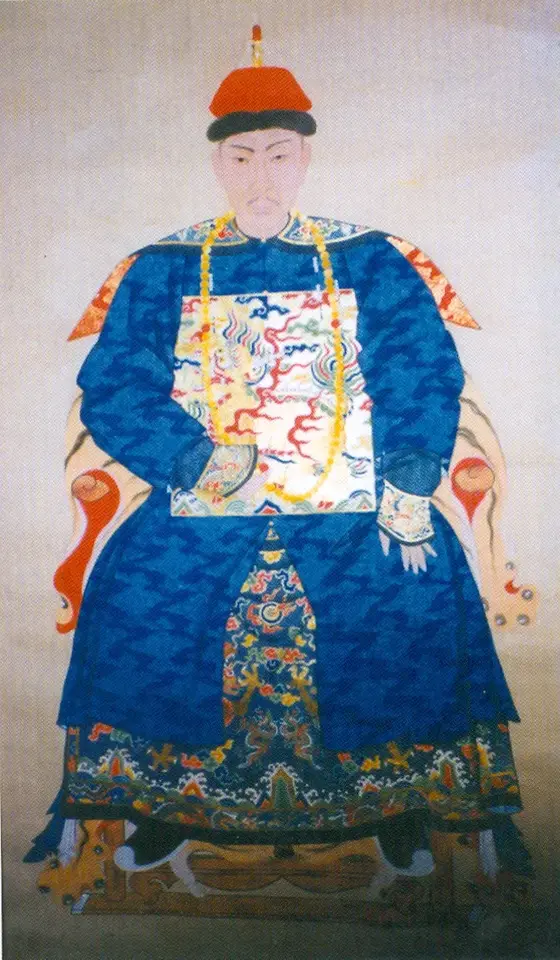
尚之信
Shang Zhixin (尚之信, 1636–1680), courtesy name Defu and art name Baiyan, was a native of Haizhou in Liaodong (modern Haicheng, Liaoning Province) belonging to the Bordered Blue Banner of the Chinese Martial (Hanjun). He was the eldest son of Shang Kexi, the founding Prince Pingnan of the Qing dynasty, and served as one of the pivotal feudatory chieftains during the Revolt of the Three Feudatories. Known in his youth for…
Shang Zhixin (尚之信, 1636–1680), courtesy name Defu and art name Baiyan, was a native of Haizhou in Liaodong (modern Haicheng, Liaoning Province) belonging to the Bordered Blue Banner of the Chinese Martial (Hanjun). He was the eldest son of Shang Kexi, the founding Prince Pingnan of the Qing dynasty, and served as one of the pivotal feudatory chieftains during the Revolt of the Three Feudatories. Known in his youth for physical bravery and martial prowess, Shang Zhixin was sent to Beijing in 1650 as a princely hostage and court attendant. He won the personal favor of the Shunzhi Emperor, who appointed him an imperial guard and elevated him to Junior Guardian and Grand Guardian of the Heir Apparent. In 1671, Shang Zhixin returned to Guangzhou to assist his aging father in administering the provincial military affairs of Guangdong. Known for his volatile temperament and tyrannical governance, Shang Zhixin clashed bitterly with Shang Kexi, who remained uncompromisingly loyal to the Qing throne. In 1673, Shang Kexi's petition to retire to Liaodong prompted the Kangxi Emperor's order to abolish the southern feudatories, which in turn provoked Wu Sangui's open rebellion in Yunnan. In spring 1676, faced with rebellious pressures from Chaozhou and approaching enemy forces, Shang Zhixin launched a palace mutiny, placed his bedridden father under strict house arrest, seized supreme military command over Guangdong, and defected to Wu Sangui, who granted him the title Prince of Fude. As Qing armies launched an overwhelming counteroffensive across central and southern China, Shang Zhixin recognized the collapsing fortunes of the rebel coalition. In 1677, he switched allegiances once more and surrendered to the Qing dynasty. The Kangxi Emperor temporarily pardoned his treason, confirmed his succession as Prince Pingnan, and appointed him General of Inspiring Might to lead troops into Guangxi. However, Shang Zhixin remained insubordinate and treacherous, deliberately delaying military marches, withholding grain from imperial divisions, and plotting a second rebellion in Guilin. In 1680, his treasonous correspondence was exposed by Governor-General Jin Guangzu. The Kangxi Emperor ordered his arrest on the frontline and dispatched an imperial decree commanding him to commit suicide in Guangzhou at the age of forty-five.
Shang Zhixin is born in Haizhou as the eldest son of Prince Shang Kexi, mastering horsemanship.
Sent to Beijing as an imperial attendant, securing rapid favor under the Shunzhi Emperor.
Elevated to Duke of the First Class and granted the titles of Junior Guardian and Grand Guardian.
Returns to Guangdong to assist in military affairs, establishing a notoriously oppressive rule.
Shang Kexi requests retirement; Kangxi orders feudatory abolition; Wu Sangui rebels in Yunnan.
Stripped of his military authority by Shang Kexi, who remains uncompromisingly loyal to Beijing.
Stages a military mutiny, imprisons his father, seizes Guangdong, and defects to Wu Sangui.
Defects back to the Qing throne, receiving confirmation as Prince Pingnan from Emperor Kangxi.
Dispatched to command forces against rebel remnants in Guangxi, intentionally stalling his march.
Secretly withholds supplies and negotiates with rebel commanders to plot an independent uprising.
Arrested on the frontline after his conspiracy is uncovered and commanded to commit suicide.
Shang Zhixin was born on August 2, 1636, in Haizhou of Liaodong as the eldest son of Prince Shang Kexi and Lady Shu. Raised amidst the chaotic military conflicts of the Ming-Qing transition, Shang Zhixin possessed an aggressive temperament, immense physical strength, and exceptional archery and riding abilities.
In 1649, Shang Kexi was commissioned to pacify southern China, conquering Guangzhou in the winter of 1650. In accordance with imperial regulations governing regional feudatory marshals, Shang Kexi dispatched his fourteen-year-old eldest son to Beijing to serve as a court attendant and hostage. The Shunzhi Emperor, mindful of Shang Kexi's monumental military achievements in conquering Lingnan, treated the young scion with exceptional distinction, appointing him an imperial guard of the inner court.
In 1656, the Shunzhi Emperor conferred upon Shang Zhixin the title of first-class Jingkinihafan (first-class Viscount), promptly elevating him to Duke of the First Class with the honorary titles of Junior Guardian and Grand Guardian of the Heir Apparent. Moving among the highest circles of Manchu nobility in the capital, Shang Zhixin adopted Manchu customs and was colloquially referred to by his contemporaries as "Anda Gong" (noble sworn brother in Manchu).
During the minority of the Kangxi Emperor, internal court factionalism intensified under the regent Oboi. Shang Zhixin maintained close contact with southern news, regularly writing to his father regarding shifting political winds in Beijing. In 1671, the aging and ailing Shang Kexi petitioned the throne to allow his eldest son to return to Guangzhou to assist in provincial defense. Emperor Kangxi granted the request, bestowing lavish traveling stipends and fine steeds, whereupon Shang Zhixin returned to the south.
Upon returning to Guangzhou, Shang Zhixin took advantage of the immense commercial wealth and autonomy of the southern feudatory domain. He aggressively recruited personal retinues of mercenary swordsmen, surrounding himself with lawless retainers and intimidating provincial civil authorities. Shang Zhixin was naturally violent and cruel, frequently subjecting subordinates and commoners to horrific corporal punishment and summary executions.
He established private tribunals in Guangzhou, unlawfully extorted maritime customs duties and salt revenues, and diverted immense fortunes into his private vaults. Shang Kexi, who governed his domain with traditional military discipline and meticulous obedience to imperial law, was profoundly distressed by his eldest son's lawlessness. Serious estrangement developed between father and son.
Observing that his second son Shang Zhixiao was prudent, dutiful, and respectful, Shang Kexi began relying heavily on Zhixiao while systematically sidelining Zhixin. Shang Kexi actively prevented Shang Zhixin from obtaining direct control over the feudatory banners, which festered deep resentment and venomous jealousy in Shang Zhixin's heart.
In the spring of 1673, the seventy-year-old Shang Kexi, weary of his eldest son's reckless behavior, petitioned Emperor Kangxi to surrender his feudatory seal and allow him to relocate his family back to Liaodong. The young Kangxi Emperor seized this opportunity to order the complete abolition of the feudatory system. Panicked by the impending loss of their hereditary domains, Wu Sangui in Yunnan and Geng Jingzhong in Fujian took up arms in open rebellion, plunging the empire into the Revolt of the Three Feudatories.
As civil war erupted, Emperor Kangxi ordered Shang Kexi to remain in Guangzhou to defend the southern perimeter. Shang Kexi swore unwavering allegiance to the Qing throne, executing Wu Sangui's emissaries and deploying garrisons along the strategic passes of Meiling and Shaozhou. Fully aware that Shang Zhixin harbored treasonous sympathies, Shang Kexi confiscated his command tallies and entrusted the forward armies to Shang Zhixiao.
In 1674, Geng Jingzhong revolted in Fujian, while Liu Jinzhong, commander of the Chaozhou garrison, also renounced Qing authority. By early 1676, Wu Sangui's general Ma Xiong had seized Guilin and Liuzhou in neighboring Guangxi, pressing toward Zhaoqing and placing Guangdong in acute military jeopardy. At this critical juncture, Shang Kexi fell gravely ill, leaving provincial defenses disorganized.
Shang Zhixin secretly conspired with Guangzhou city garrison commanders, distributing bribes among mercenary captains. On the night of March 26, 1676, Shang Zhixin staged a sudden military coup, deploying hundreds of armed guards to encircle the princely residence. He placed the bedridden Shang Kexi under strict isolation, barred all visitors, and disarmed Shang Zhixiao, seizing the official feudatory seals and assuming absolute dictatorial power over Guangdong.
Immediately following his takeover, Shang Zhixin sent couriers to Wu Sangui in Hunan, declaring his complete submission. Wu Sangui was overjoyed, issuing decrees confirming Shang Zhixin as Prince of Fude and Grand General of the Righteous Expedition. Wu also arranged a marriage alliance between his granddaughter and Shang Zhixin's nephew, commanding Shang Zhixin to march north into Jiangxi to support the main insurgent offensive.
Witnessing his eldest son's mutiny, betrayal, and alliance with the rebels, Shang Kexi was consumed with sorrow and despair. On December 4, 1676, Shang Kexi died in Guangzhou at the age of seventy-three, leaving a deathbed testament reiterating his eternal loyalty to the Qing dynasty and requesting that his remains be transported back to Liaodong. Shang Zhixin's betrayal of his own father cemented his infamous reputation throughout the realm.
Despite receiving Wu Sangui's aristocratic honors, Shang Zhixin was an opportunistic warlord interested purely in personal survival and wealth. He recognized that while the Qing court had suffered initial setbacks in Hunan, its imperial armies remained formidable across northern and central China. Unwilling to risk his forces in costly battles, Shang Zhixin remained stationary in Guangzhou, repeatedly ignoring Wu Sangui's frantic demands to march his divisions into Jiangxi.
In autumn 1676, Emperor Kangxi directed Prince Yolo and Prince Giyesu to spearhead massive counteroffensives, liberating Jiangxi and forcing Geng Jingzhong to surrender in Fujian. As Wu Sangui's forces began to disintegrate and the rebel alliance unraveled, Shang Zhixin realized that continued rebellion would bring utter ruin.
In May 1677, Shang Zhixin executed Wu Sangui's overseers in Guangzhou and secretly dispatched maritime messengers carrying his formal surrender to Beijing. In his memorial, he claimed that his earlier mutiny had been forced upon him by insubordinate officers, begging for imperial forgiveness and pledging his full army to the Qing cause.
Preoccupied with the decisive campaigns in Hunan, Emperor Kangxi chose to adopt an accommodating policy toward Guangdong to avoid fighting on multiple fronts. The emperor issued a decree pardoning Shang Zhixin's treason, confirmed his succession as Prince Pingnan, and conferred upon him the title General of Inspiring Might, commanding him to lead Guangdong forces into Guangxi to hunt down rebel remnants.
Although appointed imperial General of Inspiring Might, Shang Zhixin showed zero genuine loyalty. In late 1678, when imperial orders arrived directing him to advance swiftly toward Hengzhou and Nanning to coordinate with Prince Yolo, Shang Zhixin stalled for months, demanding enormous cash subsidies for every mile marched.
During the military advance across Guangxi, Shang Zhixin permitted his troops to loot local communities, extorting grain and gold from impoverished towns while refusing to engage rebel divisions. Furthermore, he systematically sabotaged the imperial campaign by withholding grain shipments and munitions destined for Qing armies, hoping to exhaust the northern forces and preserve his personal hegemony over southern China.
In early 1680, with Wu Shifan encircled in Kunming and the Three Feudatories rebellion nearing total collapse, Governor-General Jin Guangzu and Governor Jin Jun intercepted secret communications revealing that Shang Zhixin was conspiring with defected rebel commanders to stage another general uprising in Guilin.
Outraged by this persistent treachery, Emperor Kangxi decided to crush the rebel prince without mercy. The emperor dispatched Inner Court Chamberlain Laigotu with imperial bodyguards to Guangxi, coordinating with Governor-General Jin Guangzu to spring a trap at the military encampment in Wuxuan. Shang Zhixin was seized without a fight, stripped of command, and transported under heavy guard to Guangzhou.
On October 9, 1680, Emperor Kangxi issued an imperial proclamation listing twenty-one treasonous crimes committed by Shang Zhixin, including defying his father, staging a mutiny, allying with Wu Sangui, oppressing civilians, and plotting a second rebellion. Shang Zhixin was stripped of all noble ranks and offices. Out of respect for Shang Kexi's founding loyalty, the emperor spared him from public dismemberment, ordering him to commit suicide by the sword in his Guangzhou residence at age forty-five. Following his death, Guangdong's feudatory garrison was permanently reorganized into standard provincial administrations.
In spring 1676, at the climax of the Three Feudatories uprising, Shang Zhixin exploited his father Shang Kexi's terminal illness to stage a sudden military mutiny in Guangzhou. He placed his father under house arrest, disarmed his brother Shang Zhixiao, and seized full military command of Guangdong.
Aligning with Wu Sangui, he received the title Prince of Fude and Grand General of the Righteous Expedition. This violent takeover severed Guangdong from Qing imperial control, profoundly altering the geopolitical balance of southern China during the conflict's most volatile stage.
Following his defection to Wu Sangui, Shang Zhixin adopted an opportunistic wait-and-see strategy, refusing to deploy his divisions into combat in Jiangxi. Recognizing that the Qing counteroffensives under Prince Yolo were systematically dismantling the rebel coalition, Shang Zhixin executed Wu Sangui's inspectors in Guangzhou in May 1677.
He sent maritime emissaries to Beijing to surrender his domain to the Qing court, earning confirmation as Prince Pingnan and appointment as General of Inspiring Might. His opportunistic survival strategy temporarily preserved his princely status amidst the general collapse of the rebel alliance.
During the Guangxi campaign between 1678 and 1680, Shang Zhixin engaged in persistent insubordination, stalling his march, extorting regional towns, and withholding vital logistics from imperial divisions while plotting a second insurrection in Guilin.
His treasonous conspiracy was discovered by Governor-General Jin Guangzu, leading to his swift arrest in Wuxuan and his execution by forced suicide in Guangzhou. Shang Zhixin's downfall removed the last autonomous military stronghold in Lingnan, allowing the Qing empire to definitively dismantle the feudatory system in Guangdong and reassert centralized imperial governance.
FIGURES ASSOCIATED WITH THIS DYNASTY