Birth in Changtai
Born into a farming family in Changtai, Fujian; known as a bold, chivalrous youth.
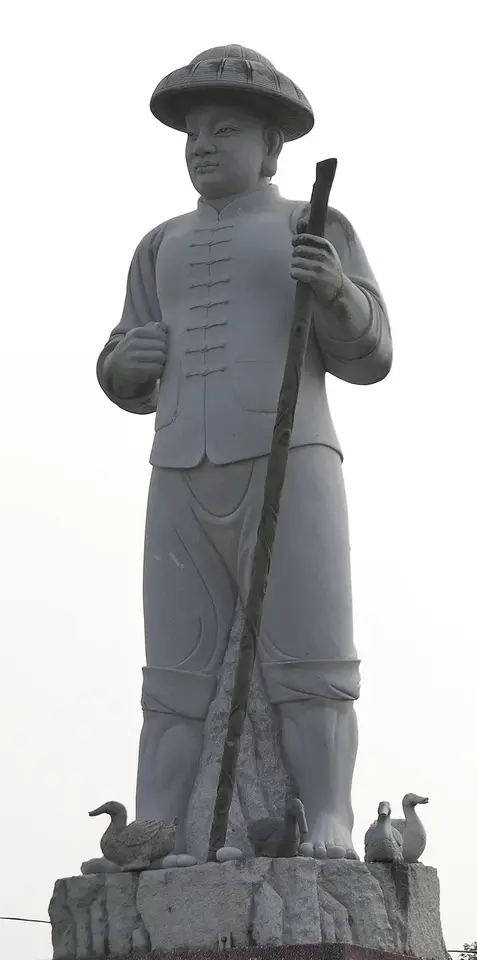
朱一贵
Zhu Yigui (朱一贵, 1690 – February 22, 1722), originally named Zhu Zu and colloquially known as the "Duck Mother King," was a native of Changtai County, Zhangzhou Prefecture, Fujian. He was an eminent leader of popular anti-Qing resistance in Taiwan during the Kangxi reign, founding an insurgent Ming restorationist regime where he reigned as the King of Resurgence under the reign title "Yonghe." In 1713, Zhu crossed the Taiwan…
Zhu Yigui (朱一贵, 1690 – February 22, 1722), originally named Zhu Zu and colloquially known as the "Duck Mother King," was a native of Changtai County, Zhangzhou Prefecture, Fujian. He was an eminent leader of popular anti-Qing resistance in Taiwan during the Kangxi reign, founding an insurgent Ming restorationist regime where he reigned as the King of Resurgence under the reign title "Yonghe." In 1713, Zhu crossed the Taiwan Strait as an immigrant laborer, initially serving briefly as a yamen runner before settling in the remote foothills of Luohan Neimen (modern Neimen District, Kaohsiung City) in Fengshan County, where he made a modest living herding ducks. Known for his generous, chivalrous demeanor, Zhu regularly slaughtered poultry and brewed liquor to entertain impoverished travelers, passionately lamenting the corrupt state of governance under the Qing dynasty. In 1721, amidst earthquake disasters and famine, Prefect Wang Zhen of Taiwan Prefecture, concurrently acting as magistrate of Fengshan, allowed his son to impose extortionate levies, arresting hundreds of locals who prayed at religious festivals or cut bamboo to extract exorbitant ransoms. Infuriated by this official tyranny, Zhu Yigui formed a blood pact with Huang Dian, Li Yong, and fourteen companions, declaring resistance under the banner of the Ming imperial dynasty. Claiming royal ancestry by virtue of his surname, Zhu was proclaimed Supreme Commander of Great Ming Resurgence, unleashing an island-wide rebellion. Joined by Hakka insurgent forces under Du Junying, Zhu's army achieved sweeping victories, annihilating the Qing garrison at Chunniupu and killing Brigadier General Ouyang Kai. In May 1721, the insurgents captured Taiwan Prefecture (modern Tainan), forcing imperial magistrates to flee to Penghu. Controlling virtually the entire island with an army numbering three hundred thousand, Zhu took the throne as the King of Resurgence, proclaimed the Yonghe era, abolished the Qing queue order, restored traditional Han clothing, held civil examinations, and performed solemn sacrifices to Heaven and Koxinga (Zheng Chenggong). However, factional disputes between Minnan and Hakka commanders fractured the rebel leadership, prompting Du Junying to depart. In June, the Qing court dispatched Admiral Shi Shipiao and Brigadier General Lan Tingzhen with an amphibious expedition of over ten thousand soldiers. Forcing a landing at Lu'ermen, the Qing armies recaptured the prefectural capital. Zhu waged a desperate fighting retreat to Gouweizhuang, where he was betrayed by local collaborators and captured. Transported in a cage to Beijing, Zhu was executed by lingchi (slow slicing) in early 1722 at the age of thirty-three. As the first island-wide rebellion in Taiwanese history, his uprising profoundly shook Qing rule and compelled imperial administrators to restructure colonial governance in Taiwan.
Born into a farming family in Changtai, Fujian; known as a bold, chivalrous youth.
Immigrated to Taiwan, residing in Luohan Neimen, Fengshan, where he bred ducks and was nicknamed Duck Mother King.
Prefect Wang Zhen and his son extorted the island through arbitrary arrests and crushing tax quotas following earthquakes.
Formed a blood oath with sixteen leaders; donned yellow robes on April 19 and stormed the Gangshan military outposts.
Defeated and killed General Ouyang Kai at Chunniupu; liberated Taiwan Prefecture, commanding three hundred thousand insurgents.
Crowned King of Resurgence and proclaimed the Yonghe era; abolished queue orders and restored Han dress; internal discord emerged.
Admiral Shi Shipiao and General Lan Tingzhen landed at Lu'ermen; retook the capital as Zhu withdrew into the interior.
Betrayed by local villagers under Yang Xu at Gouweizhuang in Chiayi; seized and delivered in chains to the Qing camp.
Interrogated in the capital; executed by slow slicing on February 22 at age thirty-three.
Zhu Yigui, originally named Zhu Zu, was born into an ordinary farming family in Changtai County, Zhangzhou Prefecture, Fujian. From an early age, he possessed a tall, imposing stature, physical courage, and a penchant for roaming freely among common folk. In 1713, amidst the wave of southern Fujianese immigration across the Taiwan Strait, Zhu ventured to Taiwan seeking livelihood. Upon arrival, he served briefly as an assistant courier in the Taiwan Circuit yamen, witnessing firsthand the rapacity, extortion, and harsh judicial abuses practiced by Qing colonial bureaucrats against the settler population, prompting him to resign.
Departing official circles, Zhu relocated to the secluded hill country of Luohan Neimen (modern Neimen District, Kaohsiung City) in Fengshan County, building a thatched cottage on the grassland of Muding to raise ducks. He demonstrated remarkable skill in duck herding; according to local folklore, a mere wave of his bamboo cane caused thousands of ducks to marshal into disciplined ranks, leading neighbors to bestow upon him the affectionate title "Duck Mother King." Generous and disdainful of wealth, Zhu championed the poor against local bullies. Whenever visitors or destitute vagrants arrived at his cottage, he slaughtered ducks, poured wine, and engaged in impassioned discussions concerning dynastic misrule. Lamenting the fallen Ming Dynasty with deep sorrow, he gradually commanded immense respect among local tenant farmers, laborers, and displaced wanderers across southern Taiwan.
Between late 1720 and early 1721, a succession of severe earthquakes rocked Taiwan, unleashing coastal tidal floods and plunging agricultural communities into starvation. At this critical juncture, the post of Fengshan magistrate fell vacant, and Prefect Wang Zhen of Taiwan Prefecture assumed concurrent jurisdiction. Renowned for greed, Wang delegated local governance entirely to his son, who imposed exorbitant illicit taxes upon the impoverished settlers. When villagers organized religious theater to thank local deities for surviving the seismic shocks, Wang arrested over forty people on concocted charges of illegal sworn brotherhood. Furthermore, when peasants gathered bamboo in the hills, Wang denounced them for violating boundary bans, imprisoning more than two hundred people and releasing only those who paid heavy ransoms, while flogging those without funds and banishing them across the sea. Working cattle and sugar mills were subjected to crushing exactions, pushing social tensions across the island to the boiling point.
Zhu recognized that the oppressed populace was prepared to risk death in open revolt. On April 11, 1721, Zhu convened sixteen close confederates—including Huang Dian, Li Yong, Wu Wai, and Yan Zijing—swearing a blood brotherhood in Neimen to overthrow the Qing. On April 19, Huang Dian and Li Yong led several hundred armed villagers to Zhu's home, draped a yellow imperial robe over his shoulders, and bowed before him, shouting imperial acclamations. The rebels stripped off Qing garments, donned traditional Han attire, and raised red war banners bearing the inscriptions "Supreme Commander Zhu," "Great Ming Resurgence," and "Recovering the Realm." The uprising ignited instant island-wide response. That very night, the insurgents overwhelmed the Qing outpost at Gangshan, capturing firearms, swords, and wicker shields, before sweeping through southern defense garrisons like Xinyuan, Beitou, and Xiadanshui. Within days, the rebel ranks swelled to over twenty thousand men.
Simultaneously, Hakka farming insurgents along the Xiadanshui River rose in revolt under Du Junying and his son Du Huisan, joining forces with Zhu Yigui's army in Fengshan. In late April, Qing Provincial Commander Ouyang Kai marched his elite forces south to confront the rebels at Chunniupu. Fighting with desperate fury, the insurgent soldiers routed the imperial ranks; a turncoat squad commander, Yang Tai, stabbed General Ouyang Kai in the back, throwing the Qing lines into panic. Numerous imperial officers, including Major Hu Zhongyi and Captain Jiang Zilong, fell in battle, and the survivors fled northward.
On May 26, 1721, Zhu Yigui's victorious army entered the capital of Taiwan Prefecture (modern Tainan). Taiwan Intendant Liang Wenxuan, Prefect Wang Zhen, and other civilian officials fled in terror across the sea to the Penghu Islands. Operating on multiple fronts, the rebels captured Fengshan and Zhuluo counties, leaving only the remote garrison at Danshui in northern Taiwan in imperial hands. The insurgent movement reached its zenith, commanding over three hundred thousand participants and prompting imperial dispatches to report that all of Taiwan had fallen.
On May 30, the rebel leadership crowned Zhu Yigui as King of Resurgence (also styled Righteous King) and proclaimed the dynastic title Great Ming and the reign title Yonghe. Zhu issued decrees abolishing the Qing queue order, cutting off queues, restoring traditional Han headwear and robes, opening classical examinations, and appointing forty senior civil and military officials. In a grand public ceremony, he offered solemn sacrifices to Heaven, the imperial ancestors, and Koxinga (Zheng Chenggong), opening granaries to distribute grain to the needy.
However, at the height of victory, deep ethnic and factional fractures crippled the insurgent camp. The rebel army was composed of southern Fujianese (Hoklo) immigrants and eastern Guangdong (Hakka) settlers, lacking unified political discipline and strategic cohesion.
During the allocation of titles, Hakka leader Du Junying, frustrated in his ambition to secure royal honors and resentful of Zhu's enforcement of military discipline against pillaging, turned against the leadership. Bloodshed erupted between Hoklo and Hakka factions in the capital, and Du led tens of thousands of his followers out of Tainan, encamping north at Mao'ergan. This fatal rupture severely undermined insurgent military capabilities, causing the rebels to lose the critical window to seize the Penghu Islands and cut off imperial maritime reinforcements.
Alarmed by the loss of Taiwan, the Kangxi Emperor ordered Viceroy Manbao of Min-Zhe to Xiamen to direct counterinsurgency operations, mobilizing an expeditionary force under Fujian Naval Commander Shi Shipiao and South Ao Brigade General Lan Tingzhen, comprising hundreds of war junks and over ten thousand veterans.
On July 10, 1721, Shi and Lan exploited seasonal monsoons to approach the Lu'ermen channel, bombarding coastal redoubts with heavy artillery. Overcoming rebel shore batteries, Qing troops secured a beachhead and advanced toward the capital. On July 15, imperial forces retook Tainan. Zhu Yigui led his remaining fighters north toward Zhuluo, repeatedly ambushed by Lan Tingzhen's flanking forces and suffering devastating losses.
Retreating through central Taiwan, Zhu established his final headquarters at Gouweizhuang (modern Taibao City, Chiayi County). By this time, allied rebel commanders had dispersed, and Hakka leader Du Junying had been captured and executed along the Huwei River after attempting to surrender.
The Qing command placed a massive bounty on Zhu's head, threatening to raze uncooperative villages. On August 27, 1721, treacherous local village headmen under Yang Xu and Chen Lie invited Zhu and his exhausted retainers to a banquet under the pretext of provisioning their retreat. Drugged and ambushed by hidden squads, Zhu fought fiercely but was overpowered and delivered in chains to Lan Tingzhen's camp.
Interrogated by Commander Shi Shipiao and General Lan Tingzhen, Zhu stood defiant, refusing to kneel. When Lan berated him as a traitorous bandit, Zhu retorted: "I sought to restore the Great Ming and rescue the people of Taiwan from rapacious officials; how can you call this treason! My cause has failed, and I seek only an honorable death!" Bound inside a wooden cage, Zhu was transported under heavy guard across the sea to Xiamen and forwarded overland to Beijing.
Throughout tortuous questioning by the Board of Punishments in the imperial capital, Zhu maintained unbroken defiance. On February 22, 1722, imperial decrees ordered that Zhu Yigui be subjected to execution by slow slicing (lingchi). Zhu met his death with serene courage at the age of thirty-three. Remaining insurgent bands continued guerrilla warfare in the southern mountains of Taiwan until order was restored in the early Yongzheng era.
In revolt against intolerable colonial extortion, Zhu Yigui raised the standard of Ming restoration in Luohan Neimen, uniting broad swathes of the Taiwanese frontier population. Following the capture of Tainan, he established the Yonghe regime, appointed civil ministers, restored Han dress and ceremonies, and held imperial examinations, creating the first independent popular administration established by Han Chinese settlers on the island of Taiwan.
Demonstrating notable tactical coordination, Zhu Yigui allied diverse regional resistance bands, ambushing and eliminating General Ouyang Kai's imperial army at Chunniupu. Within less than two weeks, his forces liberated Fengshan, Zhuluo, and Tainan, expelling the Qing civil administration to Penghu and commanding over three hundred thousand people in open resistance against dynastic rule.
Zhu Yigui's unyielding composure on the execution grounds in Beijing underscored his dedication to popular defense. His uprising dealt a seismic blow to Qing colonial policy in Taiwan, forcing the Kangxi and Yongzheng emperors to acknowledge the disastrous consequences of administrative venality. The revolt compelled the Qing court to overhaul surveillance circuits, adjust frontier troop rotations, and embrace comprehensive developmental proposals drafted by scholars like Lan Dingyuan, shaping eighteenth-century Taiwanese governance.
FIGURES ASSOCIATED WITH THIS DYNASTY