Military General
Served as a military general in Qin, incurring imperial disfavor over policy disputes.
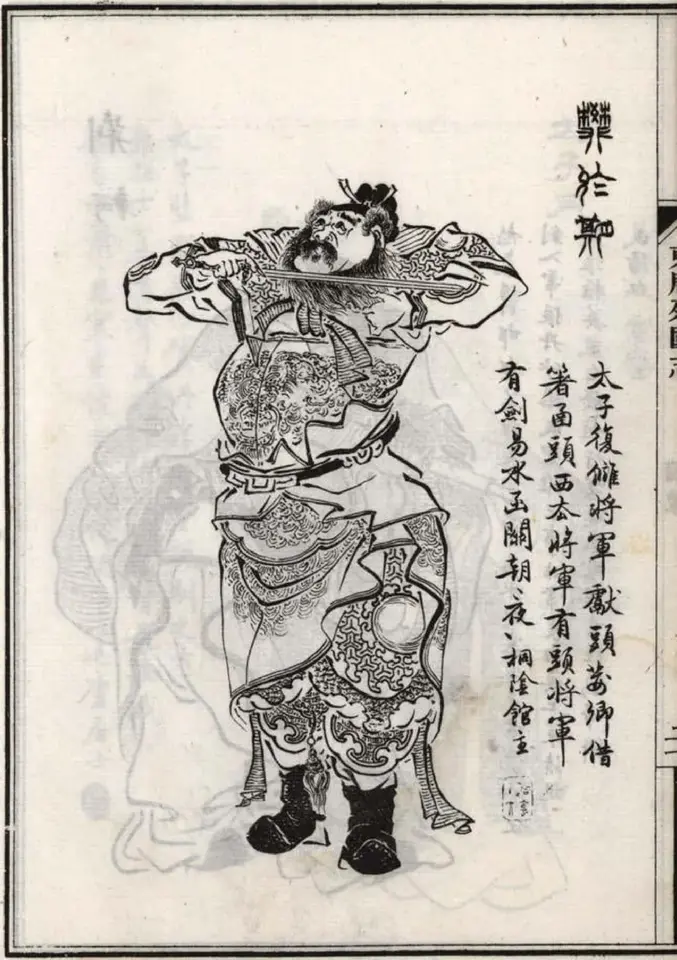
樊於期
Fan Yuqi (樊於期, died 227 BCE), also rendered Fan Yuqi (樊于期), was a prominent military general of the State of Qin during the late Warring States period. Serving as a field commander during Qin's wars of expansion, he incurred the wrath of King Zheng of Qin (later Qin Shi Huang) and was forced to flee the kingdom. Wandering through multiple eastern states where terrified rulers refused him sanctuary, he eventually found refuge…
Fan Yuqi (樊於期, died 227 BCE), also rendered Fan Yuqi (樊于期), was a prominent military general of the State of Qin during the late Warring States period. Serving as a field commander during Qin's wars of expansion, he incurred the wrath of King Zheng of Qin (later Qin Shi Huang) and was forced to flee the kingdom. Wandering through multiple eastern states where terrified rulers refused him sanctuary, he eventually found refuge in the northern State of Yan, where Crown Prince Dan welcomed and protected him with profound honor. In retaliatory fury, King Zheng executed Fan Yuqi's entire family and clan in Qin and placed a bounty of one thousand catties of gold and a fief of ten thousand households on his severed head. In 228 BCE, the Qin army commanded by Wang Jian overran Handan, the capital of Zhao, capturing King Qian and driving northward directly to the southern bank of the Yishui River, placing the survival of Yan in mortal peril. In desperation, Crown Prince Dan engaged the heroic assassin Jing Ke to assassinate the King of Qin. Jing Ke observed that approaching the vigilant monarch required tokens of absolute credibility, specifically the detailed map of the fertile Dukang region and the severed head of Fan Yuqi. When Crown Prince Dan refused to harm his guest, Jing Ke visited Fan Yuqi in private to disclose the scheme. Burning with the desire to avenge his slaughtered clan and preserve Yan, Fan Yuqi drew his sword and slit his own throat without hesitation. His noble sacrifice became an enduring symbol of the heroic and tragic spirit of the Yan-Zhao region, celebrated across centuries of Chinese literature and historical commentary.
Served as a military general in Qin, incurring imperial disfavor over policy disputes.
Fled Qin and wandered through eastern kingdoms before seeking refuge under Crown Prince Dan of Yan.
King Zheng ordered the extermination of Fan Yuqi's parents and clan, offering a massive bounty for his head.
Wang Jian captured Zhao's capital and pushed Qin legions to the Yan border; Crown Prince Dan plotted the assassination.
Informed of Jing Ke's plan, Fan Yuqi slit his throat to yield his head as the vital credential for the assassination attempt.
The early origins and family background of Fan Yuqi are recorded sparsely in surviving pre-Qin chronicles. It is established that he rose through military merit within the Qin armed forces, attaining the status of general during the aggressive expansionist campaigns orchestrated by King Zheng and Chancellor Lu Buwei. As Qin intensified its territorial conquests across eastern China, internal rivalries and strict penal statutes created severe perils for commanders. Due to an operational failure or political discord, Fan Yuqi deeply offended King Zheng. Aware of the lethal severity of Qin legal codes, where military failure or royal displeasure routinely brought execution, Fan Yuqi fled the kingdom.
Becoming a wanted fugitive, Fan Yuqi traveled through the central states of Wei, Qi, and Chu. However, terrified of provoking the predatory Qin army into punitive invasions, the rulers of the eastern kingdoms shut their gates against him. Wandering in isolation and exhaustion, Fan Yuqi made his way northeast to the State of Yan. There he sought the protection of Crown Prince Dan, who had previously lived as an aggrieved political hostage in Xianyang and harbored deep personal enmity toward King Zheng. Crown Prince Dan admired martial chivalry and was deeply moved by Fan Yuqi's plight, receiving the displaced general with elevated hospitality.
The news of Fan Yuqi's presence in Yan alarmed the court. Grand Tutor Ju Wu, the mentor of Crown Prince Dan, hastened to the palace to remonstrate urgently against harboring the fugitive. Ju Wu warned that King Zheng was ruthless and determined to swallow the feudal states, noting that Qin's military prestige already terrified the realm. Should Qin discover that its escaped general was living openly in Yan, it would seize the pretext to launch an overwhelming northern offensive. Ju Wu compared the act to "placing fresh meat in the path of a starving tiger," predicting uncontrollable catastrophe.
Ju Wu advised that Fan Yuqi should be escorted beyond the northern frontier to seek refuge among the Xiongnu nomads, thereby depriving Qin of a justification for invasion. Following this step, Yan should form a defensive alliance with Han, Zhao, and Wei, coordinate with Qi and Chu to the south, and secure a peace pact with the Xiongnu Chanyu to withstand Qin collectively. Crown Prince Dan rejected this pragmatic counsel. He maintained that Fan Yuqi had sought refuge in complete despair, and that abandoning or expelling an elder who had trusted him would be dishonorable. Determined to shield Fan Yuqi, Crown Prince Dan subsequently enlisted the hermit Tian Guang, who introduced him to the renowned swordsman Jing Ke.
In Xianyang, King Zheng was incensed upon learning that Crown Prince Dan had welcomed Fan Yuqi. To punish treason and intimidate the realm, King Zheng enacted collective punishment against Fan Yuqi's household remaining in Qin. His aged parents, wife, children, and broader clan relatives were arrested and systematically executed, while their ancestral properties and estates were confiscated by the crown.
Furthermore, King Zheng promulgated an extraordinary imperial bounty across the empire, offering one thousand catties of gold and a hereditary fief of ten thousand households to anyone who presented Fan Yuqi's severed head. The exorbitant price placed on his head underscored King Zheng's visceral hatred for the rebellious general. When the news reached Yan, Fan Yuqi was devastated by grief and fury over the slaughter of his entire bloodline. He spent his days in Yan looking westward toward Qin in agonizing despair, weeping bitterly over his inability to strike back at the tyrant who had destroyed his family.
In 228 BCE, the strategic landscape collapsed as Qin general Wang Jian led an overwhelming force to seize Handan, the capital of Zhao. King Qian was captured, and the territory of Zhao was annexed into the Qin administrative system. Wang Jian's veteran legions swept through northern Zhao borderlands, stationing armored vanguard cavalry directly along the southern banks of the Yishui River, facing Yan across the border.
With the Qin invasion imminent, Crown Prince Dan panicked and pressed Jing Ke to initiate the assassination mission immediately. Jing Ke analyzed the tactical situation, explaining that attempting to approach King Zheng without compelling credentials would fail, as Qin palace security was impregnable. Jing Ke noted that King Zheng had placed a colossal bounty on Fan Yuqi's head and long coveted the rich agricultural lands of Dukang in southern Yan. If they presented both Fan Yuqi's severed head and the detailed administrative map of Dukang, King Zheng would eagerly grant an intimate audience, allowing the assassin to close within striking distance. When Crown Prince Dan heard this demand, he wept and refused, declaring that he could not bear to take the life of an honorable guest who had placed his trust in him.
Recognizing that the Crown Prince's compassion would cost Yan its survival, Jing Ke resolved to bypass the court and approach Fan Yuqi privately. Meeting him in seclusion, Jing Ke spoke candidly of the tragedy, recounting how King Zheng had slaughtered his parents and clan and offered ten thousand households for his head. Fan Yuqi looked to the heavens and wept, confessing that the grief burned in his bones day and night, yet he lacked any means to obtain vengeance.
Seizing the moment, Jing Ke revealed his enterprise: "I possess a plan that can simultaneously avenge your slaughtered clan and rescue Yan from destruction. If I may have your severed head to present to the King of Qin, he will receive me in personal audience with absolute joy. Once before his throne, I shall seize his sleeve with my left hand and plunge a poisoned dagger into his chest with my right. Your family will be avenged, and Yan will be saved from humiliation. Would you consent to this?"
Upon hearing Jing Ke's plan, Fan Yuqi's suppressed fury and longing for vengeance surged forth. Baring his right arm, he stepped forward, clenching his fist, and declared: "This is what I have ground my teeth and broken my heart over day and night, and only now do I receive your instruction!" Without a moment's hesitation, Fan Yuqi drew his sword, severed his own throat, and collapsed in a pool of blood. Crown Prince Dan rushed to the scene upon hearing the report, weeping inconsolably over the fallen general's corpse. With no other alternative, the Crown Prince placed Fan Yuqi's head in a lacquered wooden casket. In 227 BCE, Jing Ke carried the head of Fan Yuqi and the map of Dukang to Xianyang, where he enacted the historic assassination attempt in the imperial palace.
Fan Yuqi's historical legacy is centered upon his extraordinary self-sacrifice to advance Jing Ke's assassination mission against Qin Shi Huang. By willingly surrendering his own life to provide the essential credential that unlocked access to the inner court of Xianyang, Fan Yuqi exemplified the highest ideals of Warring States chivalry and unyielding defiance against tyranny. His selfless martyrdom became a core cultural motif in traditional Chinese literature, embodying the enduring ethos of tragic heroism celebrated in the ballads and poetry of northern China.
In the field of Warring States historiography, scholars have long debated whether Fan Yuqi and the contemporary Qin general Huan Yi were the same individual. The prominent historian Yang Kuan proposed in his History of the Warring States that Fan Yuqi was Huan Yi. Yang argued that Huan Yi won successive campaigns against Zhao between 237 and 234 BCE, but was severely routed by the Zhao commander Li Mu at the Battle of Fei in 233 BCE. Facing capital punishment under strict Qin laws for the disaster, Huan Yi fled to Yan and changed his name to Fan Yuqi, prompting King Zheng's furious extermination of his family and the unprecedented bounty. Phonetically, "Huan" and "Fan" were phonetically adjacent in Old Chinese, as were "Yi" and "Qi."
However, numerous historians dispute this hypothesis based on the Stratagems of the Warring States, which explicitly records that Li Mu defeated the Qin army and slew General Huan Yi in battle. Furthermore, no excavated epigraphic source confirms the name change. Consequently, modern mainstream scholarship regards the "Huan-Fan identity" as an intriguing hypothesis, while continuing to evaluate Fan Yuqi as an independent military commander and tragic martyr of the late Warring States era.
FIGURES ASSOCIATED WITH THIS DYNASTY