Birth in Jianzhou
Born as the second son of Nurhaci to primary consort Lady Tunggiya.
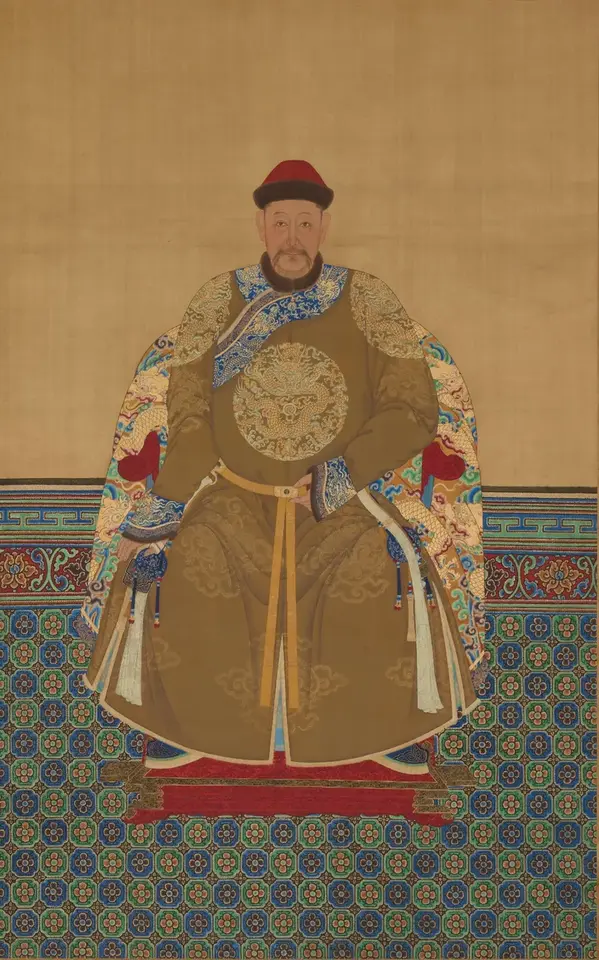
爱新觉罗·代善
Aisin Gioro Daishan (爱新觉罗·代善, August 19, 1583 – November 25, 1648), also transcribed as Daišan, belonging to the Manchu Plain Red Banner, was the second son of Nurhaci, founding leader of the Later Jin dynasty, born to his primary consort Lady Tunggiya. He was an outstanding military commander, statesman, the foremost of the "Four Senior Beiles" (Da Beile) of the Later Jin, the inaugural Prince Li of the First Rank, and one…
Aisin Gioro Daishan (爱新觉罗·代善, August 19, 1583 – November 25, 1648), also transcribed as Daišan, belonging to the Manchu Plain Red Banner, was the second son of Nurhaci, founding leader of the Later Jin dynasty, born to his primary consort Lady Tunggiya. He was an outstanding military commander, statesman, the foremost of the "Four Senior Beiles" (Da Beile) of the Later Jin, the inaugural Prince Li of the First Rank, and one of the foundational "Iron-Cap Princes" of the Qing dynasty. Accompanying his father on campaigns to unify the Jurchen tribes from his youth, Daishan gained renown for his steadfast valor. In 1607, during the Battle of Wujieyan, he charged through heavy snowdrifts to slay the Ula general Bokdo, for which Nurhaci granted him the honorary title "Guying Baturu" (meaning Iron Hero). In 1616, upon the founding of the Later Jin dynasty, he was created a Senior Beile, commanding the Plain Red and Bordered Red Banners. During the decisive Battle of Sarhu in 1619, Daishan served as commander of the right-wing army, ambushing and killing Ming commander Du Song at Jilin Cliff, routing Ma Lin at Shangjian Cliff, and annihilating Liu Ting's forces, cementing the survival and ascendance of the Later Jin state. Daishan demonstrated exceptional statesmanship at crucial dynastic junctures. Following Nurhaci's death in 1626, Daishan waived his own seniority to endorse his eighth brother Hong Taiji (Emperor Taizong) as Khan. In 1631, after the Battle of Dalinghe, he led the prince-commanders in abolishing the collegial power-sharing system, formalizing the emperor's sole supreme authority. Following Hong Taiji's sudden death in 1643, Daishan presided over the imperial princes' council at Chongzheng Hall, defusing civil war by engineering the enthronement of the six-year-old ninth prince, Fulin (Emperor Shunzhi). Passing away in Beijing in 1648 at the age of sixty-six, he received the posthumous title Lie. In 1778, Emperor Qianlong declared the Prince Li peerage hereditary in perpetuity, placing it at the head of the eight founding Iron-Cap Princely houses.
Born as the second son of Nurhaci to primary consort Lady Tunggiya.
Participated in the conquest of the Hada tribe, demonstrating tactical skill and valor.
Slew Ula commander Bokdo at the Battle of Wujieyan; awarded the title "Guying Baturu."
Later Jin was established; appointed head of the Four Senior Beiles, controlling the Plain Red and Bordered Red Banners.
Commanded the right-wing army, decisively crushing Ming generals Du Song, Ma Lin, and Liu Ting.
Deposed from crown heir status by Nurhaci following domestic disputes and mistreatment of elder sons.
Following Nurhaci's death, united the princes to enthrone Hong Taiji as supreme Khan.
Led the beiles in kneeling before Hong Taiji, dismantling collegial joint-rule in favor of imperial autocracy.
Elevated to Prince Li of the First Rank upon the declaration of the Qing dynasty.
Participated in the siege of Jinzhou and the decisive confrontation at Songshan against Hong Chengchou.
Mediated the succession stalemate between Hooge and Dorgon, installing prince Fulin as Emperor Shunzhi.
Accompanied the court to the new capital of Beijing, granted exemption from kneeling during imperial audiences.
Passed away at his residence on November 25 at sixty-six, posthumously honored as Prince Li Lie, with his peerage later made hereditary in perpetuity.
Daishan was born on August 19, 1583, as the second son of Nurhaci, sharing the same mother, primary consort Lady Tunggiya, with his elder brother Cuyen. Growing up amid the rugged forests and rivers of Jianzhou, Daishan mastered horse archery and exhibited an imposing physical stature paired with tactical prudence. In 1599, at the age of seventeen, he accompanied his father on the expedition against the Hada tribe of the Haixi Jurchens, charging courageously into enemy lines and decapitating hostile commanders, marking the beginning of his military career.
In March 1607, the chieftain of Feiyou City in the Warka tribe sought protection from Nurhaci against relentless raids from the Ula tribe, requesting resettlement into Jianzhou territory. Nurhaci dispatched his brother Surhaci, eldest son Cuyen, second son Daishan, and veteran generals Fiongdon and Hūrhan with three thousand troops to provide escort. Chieftain Buzhantai of the Ula tribe dispatched his uncle Bokdo with more than ten thousand cavalry to intercept them at Wujieyan (near the modern Tumen River). A blinding blizzard covered the rugged mountain paths, and the outnumbered Jianzhou detachment found itself encircled by enemy forces.
Facing dire peril, Daishan addressed Cuyen, vowing: "Today our survival depends solely on this confrontation; if I do not slay the enemy commander, I shall not return alive!" Daishan spurred his warhorse directly into the hail of arrows, broke through the enemy center, and decapitated the Ula commander Bokdo on the field while capturing Bokdo's son. The Ula army collapsed in panic, allowing the Jianzhou force to pursue and slay more than three thousand enemy soldiers while seizing vast stores of armor and horses. Overjoyed by the victory, Nurhaci removed his own armor to bestow it upon Daishan, conferring upon him the honorary title "Guying Baturu" (Manchu for Iron Hero).
Between 1612 and 1613, Daishan served as vanguard commander during Nurhaci's campaigns against the Ula, capturing six fortresses including Sunzhatai and forcing Buzhantai to flee to Yehe, thereby securing Jianzhou's hegemony over eastern Manchuria.
On Lunar New Year's Day in 1616, Nurhaci declared the establishment of the Later Jin dynasty at Hetu Ala, adopting the reign title Tianming. He created eight prince-commanders, naming Daishan the foremost of the Four Senior Beiles (Da Beile) due to his preeminent military record and seniority. Daishan commanded the elite troops of the Plain Red and Bordered Red Banners, sharing seats on equal footing with Nurhaci during state council deliberations. Following the execution of Cuyen in 1615 for insubordination, Nurhaci designated Daishan as his heir-apparent, placing the general administration of the eight banners under his purview.
In April 1618, Nurhaci proclaimed the "Seven Grievances" and declared war on the Ming dynasty. Daishan spearheaded the assault on Fushun, setting an ambush outside the city walls that routed the Ming relief force under General Zhang Chengyin and killing over ten thousand Ming troops. In July, Daishan captured the strategic fortress of Qinghe, clearing Ming forward outposts across eastern Liaodong.
In March 1619, the Ming court assembled over one hundred thousand elite troops from across China, launching the four-pronged Sarhu offensive aimed at crushing Hetu Ala. Confronting this existential threat, Nurhaci devised the strategic doctrine of "concentrating forces against one route while disregarding the others," entrusting Daishan with tactical command of the right-wing strike forces.
At dawn on April 14, the Ming western column under General Du Song advanced toward Sarhu Mountain and Jilin Cliff. Observing Du Song's divided deployments across the river, Daishan led iron cavalry from the two Red Banners in a downhill charge directly against the Ming entrenchments. Despite suffering multiple wounds, Daishan cut down several Ming field officers, inspiring his troops to overrun Du Song's fortifications. Du Song was killed by an arrow, and his western army was annihilated.
Without pausing, Daishan led his forces through the night to reinforce Nurhaci at Shangjian Cliff against the northern Ming column commanded by Ma Lin. Daishan led the frontal assault against Ma Lin's fortified positions amidst intense cannon fire, shattering Ming defensive lines and forcing Ma Lin to flee. Days later, Daishan laid an ambush at Abudali Cliff, trapping and killing southern commander Liu Ting and wiping out his crack troops. Throughout the five-day campaign, Daishan traversed over a hundred miles and destroyed three Ming field armies, playing the decisive role in saving the Later Jin dynasty.
Following the triumph at Sarhu, the Later Jin forces captured Kaiyuan, Tieling, and extinguished the Yehe tribe, with Daishan consistently fighting in the vanguard. However, at the peak of his prestige, fierce domestic conflicts disrupted his position as heir. In September 1620, internal friction erupted within Daishan's household. He favored his second wife Lady Nala while severely mistreating his elder sons, Yoto and Sahaliyan, born to his deceased first wife Lady Ligiya, driving his second son Shoto to attempt flight. Concurrently, consort De'inze accused Daishan of maintaining improper social familiarity with Primary Consort Abahai.
Enraged by these scandals, Nurhaci sternly reprimanded Daishan for domestic incompetence and lack of filial magnanimity, publicly revoking his status as crown heir. Facing imminent disgrace, Daishan executed Lady Nala in self-reproach, adopting an intensely cautious and deferential demeanor thereafter.
In August 1626, Nurhaci died at Aijipu following his defeat at Ningyuan, leaving no explicit testament regarding the succession. The Later Jin state faced severe uncertainty. With Cuyen long deceased, Daishan, as the eldest surviving son, Senior Beile, and commander of two banners, was the most qualified claimant. Meanwhile, the younger princes Dorgon and Dodo commanded substantial support, threatening internal discord.
At this critical crossroads, Daishan's sons Yoto and Sahaliyan secretly exhorted him: "The Eighth Prince Hong Taiji possesses unmatched wisdom, martial brilliance, and administrative capacity. He alone can consolidate the state." Daishan recognized the overriding importance of state cohesion over personal ambition. The following day at the council of princes, Daishan formally proposed: "The Eighth Prince exhibits supreme virtue and profound intellect, and was deeply trusted by the late sovereign; he should be installed as our Khan!" The princes unanimously assented, enabling Hong Taiji to ascend the throne smoothly and avoiding civil strife.
Initially, Hong Taiji governed alongside Daishan, Amin, and Manggūltai in a collegial quadrumvirate. Although Daishan occupied the premier seat among the Four Senior Beiles, he exercised scrupulous restraint. In May 1627, he accompanied Hong Taiji on the Ningjin campaign, and in October 1629, he led left-wing forces through Dongjiakou to besiege Beijing, routing Ming Guan-Ning cavalry outside Guangqumen.
In August 1631, Hong Taiji launched the Battle of Dalinghe, trapping Ming general Zu Dashou inside the fortress. Ming commanders Wu Xiang and Song Wei led forty thousand troops from Jinzhou to relieve the siege. Daishan and Hong Taiji personally directed banner cavalry at Changshan, smashing the relief army, killing over four thousand Ming soldiers, and ultimately forcing Zu Dashou's surrender.
Following this triumph, the collegial system became a glaring obstacle to centralized governance. Daishan took the lead in dismantling this feudal structure. In the winter of 1631, Daishan united the princes in petitioning Hong Taiji, asserting: "The Khan is sovereign of all under heaven. Sitting on equal terms with the beiles obscures fundamental hierarchies." Daishan voluntarily relinquished his shared throne, taking his place among the ministers to perform the full imperial kowtow before Hong Taiji, thereby establishing the supreme sole authority of the monarch.
In April 1636, Hong Taiji proclaimed the founding of the Great Qing dynasty in Shengjing, adopting the reign title Chongde. Daishan was invested as Prince Li of the First Rank, standing at the summit of the imperial nobility.
In early 1638, when the Khalkha Mongol Zasagtu Khan harassed the northern border, Hong Taiji entrusted Daishan with supervising the capital at Shengjing. In 1640, the Songshan-Jinzhou campaign commenced, with Ming commander Hong Chengchou leading one hundred and thirty thousand frontier troops toward Jinzhou. Despite approaching sixty years of age, Daishan accompanied Hong Taiji on forced marches to Songshan. During the bloody clashes at Changlingshan, Daishan led the Plain Red Banner cavalry to sever Ming supply lines and crush Hong Chengchou's retreating columns, assisting in the capture of Jinzhou and Songshan and breaking Ming defenses outside the Great Wall.
On the night of September 21, 1643, Emperor Taizong died suddenly in Shengjing without naming an heir. The Qing empire plunged into another acute crisis. The banner forces split into two armed factions: Hong Taiji's eldest son Hooge held the fierce support of the Plain Yellow and Bordered Yellow Banners, while Prince Rui (Dorgon) and Prince Yu (Dodo) commanded the Plain White and Bordered White Banners. Armed commanders packed the palace corridors, declaring readiness to die rather than accept an outsider, pushing the dynasty to the brink of fratricidal warfare.
On September 26, the princes and ministers convened at Chongzheng Hall in Shengjing. As the senior-most imperial prince, the sixty-one-year-old Prince Li Daishan presided over the assembly. With Hooge hesitating and Dorgon refusing to yield, the standoff reached a perilous impasse. Relying on his undisputed prestige, Daishan perceived that enthroning Hooge would provoke the White Banners, whereas enthroning Dorgon would trigger rebellion from the Yellow Banners. Daishan decisively rejected both adult contenders and proposed enthroning Hong Taiji's six-year-old ninth son, Fulin (Emperor Shunzhi), with Dorgon and Jirgalang serving as co-regents. This brilliant compromise preserved dynastic continuity, placated both factions, and averted immediate civil war.
In April 1644, Qing forces under Dorgon passed through Shanhai Pass to defeat Li Zicheng and establish control over Beijing. In September, Daishan escorted the young Emperor Shunzhi and imperial consorts to the new capital. Recognizing his supreme founding contributions, Emperor Shunzhi granted Daishan extraordinary privileges, exempting him from kneeling during imperial audiences, bestowing an opulent palace inside Chongwenmen, and consulting him on major state matters.
On November 25, 1648, Daishan passed away peacefully at his residence in Beijing at sixty-six. Emperor Shunzhi suspended court for three days, dispatched grand secretaries to perform state sacrifices, bestowed ten thousand taels of silver, and granted the posthumous name Lie. In 1778, Emperor Qianlong reviewed the founding era, extolling Daishan for his loyalty and selflessness in enthroning Taizong and Shizu, declaring the Prince Li lineage hereditary in perpetuity and enshrining him in the Imperial Ancestral Temple.
The Battle of Sarhu in 1619 was the decisive engagement that shaped the geopolitical destiny of Northeast Asia for three centuries.
As supreme field commander of the right-wing army, Daishan demonstrated exceptional operational leadership against superior Ming numbers. He ambushed and destroyed Du Song's western column at Jilin Cliff, swiftly pivoted to defeat Ma Lin at Shangjian Cliff, and executed a decisive counter-offensive to defeat Liu Ting at Abudali Cliff. Destroying three Ming field armies in five days while fighting in the vanguard, Daishan established the foundational victory upon which the Qing empire was built.
Following Nurhaci's death in 1626, the Later Jin succession was vulnerable to chaotic factional warfare.
As the eldest surviving son and premier Senior Beile, Daishan was in the strongest position to claim the throne. Transcending personal ambitions, he recognized Hong Taiji's superior administrative and military talents, championing his enthronement before the council of princes. Furthermore, after the Battle of Dalinghe in 1631, Daishan took the lead in relinquishing the quadrumvirate collegial rule, submitting to Hong Taiji's sole imperial authority and laying the bedrock for early Qing centralized autocracy.
Following Hong Taiji's sudden demise in 1643, the armed confrontation between Hooge and Dorgon threatened to tear the Qing dynasty apart on the eve of entering China proper.
Presiding over the Chongzheng Hall assembly, Prince Li Daishan utilized his unrivaled moral authority to defuse the standoff. He decisively rejected divisive adult claimants and engineered the succession of the child-emperor Fulin under dual regency. This masterful compromise preserved the eight banners intact, providing the indispensable military solidarity required to march into Beijing in 1644.
Daishan distinguished himself not only through his personal exploits but through the cultivation of illustrious descendants who anchored the early Qing military aristocracy.
His sons and grandsons produced renowned founding commanders, including his eldest son Yoto (Prince Keqin) and grandson Lekdehun (Prince Shuncheng), both of whom earned perpetual iron-cap princely status through distinguished battlefield service. Out of the eight founding iron-cap princely houses of the Qing dynasty, Daishan's direct family held three (Prince Li, Prince Keqin, and Prince Shuncheng). His sons Sahaliyan and Mandahai were celebrated ministers of state, establishing Daishan's lineage as the premier family among the Qing imperial clan.
FIGURES ASSOCIATED WITH THIS DYNASTY