Illustrious Birth
Born into the prominent Zhou family of Yangxian, son of general Zhou Fang.
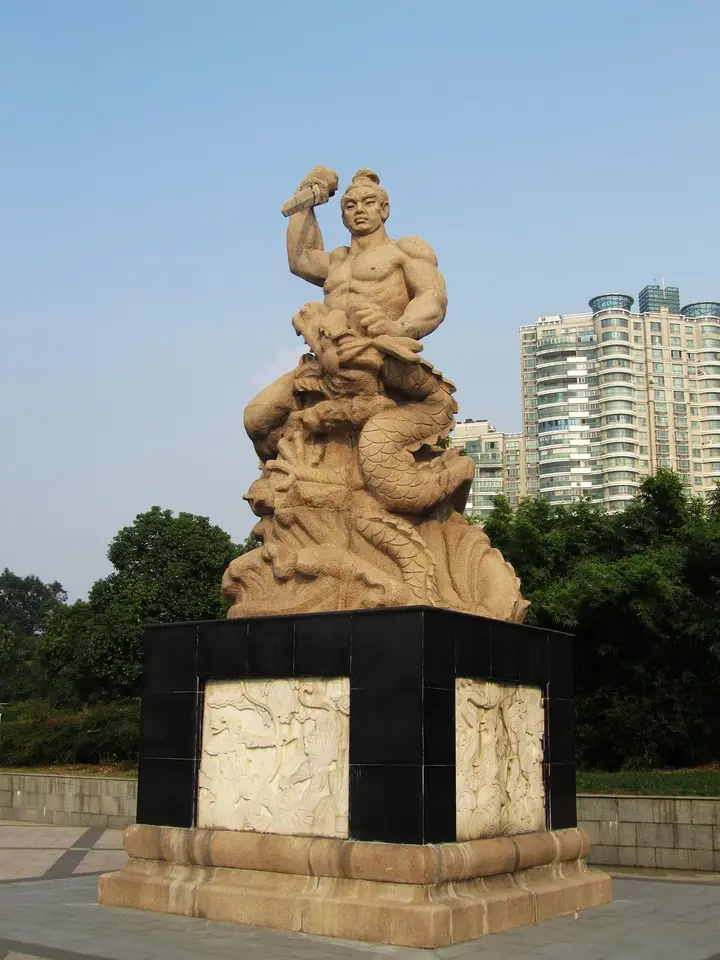
周处
Zhou Chu (周处, 236–297), courtesy name Ziyin (子隐), was a native of Yangxian County in Wu Commandery (present-day Yixing, Jiangsu Province). He was the son of Zhou Fang, the renowned general and Grand Administrator of Poyang in Eastern Wu. Serving across both Eastern Wu and Western Jin, he was an upright statesman, intrepid general, and heroic martyr during the Western Jin dynasty, rising to the position of Palace Attendant…
Zhou Chu (周处, 236–297), courtesy name Ziyin (子隐), was a native of Yangxian County in Wu Commandery (present-day Yixing, Jiangsu Province). He was the son of Zhou Fang, the renowned general and Grand Administrator of Poyang in Eastern Wu. Serving across both Eastern Wu and Western Jin, he was an upright statesman, intrepid general, and heroic martyr during the Western Jin dynasty, rising to the position of Palace Attendant Censor. Following his death in battle, he was posthumously granted the rank of General Who Pacifies the West and honored with the posthumous title Marquis Xiao. In his youth, Zhou Chu possessed Herculean physical strength and a tempestuous, unbridled temper, terrorizing his native region alongside a white-browed tiger in Mount Nan and a ferocious river serpent under Long Bridge, collectively feared as the "Three Scourges of Yangxian." Upon discovering that his fellow villagers reviled him as the worst of the three perils, he underwent a sudden awakening, hunting down and killing the beast in the mountains and battling the water dragon for three days and nights. Guided by the famed scholar Lu Yun, he turned his life around, dedicating himself to classical scholarship, filial piety, and civic virtue, becoming China's ultimate cultural archetype of the reformed rogue. Zhou Chu served Eastern Wu as Assistant Director of the Eastern Library and Commander of Wunan. After the fall of Wu, he entered Western Jin governance, serving as Grand Administrator of Xinping and Guanghan, pacifying frontier tribes and clearing three decades of backlog legal disputes. As Palace Attendant Censor, he fearlessly impeached corrupt imperial relatives, including the Emperor's uncle Sima Rong, Prince of Liang. When the Di chieftain Qi Wannian rebelled in 296, Sima Rong exploited his military command over the western theater to send Zhou Chu into battle with an isolated vanguard of five thousand troops against seventy thousand rebels, while deliberately cutting off supplies and reinforcements. Zhou Chu fought desperately until his arrows were exhausted, slaying thousands before dying a martyr's death. He was also a noted scholar who authored Fengtu Ji, China's foundational treatise on regional customs and festival folklore.
Born into the prominent Zhou family of Yangxian, son of general Zhou Fang.
Hunted the mountain tiger and slew the water serpent; guided by Lu Yun to reform his life.
Appointed Assistant Director of the Eastern Library and Commander of Wunan; ennobled as Marquis of Qingliu Pavilion.
After Wu fell, rebuked Wang Hun's condescension at the banquet in Jianye, asserting that national ruin was shared by Wei and Wu alike.
Appointed Grand Administrator of Xinping, pacifying Di and Qiang tribes and establishing frontier peace.
Governed Guanghan Commandery, clearing backlogged legal cases accumulated over thirty years.
Administered the Kingdom of Chu, burying unclaimed skeletal remains; summoned to court as Cavalier Regular Attendant.
Elevated to Palace Attendant Censor, fearlessly prosecuting corrupt princes and impeaching Sima Rong.
Qi Wannian rebelled; hostile courtiers dispatched Zhou Chu under Sima Rong's regional command.
Forced to attack seventy thousand rebels at Liumo with five thousand starving men; died fighting to the last breath.
Zhou Chu was born into an illustrious military household, his father Zhou Fang having achieved empire-wide renown through the deceptive victory at Shiting against Wei general Cao Xiu. Zhou Chu lost his father at an early age. Before reaching the age of twenty, he grew into a man of immense physical strength, fond of racing horses and hunting game. Unrestrained by social conventions and driven by tempestuous passions, he acted violently and arrogantly, causing profound distress among the local community. At the time, the people of Yixing suffered from a white-browed tiger roaming Mount Nan and a fearsome river serpent lurking beneath Long Bridge; they grouped these two predatory beasts with the tyrannical Zhou Chu as the "Three Scourges of Yixing," regarding Zhou Chu as the most perilous of all.
One day, observing village elders sighing in dejection, Zhou Chu inquired why they appeared so distressed during a bountiful harvest. An elder sighed: "While the three scourges remain unvanquished, how could there be joy?" Proud of his martial prowess, Zhou Chu vowed to eliminate them. Taking up his bow and blade, he ventured into the deep mountains and tracked down and slew the tiger. He then plunged into the churning waters beneath Long Bridge to grapple with the river dragon. The wounded serpent drifted and thrashed across dozens of leagues, with Zhou Chu clinging to it in relentless combat for three days and three nights. Believing both monster and youth had drowned, the villagers celebrated with lanterns and festivities.
Emerging victorious from the river, Zhou Chu witnessed the rejoicing crowds and experienced a profound moment of self-realization, recognizing how deeply he was abhorred by his neighbors. Filled with remorse, he resolved to reform his character. He journeyed to Wu Commandery to seek out the famous literary brothers Lu Ji and Lu Yun. Finding Lu Ji away, he met Lu Yun and confessed his past misdeeds, lamenting that his youth was wasted and it might be too late to reform. Lu Yun comforted and encouraged him: "The ancients treasured hearing the right way in the morning and reforming by evening. You still possess a bright future. One should only worry that noble resolve is unformed; why fear that illustrious fame will not shine?" Deeply moved, Zhou Chu devoted himself to rigorous scholarship, moral refinement, and unswerving integrity. Within a year, local administrations competed to recruit him.
Having mastered both classical scholarship and martial strategy, Zhou Chu entered public administration in Eastern Wu, serving as Assistant Director of the Eastern Library, overseeing the compilation of dynastic histories. In the waning years of the tyrant Sun Hao, he was appointed Commander of Wunan, taking charge of elite imperial bodyguard formations, and was ennobled as the Marquis of Qingliu Pavilion. He maintained strict integrity and professional duty within a corrupt and volatile court.
In 280, the founding emperor of Western Jin, Sima Yan, launched a multi-pronged assault that extinguished the Eastern Wu state. Western Jin Commander and Left Vice Director of the Secretariat Wang Hun held a victory banquet in the former imperial palace at Jianye to entertain officers and surrendered Wu officials. During the festivities, Wang Hun condescendingly addressed the Wu elites: "As survivors of a vanquished state, do you not feel grief in your hearts?" The humiliated Wu courtiers kept silent in intimidation.
Zhou Chu stood up boldly and replied with composure: "In the late Han, the realm shattered into three contending realms. Cao Wei fell first to Jin, and Sun Wu has now collapsed today. The anguish of a fallen state is a shared tragedy across all under heaven; how could it belong to Wu alone?" Hearing these poignant words, Wang Hun blushed with shame and fell silent. Zhou Chu's extraordinary dignity and moral courage won widespread admiration throughout the Western Jin court.
Following his move to Luoyang, Zhou Chu was appointed Grand Administrator of Xinping on the northwestern frontier, where Han Chinese lived alongside various non-Han groups. Zhou Chu implemented benevolent and pragmatic policies, clarified legal codes, and pacified the Di and Qiang tribes, persuading previously rebellious factions to submit peacefully. His administrative success earned widespread praise across Yongzhou. He was subsequently reassigned as Grand Administrator of Guanghan. Guanghan Commandery had accumulated an immense backlog of unsettled judicial disputes, some lingering unresolved for three decades. Zhou Chu personally examined the archives, analyzed each case, and rendered fair adjudications, liberating the wrongfully imprisoned and restoring legal harmony.
He later resigned his post to attend to his aging mother. Shortly thereafter, the court appointed him Internal Chancellor of the Kingdom of Chu, and before he arrived, summoned him to serve as Cavalier Regular Attendant at the imperial court. Adhering to the classical precept that an official may decline a high station but never a humble duty, Zhou Chu insisted on traveling to Chu first. Finding the kingdom scarred by civil strife, he buried abandoned human remains, promoted moral education, and reformed civic customs before reporting to the imperial court.
Zhou Chu was subsequently promoted to Palace Attendant Censor, the chief of imperial surveillance and investigative discipline. In this office, he enforced the law with fearless objectivity, impeaching corrupt officials, powerful oligarchs, and imperial relatives alike. When Sima Rong, Prince of Liang (son of Sima Yi and imperial uncle), committed serious legal infractions, Zhou Chu strictly applied the statutes and prosecuted him without fear or favoritism. Sima Rong harbored a deep-seated hatred and vowed retribution.
In 296, an enormous rebellion erupted in the Guanzhong region as Di chieftain Qi Wannian declared himself emperor and mobilized hundreds of thousands of insurgents. Courtiers hostile to Zhou Chu's uncompromising integrity plotted against him, advising the throne: "Zhou Chu is the son of Wu general Zhou Fang, possessing fearless valor and resolute fortitude; he is the ideal leader for this campaign." Zhou Chu was ordered to serve under General Xiahou Jun. Knowing the perils, General Sun Xiu urged him to decline the assignment on the grounds of caring for his elderly mother. Zhou Chu replied: "How can loyalty and filial piety always be reconciled? Having dedicated my life to the sovereign, today is the very hour to sacrifice for the state."
Upon hearing of Zhou Chu's deployment, rebel leader Qi Wannian remarked: "Zhou Chu once governed Xinping; I know his capability in both civil and military arts. If he holds independent command, he will be unstoppable; but if he is restrained by others, he will certainly fall into my hands." Shortly after, the court appointed Prince of Liang Sima Rong as Grand General Who Pacifies the West, placing him in supreme command over the Guanzhong armies. Chen Zhun, Director of the Imperial Secretariat, warned that Sima Rong would seek personal revenge and urged the court to dispatch Meng Guan with ten thousand elite troops as vanguard, but the court ignored his plea.
In the first month of 297, Qi Wannian concentrated seventy thousand elite rebels at Mount Liang. Xiahou Jun and Sima Rong coerced Zhou Chu into launching an assault with an isolated vanguard of merely five thousand troops. Zhou Chu remonstrated: "Our vanguard has no rear support; charging alone guarantees disaster, destroying not only ourselves but disgracing the state." Sima Rong ignored his warning, ordered him into battle at Liumo, and deliberately severed his supply lines and military reinforcements. Zhou Chu's soldiers went into combat on empty stomachs. Knowing defeat was inevitable, Zhou Chu recited a solemn poem and charged the enemy. Fighting from dawn to dusk, Zhou Chu's vanguard killed over ten thousand enemies until their arrows were exhausted. When subordinates urged him to break out, Zhou Chu pressed his sword and shouted: "This is the moment to fulfill a minister's duty and give my life. Why should I retreat!" He fought valiantly until he was overwhelmed and slain.
In his youth, Zhou Chu was infamous for his violent arrogance, yet upon recognizing his faults, he displayed remarkable decisiveness by slaying the predatory beasts and seeking counsel from Lu Yun. Through immense discipline, he transformed himself into an immortal model of loyalty, filial piety, and civic virtue, celebrated for millennia in Chinese history as the quintessential reformed rogue.
As Palace Attendant Censor, Zhou Chu embodied the highest ethical standards of imperial censors, fearlessly holding the highest nobility accountable under the law. Facing certain death in the western campaign, aware of Sima Rong's murderous malice, he chose duty over evasion. Leading five thousand starving soldiers against seventy thousand foes, he fought to his dying breath, upholding the ultimate warrior pledge of dying for one's state.
In addition to his administrative and military exploits, Zhou Chu was an accomplished scholar. His pioneering work Fengtu Ji (Record of Local Customs) systematically chronicled the seasonal customs, festival traditions, and regional folklore of the Jiangnan region. It provides the earliest extant written record of Dragon Boat Festival customs (such as picking mugwort, eating zongzi, and hanging calamus swords), Double Seventh Festival, and Double Ninth Festival, establishing a foundational cornerstone for Chinese cultural anthropology. He also composed thirty chapters of Moyu and a history titled Wu Shu.
FIGURES ASSOCIATED WITH THIS DYNASTY