Upbringing in a Martial Lineage
Born into the aristocratic Sun clan of Fuchun, learning horsemanship, archery, and swordsmanship alongside clan youths.
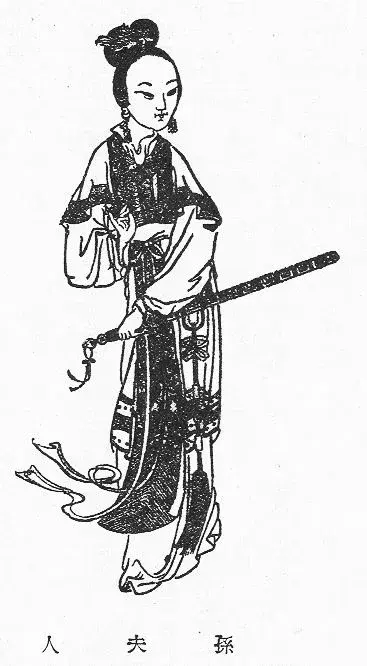
孙夫人
Lady Sun (孙夫人, dates of birth and death unrecorded), a native of Fuchun in Wu Commandery (modern Fuyang, Hangzhou, Zhejiang Province), was the daughter of General Who Smashes the Cankered Sun Jian and younger sister to both warlord Sun Ce and Sun Quan, founding Emperor of Eastern Wu. She was also the primary consort of Liu Bei, Emperor Zhaolie of Shu Han. Popular opera traditions and folklore frequently refer to her as "Sun…
Lady Sun (孙夫人, dates of birth and death unrecorded), a native of Fuchun in Wu Commandery (modern Fuyang, Hangzhou, Zhejiang Province), was the daughter of General Who Smashes the Cankered Sun Jian and younger sister to both warlord Sun Ce and Sun Quan, founding Emperor of Eastern Wu. She was also the primary consort of Liu Bei, Emperor Zhaolie of Shu Han. Popular opera traditions and folklore frequently refer to her as "Sun Shangxiang" or "Sun Ren." In 209, following the allied victory at the Battle of Red Cliffs, Sun Quan sought to solidify the anti-Cao Cao military alliance by giving his twenty-year-old sister in marriage to Liu Bei, who was then nearly fifty and consolidating his hold over Jingzhou. Lady Sun was exceptionally agile, courageous, and fiercer in temperament than ordinary women, sharing the martial spirit of her elder brothers. Her personal retinue included more than a hundred armed female attendants wielding broadswords, whose menacing presence kept Liu Bei constantly on guard. During her residence in Jingzhou, her Wu retainers frequently committed unlawful acts, prompting Liu Bei to appoint the strict and upright general Zhao Yun to supervise internal affairs and construct a separate fortified settlement at Chanling, historically remembered as "Lady Sun's City." In 211, when Liu Bei led his forces into Sichuan, Sun Quan sent a fleet to bring his sister home. Lady Sun attempted to take Liu Bei's young heir Liu Shan with her, but Zhuge Liang dispatched Zhao Yun and Zhang Fei to intercept her vessel on the Yangtze River and secure the child. Following her return to Jiangdong, she disappeared entirely from official historical records, enduring as an iconic symbol of political matrimony and female martial prowess in classical Chinese culture.
Born into the aristocratic Sun clan of Fuchun, learning horsemanship, archery, and swordsmanship alongside clan youths.
Following the Battle of Red Cliffs, married Liu Bei in Jingzhou under Sun Quan's diplomatic arrangement to cement the southern alliance against Cao Cao.
Resided in Jingzhou with her retinue of armed maidservants; Liu Bei appointed Zhao Yun to regulate internal affairs and built a separate fortress at Chanling for her garrison.
When Liu Bei campaigned in Yi Province, Sun Quan sent ships to bring her home; she attempted to bring young Liu Shan with her, but Zhao Yun and Zhang Fei intercepted her boat, after which she returned alone to Wu.
Following Liu Bei's pacification of Yi Province and marriage to Lady Wu, official dynastic records cease all mention of Lady Sun's subsequent life.
Lady Sun was born into the preeminent military family of the Jiangdong region. Her father, Sun Jian, was the renowned Commandant of Changsha who won fame across the empire by slaying Hua Xiong and routing Dong Zhuo during the anti-Dong Zhuo campaigns, later posthumously honored as Emperor Wulie. Her eldest brother, Sun Ce, known as the "Little Hegemon," conquered the six commanderies of the South to establish the territorial foundation of the state, while her second brother, Sun Quan, became the founding emperor of the Eastern Wu dynasty. Raised in an environment steeped in martial values and chivalric pride, Lady Sun displayed unusual independence and physical vigor from early youth.
Possessing exceptional intelligence and a fiercely determined character, she was renowned for embodying the intrepid spirit of her elder brothers. Rather than occupying herself with traditional needlework and domestic passivity, she mastered horsemanship, archery, and sword combat alongside her male cousins. She recruited and trained an elite household retinue of over one hundred young maidservants who carried bladed weapons wherever they went, maintaining the discipline and vigilant demeanor of an active military encampment.
In late 208, the allied forces of Sun Quan and Liu Bei achieved a momentous triumph over Cao Cao's northern armada at the Battle of Red Cliffs. However, in the immediate aftermath of the battle, delicate rivalries emerged over the control of the strategic southern commanderies of Jingzhou. Liu Bei swiftly pacified Changsha, Lingling, Guiyang, and Wuling, establishing his administrative headquarters at Gong'an and expanding his territorial strength.
Observing Liu Bei's rapid resurgence, Sun Quan recognized the urgent necessity of binding the southern warlords together against the looming threat from Cao Cao. In late 209, Sun Quan proposed a high-level diplomatic union, offering his twenty-year-old sister in marriage to Liu Bei, who was then forty-nine years of age. This celebrated political alliance resolved immediate diplomatic tensions between Wu and Shu, granting Liu Bei international legitimacy in Jingzhou while providing both regimes with several vital years of strategic stability to expand their respective territories.
Despite the outward pomp of the imperial wedding, this diplomatic marriage was fraught with mutual suspicion and strategic vigilance. Historical records describe Lady Sun as fierce and unyielding. In their marital quarters, her hundred female attendants stood at attention lining the corridors brandishing bare swords, transforming the domestic residence into a guarded citadel. Despite being a veteran military commander who had survived decades of warfare, Liu Bei entered her private chambers with profound unease and trepidation.
Strategist Fa Zheng recognized the severe perils of this domestic arrangement, counseling Liu Bei to maintain cautious distance from his bride. Reflecting upon this precarious period, Fa Zheng famously remarked: "When our lord was stationed at Gong'an, he feared the might of Cao Cao to the north and dreaded the coercion of Sun Quan to the east, while at home he lived in constant dread that Lady Sun might incite insurrection under his very elbows—truly a predicament of acute hazard!" Lady Sun's armed household served effectively as Eastern Wu's political garrison within Liu Bei's inner court.
Beyond her intimidating personal style, Lady Sun's status as the sister of the sovereign ruler of Wu caused significant administrative friction. The contingent of soldiers, officers, and civilian retainers she brought from Jiangdong acted with haughty arrogance, frequently defying local civil laws and disturbing the peace of the Jingzhou populace. Recognizing that domestic instability could compromise his military base, Liu Bei appointed General Zhao Yun as Comptroller of the Camps, giving him complete authority over palace discipline and the suppression of disorderly Wu personnel.
To eliminate daily domestic friction and reduce internal security risks, Liu Bei ordered the construction of a dedicated fortified town at Chanling, approximately twenty li west of Gong'an, where Lady Sun and her entire personal army were permanently quartered. Local gazetteers, such as the Song Dynasty Record of Famous Places, recorded that Lady Sun maintained deep political distrust toward Liu Bei and chose to maintain her own fortified citadel separate from his headquarters, giving rise to the historical monument known as "Lady Sun's City."
In 211, Governor Liu Zhang of Yi Province dispatched emissaries inviting Liu Bei to march west into Sichuan to counter Zhang Lu of Hanzhong. Liu Bei mobilized an expeditionary force comprising Pang Tong, Huang Zhong, and Wei Yan, leaving Zhuge Liang, Guan Yu, Zhang Fei, and Zhao Yun behind to safeguard Jingzhou. Learning that Liu Bei had departed for the distant mountains of the west, Sun Quan seized upon the void to launch a surprise diplomatic withdrawal, sending a large fleet of warships up the Yangtze River under the pretext of welcoming his sister home for an imperial visit.
Seeking to secure strategic leverage for her brother's regime, Lady Sun boarded the flagship and attempted to smuggle Liu Bei's only surviving heir, the young prince Liu Shan, back to Eastern Wu as a hostage. Zhuge Liang immediately grasped the catastrophic danger and dispatched Zhao Yun and Zhang Fei with fast interceptor boats. Catching up with the Wu flotilla on the rushing waters of the Yangtze, Zhao Yun and Zhang Fei boarded the flagship with drawn weapons, demanding the immediate return of the imperial scion. Overawed by the resolve of the two generals, Lady Sun surrendered Liu Shan and sailed downstream alone to Wu, permanently severing her connection with the Shu-Han house.
Following the dramatic interception on the Yangtze, Lady Sun vanished into the domestic sphere of the Sun clan in Jianye. In 214, after Liu Bei conquered Chengdu and accepted Liu Zhang's surrender, the Shu-Han court formalized a new political marriage between Liu Bei and Lady Wu, the younger sister of the influential Sichuanese general Wu Yi.
Official historical sources, including Chen Shou's Records of the Three Kingdoms, contain no further mention of Lady Sun's later life or death. Once her diplomatic utility as a marital bridge had collapsed, classical male chroniclers relegated her to obscurity. Nevertheless, her extraordinary persona captivated the popular imagination for subsequent centuries, evolving into the legendary heroine Sun Shangxiang in folk storytelling, classical drama, and vernacular literature.
In the delicate geopolitical crucible following the Battle of Red Cliffs, Lady Sun served as the indispensable human link in preserving the coalition between Wu and Shu. Sun Quan's calculated offer to marry his sister to Liu Bei provided the diplomatic reassurance required to forestall an immediate war over Jingzhou. This critical marital alliance allowed Liu Bei to establish a stable administrative sanctuary in southern Jingzhou, recruit brilliant talents, and prepare his westward march into Sichuan, ultimately enabling the tripartite division of China into the Three Kingdoms.
Within traditional dynastic records, Lady Sun stands out as a unique aristocrat who shattered conventional Confucian gender expectations. Chronicled by Chen Shou as possessing "keen intellect and fierce martial energy, carrying the proud spirit of her brothers," she commanded her own retinue of armed women who drilled with real blades and escorted her on horseback. Her assertive and defiant posture transformed her from a passive pawn of dynastic diplomacy into an imposing political actor who commanded the fear and respect of seasoned warlords.
Lady Sun's historical stay in southern Hubei left a lasting physical monument in Chinese architectural and geographical history. The dedicated fortress constructed for her and her retinue at Chanling was recorded across subsequent dynastic geographies, including the Tang Geographical Treatise and the Imperial Comprehensive Geography. Very few individual fortresses across Chinese history have been permanently named after aristocratic women, making "Lady Sun's City" an enduring archaeological and cultural testament to the unique military and domestic tensions of the late Han warlord period.
The failed abduction of Liu Shan in 211 was a pivotal turning point in the survival of the Shu-Han state. Had Lady Sun succeeded in spiriting Liu Bei's legal heir to Jianye, Eastern Wu would have held an unassailable political trump card, enabling Sun Quan to extract territorial concessions in Jingzhou and subvert Liu Bei's campaign in Sichuan. The vigilant intervention orchestrated by Zhuge Liang and executed by Zhao Yun and Zhang Fei neutralized this threat, securing the succession of the future Shu emperor and preserving the strategic autonomy of Liu Bei's enterprise.
In the centuries following the Three Kingdoms era, Lady Sun's historical character underwent a profound literary transformation. In Luo Guanzhong's fourteenth-century epic Romance of the Three Kingdoms, she was reimagined as a romantic heroine deeply devoted to Liu Bei, assisting him in outwitting Zhou Yu's stratagems. Later commentary by Mao Zonggang popularized the tragic legend that she committed suicide by jumping into the Yangtze upon hearing false reports of Liu Bei's death following the Battle of Yiling. This legend inspired the construction of the "Temple of the Fierce Heroine" (Xiaoji Shrine) at Jiaoji Mountain in Wuhu, cementing her status as a beloved icon of classical Chinese heroic folklore.
FIGURES ASSOCIATED WITH THIS DYNASTY