Enlisting against Yellow Turbans
Recruited as a soldier to suppress the Yellow Turban Rebellion, appointed Major under Han Fu.
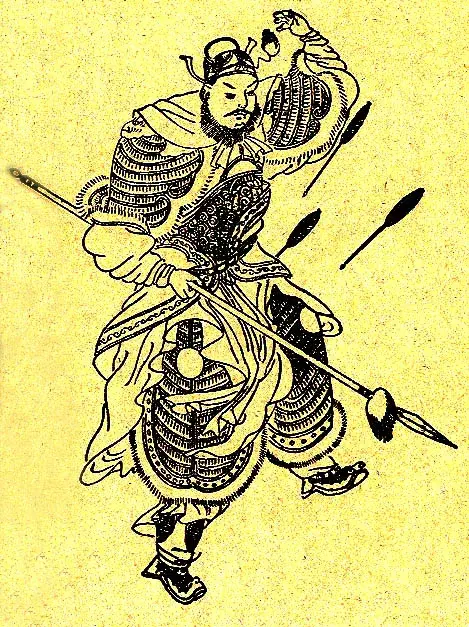
张郃
Zhang He (张郃, ? – 231), courtesy name Junyi (儁乂), and posthumously named Zhuanghou (壮侯), was a native of Mo County, Hejian Commandery, Ji Province (present-day Renqiu City, Hebei Province). He was one of the celebrated "Five Elite Generals" of Cao Wei during the late Han and Three Kingdoms periods, rising to General of Chariots and Cavalry Who Conquers the West with Senior Official of Exceptional Rank status, and elevated to…
Zhang He (张郃, ? – 231), courtesy name Junyi (儁乂), and posthumously named Zhuanghou (壮侯), was a native of Mo County, Hejian Commandery, Ji Province (present-day Renqiu City, Hebei Province). He was one of the celebrated "Five Elite Generals" of Cao Wei during the late Han and Three Kingdoms periods, rising to General of Chariots and Cavalry Who Conquers the West with Senior Official of Exceptional Rank status, and elevated to Marquis of Mo. Renowned for profound tactical intellect, mastery of field encampments, and unmatched reading of geographical terrain, he was lauded by the Western Jin historian Chen Shou in the Records of the Three Kingdoms: "Zhang He understood operational variables, excelled at arranging encampments, and anticipated battlefield developments and terrain with unfailing accuracy; even Zhuge Liang held him in deep dread." Responding to recruitment calls during the Yellow Turban Rebellion in 184, Zhang He entered military service as a Major under Ji Province Governor Han Fu. When Han yielded the province to Yuan Shao, Zhang joined Yuan's army, winning distinction in destroying Gongsun Zan to attain the rank of Internuncio of Ningguo. During the Battle of Guandu in 200, Zhang urged Yuan Shao to dispatch relief forces to save the grain depot at Wuchao; when Yuan refused and Wuchao fell, court advisor Guo Tu slandered Zhang to escape blame. Facing execution, Zhang surrendered to Cao Cao, who warmly welcomed him, comparing his arrival to Han Xin joining Liu Bang. Over the next three decades, Zhang He campaigned extensively under Cao Cao, fighting in the northern desert against the Wuhuan, crushing Ma Chao in the Guanzhong campaign, and subjugating Zhang Lu in Hanzhong. At the Battle of Mount Dingjun in 219, when supreme commander Xiaohou Yuan fell in combat and imperial forces faced collapse, Zhang took interim command, reorganizing the defensive lines and withdrawing to Chencang to stabilize the northwestern frontier. Under Cao Pi and Cao Rui, he was promoted to General of the Left and Marquis of Mo. During Zhuge Liang's first Northern Expedition in 228, when three commanderies defected to Shu Han, Zhang was entrusted with forward command; at the Battle of Jieting, he exploited Ma Su's isolated hilltop position by severing water supplies, routing the Shu vanguard and compelling Zhuge Liang to retreat to Hanzhong. In 231, during Zhuge Liang's fourth Northern Expedition, Sima Yi forced Zhang to pursue the retreating Shu army against his advice; advancing into the narrow defiles of Mumen Trail, Zhang was ambushed by crossbowmen and died heroically from an arrow wound to the knee, receiving the posthumous title Zhuanghou.
Recruited as a soldier to suppress the Yellow Turban Rebellion, appointed Major under Han Fu.
Followed Han Fu's surrender of Ji Province to join Yuan Shao; promoted to Internuncio of Ningguo after defeating Gongsun Zan.
Advised Yuan Shao to relieve Wuchao; framed by Guo Tu after Wuchao's fall, surrendered to Cao Cao and appointed Major-General.
Served as vanguard alongside Zhang Liao in the expedition against the Wuhuan, crushing Tadun and promoted to General Who Pacifies the Di.
Followed Cao Cao to defeat Ma Chao and Han Sui; campaigned in Anding to pacify Lushui Hu and Qiang tribes.
Advanced into Hanzhong to defeat Zhang Lu; fought Shu general Zhang Fei for fifty days at Dangqu before securing civilian transfers.
Xiaohou Yuan was slain at Mount Dingjun; Zhang assumed interim command, rallying the troops and checking Liu Bei's advance at the Han River.
Following Cao Pi's ascension, appointed General of the Left and Marquis of Mo, directing western frontier defenses.
Crossed the Yangtze River during the campaign against Eastern Wu, routing Sun Sheng on the river island of Bailizhou.
Severed water supplies to shatter Ma Su's army at Jieting, repelling Zhuge Liang's first Northern Expedition; promoted to General of Chariots and Cavalry.
Ordered by Sima Yi to pursue retreating Shu forces against his counsel; ambushed by crossbowmen at Mumen Trail and killed in action, posthumously named Zhuanghou.
Zhang He was born in Mo County, Hejian Commandery, Ji Province. In 184, during the final years of the Eastern Han dynasty, the Yellow Turban Rebellion erupted across northern and central China, throwing the empire into civil war. The young Zhang He enlisted in the imperial levies dispatched by the Governor of Ji Province, Han Fu. Recognizing his physical bravery and natural grasp of battlefield formations, Han appointed him Major of the Army, deploying his units to suppress scattered insurgent remnants across northern Hebei.
In 191, intimidated by warlord Yuan Shao, Han Fu surrendered Ji Province. Evaluating regional prospects, Zhang He transferred his allegiance to Yuan Shao, who appointed him as a cavalry commander. At that time, warlord Gongsun Zan held dominant power in You Province, his elite "White Horse Volunteers" horse archers dominating northern combat. In the protracted campaigns that followed, including the Battle of Jieqiao, Longcou, and Julu, Zhang He served as Yuan's frontline assault commander. During the final siege of Gongsun Zan's fortified redoubts at Yijing, Zhang repeatedly breached stone parapets, earning promotion to Internuncio of Ningguo and standing as one of the premier generals of Hebei.
In 200, Yuan Shao and Cao Cao clashed in the pivotal Battle of Guandu for supreme dominion over northern China. As the armies stalemated behind elaborate trenches and earthworks, Cao Cao personally led five thousand elite infantry and cavalry on a night raid to torch Yuan's primary supply depot at Wuchao. When reports reached the headquarters, Zhang He urged Yuan Shao to take immediate action: "Cao Cao has committed his elite troops against Wuchao; Commander Chunyu Qiong cannot hold out alone. If our grain is lost, the entire army will collapse without a fight! We must dispatch our main force to save Wuchao immediately!"
However, Yuan's chief strategist, Guo Tu, argued the opposite, advising Yuan to mount a frontal assault against Cao Cao's heavily fortified headquarters at Guandu. Zhang He protested vehemently: "Cao Cao's central camp is built like solid stone; it cannot be breached in a few hours. If Wuchao falls, all is lost!" Indecisive and swayed by flatterers, Yuan dispatched only light cavalry to Wuchao while ordering Zhang He and Gao Lan to assault Cao's camp.
Cao's camp bristled with crossbow batteries and interlocking barriers, repelling every assault. Soon, messengers confirmed that Wuchao was completely destroyed. Fearing execution for his failed advice, Guo Tu slandered Zhang He to Yuan Shao, claiming that Zhang rejoiced at the defeat and uttered treasonous complaints. Knowing that Yuan had previously executed loyal ministers Tian Feng and Ju Shou, Zhang recognized that his life was forfeit. He ordered his siege engines torched and marched his entire division to Cao Cao's camp to surrender. Delighted, Cao Cao came out personally to grasp his hand, declaring: "In antiquity, Wu Zixu failed to realize danger in time, bringing ruin upon himself; how far superior is your arrival, like Weizi leaving Yin or Han Xin joining the Han!" Cao Cao appointed him Major-General and created him Marquis of a Chief Village.
Joining Cao Cao's ranks, Zhang He began three decades of brilliant generalship. In 204, he participated in the siege of Ye, pursuing Yuan Tan and Yuan Shang across Hebei. In 207, during the desert expedition against the Wuhuan at Liucheng, Zhang He and vanguard commander Zhang Liao spearheaded the rapid crossing of the Lulong Pass. At the Battle of Mount Bailang, the vanguard encountered tens of thousands of Wuhuan horsemen; Zhang He charged straight into the enemy lines, decapitating the Wuhuan Khan Tadun and routing the nomadic host, for which he was promoted to General Who Pacifies the Di.
In 211, warlords Ma Chao and Han Sui organized a formidable western coalition along the Wei River. Zhang He campaigned with Cao Cao's main army to shatter the allied cavalry, subsequently leading independent detachments into Anding to subjugate the Lushui Hu and Qiang tribes. In 215, during the conquest of Hanzhong against the religious warlord Zhang Lu, Zhang He advanced as vanguard commander. At Yangping Pass, when dense mountain fogs disoriented both armies, Zhang exploited a misdirection in the mist to scale the ridge and storm the enemy defenses, compelling Zhang Lu to surrender.
Leaving Xiaohou Yuan to govern Hanzhong, Cao Cao ordered Zhang He to lead an expedition into Baxi to resettle local populations into the north. Shu Han commander Zhang Fei intercepted him from Langzhong, engaging Zhang He in a grueling mountain campaign around Dangqu and Mengtou that lasted over fifty days. Exploiting narrow defiles, Zhang Fei ambushed Zhang's rearguard, forcing Zhang to abandon his mount and climb mountain trails on foot with only a dozen bodyguards to return to Nanzheng. Although checked militarily, Zhang successfully transported tens of thousands of civilian families into Hanzhong, fulfilling his strategic mandate, and Cao Cao rewarded him with the title General Who Destroys Bandits.
Between 218 and 219, Liu Bei mobilized the entire military resources of Shu to seize Hanzhong, establishing positions at Mount Dingjun. While Xiaohou Yuan guarded the southern sector, Zhang He garrisoned the eastern outpost of Guangshi. Recognizing Zhang He as the true operational mind of the Wei army, Liu Bei deployed more than ten thousand elite troops to launch a midnight assault on Guangshi, setting fire to the wooden abatis. Zhang personally led his guards through the burning palisades, repelling repeated assaults and holding his position intact throughout the night.
Frustrated at Guangshi, Liu Bei shifted his attack to Xiaohou Yuan's main camp. When Xiaohou led a small party to repair damaged barriers, veteran Shu general Huang Zhong launched a downhill cavalry charge, cutting down Xiaohou Yuan and throwing the Wei forces into chaotic panic. With the supreme commander dead and communication severed, imperial troops stood on the verge of total collapse.
In this mortal crisis, Military Inspector Guo Huai and Senior Clerk Du Xi rallied the officers, declaring: "General Zhang is a renowned master of war whom even Liu Bei deeply fears. Unless General Zhang assumes command, we cannot survive!" The generals unanimously invited Zhang to assume supreme authority. Accepting the mantle without hesitation, Zhang issued immediate tactical deployments, stabilized defensive perimeters, and restored iron discipline. When Liu Bei prepared to cross the Han River to storm the Wei camp the following morning, he saw Zhang's lines tightly formed and bristling with crossbows, halting his troops in dismay. Zhang subsequently executed a disciplined withdrawal to the strategic defiles of Chencang, sealing the mountain passes and preventing Shu forces from breaking out into Guanzhong. From Chang'an, Cao Cao dispatched the imperial ceremonial staff, praising Zhang's decisive leadership.
When Cao Pi established the Cao Wei dynasty in 220, he appointed Zhang He as General of the Left and elevated him to Marquis of Mo. During the Huangchu era, Zhang assisted Cao Zhen in suppressing revolts by the Lushui Hu and Eastern Qiang tribes in Liang Province, securing the Silk Road trading corridors. In 222, campaigning against Eastern Wu along the middle Yangtze, Zhang led amphibious detachments across the river to overrun Wu commander Sun Sheng's batteries on Bailizhou, severing water communications around Jiangling.
In the spring of 228, Shu Han Chancellor Zhuge Liang launched his first Northern Expedition out of Qishan, catching Cao Wei by surprise. With the commanderies of Tianshui, Nan'an, and Anding defecting to Shu, the capital of Luoyang was thrown into panic. The young emperor Cao Rui traveled to Chang'an to direct operations, granting Zhang He exceptional rank and dispatching him with fifty thousand infantry and cavalry to meet the invasion. Zhuge Liang entrusted his vanguard to his protégé Ma Su, assisted by veteran general Wang Ping, with orders to block the strategic chokepoint of Jieting.
Disregarding Zhuge Liang's precise instructions to establish fortifications directly across the valley road, Ma Su insisted on encamping his army atop an isolated hill, claiming that holding the high ground would terrify the enemy. Arriving at Jieting, Zhang He ascended a neighboring ridge, instantly recognizing Ma Su's fatal error. Instead of assaulting the hill frontally, Zhang deployed his troops to form an airtight blockade around the perimeter, digging trenches and severing all access to local mountain streams.
Deprived of water for several days, the Shu soldiers descended into panic and thirst. Exploiting their distress, Zhang ordered fire arrows shot into the dry grass, launching a synchronized assault from all sides. The Shu vanguard disintegrated in utter rout; Ma Su fled the field, leaving only Wang Ping to beat drums and gather a thousand survivors in defensive formation. The crushing victory at Jieting shattered Zhuge Liang's entire strategic deployment, leaving his army's flank exposed and compelling him to execute Ma Su and order an immediate retreat to Hanzhong. Zhang capitalized on his triumph by swiftly recapturing the three rebel commanderies. In recognition of this feat, Cao Rui promoted Zhang to General of Chariots and Cavalry Who Conquers the West.
In the spring of 231, Zhuge Liang launched his fourth Northern Expedition, encircling Qishan with grain transport facilitated by wooden oxen and flowing horses. Grand General Sima Yi commanded the Wei army, with Zhang He serving as second-in-command. Observing that the Shu forces had traveled far and sought a swift engagement, Sima Yi adopted a passive defense behind deep trenches. Zhang He advised an active strategy: "The enemy has advanced far seeking battle in vain; their only advantage lies in sudden maneuvers. We should dispatch detachments to sever their communication through Yong and Mei rather than remaining locked in place." Sima Yi refused the suggestion.
In June 231, running out of provisions, Zhuge Liang ordered an orderly withdrawal from Qishan. Seeing the Shu forces depart, Sima Yi ordered Zhang He to lead elite cavalry in immediate pursuit. Knowing classical military doctrine, Zhang cautioned Sima Yi: "Military canon dictates that one must never pursue a retreating army, nor press a desperate foe. Zhuge Liang directs his troops with exceptional discipline; in his retreat, he will surely prepare lethal ambushes. Pursuing him will invite disaster!" However, Sima Yi insisted, compelling Zhang to obey imperial military command.
Leading his vanguard into the rugged defiles of Mumen Trail south of Lveyang (modern southwest of Tianshui, Gansu), Zhang entered a narrow ravine flanked by sheer, forested cliffs. Suddenly, signal horns sounded, and thousands of Shu crossbowmen hidden along the ridges released a devastating volley of arrows and boulders. Crossbow bolts fell like torrential rain. Charging forward to rally his men, Zhang was struck in the right knee by an arrow that pierced through the joint. Severely wounded and bleeding profusely, the veteran commander died heroically on the battlefield. Cao Rui mourned his passing with deep sorrow, bestowing upon him the posthumous title Zhuanghou and granting noble peerages to his sons.
During the Battle of Guandu in 200, Zhang He demonstrated strategic prescience by identifying the defense of Wuchao as the hinge upon which the entire war turned. When Yuan Shao disregarded his counsel and framed him for failure, his surrender to Cao Cao shattered the political and military equilibrium of northern China.
Welcomed by Cao Cao as an invaluable asset, Zhang played a central role in subsequent campaigns, pacifying Hebei, conquering the Wuhuan at Mount Bailang, and routing western warlords along the Wei River.
Following the death of Xiaohou Yuan at Mount Dingjun in 219, imperial forces stood on the brink of total annihilation. Stepping forward in the crisis, Zhang assumed command, quickly restoring discipline among panicked units.
His calm leadership deterred Liu Bei from crossing the Han River, allowing the army to execute a safe tactical withdrawal to Chencang. This feat preserved the defensive integrity of the northwest and denied Shu Han access to Guanzhong.
In 228, Zhang He achieved his most famous operational triumph at the Battle of Jieting. Recognizing the fatal vulnerability of Ma Su's encampment atop an isolated hill, Zhang executed a blockade that severed the garrison's water supply.
By routing the Shu vanguard, Zhang collapsed the northern axis of Zhuge Liang's first Northern Expedition, forcing the Shu army to abandon its gains and retreat to Hanzhong, altering the strategic trajectory of the Three Kingdoms conflict.
Throughout his career, Zhang He was revered as the quintessential tactical commander. His defining attribute—"understanding operational variables, arranging encampments with mastery, and calculating terrain with unfailing accuracy"—earned him the respect and fear of his adversaries, including Zhuge Liang.
Uniquely among the generals of the era, Zhang combined battlefield brilliance with intellectual refinement, actively patronizing Confucian scholars and recommending local men of virtue to the imperial court.
FIGURES ASSOCIATED WITH THIS DYNASTY