Born in Shangjing
Born in Huining Prefecture as the grandson of Emperor Taizu; immersed himself in classical Han histories, military arts, and poetry from childhood.
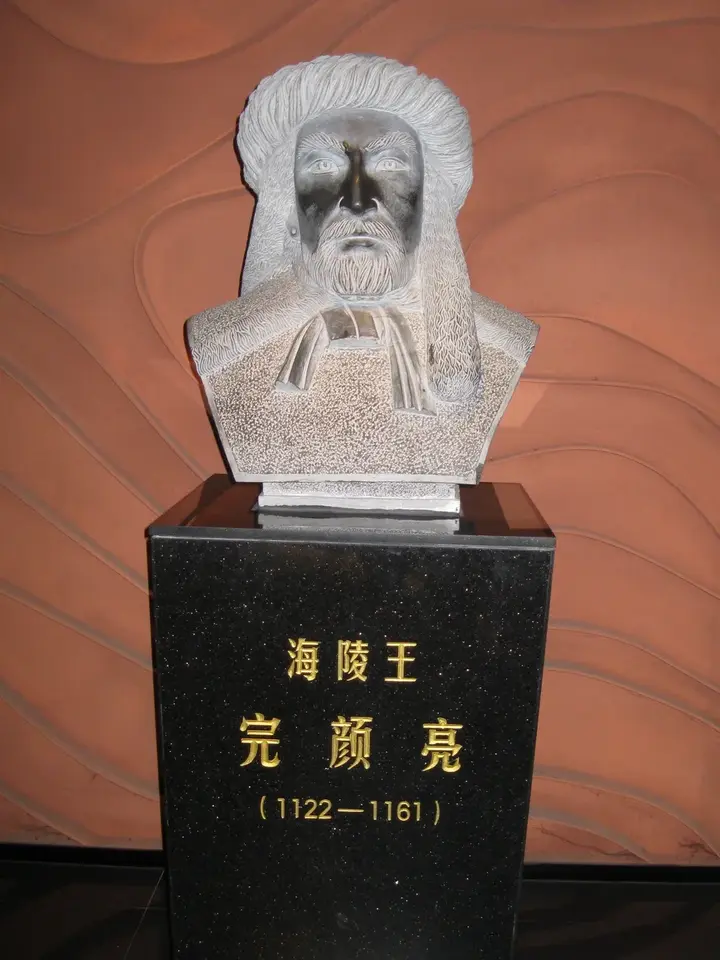
完颜亮
Wanyan Liang (完颜亮, 1122–1161), Jurchen name Digunai (迪古乃), courtesy name Yuangong (元功), was a grandson of Jin founder Emperor Taizu (Wanyan Aguda) and the second son of Prince of Liao Wanyan Zonggan. He reigned as the fourth emperor of the Jin Dynasty. Possessing keen intelligence, military prowess, and deep immersion in classical Han scholarship, poetry, and calligraphy, Wanyan Liang advanced through high imperial offices in…
Wanyan Liang (完颜亮, 1122–1161), Jurchen name Digunai (迪古乃), courtesy name Yuangong (元功), was a grandson of Jin founder Emperor Taizu (Wanyan Aguda) and the second son of Prince of Liao Wanyan Zonggan. He reigned as the fourth emperor of the Jin Dynasty. Possessing keen intelligence, military prowess, and deep immersion in classical Han scholarship, poetry, and calligraphy, Wanyan Liang advanced through high imperial offices in his youth, serving as General of the State, Associate Director of the Imperial Clan Court, Vice Regent of Yanjing, and Left Vice Director of the Department of State Affairs. In December 1149, following the erratic and murderous outbursts of Emperor Xizong, Wanyan Liang organized a palace coup alongside generals Wanyan Bingde and Tangkuo Bian, executing Xizong and seizing the throne under the reign title Tiande. Upon ascending the throne, Wanyan Liang enacted comprehensive, centralized reforms to modernize the Jurchen state. Institutionally, he dismantled the cumbersome tri-departmental system inherited from Liao and Northern Song, establishing a streamlined "One Department and Six Ministries" structure under the Department of State Affairs (Shangshu Sheng) directly responsible to the sovereign, while replacing the Chief Military Commission with the Bureau of Military Affairs (Shumi Yuan) to centralize armed command. He eliminated the hereditary privileges of Jurchen noble lineages (wanhu), merged northern and southern civil service examination tracks, and instituted imperial palace examinations (dianshi) to recruit Chinese and Khitan scholars. Most significantly, in 1153 (the 1st year of the Zhenyuan era), he relocated the imperial capital from Shangjing Huining Prefecture in the far northeast to Yanjing, expanding it as Zhongdu (modern Beijing). To permanently eradicate conservative desires to retreat to the northern steppes, he ordered the complete demolition of the ancient palaces and ancestral estates in Shangjing, formally inaugurating Beijing's monumental eight-century tenure as China's dynastic capital. In 1161, he mobilized 600,000 troops in a massive four-pronged campaign against the Southern Song. However, the overextended expedition triggered a palace revolt in Liaoyang where Wanyan Yong declared himself emperor (Emperor Shizong); concurrently, Jin forces suffered defeat against Song commander Yu Yunwen at the Battle of Caishi. Moving to Guazhou Ferry on the Yangzi, Wanyan Liang's tyrannical order demanding an immediate crossing within three days sparked a military mutiny, resulting in his assassination at age forty. He was posthumously demoted to Prince of Hailing and subsequently Commoner of Hailing.
Born in Huining Prefecture as the grandson of Emperor Taizu; immersed himself in classical Han histories, military arts, and poetry from childhood.
Appointed General of the State at age nineteen, serving on the frontlines under Prince of Liang Wanyan Zongbi (Wuzhu) to master army logistics.
Elevated to Left Vice Director of the Department of State Affairs and Grand Guardian, joining the supreme executive decision-making council.
Coordinated a midnight strike within the inner palace to execute the erratic Emperor Xizong; ascended the throne, issuing a general amnesty and proclaiming the Tiande era.
Executed over seventy prominent princes of Emperor Taizong's lineage on treason charges, systematically crushing autonomous aristocratic power.
Commissioned Chancellor Zhang Hao to expand Yanjing based upon the architectural blueprints of Northern Song Kaifeng, employing hundreds of thousands of artisans.
Formally moved the imperial seat to Yanjing, designating it Zhongdu Daxing Prefecture, establishing Beijing as China's metropolitan capital.
Abolished the Chancellery and Secretariat, establishing the One Department and Six Ministries system and reorganizing the Bureau of Military Affairs.
Ordered the complete demolition of ancestral palaces and noble residences in Shangjing Huining, converting them to farmland to prevent retreat.
Mobilized 600,000 troops across four expeditionary routes to conquer the Southern Song, personally commanding the main army to the northern banks of the Yangzi.
Defeated at the Battle of Caishi while Wanyan Yong seized power in Liaoyang; assassinated by mutinous generals at the Guazhou imperial encampment at age forty.
Wanyan Liang belonged to the core founding bloodline of the Jin Dynasty. His grandfather was the empire's founder, Emperor Taizu (Wanyan Aguda), and his father was Wanyan Zonggan (Jurchen name Woben), Taizu's eldest son who had served three successive emperors as chief minister. Wanyan Zonggan was deeply devoted to Chinese administrative models, providing young Wanyan Liang with extensive exposure to classical learning. Gifted with intense ambition and acute intellect, Wanyan Liang mastered both traditional Jurchen mounted archery and classical Han prose, poetry, and calligraphy. He cultivated friendships with northern scholars, demonstrating imperial aspirations in his famous poem: "Across ten thousand leagues, literature and imperial carriages shall unite as one; how could Jiangnan remain a separate realm?"
In 1140, at age nineteen, Wanyan Liang received his first substantive appointment as General of the State, dispatched to serve under the renowned military commander Wanyan Zongbi (Jin Wuzhu). Through frontline campaigns, he mastered strategic maneuver and supply lines, winning high praise from Zongbi. Recalled to the central government, he served as Associate Director of the Imperial Clan Court and Vice Regent of Yanjing. In Yanjing, he forged close ties with prominent Han families, concluding that the empire's political center must shift from northern forests to the central agricultural plains.
By 1147, at age twenty-six, Wanyan Liang was appointed Left Vice Director of the Department of State Affairs, subsequently rising to Grand Guardian. At this juncture, Emperor Xizong sank into alcoholism and madness following the death of Empress Peiman, executing imperial princes and ministers without trial. Sensing imminent danger after the emperor threatened him with a dagger during a banquet, Wanyan Liang forged a secret alliance with palace guards and high commanders to depose the monarch.
On the night of January 9, 1150 (the 9th day of the 12th lunar month, 9th year of Huangtong), Wanyan Liang coordinated with imperial guards Wanyan Bingde, Tangkuo Bian, Pusan Sigong, and bedchamber attendant Da Xingguo. Attendant Da unlocked the palace gates, allowing Wanyan Liang and heavily armed conspirators to penetrate the bedchamber. Emperor Xizong awakened in terror and reached for his blade, but was overwhelmed and stabbed to death. Wanyan Liang ascended the throne in the Chongde Hall, issuing an amnesty and declaring the Tiande era.
Confronting powerful aristocratic cliques that could challenge his legitimacy, Wanyan Liang embarked on a ruthless purge. Emperor Taizong's descendants held immense military prestige. In 1150, fabricating conspiracy charges, Wanyan Liang executed Taizong's eldest son Wanyan Zongben, Grand Guardian Wanyan Zongmei, and over seventy imperial kinsmen, virtually wiping out Taizong's lineage. Subsequently, he executed his fellow conspirators Wanyan Bingde and Tangkuo Bian, alongside veteran general Wanyan Zongmin. Across several years, hundreds of high aristocrats were eliminated, dismantling the tribal oligarchy and concentrating absolute executive authority in the sovereign's hands.
Consolidating his grip on the court, Wanyan Liang executed a momentous geopolitical decision: moving the imperial capital to Zhongdu (modern Beijing). Since the dynastic foundation, the capital had remained in Shangjing Huining Prefecture (modern Acheng, Harbin). Situated in the frigid northeast, Shangjing suffered from logistical isolation and served as the stronghold of conservative tribal oligarchs who opposed sinicization and southern expansion.
In 1151, Wanyan Liang issued an imperial decree commanding Chancellor Zhang Hao and Vice Minister of Works Lu Yanlun to reconstruct Yanjing. Mobilizing 800,000 laborers and 400,000 soldiers, the project expanded the former Liao southern capital into a magnificent metropolis modeled upon Northern Song Kaifeng. In March 1153, Wanyan Liang led the court south from Shangjing, officially establishing his seat at "Zhongdu Daxing Prefecture."
To extinguish all nostalgia for the northeastern homelands, Wanyan Liang took extreme measures in 1157: he commanded that all ancestral palaces, princely residences, and tribal shrines in Shangjing be leveled to the ground and converted into farmland, while relocating the ancestral imperial tombs to Dafangshan in the southwestern outskirts of modern Beijing. By burning his bridges, he anchored the Jin Dynasty within the agricultural heartland, beginning Beijing's eight-century tenure as China's imperial capital.
In Zhongdu, Wanyan Liang implemented far-reaching reforms across administrative, economic, and cultural spheres.
Administratively, he dismantled the dual institutional track that separated Jurchen and Chinese populations, abolishing the Chancellery (Menxia Sheng) and Secretariat (Zhongshu Sheng). In 1156, he established the One Department and Six Ministries system, concentrating all executive authority in the Department of State Affairs (Shangshu Sheng) directly under the emperor. Concurrently, he abolished the Chief Military Commission (Duyuanshuai Fu), subordinating military command to the Bureau of Military Affairs (Shumi Yuan) to prevent imperial princes from maintaining private armies.
In the civil service, he reformed examinations to eliminate aristocratic monopolies. Previously, civil examinations were split into northern and southern tracks with preferential quotas for Jurchen elites. Wanyan Liang unified the examination tracks, abolished hereditary privileges for Jurchen wanhu nobility, and instituted imperial palace examinations (dianshi) personally presided over by the emperor. Through these open examinations, talented Chinese, Khitan, and Jurchen scholars entered the central bureaucracy, transforming the state into a merit-based Confucian bureaucracy.
Economically, he introduced the bimetallic circulation of copper coins and paper currency, minting "Zhenglong Yuanbao" copper coins in 1158 while establishing official exchange bureaus for paper currency (jiaochao), transforming Zhongdu into a commercial metropolis of over one million residents.
Wanyan Liang harbored intense ambitions to unify China. He famously declared his four life goals: "State affairs shall proceed entirely from my will; I shall command a host of millions to traverse the realm; I shall gather the world's beauties into my palace; and I shall conquer Jiangnan to unite the entire world." Having centralized administrative power, he resolved to extinguish the Southern Song.
In the autumn of 1161, defying the counsel of senior statesmen and murdering his adoptive mother Dowager Tudan when she urged caution, Wanyan Liang mobilized 600,000 troops across four prongs. He personally commanded the eastern field army through the Huai River valley toward Hangzhou; western armies advanced toward Xiangyang and Sichuan; and an imperial fleet sailed south from Shandong.
However, the enormous mobilization fractured domestic stability. Khitan tribes revolted in the northern frontier, and in October 1161, Prince Wanyan Yong orchestrated a coup in Liaoyang, proclaiming himself emperor (Emperor Shizong) and deposing Wanyan Liang. Simultaneously, frontline operations collapsed: the Jin naval armada was incinerated by Song naval general Li Bao at the Battle of Tangdao; in November, Wanyan Liang's attempt to force the Yangzi at Caishi was shattered by Song scholar-general Yu Yunwen, whose paddle-wheel warships and explosive projectiles inflicted catastrophic losses.
Facing military defeat and domestic usurpation, Wanyan Liang fell into frantic desperation. Regrouping his forces at Guazhou Ferry near Yangzhou, he assembled his commanders on December 14, issuing an ultimatum that all units must force a crossing of the Yangzi within three days or face execution. Driven to desperation, Commander Wanyan Yuanyi and General Gao Jingchong organized an armed mutiny at dawn on December 15. Surrounding the imperial pavilion, mutinous soldiers loosed arrows through the tents, storming the bedchamber and strangling Wanyan Liang with a bowstring at age forty. Following his demise, Emperor Shizong demoted him to Prince of Hailing and later reduced his status to Commoner of Hailing.
Wanyan Liang's supreme historical contribution was his strategic decision to establish the imperial capital at Zhongdu Daxing Prefecture (modern Beijing). Prior to his reign, Beijing had served only as a secondary seasonal capital (Liao Nanjing); under Wanyan Liang, it became the primary political, military, and administrative capital of a major Chinese dynasty.
The construction of Zhongdu strictly adhered to the classical guidelines of the Rites of Zhou, featuring central north-south axes and symmetrical palace complexes that directly provided the urban foundation for Yuan Dadu and Ming-Qing Beijing. By shifting the imperial seat into northern China, Wanyan Liang united northeastern and central Chinese geographic zones, establishing Beijing as the preeminent political capital of China for the subsequent eight centuries.
Wanyan Liang's institutional restructuring accelerated the transition of the Jurchen state from a tribal confederacy into a centralized bureaucratic empire. In early Jin times, aristocratic councils and hereditary meng'an-mouke commanders commanded autonomous military retinues that paralyzed royal governance.
With singular political audacity, Wanyan Liang established the One Department and Six Ministries structure, eliminating the independent authority of traditional chancellors and placing all administrative power beneath the throne. By subordinating the military to the Bureau of Military Affairs and abolishing hereditary aristocratic appointments, he established professional bureaucratic standards of personnel evaluation and meritocracy, furnishing the durable administrative framework inherited by Emperor Shizong during the prosperous Dading era.
In cultural policy, Wanyan Liang dismantled ethnic segregation within the bureaucracy by reforming the imperial examination system. Merging northern and southern tracks, he enabled Chinese, Jurchen, and Khitan scholars to compete on equal terms through examinations focused upon classical commentaries and statecraft essays, initiating the imperial palace examination format in Jin history.
Possessing remarkable personal literary talent, Wanyan Liang composed vigorous poetry celebrated across north and south. Under his patronage, classical Confucian learning took deep root across northern China. The cultural sophistication of the Jin court matured rapidly, producing an integrated multi-ethnic civil elite that bridged regional divisions and fostered the broader unity of Chinese civilization.
In economic statecraft, Wanyan Liang carried out far-reaching monetary reforms to stabilize northern commerce. Previously, circulating currency in the Jin realm consisted of a chaotic mixture of antique Song, Liao, and regional coins. Following his relocation to Zhongdu, Wanyan Liang minted the uniform "Zhenglong Yuanbao" copper coinage in 1158 and established state reserves to regulate paper currency (jiaochao), facilitating long-distance trade.
Furthermore, he standardized weights and measures across northern provinces, reclaimed neglected agricultural lands along the Yellow and Huai river basins, and sponsored irrigation canals to sustain the burgeoning metropolitan population of Zhongdu, providing the economic foundation for the twelfth-century northern economy.
FIGURES ASSOCIATED WITH THIS DYNASTY