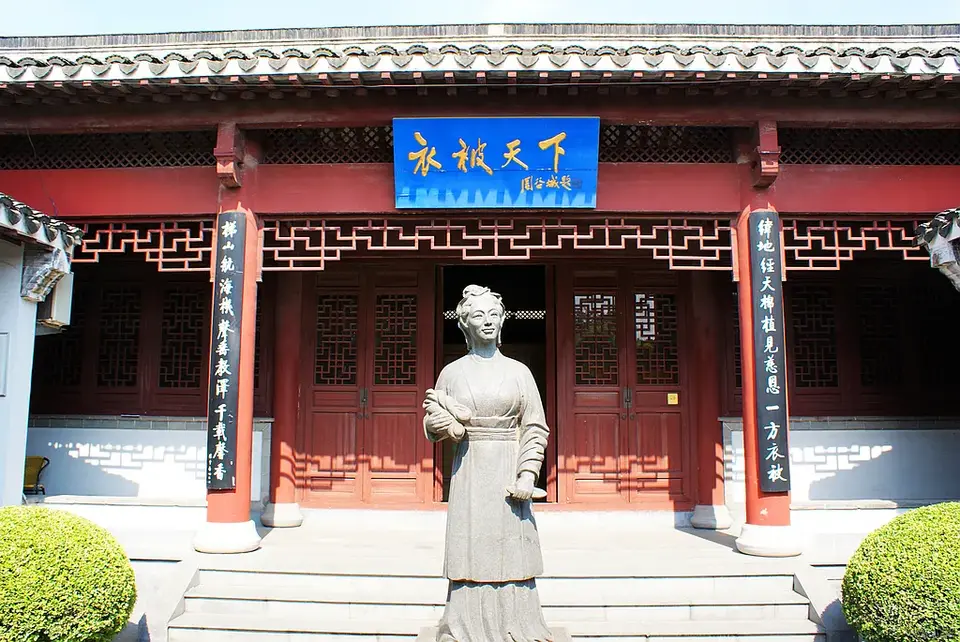
Life Story
Impoverished Youth and Escape across the Seas
Huang Daopo was born during the Chunyou era of the Southern Song dynasty in the water country of Wunijing in Songjiang Prefecture. At that time, southeastern China suffered from repeated natural disasters, crushing fiscal extractions, and societal distress. The low-lying terrain of Wunijing possessed infertile, brackish soil that yielded meager grain harvests; consequently, local peasant households planted cotton on marginal plots around their homesteads to supplement their precarious livelihood. Huang Daopo grew up in this impoverished rural setting.
According to regional traditions and later local gazetteers, she was sold at twelve or thirteen into the local Huang household as a child bride. Under the harsh constraints of traditional patriarchal domination, she performed exhausting agricultural labor by day and worked by the dim glow of an oil lamp late into the night weaving rough homespun cloth, enduring incessant verbal rebukes and physical beatings from her in-laws and husband. Following a particularly brutal assault, she was locked into a windowless woodshed without food. Possessing an unyielding spirit, she tore open the thatched roof during the night, fled to the banks of the Huangpu River, and concealed herself under the bottom deck of an ocean-going merchant junk docked at the harbor.
At dawn, the trading vessel set sail. When sailors inspected the hold and discovered the bruised and ragged girl, they were moved to deep compassion by her harrowing account. Choosing not to return her to abuse, the crew permitted her to remain aboard as the ship sailed south across thousands of miles of rough seas, eventually making landfall at the port of Yazhou on the southern tip of Hainan Island.
Three Decades among the Li and Learning the Craft
Upon arriving at the tropical frontier of Yazhou, the adolescent Huang Daopo found herself isolated and destitute, settling near Shuinan Village along the estuary of the Ningyuan River. Shuinan was a bustling commercial nexus where maritime trade routes converged, characterized by mixed settlements of indigenous Li people and Han immigrants. The warm-hearted Li women welcomed the stranded young woman with unstinting generosity, providing shelter, food, and daily care, granting her a secure sanctuary after years of trauma.
During the Song and Yuan dynasties, the Li people of southern Hainan possessed the most advanced cotton processing and textile technology in East Asia. From ancient times, Li communities had cultivated tree cotton, pioneering wooden rollers for ginning, bone spindles and spinning wheels for twisting thread, and foot-braced backstrap looms for intricate weft-patterned weaving. Their renowned Li brocades, floral blankets, and patterned screens were celebrated throughout the empire, having been selected as imperial tribute presented to the Southern Song court in Lin'an.
Huang Daopo resided in the Li village for over thirty years, maturing from an exiled refugee into a seasoned artisan. Sharing hearth and field with her Li peers, she integrated fully into their community life. With acute intelligence and tireless patience, she studied every phase of production: soil preparation, seed selection, picking, ginning, bow-fluffing, spinning, drafting, vegetable dyeing, and complex multi-heddle jacquard weaving, absorbing centuries of indigenous technical knowledge into a unified, practical craft.
Return to Wunijing and Comprehensive Technological Revolution
In 1292, the Yuan court established Songjiang Prefecture, bringing administrative stability and revitalized commerce to the Yangtze Delta. Around the Yuanzhen era (1295–1297), the aging Huang Daopo, now in her sixties, yearned for her ancestral homeland. Bidding farewell to her Li companions, she boarded a northbound grain transport vessel, carrying indigenous textile implements and decades of practical expertise back to her native Wunijing.
Upon her arrival, she discovered that while cotton cultivation had spread across Songjiang, processing methods remained extremely primitive. Villagers removed seeds by peeling them one by one with their fingers, leaving their hands calloused and bleeding while producing less than a pound of clean fiber daily. To fluff cotton, they used tiny, one-foot bamboo bows plucked with their fingers, which was exhausting and ineffective. Spinning relied on heavy single-spindle hand wheels, producing uneven yarn prone to snapping, while weaving was restricted to narrow, coarse, monochrome fabric that yielded meager market returns.
Confronted with the hardships of her neighbors, Huang Daopo resolved to make her knowledge public. Synthesizing Li mechanical concepts with Jiangnan carpentry and metallurgical expertise, she engineered the double-roller wooden gin to mechanize seed extraction. She enlarged the fluffing bow to five feet, stringing it with thick cord and utilizing a wooden mallet to strike the string, dramatically improving fiber loft. She redesigned the gear ratio and foot treadle of the spinning wheel to invent the three-spindle machine, allowing one worker to spin three uniform threads at once. Finally, she adapted Li brocade techniques to create complex floral patterns, establishing the famous Wunijing blanket style.
Instructing the People and Transforming Songjiang
Huang Daopo was not merely an inventor but an altruistic educator. She opened her modest workshop in Wunijing to women from surrounding villages, refusing to treat her craft as a proprietary trade secret. She patiently demonstrated how to build wooden gins, strike the large mallet bow, coordinate foot rhythms on the three-spindle wheel, and execute the intricate steps of interweaving, color matching, heddling, and pattern lifting, while freely sharing her formulas for vegetable dye extraction.
Under her dedicated guidance, a transformative industrial boom swept through Wunijing and neighboring counties. Farm women spun thread and threw shuttles late into the night, achieving an exponential rise in output. Wunijing produced vivid, durable cotton textiles decorated with floral sprigs, soaring phoenixes, and auspicious emblems, christened Wunijing blankets. Merchants arrived from distant provinces to purchase these goods in bulk. Within a few years, more than a thousand households around Wunijing sustained themselves through cotton textiles, transforming a formerly impoverished district into a prosperous commercial center.
This breakthrough established Songjiang Prefecture as the preeminent textile capital of imperial China. Huang Daopo's innovations constituted an authentic grassroots technological revolution, lifting millions of peasant families from grinding poverty and establishing her as an enduring patron of Chinese industry.
Passing at Huajing and Immortal Commemoration
In the early Dade era of the Yuan dynasty (c. 1300s), Huang Daopo passed away peacefully in Wunijing after a lifetime of labor. News of her death plunged the surrounding communities into deep mourning. Villagers gathered from miles around, weeping openly, and pooled their resources to inter her respectfully in Dongwan Village (modern Huajing Town, Xuhui District, Shanghai). To honor her benevolence, the local populace erected a shrine adjacent to her tomb, worshiping her as Mother Huang and the First Cotton Deity, establishing annual communal sacrifices on the sixth day of the fourth lunar month and the twentieth day of the seventh lunar month.
Decades later, in 1362, local literatus Zhang Shouzhong funded the relocation and rebuilding of the shrine on a spacious site south of the ancestral tombs of the regional water transport directors. Renowned poet Wang Feng commemorated the occasion by composing his famous verses in the Wuxi Collection, celebrating her historic voyage and the miraculous ingenuity of her looms. Throughout the Ming and Qing dynasties, prefectural officials and literati restored her shrine more than ten times.
In the Qing era, the Kangxi Emperor praised cotton cultivation in his Rhapsody on Tree Cotton. In 1957, the Shanghai municipal authorities refurbished her tomb and erected a marble stele reading Tomb of the Yuan Dynasty Textile Innovator Huang Daopo. In 1987, her resting place was designated a protected historical site by the Shanghai government, and in 2006, her traditional techniques were inscribed on China's National List of Intangible Cultural Heritage, preserving her humanitarian and technological legacy across the centuries.
Major Achievements
Developing the Iron-Wood Cotton Gin and Mechanizing Ginning
Prior to Huang Daopo's intervention, seed separation was the primary obstacle restricting the cotton economy of Jiangnan. Because cotton fibers adhere tightly to hard seeds, manual peeling was agonizingly slow and damaged the fiber staples. Adapting indigenous Li wooden rollers and combining them with Jiangnan wood-and-iron metallurgical craft, she created the jiaoche roller gin.
The machine featured a sturdy wooden frame supporting two horizontally mounted, counter-rotating rollers: an upper thin iron rod and a lower thick wooden roller, synchronized through gearing and operated by a hand crank. When raw seed cotton was fed into the narrow aperture, friction pulled the supple lint through to the far side while the rigid seeds, unable to pass through the gap, were stripped away and dropped into a collection bin. This mechanical device replaced tedious manual peeling, multiplying ginning productivity more than tenfold and overcoming the initial bottleneck in the textile production chain.
Creating the Large Mallet-Struck Bow and Fluffing Innovation
Once ginned, raw cotton fibers must be thoroughly fluffed and cleaned before spinning. Songjiang villagers previously used small, one-foot bamboo bows strung with silk thread, strummed feebly with fingers, which left fibers knotted and clogged with dust. Huang Daopo transformed this step by inventing the large mallet-struck bow.
She expanded the bow frame to four or five feet in length, constructed from heavy, flexible wood strung with heavy hemp or gut rope, paired with a specialized heavy wooden mallet. Suspending the bow over a dense layer of cotton, the operator struck the bowstring with rhythmic blows of the mallet. The intense mechanical vibrations pulverized tangles, shaking loose residual seed husks and dirt, fluffing the fibers into an ethereal, cloud-like consistency. This technique reduced processing time and provided an exceptionally uniform raw material suitable for high-count yarn, spreading later to Japan where it was celebrated as the Tang bow.
Inventing the Treadle Three-Spindle Spinning Wheel
In the yarn-twisting process, Huang Daopo achieved a landmark breakthrough in ancient mechanical engineering by inventing the treadle three-spindle cotton spinning wheel. Prior artisans utilized hand-cranked single-spindle wheels, where one hand turned the drive wheel while the other drafted the roving, resulting in slow speeds and frequent fiber breakage. Addressing the shorter staple length of cotton relative to hemp, she systematically redesigned the spinning wheel.
She reduced the diameter of the bamboo drive wheel, adjusted the crank eccentric distance, and re-engineered the leverage ratio of the foot treadle to ensure a smooth, stable rotational speed that matched the tensile limit of cotton fibers. Most decisively, she converted the power source to dual foot pedals and mounted three spinning spindles in parallel atop the frame. This innovation freed the operator's hands entirely; while her feet maintained uniform rotational momentum, her hands simultaneously drafted and spun three independent threads. The three-spindle machine tripled individual output, leading British science historian Joseph Needham to remark that Huang Daopo's mechanical layout anticipated the multi-spindle principles of Europe's Industrial Revolution by over four centuries.
Formulating Jacquard Weaving Techniques and Clothing the Realm
At the weaving stage, Huang Daopo elevated Chinese cotton textiles to an exquisite artistic height. Overcoming the limitations of plain, narrow homespun cloth, she integrated the weft-patterning methods of Li floral blankets with Jiangnan multi-heddle silk-weaving loom structures, codifying the complete four-stage jacquard protocol of interweaving, color matching, heddling, and pattern lifting.
Her method utilized diverse yarn weights and twist directions, botanical dyes such as indigo and madder for chromatic harmony, complex heddle arrays for warp separation, and pattern rods for raising selected warp threads to insert colored wefts. This system enabled the production of iconic Wunijing blankets adorned with scattered floral sprigs, swirling phoenixes, geometric chessboards, and auspicious script. Highly durable and visually stunning, these textiles were transported along inland canals and coastal shipping routes, establishing Songjiang as the textile heart of Ming and Qing China, where annual production reached tens of millions of bolts and generated half the empire's fiscal revenues.
Elevating Female Economic Status and Spurring Urban Commercialization
Huang Daopo's technological breakthroughs restructured rural socioeconomic dynamics and gender roles throughout the Lower Yangtze. Prior to her innovations, traditional peasant households conformed to subsistence agriculture where female home spinning was merely peripheral. The emergence of high-value commercial cotton cloth meant that a woman's earnings from spinning and weaving frequently surpassed the grain revenues of male field labor. Rural women became the principal cash earners of the peasant household, establishing the hybrid production model of weaving to assist farming, celebrated in folk songs across Shanghai.
Furthermore, commercialized textile production stimulated urban expansion across Jiangnan. Raw cotton markets and merchant firms emerged along waterways, fostering ancillary industries in ginning, dyeing, calendering, and shipping. Market towns including Wunijing, Zhujing, Zhujiajiao, Sanlin, and Longhua flourished as commercial hubs, absorbing rural surplus labor and providing foundational momentum for early modern industrial enterprise in the Yangtze Delta.