Birth in Beijing
Born in the Prince Qingxi mansion as the eldest son of Prince Mianxing.
奕劻
Aisin Gioro Yikuang (爱新觉罗·奕劻, courtesy name Futing, March 24, 1838 – January 29, 1917), also known as Prince Qing, was a pivotal imperial clansman, statesman, and the first Prime Minister of the Qing Dynasty, registered under the Manchu Bordered Blue Banner. He was a great-grandson of the Qianlong Emperor and grandson of Prince Qingxi (Yonglin). Initially succeeding as a Bulwark General, he was progressively elevated through…
Aisin Gioro Yikuang (爱新觉罗·奕劻, courtesy name Futing, March 24, 1838 – January 29, 1917), also known as Prince Qing, was a pivotal imperial clansman, statesman, and the first Prime Minister of the Qing Dynasty, registered under the Manchu Bordered Blue Banner. He was a great-grandson of the Qianlong Emperor and grandson of Prince Qingxi (Yonglin). Initially succeeding as a Bulwark General, he was progressively elevated through the ranks of Beile and Prince of the Second Rank during the Xianfeng and Tongzhi eras. Highly compliant and an accomplished calligrapher, he earned the enduring favor and trust of Empress Dowager Cixi, becoming a cornerstone of late Qing governance. Following the dismissal of Prince Gong in the Political Shift of 1884, Yikuang took charge of the Zongli Yamen and was created Prince Qing of the First Rank. After the Boxer Uprising of 1900, Yikuang and Li Hongzhang served as imperial plenipotentiaries, negotiating and signing the humiliating Boxer Protocol with eleven foreign powers. In 1903, he succeeded Ronglu as Chief Grand Councilor and was awarded hereditary prince status. In May 1911, the Qing court established a constitutional cabinet, appointing Yikuang as Prime Minister. However, his "Imperial Cabinet" concentrated power in royal hands, alienating constitutionalists. Following the 1911 Wuchang Uprising, Yikuang supported the abdication of Emperor Puyi to secure royal preferential treatment, retiring to Tianjin, where he died in 1917 with the posthumous title Mi.
Born in the Prince Qingxi mansion as the eldest son of Prince Mianxing.
Adopted by his deceased uncle Mianti, succeeding to the rank of Bulwark General to commence his court career.
Succeeded the ousted Prince Gong as head of the Zongli Yamen, elevated to Prince Qing of the Second Rank.
Appointed with Prince Chun to supervise naval development upon the establishment of the Admiralty.
Advanced to Prince Qing of the First Rank on the occasion of Empress Dowager Cixi's sixtieth birthday.
Aided Cixi in securing Beijing defenses during the coup, receiving hereditary succession status as an Iron-Cap Prince.
Appointed Plenipotentiary with Li Hongzhang following the Allied occupation of Beijing, signing the Boxer Protocol in 1901.
Succeeded Ronglu as Chief Grand Councilor and Supervisor of the Ministry of Finance, commanding supreme administrative power.
Abolished the Grand Council to establish a constitutional cabinet, becoming the first Prime Minister in Chinese history.
Persuaded Empress Dowager Longyu to issue the abdication edict, ending two millennia of imperial monarchy in China.
Died in his residence in the British Concession of Tianjin at the age of seventy-eight; granted the posthumous title Mi.
Yikuang traced his pedigree to the Qing imperial core as the grandson of Prince Qingxi (Yonglin), the seventeenth son of Emperor Qianlong. In the twenty-second year of Daoguang (1842), a bitter scandal convulsed the Prince Qing mansion when Yikuang's biological father, Mianxing, was convicted of bribing Clan Court officers to seize ancestral inheritance titles, resulting in banishment to Mukden. In the twenty-ninth year of Daoguang (1849), when Mianxing's brother Mianti died childless, the court decreed Yikuang's adoption as Mianti's heir, confirming him with the diminished rank of Bulwark General. The family mansion was subsequently reassigned to Prince Gong, leaving Yikuang in straitened circumstances.
Nevertheless, Yikuang exhibited remarkable tact, attentiveness, and diplomatic instincts. He advanced to Prince of the Fourth Rank in 1852 and Prince of the Third Rank in 1860. Before Empress Dowager Cixi assumed the regency, she engaged in constant confidential correspondence with her brother Guixiang. Yikuang, possessing an impeccable, elegant calligraphic hand, was frequently summoned to transcribe private imperial letters, cementing Cixi's personal confidence. Following Emperor Tongzhi's imperial wedding in 1872, Yikuang was granted the brevet status of Prince of the Second Rank and designated Grand Minister of the Imperial Presence.
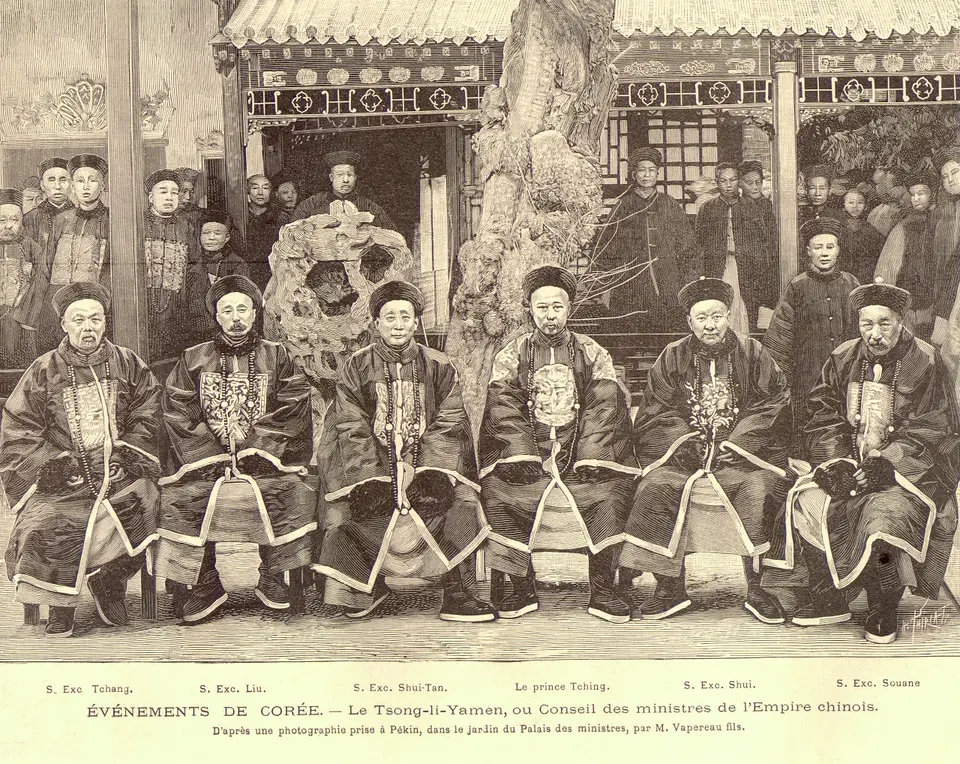
In the tenth year of Guangxu (1884), amidst military setbacks during the Sino-French War, Empress Dowager Cixi orchestrated the Jiashen coup, ousting Prince Gong and purging his entire Grand Council and foreign office staff. In his place, Cixi elevated the pliable Yikuang as head of the Zongli Yamen, investing him as Prince Qing of the Second Rank. In 1885, the Qing court established the Admiralty, appointing Yikuang to manage naval affairs alongside Prince Chun. Over the next fifteen years, Yikuang adhered strictly to imperial instructions. During the Sino-French negotiations, he implemented the policy of combining active defense with negotiated settlement, assisting Li Hongzhang in concluding the Treaty of Tientsin.
In the twentieth year of Guangxu (1894), Yikuang was advanced to Prince Qing of the First Rank. During the 1898 Hundred Days Reform, perceiving the deepening rift between the emperor and the empress dowager, Yikuang firmly backed Cixi's faction, coordinating metropolitan military units to suppress reformists. Deeply appreciative, Cixi rewarded Yikuang by conferring perpetual hereditary rank upon his princely title, establishing him as the final Iron-Cap Prince of the Qing dynasty.
In late 1900, the Boxer Uprising consumed northern China. Yikuang had earlier supervised missionary dispute regulations and urged suppression of boxing societies under the policy of "quelling boxers to pacify foreigners." However, when conservative princes supported the Boxers, Yikuang retreated into passive compliance. When Allied troops captured Beijing and the court fled west, Yikuang was appointed Plenipotentiary with Li Hongzhang. Negotiating under foreign occupation, Yikuang conceded to foreign demands, signing the Boxer Protocol in September 1901 and securing the emperor and empress dowager's return to the capital.
Upon the court's return to Beijing, Yikuang's diplomatic accomplishments were rewarded with unprecedented favor. Following the death of Chief Grand Councilor Ronglu in 1903, Cixi appointed Yikuang Chief Grand Councilor and Supervisor of the Ministry of Finance, making Prince Qing's title hereditary in perpetuity. Recognizing the rising star of Zhili Governor-General Yuan Shikai and his modernization of the Beiyang Army, Yikuang forged a formidable political partnership. Yuan supplied astronomical bribes and operational funding to Prince Qing's mansion, while Yikuang systematically shielded Yuan's Beiyang interests before Cixi, cementing the dominant "Qing-Yuan Alliance."
During his tenure at the head of the Grand Council, Yikuang and his eldest son Zaizhen presided over rampant venality and office-selling. Censors such as Jiang Shixing and Zhao Qilin repeatedly impeached Yikuang for stashing millions in British HSBC accounts and accepting gifts from provincial aspirants, but Cixi invariably dismissed all allegations. To maintain imperial favor, Yikuang introduced mahjong to the imperial palace and dispatched concubines to attend Cixi. Foreign correspondents such as George Ernest Morrison reported on his vast financial assets in Western banks. Following the deaths of Cixi and Guangxu in 1908, Prince Regent Zaifeng attempted to purge Yuan Shikai; Yikuang utilized his seniority to cushion the transition, preserving his status as supreme minister.
In May 1911 (4th month of the 3rd year of Xuantong), under mounting constitutional pressure, the Qing government abolished the Grand Council and established China's first formal responsible cabinet, naming Yikuang Prime Minister. However, out of thirteen ministers, nine were Manchus and five were imperial clan princes, prompting bitter condemnation of the government as the "Imperial Cabinet." Yikuang's administration enacted the nationalization of private trunk railways, expropriating commercial investments across Sichuan, Hubei, Hunan, and Guangdong, which immediately ignited the Railway Protection Movement and catalyzed the Wuchang Uprising in October 1911.
With provincial declarations of independence multiplying rapidly, Yikuang realized imperial forces could not quell the rebellion without Beiyang support. He persuaded Prince Regent Zaifeng to dissolve the Imperial Cabinet and recall Yuan Shikai to supreme command. When Yuan formed a new ministry in November 1911, Yikuang stepped down, assuming the ceremonial presidency of the Privy Council. Convinced that monarchical preservation was impossible, Yikuang coordinated with Yuan during the imperial conferences, urging Empress Dowager Longyu to accept the republican Articles of Favorable Treatment. On February 12, 1912, the Qing emperor abdicated, terminating imperial rule. Yikuang retired to the British Concession in Tianjin, passing away in January 1917; the deposed court bestowed the posthumous name Mi.
Surrounded by foreign expeditionary forces in the occupied capital of Beijing, Yikuang performed the most arduous and consequential diplomatic assignment of the late Qing dynasty. Collaborating with Li Hongzhang under extreme coercion, he completed negotiations with eleven foreign ministers, terminating military occupation in the capital and preserving the nominal continuity of the Qing court.
In 1911, Yikuang presided over the structural modernization of the Qing executive branch, assuming office as the first Prime Minister in imperial history. However, the blatant clan nepotism of his "Imperial Cabinet" utterly shattered constitutionalists' faith in peaceful imperial reform, directly triggering the widespread provincial defections that fueled the 1911 Xinhai Revolution.
During the existential crisis of 1911–1912, Yikuang rejected the fanatical calls of the Royalist Party for armed resistance, championing the Articles of Favorable Treatment negotiated between Yuan Shikai and southern revolutionaries. In imperial palace councils, his senior voice as the foremost clan prince proved decisive in securing the peaceful abdication of the child emperor Puyi, ensuring a bloodless transition from imperial autocracy to a modern republic.
From 1903 onward, Yikuang maintained a dominant partnership with Beiyang Viceroy Yuan Shikai. Backed by Beiyang military force and financial subsidies, Yikuang shielded Yuan's administrative, police, and military innovations at court. This coalition profoundly realigned the central political structure of late Qing and dictated the trajectory of the 1911 transition.
Following his appointment to the Zongli Yamen, Yikuang assisted in executing wartime diplomacy during the Sino-French War and participated in the establishment of the Admiralty in 1885 alongside Prince Chun. He oversaw coastal defense appropriations and warship acquisitions, playing a continuous administrative role in the modernization of late Qing maritime forces.
Prior to the Boxer conflict, Yikuang managed escalating religious conflicts such as the Juye Incident, helping formulate official regulations for missionary disputes. He advocated for the suppression of violent boxing bands and the maintenance of peaceful relations with foreign states, formulating realistic containment strategies before the crisis erupted.
FIGURES ASSOCIATED WITH THIS DYNASTY