Birth into an Illustrious Lineage
Born into the elite Lu clan of Wu Commandery; his father Lu Kang served as Grand Administrator of Lujiang.
陆绩
Lu Ji (陆绩, 188–219 AD, courtesy name Gongji), a native of Wu County in Wu Commandery (present-day Suzhou, Jiangsu Province), was an eminent scholar, statesman, astronomer, and philosophical commentator of Eastern Wu during the Three Kingdoms Period. The son of Lu Kang, Grand Administrator of Lushan during the late Eastern Han dynasty, Lu Ji is celebrated as one of the central figures in the traditional *Twenty-Four Filial…
Lu Ji (陆绩, 188–219 AD, courtesy name Gongji), a native of Wu County in Wu Commandery (present-day Suzhou, Jiangsu Province), was an eminent scholar, statesman, astronomer, and philosophical commentator of Eastern Wu during the Three Kingdoms Period. The son of Lu Kang, Grand Administrator of Lushan during the late Eastern Han dynasty, Lu Ji is celebrated as one of the central figures in the traditional Twenty-Four Filial Exemplars for the timeless story of "concealing oranges to present to his mother." Born into the illustrious Lu clan of Wu, he exhibited profound intellect and devotion to classical learning from early childhood, mastering Confucian canonical texts, astronomy, mathematical sciences, and divination. At the tender age of six, while visiting the warlord Yuan Shao's ally Yuan Shu in Jiujiang with his father, Lu Ji received oranges as hospitality and concealed three inside his robes for his mother. When the fruits dropped as he bowed in departure, his heartfelt filial response astonished the entire banquet. As a youth in Sun Ce's entourage, when prominent senior scholars advocated pure martial force to conquer the empire, young Lu Ji fearlessly spoke up from the back row, citing Guan Zhong and Confucius to champion the preeminence of cultural virtue and moral benevolence over raw military coercion. Sun Quan subsequently recruited him as a Clerk in the Memorials Bureau, where his uncompromising rectitude and fearless integrity commanded immense respect. In 210 AD, Sun Quan appointed Lu Ji Grand Administrator of Yulin and General of the Division, dispatching him to pacify the remote southern territory of Jiaozhou with two thousand troops. Despite suffering from chronic leg ailments and preferring intellectual contemplation to border administration, Lu Ji governed the malaria-ridden frontier with exceptional benevolence, constructing municipal fortifications and drilling the famous "Lu Gong Well" to provide clean drinking water and stem infectious epidemics. Alongside his official duties, he authored monumental scientific treatises including the Armillary Sphere Chart (Huntian Tu) and commentaries on the Classic of Changes (Zhouyi) and Yang Xiong's Taixuanjing. Lu Ji passed away at the age of thirty-two. His incorruptibility was so absolute that upon his return journey, his baggage was too light to stabilize his boat, forcing his subordinates to place a massive boulder in the hold. Preserved as the famous "Stone of Incorruptibility" (Lianshi), it stands today as an enduring cultural monument to clean governance.
Born into the elite Lu clan of Wu Commandery; his father Lu Kang served as Grand Administrator of Lujiang.
At age six in Jiujiang, concealed oranges given by Yuan Shu to take home to his mother, earning widespread renown for filial devotion.
As a junior guest in Sun Ce's camp, boldly refuted senior scholars by arguing that moral virtue surpassed martial conquest.
Sun Quan took control of Jiangdong and appointed Lu Ji Clerk in the Memorials Bureau, respecting his unwavering integrity.
Appointed Grand Administrator of Yulin and General of the Division; governed the southern frontier, dug civic wells, and pursued astronomical research.
Composed his farewell elegy and died in office at age thirty-two; his ballast stone became celebrated as the immortal Lianshi.
Lu Ji belonged to the prominent Lu clan of Wu Commandery, one of the most prestigious aristocratic lineages in southern China. His great-grandfather Lu Xu and granduncle Lu Yu had served the Eastern Han court with distinction, while his father Lu Kang governed Lujiang Commandery with celebrated loyalty and steadfast moral courage. Endowed with an imposing physical stature and exceptional intellectual curiosity, Lu Ji exhibited an early passion for Confucian learning. In his youth, he immersed himself in the Classic of Poetry and the Classic of History, progressing to deep examinations of the Rites and the Classic of Changes, while mastering calendrical astronomy, mathematics, and occult computations.
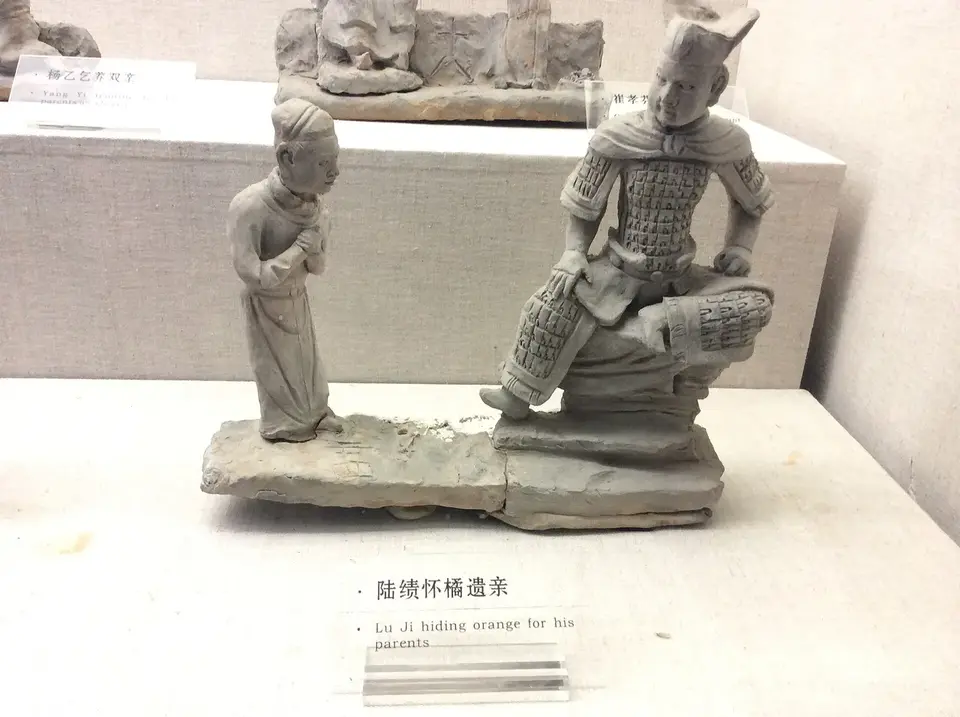
In 193 AD, the six-year-old Lu Ji accompanied his father Lu Kang to visit the regional warlord Yuan Shu in Jiujiang. Recognizing the high status of his guests, Yuan Shu had his attendants serve sweet southern oranges, which were rare and prized delicacies. After finishing his portion, young Lu Ji quietly slipped three oranges into the folds of his wide sleeves. At the conclusion of the feast, as Lu Ji bowed deeply to offer his farewell greetings, the three oranges slipped from his robes and rolled across the tiled reception hall.
Yuan Shu laughed boisterously and teased the child in front of the gathered guests, inquiring why a young noble guest would secretly pilfer fruit from his host's table. Six-year-old Lu Ji knelt respectfully and replied that his mother was exceedingly fond of sweet oranges; having tasted them, he could not bear to enjoy them alone and wished to bring them home for her to savor. Yuan Shu was astonished by the child's natural affection and filial devotion. The story of "Lu Ji concealing oranges" spread rapidly throughout the Huai and Yangzi river valleys, eventually being immortalized by Yuan dynasty scholar Guo Jujing in the canonical Twenty-Four Filial Exemplars.
During the Xingping era, warlord Sun Ce conquered Jiangdong and established his headquarters in Wu Commandery, gathering intellectual luminaries to his banner. Lu Ji entered Sun Ce's entourage as a junior scholar. On one occasion, senior advisors including Zhang Zhao, Zhang Hong, and Qin Song sat as honored guests, passionately discussing the fractured state of the empire. They unanimously asserted that in an era of violent chaos, the realm could only be subdued and unified through unyielding martial force and armed conquest.
Due to his young age, Lu Ji occupied the very last seat at the rear of the hall. Hearing their discourse, he stood up abruptly and declared in a resonant voice: "In antiquity, when Guan Zhong served Duke Huan of Qi as chancellor, he united the feudal lords nine times and rectified the entire realm without resorting to war chariots! Confucius instructed that if distant peoples refuse to submit, one must cultivate civil virtue to attract them. Today, gentlemen assemble to deliberate statecraft, yet rather than pursuing moral benevolence and ethical transformation, you advocate solely for naked military force! Though I am but a youthful beginner, I cannot rest easy with such flawed arguments!"
The entire hall fell into stunned silence. Veteran statesmen like Zhang Zhao and Zhang Hong looked at each other in disbelief, deeply moved and humbled by the youth's eloquence, profound erudition, and moral fearlessness. Lu Ji's intellectual reputation soared across the region. Though still in his teens, his scholarship and gravitas surpassed that of senior contemporaries. He was ranked as an equal to Gu Shao and held in higher esteem by regional scholars than his contemporaries Lu Xun, Zhang Dun, and Bu Jing.
Lu Ji's magnanimous demeanor attracted prominent friends. Pang Tong, the famed strategist of Jingzhou known as the "Fledgling Phoenix," and Yu Fan, an outspoken senior scholar of Kuaiji known for his severe standards, were both significantly older than Lu Ji, yet both developed profound, lifelong friendships with him. In 210 AD, when Zhou Yu died in Baqiu and Pang Tong escorted the funeral cortege back to Wu, Lu Ji traveled with Quan Cong and Gu Shao to offer condolences. During their farewell conversations, Pang Tong praised Lu Ji as possessing the extraordinary stamina of a thoroughbred steed capable of boundless journeys.
In 200 AD, Sun Ce was assassinated, and his younger brother Sun Quan inherited authority over Jiangdong. Seeking talented local figures, Sun Quan appointed Lu Ji as a Clerk in the Memorials Bureau. Guided by strict Confucian ethics, Lu Ji discharged his duties with scrupulous fairness and uncompromising honesty, frequently submitting blunt admonitions on administrative conduct. His colleagues revered and feared his incorruptibility. Although Sun Quan recognized Lu Ji's immense talents, the young lord felt uneasy in the presence of his unyielding righteousness, fearing that such independence might prove difficult to govern at court.
In 210 AD, following the pacification of Jiaozhou, Sun Quan appointed Lu Ji Grand Administrator of Yulin and General of the Division, granting him command of two thousand troops to secure the far southern frontier. Yulin was a remote, rugged territory plagued by oppressive heat, tropical malaria, and volatile indigenous tribes. Lu Ji suffered from chronic leg ailments that made walking arduous, and his personal ambition lay entirely in classical study and authoring scholarly treatises rather than managing military garrisons in distant borderlands.
Nevertheless, Lu Ji accepted the appointment without complaint, undertaking the grueling multi-month journey south with his young family. Upon arrival, he instituted clean, disciplined governance, prohibiting officials and soldiers from extorting local tribes. Finding that the regional drinking water was brackish and responsible for rampant infectious fevers, Lu Ji surveyed the topography outside the commandery seat and mobilized soldiers and civilians to excavate a deep civic well. The sweet freshwater that gushed forth dramatically improved public health and curtailed epidemics. The grateful populace named the water source the "Lu Gong Well."
Lu Ji actively developed irrigation channels, encouraged agricultural reclamation, and established commandery schools to instruct indigenous youths in classical texts and Confucian etiquette. Through moral benevolence rather than force, he won the allegiance of regional chieftains, who submitted tributes and integrated peacefully into the administrative structure. During his tenure, a daughter was born to him; to honor his deep bond with the people of the commandery, he named her Lu Yusheng (meaning "born in Yulin").
Despite heavy administrative and military burdens, Lu Ji never ceased his intellectual inquiries. Burning the midnight oil in his frontier residence, he conducted deep research into astronomy, mathematics, and canonical hermeneutics. Championing the Huntian (celestial sphere) theory developed by Western Han scholars against the prevailing flat-earth Gaitian school, he calculated the orbital trajectories of the sun, moon, and five planets. He drafted the groundbreaking Huntian Tu (Armillary Sphere Chart) and authored the Huntian Yi Shuo (Discourse on the Armillary Sphere), articulating an advanced cosmological model of a spherical Earth enclosed within celestial spheres like an egg yolk within a shell.
Simultaneously, Lu Ji sought to cleanse Han dynasty classical interpretation of superstitious omens and apocrypha. He composed voluminous, rigorous commentaries on the Classic of Changes and Yang Xiong's philosophical work Taixuanjing. Historian Chen Shou later remarked in the Records of the Three Kingdoms that Lu Ji's contribution to Yang Xiong's philosophy was equivalent to Zuo Qiuming's elucidation of Confucius or Zhuang Zhou's expansion of Laozi, representing an unexcelled pinnacle of scholarly synthesis.
Prolonged residence in the tropical environment severely aggravated Lu Ji's underlying health conditions. By 219 AD, his chronic illnesses worsened, and realizing that his end was near, he calmly composed his famous deathbed elegy: "Here lies Lu Ji of Wu Commandery, a determined scholar of the Han; in youth he mastered the Odes and Documents, in adulthood he contemplated the Rites and Changes. Ordered south on imperial service, he encountered affliction and adversity, meeting an untimely fate. Alas, how sorrowful!" He then added a prophetic declaration: "Sixty years from this day, carts will share the same axle tracks, and writing will share the same script; my only grief is that I shall not live to witness it!" This striking forecast accurately anticipated the eventual Western Jin reunification of China sixty-one years later. He died shortly after at the age of thirty-two.
Throughout his years in office, Lu Ji lived with absolute austerity, refusing any form of illicit wealth. When his bereaved family packed his belongings to transport his coffin back to Wu Commandery, they discovered that his earthly possessions consisted solely of several crates of weathered manuscripts and worn clothing, without a single bolt of silk or bag of silver. The merchant vessel hired for the coastal voyage rode so high in the water that the sailors feared it would capsize in rough sea waves. In desperation, his attendants had a massive granite boulder weighing thousands of pounds hauled onto the ship to serve as ballast, allowing the vessel to safely cross the sea.
Upon arriving in Wu, local citizens were overwhelmed by the realization that their brilliant administrator had returned home with nothing but a giant stone in his cargo hold. They reverently moved the ballast boulder to the prefectural courtyard, dubbing it the "Stone of Incorruptibility" (Lianshi). Relocated during the Ming and Qing dynasties to the Suzhou Confucian Temple, the stone remains one of China's most celebrated cultural monuments dedicated to administrative purity, cementing Lu Ji's eternal reputation as a paragon of virtuous statecraft.
At age six in Jiujiang, Lu Ji took three oranges from Yuan Shu's banquet and hid them in his sleeve to take home to his mother.
When the fruit dropped as he bowed, his candid devotion to his mother astonished the warlord; the episode was enshrined in Guo Jujing's Twenty-Four Filial Exemplars as an immortal symbol of filial piety.
As a youthful attendee at Sun Ce's strategy council in Wu Commandery, Lu Ji boldly stood up against senior scholars who advocated pure martial force.
By invoking Guan Zhong's peaceful hegemony and Confucius's emphasis on civil virtue, he demonstrated extraordinary moral courage and intellectual depth that captivated Jiangdong's cultural elite.
Serving as Grand Administrator of Yulin in the remote south, Lu Ji governed with incorruptible integrity and deep humanitarian compassion.
He excavated the celebrated "Lu Gong Well" to provide clean drinking water, halted raging epidemics, constructed municipal defenses, and advanced education among indigenous tribes.
During his tenure as commandery governor, Lu Ji refused all corrupt enrichment, returning home so poor that his sea vessel lacked ballast.
Subordinates loaded a massive granite boulder into the cargo hold to keep the vessel stable, creating the immortal legend of the Lianshi as an eternal standard of clean governance.
Devoting his leisure hours to profound scientific inquiry, Lu Ji championed spherical celestial astronomy against flat-earth doctrines.
He drafted the renowned Huntian Tu and authored commentaries on the Classic of Changes and Taixuanjing, establishing himself as an outstanding polymath and astronomer of the Three Kingdoms era.
FIGURES ASSOCIATED WITH THIS DYNASTY