Birth in Eastern Fujian
Born along the Ao River in Lianjiang County, Fuzhou Prefecture, Fujian, into a scholarly family.
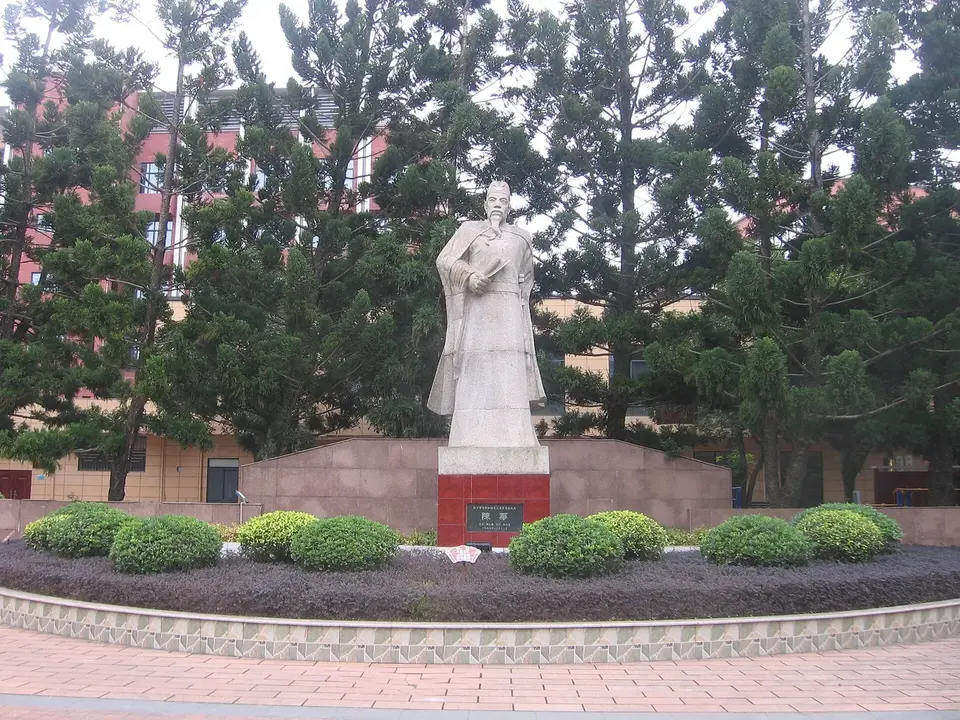
陈第
Chen Di (1541 – 1617), courtesy name Jili, art name Yizhai, and later sobriquets Wenma Shannong and Traveler of the Five Sacred Mountains, was a native of Lianjiang County, Fuzhou Prefecture, Fujian. An outstanding phonologist, military strategist, bibliophile, and traveler during the Wanli reign of the Ming dynasty, he combined civil and martial talents from his youth, mastering military treatises. In the early Wanli reign,…
Chen Di (1541 – 1617), courtesy name Jili, art name Yizhai, and later sobriquets Wenma Shannong and Traveler of the Five Sacred Mountains, was a native of Lianjiang County, Fuzhou Prefecture, Fujian. An outstanding phonologist, military strategist, bibliophile, and traveler during the Wanli reign of the Ming dynasty, he combined civil and martial talents from his youth, mastering military treatises. In the early Wanli reign, he submitted strategic memorials on coastal defense to anti-piracy general Qi Jiguang, earning deep admiration from Commander Yu Dayou, who inducted him into his staff. Later recommended to serve in Jizhou Garrison, he was appointed Garrison Commander and Mobile Corps Commander of Gubeikou, guarding the strategic Great Wall pass for a decade and repelling Mongol incursions. In 1583, he retired from military service, constructing Juanyou Lu and the Shishan Hall library, gathering over 10,000 volumes. In 1602, over sixty years of age, Chen accompanied naval general Shen Yourong across the Taiwan Strait to suppress Japanese pirates, conducting field investigations in indigenous settlements and authoring Dongfan Ji (Record of the Eastern Barbarians), the earliest firsthand documentary account of indigenous Taiwanese society, livelihood, customs, and geography. Theoretically, challenging the Song Dynasty convention of arbitrarily changing rhymes (xieyun), Chen formulated the landmark scientific thesis that "Time has past and present; geography has south and north; characters undergo reforms, and pronunciations shift." He authored Maoshi Guyin Kao (Research into the Ancient Pronunciation of the Mao Odes) and Qu Song Guyin Yi, pioneering the dual methodology of internal and external textual verification, eradicating ancient phonological obscurities and becoming the founding father of Qing evidential scholarship and historical Chinese phonology.
Born along the Ao River in Lianjiang County, Fuzhou Prefecture, Fujian, into a scholarly family.
With pirates raiding the Fujian coast, Chen submitted a memorial to Qi Jiguang proposing defense strategies.
Met General Yu Dayou in Fuzhou; highly valued, Chen was instructed in ancient chariot warfare formations.
Recommended by Yu Dayou to serve under Qi Jiguang in Jizhou, appointed Commander of Gubeikou.
Resigned from military rank, returning to Lianjiang to build Juanyou Lu and Shishan Hall, collecting 10,000 volumes.
Accompanied naval commander Shen Yourong across the sea to Dayuan (Taiwan) to subdue pirates, authoring Dongfan Ji.
Resided at scholar Jiao Hong's home in Nanjing for five years, transcribing rare texts and returning with two carts of books.
Following years of research, completed the four-volume phonological masterwork Maoshi Guyin Kao.
Compiled the two-volume Shishan Tang Cangshu Mulu, summarizing his lifelong library collections.
Passed away peacefully at Juanyou Lu in Lianjiang at seventy-seven.
Chen Di was born in 1541 (the twentieth year of the Jiajing reign) along the Ao River in Lianjiang County, Fuzhou Prefecture, Fujian. His lineage was an eminent local family with a rich book-collecting tradition. Living during the height of the mid-Jiajing wokou piracy crises, Chen witnessed devastated coastal towns and displaced refugees, resolving to pursue practical statecraft (jingshi zhigong). Beyond classical Confucian texts, he studied ancient military treatises such as Sun Tzu's Art of War and Wu Qi's treatises, practicing horsemanship, archery, and swordsmanship, combining literati erudition with martial courage. In 1562, when Qi Jiguang led troops into Fujian to suppress pirates, the youthful Chen visited Qi's camp to submit military memorials detailing fort construction and coastal patrol strategies, winning Qi's admiration.
In the early Wanli reign, Chen taught students in Fuzhou, frequently discussing national frontier defense with scholar-officials. Hearing of his military gifts, Grand Coordinator Yu Dayou invited him onto his staff. Yu, a master of tactics and chariot formations, recognized Chen's loyalty and taught him ancient chariot defense tactics. In 1575, Yu recommended Chen to Jizhou Supreme Commander Qi Jiguang. Qi hired Chen to serve beyond the passes, appointing him Commander of Gubeikou, soon elevated to Mobile Corps Commander. Gubeikou commanded the vital Yanshan Mountain corridor leading to the Mongolian steppe, serving as the northern defensive gateway to Beijing. Over ten years, Chen rebuilt fortifications, repaired the Great Wall, drilled beacon signals, and patrolled the passes in freezing blizzards, repelling Mongol cavalry and keeping the frontier secure.
In 1583 (the eleventh year of the Wanli reign), following the death of Senior Grand Secretary Zhang Juzheng, court politics shifted; Qi Jiguang was demoted to Guangdong, and Yu Dayou had passed away. Realizing that frontier affairs were deteriorating and court politics were perilous, Chen submitted his resignation at forty-three to return to Lianjiang. North of the county walls, he built a residence named "Juanyou Lu" ("Retreat from Weary Travels"), constructing alongside it a library named "Shishan Hall" dedicated to housing ancient and modern literature.
Chen had no hobbies other than books, loving literature with boundless passion. Although he inherited ancestral volumes, he considered his learning limited. Traveling with a single servant carrying book baskets, he journeyed across China, purchasing rare texts wherever he went. At sixty-four, hearing that Hanlin Zhuangyuan Jiao Hong possessed the empire's richest private library in Nanjing, Chen journeyed to Jinling, residing at Jiao's mansion for five years to read and transcribe rare manuscripts, hiring two large carts to transport his books home. Through decades of collecting, his library amassed over 1,900 titles across 10,000 volumes, including hundreds of rare Song and Yuan blockprints. In 1616, he compiled the two-volume Shishan Tang Cangshu Mulu, establishing a pioneering classification scheme that broke away from conventional fourfold cataloging, serving as a model for Ming bibliophiles.
In 1602 (the thirtieth year of the Wanli reign), piracy flared along the Fujian coast. Japanese pirates and Chinese brigands established bases at Dayuan (Taiwan), raiding merchant shipping from Penghu and Wanggang. The Grand Coordinator of Fujian ordered naval general Shen Yourong to command a fleet to destroy the pirate strongholds. Though sixty-two years of age, Chen was eager to serve, securing permission to accompany Shen's flagship across the Taiwan Strait.
Overcoming severe storms near Penghu, the Ming fleet smashed the pirates in the Taiwan Strait, burning enemy ships and expelling them from Dayuan. Following the victory, the naval force rested in Taiwan for over twenty days. Despite his advanced age, Chen traveled with light luggage into indigenous settlements near modern Tainan (Chihkan and Anping), conversing with Pingpu tribal elders around campfires and visiting thatched villages. He investigated their agriculture, food, clothing, marriage, funeral rites, language, trade, and social organization. Upon his return, Chen recorded his firsthand observations in Dongfan Ji (Record of the Eastern Barbarians). This work stands as the earliest firsthand eyewitness documentary record of indigenous Taiwanese society in world history, possessing immense anthropological and geographical value.
In his later years, Chen devoted himself entirely to classical Chinese phonology. From the Song dynasty onward, Neo-Confucian scholars led by Zhu Xi, failing to understand historical sound shifts between ancient, middle, and modern Chinese, arbitrarily altered pronunciations whenever rhymes in the Classic of Poetry (Shijing) or Songs of Chu (Chuci) did not rhyme according to contemporary speech, calling this practice "harmonizing rhymes" (xieyun). This subjective alterations distorted the ancient Chinese phonological system.
Detesting this unscientific practice, Chen resolved to restore historical truth through empirical research. From 1600 onward, he secluded himself in Juanyou Lu, examining pre-Qin and Han texts. After six years of rigorous collation, he completed the epochal four-volume phonological treatise Maoshi Guyin Kao in 1606, followed by the three-volume Qu Song Guyin Yi. Establishing an unassailable empirical methodology, Chen disproved the "xieyun" dogma, laying the scientific foundation for historical Chinese linguistics. On 1617, Chen passed away peacefully at Juanyou Lu in Lianjiang at seventy-seven.
Chen Di's supreme contribution to Chinese intellectual history was formulating the scientific concept of historical phonological evolution. In the preface to Maoshi Guyin Kao, he proclaimed the famous thesis: "The ancient sages were supreme masters of human ethics; how could they compose verse and arbitrarily alter rhymes?... Time has past and present; geography has south and north; characters undergo reforms, and pronunciations shift, all of which are natural necessities." This proposition established the foundational linguistic principle that language and sound change historically, dispelling millennia of confusion that viewed ancient sounds as static or arbitrarily mutable.
Methodologically, Chen created an empirical framework based on "internal evidence" (benzheng) and "external evidence" (pangzheng). Internal evidence referred to the rhyming patterns within the 305 poems of the Shijing itself as the primary standard. External evidence consisted of assembling identical rhyme words from the Yijing, Shangshu, Spring and Autumn Annals, Chuci, bronze inscriptions, pre-Qin philosophers, and Han-Wei rhapsodies, corroborated by phonetic indicators (duruo) and harmonic components in Xu Shen's Shuowen Jiezi. Through rigorous cross-referencing, Chen established ancient rhyme categories, proving that every ancient pronunciation was historically grounded. This breakthrough eradicated the Song "xieyun" dogma, directly inspiring Qing evidential masters such as Gu Yanwu, Yan Ruoqu, Jiang Yong, Dai Zhen, Qian Daxin, and Duan Yucai, cementing Chen's reputation as the founding father of Qing evidential scholarship and historical Chinese phonology.
Authored following Shen Yourong's 1602 expedition to Dayuan, Dongfan Ji is a national cultural treasure. Spanning roughly 1,500 characters, concise and authentic, it documented the socio-economic life of the Pingpu indigenous peoples in southwestern Taiwan. The text recorded their egalitarian governance led by village elders without formal kings; their nature-based calendar tracking seasons by plant blooming cycles; their hunting of deer, fishing, and grain cultivation; and unique customs like tooth extraction, hair cutting, and shell bead adornments. It also objectively noted peaceful trading exchanges between Chinese merchants and indigenous inhabitants exchanging textiles and agate.
Dongfan Ji is the earliest verified firsthand historical document in Chinese and world history written by an eyewitness visiting Taiwan, proving that Chinese naval forces exercised defensive jurisdiction and peaceful cultural contact in Taiwan well before the mid-Ming dynasty, providing primary source documentation for Taiwanese history, anthropology, and cross-strait relations.
In bibliography and library science, Chen was an outstanding pioneer. His Shishan Hall was a famous bibliographical sanctuary in southeastern China, gathering nearly 2,000 titles across 10,000 volumes, emphasizing Song and Yuan imprints alongside practical Ming frontier defense maps and gazetteers. Completed in 1616, the two-volume Shishan Tang Cangshu Mulu broke away from the traditional fourfold classification scheme (Classics, Histories, Masters, Collections) used since the Book of Sui, creating a six-part system: Classics, Four Books, Masters, Histories, Collections, and Diverse Schools. By giving the Four Books independent status and expanding categories for military strategy, geography, agriculture, and water conservancy, it established an innovative model for practical private book cataloging.
In his later years as an unranked commoner, Chen traveled across China's landscapes, visiting Huguang, Jiangxi, Guangdong, Guangxi, Jiangnan, the Central Plains, and the northern borders. In 1597, he toured Lingnan and Guangxi, studying karst topography and frontier passes, compiling Liang Yue Youcao. In 1611, past seventy, he ascended the Five Sacred Mountains (Mount Tai, Mount Hua, Mount Heng in Hunan, Mount Heng in Shanxi, and Mount Song), composing Wuyue Youcao. His travel writing was observant and unadorned, recording ancient sites alongside local customs, resources, and transportation, praised by contemporaries as a "Southern Xu Xiake." Blending geographic exploration with historical collation, he embodied the exploratory spirit of late Ming intellectuals.
FIGURES ASSOCIATED WITH THIS DYNASTY