Aristocratic Birth
Born into the prominent Han clan of Beihai, displaying early precocity in classics, music, and calligraphy.
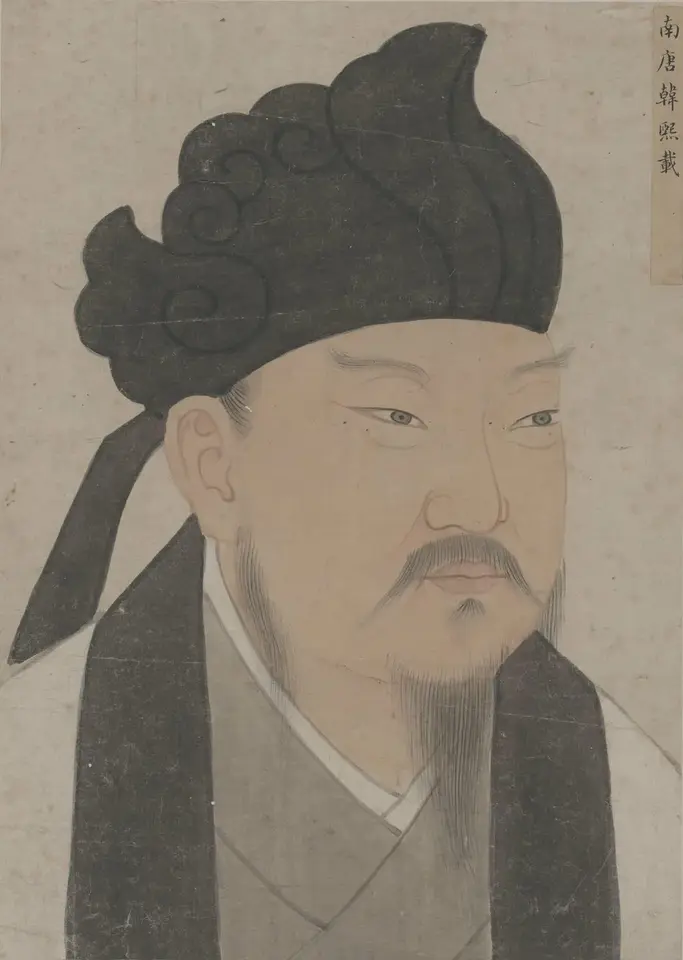
韩熙载
Han Xizai (韩熙载, 902 – August 31, 970), courtesy name Shuyan, was an eminent statesman, literary master, and calligrapher during the Five Dynasties and Ten Kingdoms period who served three successive rulers of the Southern Tang state. Hailing from an aristocratic clan in Beihai, Qi Prefecture, he obtained the Jinshi degree in the Later Tang dynasty in 926, but fled south to Yang Wu after his father was executed following a…
Han Xizai (韩熙载, 902 – August 31, 970), courtesy name Shuyan, was an eminent statesman, literary master, and calligrapher during the Five Dynasties and Ten Kingdoms period who served three successive rulers of the Southern Tang state. Hailing from an aristocratic clan in Beihai, Qi Prefecture, he obtained the Jinshi degree in the Later Tang dynasty in 926, but fled south to Yang Wu after his father was executed following a military mutiny. When Li Bian established Southern Tang in 937, Han was appointed Secretarial Gentleman to educate Crown Prince Li Jing. Under Emperor Yuanzong (Li Jing), Han became entangled in the bitter court struggle between the Song Faction and the Chang Faction. Renowned for his uncompromising candor, he championed aggressive northern campaigns and fiercely denounced corrupt ministers, which led to repeated political banishments. During the Later Zhou invasions of Huainan, he urged staunch resistance along the Yangtze. Under the last ruler, Li Yu (Houzhu), Han was elevated to Minister of War and Vice Director of the Chancellery, leading significant monetary reforms by minting iron coinage to rescue state revenues. In his final years, recognizing the inevitable demise of Southern Tang under the surging power of the Song dynasty, Han deliberately feigned moral degeneration by hosting lavish, nocturnal banquets with dozens of courtesans to avoid being appointed chancellor of a doomed regime. This stratagem inspired Li Yu to dispatch court painter Gu Hongzhong to spy on his residence, culminating in the historic masterwork The Night Revels of Han Xizai. In 970, Han died in Jinling and was posthumously honored with the rank of Chancellor and the posthumous name Wenjing.
Born into the prominent Han clan of Beihai, displaying early precocity in classics, music, and calligraphy.
Passed the imperial examination in Luoyang; fled south disguised as a Daoist after his father was executed in a mutiny.
Recruited by Li Bian upon the founding of Southern Tang to instruct Crown Prince Li Jing in the Eastern Palace.
Promoted to Vice Director in the Ministry of Works and Historiographical Compiler upon Li Jing's accession.
Condemned Chen Jue and Feng Yanlu for their disastrous Fuzhou campaign, demanding their punishment; consequently demoted.
Devised riverine defense strategies and fortified regional strongholds as Later Zhou armies invaded Huainan.
Appointed Vice Minister of Revenue and dispatched on a diplomatic tribute mission to the Song court.
Promoted to Minister of War and Academician of Qinzheng Hall, organizing the minting of iron currency.
Presented his eight-volume treatise Aphorisms (Geyan) to Li Yu; appointed Vice Director of the Chancellery.
Died at his Jinling mansion on August 31 at the age of sixty-nine; posthumously awarded the title Chancellor and the name Wenjing.
Han Xizai was born in 902 into an influential family from Beihai, Qi Prefecture. Both his great-grandfather Han Zong and his grandfather Han Deshu held senior ministerial posts under the Tang dynasty, while his father, Han Guangsi, served as Vice Military Commissioner of Pinglu under Emperor Zhuangzong of Later Tang. Endowed with extraordinary erudition, literary eloquence, and calligraphic skill, the young Han Xizai pursued studies in the eastern capital of Luoyang, gaining widespread acclaim across northern China.
In the spring of 926, Han passed the imperial examinations and attained the Jinshi degree. However, in the third lunar month, a military mutiny broke out in Yedu, throwing northern military commands into chaos. While Military Commissioner Fu Xi marched to quell the rebels, Han Guangsi and garrison commander Wang Gongyan conspired in a localized revolt. When Li Siyuan ascended the throne as Emperor Mingzong of Later Tang, both conspirators were executed, and the entire Han family faced collective punishment.
Informed of the disaster in Luoyang, Han disguised himself in coarse Daoist robes and fled south. Reaching the pivotal Zhengyang ferry on the Huai River, he encountered his examination classmate and close friend Li Gu. Over a farewell toast, Han declared: "If the Wu state appoints me chancellor, I shall personally lead an army north to conquer the Central Plains!" Li Gu replied with a smile: "If the Central Plains appoint me chancellor, I shall lead an army south to pacify Jiangnan." With this farewell pledge, Han crossed the river to enter the Yang Wu state.
Arriving at the Wu capital of Guangling, Han received patronage from regent Xu Wen on account of his literary renown. He was assigned as secretary to Li Decheng, governor of Chuzhou, and later served in Hezhou, Changzhou, and Xuanzhou. In these administrative postings, Han carried out his duties with relaxed detachment, dedicating his leisure to landscape excursions and poetic exchanges with Jiangnan literati, which established his standing as one of the preeminent literary figures south of the Yangtze.
In October 937, Prime Minister Xu Zhigao accepted the abdication of the Yang Wu ruler, established the Southern Tang dynasty, took the imperial name Li Bian, and inaugurated the Shengyuan era. Seeking seasoned talent to staff his new central administration, Li Bian summoned Han Xizai to the capital Jinling, appointing him Secretarial Gentleman in the Palace Library and commanding him to instruct Crown Prince Li Jing and the imperial princes.
In the Eastern Palace, Han developed an intimate intellectual bond with Li Jing and Prince Li Jingda. His lectures on the Confucian classics were articulate, and his historical analyses were sharp and pragmatic. Whenever the imperial court undertook state compilations or issued important edicts, Li Bian sought his input, elevating Han's visibility at court.
In 943, as Li Bian lay dying, he privately admonished the crown prince to "serve the Central Plains loyally and never lightly initiate military ventures." Han, however, possessed a keen understanding of geopolitical strategy. He believed that the isolated southern realm could not survive permanently through passive defense alone, arguing that if Jiangnan failed to exploit northern turmoil to reclaim lost territories, it would inevitably be swallowed once the northern plains were unified. He repeatedly submitted memorials advocating military preparations and border fortifications, but Li Bian maintained his conservative defensive policy.
In March 943, Li Bian passed away and Li Jing ascended the throne as Emperor Yuanzong, inaugurating the Baoda era. Li Jing promoted Han to Vice Director in the Ministry of Works and Historiographical Compiler. Proud and fiercely independent, Han quickly found himself on a collision course with entrenched court factions.
The Southern Tang court was deeply divided into two hostile camps: the Song Faction, led by elder chancellor Song Qiqiu and comprising figures like Chen Jue, Feng Yanji, Feng Yanlu, and Li Zhenggu; and the Chang Faction, composed of loyalist ministers including Sun Sheng, Chang Mengxi, and Han Xizai. The two factions fought bitterly over institutional appointments, fiscal policy, and foreign warfare.
In 946, Chen Jue and Feng Yanlu unauthorizedly dispatched a major expedition to assault Li Renda in Fuzhou. The campaign collapsed into a catastrophic rout, resulting in the slaughter of tens of thousands of southern troops and the exhaustion of state treasuries. Amidst public outrage, Han courageously submitted a searing memorial to Li Jing, denouncing Chen Jue and Feng Yanlu for deception, treasonous misconduct, and military ruin, directly demanding that Feng Yanlu be publicly decapitated to uphold imperial discipline.
This uncompromising stance provoked fierce retaliation from Song Qiqiu's faction, who accused Han of slanderous insubordination. Unwilling to execute veteran officials, Li Jing merely exiled Chen and Feng, while demoting Han to the remote post of Police Advisor in Hezhou to defuse court rancor. Han lived in quiet exile for several years, immersing himself in historical compilation and poetry.
Toward the close of the Baoda era, as the Song Faction lost royal favor, Li Jing recalled Han to the capital, promoting him to Vice Director of the Ministry of Works, Drafter of Edicts, and Secretariat Drafter. Han's administrative prose was celebrated throughout the southern courts for its classical cadence, evoking the refined literary grandeur of the High Tang Yuanhe period.
In late 955, Emperor Shizong of Later Zhou (Chai Rong) launched a massive offensive against Southern Tang, besieging the key fortress of Shouchun in Huainan. The Zhou court appointed Han's old companion Li Gu as chief commander of the invading army, bringing the two scholars into dramatic confrontation across the Huai River. Terrified by the northern juggernaut, many Southern Tang ministers urged immediate capitulation and territorial surrender. Han vigorously argued against appeasement, proposing to deploy Jiangnan's superior naval flotillas to sever enemy supply lines and fortify strategic mountain passes.
However, rampant corruption and military incompetence led to total collapse. Shouchun fell after a heroic defense by Liu Renshan, and in 958, Li Jing was forced to cede all fourteen prefectures north of the Yangtze, abandon his imperial title, and accept Zhou suzerainty. The loss devastated Southern Tang's primary revenue base and provoked a catastrophic outflow of copper coins to the north as annual tribute payments.
In 962, Han was appointed Vice Minister of Revenue to rescue the disintegrating economy. He advocated minting iron currency from domestic iron mines to replace circulating copper, proposing a dual-currency exchange standard while prohibiting the export of bronze bullion. In imperial audience, Han engaged in an impassioned debate with Chancellor Yan Xu, his commanding voice resounding through the palace halls. Although the introduction of iron cash generated market inflation and merchant resistance, it effectively halted bronze drain and sustained Southern Tang's military logistics for over a decade.
In 961, Li Jing died and was succeeded in Jinling by Crown Prince Li Congjia, remembered as Li Yu or Houzhu. Li Yu admired Han's vast scholarship, literary brilliance, and cultural refinement. He instituted nightly duty rotations at Guangzheng Hall for senior scholars, frequently summoning Han for nocturnal discussions on state governance, classical statecraft, and legal jurisprudence.
In 964, Han was promoted to Minister of War and Academician of Qinzheng Hall, presiding over the imperial examinations. In 968, he presented his monumental treatise, Aphorisms (Geyan) in five volumes along with a three-volume supplement, detailing the principles of penal governance, historical cycles, and celestial omens. Deeply impressed, Li Yu promoted Han to Vice Director of the Chancellery and Chief Academician of Guangzheng Hall, positioning him among the foremost ministers of the realm.
By this time, the newly founded Song dynasty had conquered Jingnan, Later Shu, and Southern Han, massing warships along the Yangtze to absorb Southern Tang. Desperate to rally the state, Li Yu resolved to appoint Han as Chancellor (Tong Pingzhangshi). However, Han recognized that the regime was hollowed out by royal indulgence, Buddhist extravagance, and military rot. Determined not to suffer the humiliation of being captured as the chancellor of an extinguished state, Han chose a course of self-abnegation and moral dissipation.
He exhausted his personal fortune to purchase more than forty courtesans and entertainers, transforming his Jinling residence into an open salon of continuous banqueting, revelry, and musical performances. When critics memorialized against his debauchery, Li Yu dispatched court painters Gu Hongzhong and Zhou Wenju to secretly infiltrate the gatherings and record the scenes. Viewing Gu's finished scroll, The Night Revels of Han Xizai, Li Yu observed that while Han sat amidst dancers and musicians, his countenance was heavy with sorrow and disillusionment. Understanding Han's implicit political protest, Li Yu quietly dropped the proposal to make him chancellor.
On August 31, 970, Han passed away at his Qijiashan mansion in Jinling at the age of sixty-nine. Overcome with grief, Li Yu suspended court audiences for a day, posthumously conferred the rank of Chancellor and the title Wenjing, and arranged his burial near the tomb of the famous Eastern Jin statesman Xie An at Meiyiling, ordering scholar Xu Xuan to compose his official funerary epitaph.
Following the humiliating loss of Huainan in 958, Southern Tang was stripped of its richest agricultural lands and salt monopolies while being subjected to exorbitant tribute levies from the northern courts. This resulted in an acute liquidity crisis and the near-total drain of copper coinage across the southern realm.
Appointed to superintend the treasury, Han devised a comprehensive monetary reform centered on opening southern iron deposits and casting large iron coins. He established dedicated iron mints and enforced strict customs patrols along waterways to prevent the smuggling of copper coins into Song territory. Despite severe controversy and resistance from conservative officials, the circulation of iron cash preserved vital bullion within Southern Tang, providing the indispensable revenue necessary to maintain border defenses and state administration for over a decade.
During the reign of Li Yu, when Southern Tang faced imminent subjugation by the northern Song empire, Li Yu repeatedly attempted to appoint Han as Chancellor to restore imperial authority. Having witnessed three decades of dynastic decline, Han refused to serve as the figurehead of a crumbling state or bear the historical stigma of a fallen minister.
To deflect the royal appointment, Han adopted an eccentric strategy of self-debasement. He dispersed his accumulated wealth among dozens of singing girls, staged extravagant banquets night after night, and openly disregarded Confucian decorum. At the height of this calculated dissipation, he would don tattered robes and wander among the musicians' chambers begging for food with a clapper, cultivating an image of senile unfitness. The resulting painting commissioned by Li Yu, The Night Revels of Han Xizai, captured the subtle interplay between external luxury and profound internal melancholy, creating an enduring masterpiece of Chinese narrative portraiture.
FIGURES ASSOCIATED WITH THIS DYNASTY