Life Story
Tonsure in Sichuan and Wandering in the Southeast
Wuzhun Shifan was born into the Yong family of Zitong County in Sichuan during the mid-Southern Song. From childhood, he exhibited an extraordinary affinity for Buddhist teachings, disdaining secular pursuits and delighting in folding his palms in monastic salutation. In 1187, at the tender age of nine, Shifan bid farewell to his family and sought tonsure under Master Daoqin at Mount Yinping Dajue Temple in Zitong, studying monastic rituals and core scriptures. Because his family was impoverished and lacked funds for regular monastic attire, fellow novices humorously referred to him as the Dark-Headed Youth, yet he remained untroubled and devoted to self-discipline.
In 1194, at sixteen, Shifan traveled to Chengdu to receive full ordination. The following year, he participated in the monastic summer retreat at Zhengfa Temple in Chengdu, deepening his mastery of Vinaya discipline and meditation. Realizing that the southwestern hinterland offered limited exposure to the broader Chan tradition, he shouldered his robes at twenty and embarked down the Yangtze River through the Three Gorges. Arriving in Mingzhou (modern Ningbo, Zhejiang), he entered Mount Asoka to study under Master Xiuyan Shirui. At that time, Mount Asoka was a thriving center of the Dahui Zonggao lineage, with Master Fozhao Deguang residing in the Eastern Hermitage and Kongsou Zongyin sharing the dharma seat. In this vibrant spiritual environment, the young monk's understanding expanded dramatically.
Mentorship under Po'an and Attaining the Dharma Seal
Departing from Mount Asoka, Shifan traveled to Lingyin Temple in Hangzhou to train under Songyuan Chongyue, a leading master of the Yangqi branch of the Linji School, continuing his contemplation in the southern hills for six years. Hearing that another titan of the Yangqi branch, Po'an Zuxian, was expounding the dharma with razor-sharp pedagogical methods at Mount Huazhang in Suzhou, Shifan promptly sought his guidance. He subsequently spent three years training under Master Zongyan at Huazang Temple in Changzhou before returning to Lingyin Temple to consolidate his insights.
When Vice Minister Zhang Zi established the newly built Guanghui Temple in Yuhang, he formally invited Po'an Zuxian to become the founding abbot. Shifan rushed to Guanghui Temple and served as Po'an's personal attendant for three years. During this period, Po'an subjected him to rigorous and unrelenting verbal probing; under this intense pressure, Shifan experienced sudden and total enlightenment, shedding every remaining doubt regarding life and death, and received formal seal of approval from Po'an. When Po'an subsequently ascended the abbot's seat at Jingshan Temple, Shifan accompanied him. On his deathbed, Po'an conferred upon Shifan the patriarchal dharma robe and master's portrait originally handed down by Master Mi'an Xianjie, designating Shifan as the legitimate patriarch of the Po'an lineage.
Abbot of Jingshan and Preaching before the Imperial Court
Following his transmission, Shifan served as abbot of Qingliang Temple in Mingzhou and Xuefeng Temple on Mount Jiaotai, with his reputation steadily rising across the Buddhist realm. In 1232, the Southern Song imperial court issued a decree appointing Wuzhun Shifan as the thirty-fourth abbot of the Jingshan Xingsheng Wanshou Monastery, the supreme head of the Five Mountains and Ten Monasteries of Jiangnan. Jingshan Temple had recently suffered severe destruction from an accidental conflagration. Upon arrival, Shifan restored monastic regulations, welcomed wandering practitioners, and oversaw extensive reconstruction, returning the community to a thriving assembly of over a thousand monks.
In 1233, Emperor Lizong, deeply moved by his spiritual stature, summoned Wuzhun Shifan to the Ciming Hall in the imperial palace of Lin'an. Emperor Lizong personally inquired about the core essence of Chan awakening and righteous statecraft. Shifan responded with lucid, unpretentious clarity, explaining that true governance starts with recognizing one's original nature, exercising caution in peace, and practicing moral self-cultivation to benefit the people. Highly impressed, Emperor Lizong granted him the prestigious title Chan Master Fojian, alongside substantial consignments of imperial gold, silver, and fine silk, directing all funds toward the rebuilding of Jingshan Temple. This imperial encounter solidified Wuzhun Shifan's status as the supreme spiritual authority of Southern Song Buddhism.
Transmitting the Dharma to Japan and Peaceful Demise
During his tenure at Jingshan, Wuzhun Shifan made his most profound historical contribution through the spiritual cultivation of Japanese monks. In 1235, Japanese monk Enni Ben'en crossed the East China Sea and climbed Mount Jingshan to seek instruction. Recognizing Enni's pure aspiration and sharp intellect, Shifan accepted him as an intimate disciple, instructing him in Linji Yangqi Chan practice. Enni trained at Jingshan for six years, serving as personal attendant and mastering the dharma, whereupon Shifan granted him an inka certificate of enlightenment and an inscribed patriarchal portrait.
In 1241, Enni Ben'en prepared to return to Japan. Shifan not only imparted spiritual teachings but also gifted him the complete monastic code Chanyuan Qinggui, formal tea banquet rituals, fine Jingshan tea seeds, and stone-mill tea processing methods. Upon returning to Japan, Enni founded Tofuku-ji in Kyoto, modeling its monastic structure and tea ceremonies directly upon Jingshan, thereby establishing the Tofuku-ji branch of Japanese Rinzai Zen. Subsequent Japanese pilgrims, including Nanpo Shomin, followed in his footsteps, venerating Shifan's teachings and calligraphy as sacred treasures. On the fifteenth day of the third month of 1249, realizing his physical life was drawing to a close, Shifan dictated ten farewell memorials. On the eighteenth day, he entered nirvana peacefully at the Mingyue Hall of Jingshan Temple at seventy-one, being entombed before the hall.
Major Achievements
Leading the Foremost Mountain of Chan and Restoring Jingshan
Appointed abbot of Jingshan Xingsheng Wanshou Monastery in 1232 amid the aftermath of catastrophic fire damage, Wuzhun Shifan took up the formidable burden of reconstruction in his fifties. Utilizing imperial patronage granted by Emperor Lizong, he systematically rebuilt the Heavenly Kings Hall, the Grand Hall of the Great Hero, the Sutra Library, and meditation quarters. He enforced strict adherence to monastic codes, reviving the venerable spirit of the Baizhang regulations and restoring Jingshan to its undisputed glory as the supreme monastery of the Five Mountains of Chan. During his nearly two decades of leadership, Jingshan served as the paramount spiritual heart of Jiangnan Buddhism, radiating influence across East Asia.
Instructing Enni Ben'en and Founding the Japanese Lineage
Wuzhun Shifan occupies a watershed position in the history of East Asian Buddhist cross-cultural exchange. Transcending regional boundaries, he welcomed the Japanese pilgrim monk Enni Ben'en, mentoring him for six years and formally transmitting the Yangqi Linji lineage to Japan. Upon his return, Enni founded Shoten-ji in Hakata and Tofuku-ji in Kyoto, elevating Linji Chan into the predominant school of Zen in Japan, which exerted a transformative influence on the warrior class and cultural architecture of the Kamakura and Muromachi periods. Thereafter, Japanese monks visiting China consistently regarded Wuzhun Shifan's lineage as the definitive orthodox standard, generating centuries of vibrant Sino-Japanese Buddhist interchange.
Exporting Jingshan Tea Seeds and Founding Japanese Tea Culture
Alongside Zen philosophy, Wuzhun Shifan transmitted the sophisticated tea culture of the Southern Song to Japan. When Enni Ben'en departed in 1241, Shifan gifted him high-grade tea seeds from Mount Jingshan. Enni planted these seeds in his native Shizuoka, cultivating tea plants and adopting the Jingshan stone-milling method to produce powdered green tea, which created the historical foundation of the renowned Shizuoka tea industry. Furthermore, Shifan imparted the elaborate rituals of the Jingshan Tea Banquet, covering whisking, preparation, and tea-drinking etiquette. Developed further by successors like Nanpo Shomin and Sen no Rikyu, these monastic rituals evolved directly into the globally recognized Japanese Way of Tea, cementing Shifan's status as a founding father of East Asian tea culture.
Preserving National Treasure Calligraphy and Enriching East Asian Art
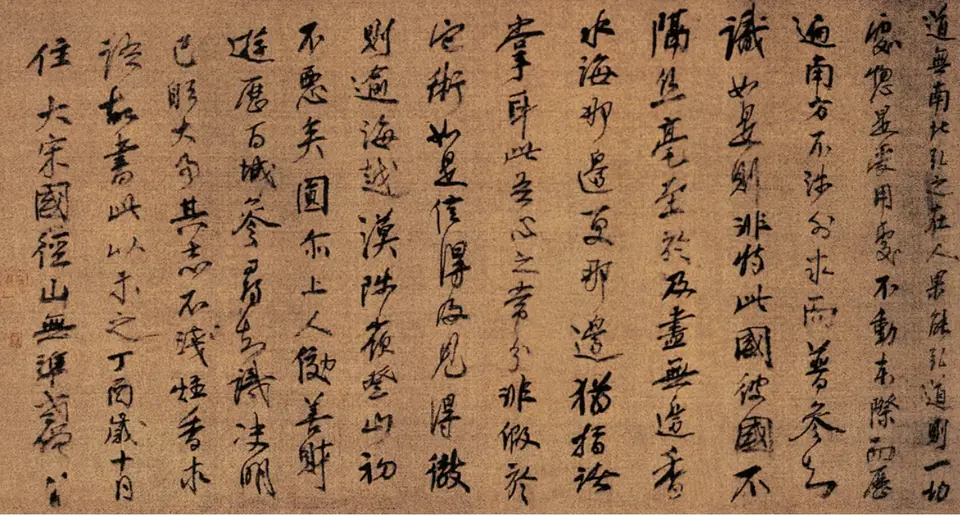
Wuzhun Shifan's calligraphy integrated the structural vigor of Jin and Tang masters with the expressive freedom of the Song dynasty, exhibiting bold, dynamic strokes imbued with transcendent Chan tranquility. Japanese disciples returning to their homeland brought back genuine ink treasures handwritten by Shifan, including the Self-Inscribed Portrait, the Inka Certificate, the Mountain Gate Appeal, the Xuanfochang Hall Plaque, and the famous letter known as the Board-Crossing Ink Record. In the Edo period, these works were cherished by renowned connoisseurs such as Matsudaira Fumai as supreme masterworks. Several of these pieces have been officially designated as National Treasures of Japan and are preserved in the Tokyo National Museum and Tofuku-ji, standing as timeless testaments to East Asian cultural fellowship.