Birth in Fuzhou
Born on March 30 in Aoqiao, Zhuzifang, Fuzhou, into the distinguished Yanmen Sa lineage.
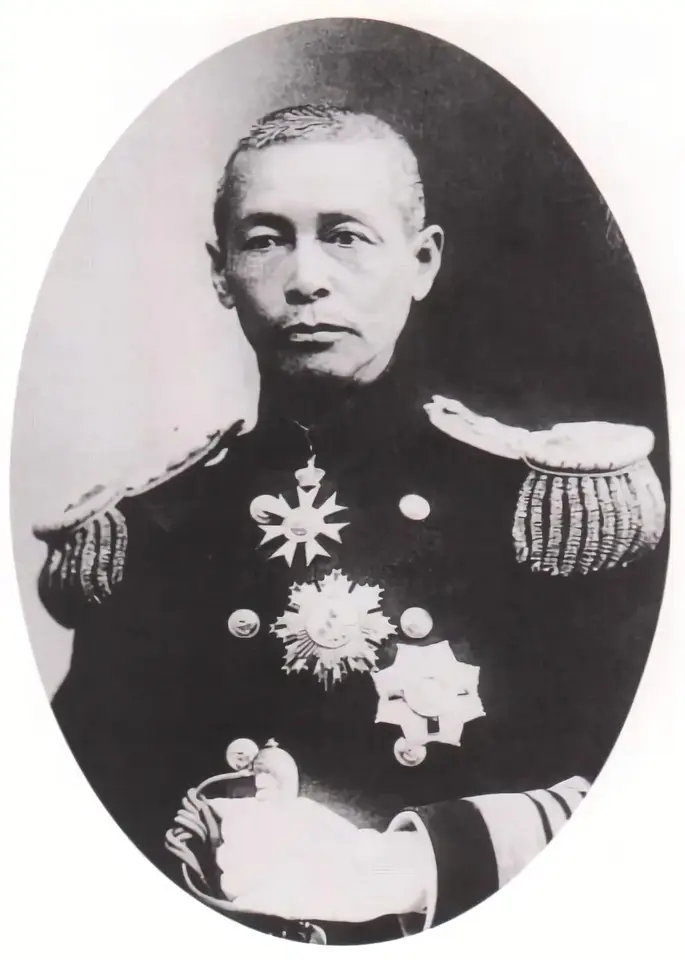
萨镇冰
Sa Zhenbing (萨镇冰, 1859–1952), courtesy name Dingming, was a native of Fuzhou, Fujian, with ancestral roots in Daixian, Shanxi, belonging to the prominent Yanmen Sa clan. He was a distinguished naval commander, naval educator, and patriotic statesman whose career bridged the late Qing dynasty, the Republic of China, and the People's Republic of China. A graduate of the Foochow Arsenal Naval Academy, Sa was selected among the…
Sa Zhenbing (萨镇冰, 1859–1952), courtesy name Dingming, was a native of Fuzhou, Fujian, with ancestral roots in Daixian, Shanxi, belonging to the prominent Yanmen Sa clan. He was a distinguished naval commander, naval educator, and patriotic statesman whose career bridged the late Qing dynasty, the Republic of China, and the People's Republic of China. A graduate of the Foochow Arsenal Naval Academy, Sa was selected among the first group of Qing naval cadets sent to Britain's Royal Naval College, Greenwich. Upon returning to China, he served as instructor at the Tianjin Naval Academy and captained the Weiyuan and Kangji warships. During the Battle of Weihaiwei in the First Sino-Japanese War of 1895, Sa led naval infantry in a heroic ten-day defense of the Ridao Island coastal battery amid blizzard conditions and Japanese naval bombardment, subsequently escorting the remains of Admiral Ding Ruchang back to his ancestral home. In the aftermath of the war, he collaborated with Ye Zugui to rebuild the Chinese navy, founding the Yantai Naval Academy and serving as Imperial Navy Commander to integrate regional squadrons into unified cruising and Yangtze fleets. When the 1911 Wuchang Uprising erupted, he ordered a de facto ceasefire and departed his flagship, facilitating the peaceful defection of the imperial navy to the republican cause. Under the Republic of China, he served twice as Minister of the Navy, briefly acted as Premier, and governed Fujian province, where his civic philanthropy earned him the title "Living Bodhisattva Sa." In his late seventies, he campaigned across western China and Southeast Asia to promote resistance against Japanese aggression. In 1949, he declined Nationalist evacuation to Taiwan, welcoming the People's Liberation Army in Fuzhou, and served on the National Committee of the Chinese People's Political Consultative Conference and the Central People's Revolutionary Military Commission until his death at age ninety-four.
Born on March 30 in Aoqiao, Zhuzifang, Fuzhou, into the distinguished Yanmen Sa lineage.
Admitted to the navigation division of the Foochow Arsenal Naval Academy to study mathematics, mechanics, navigation, and English.
Selected as one of the first government naval cadets sent to the Royal Naval College, Greenwich, interning with the Mediterranean Fleet.
Returned to serve as chief officer aboard the Chengqing; transferred in 1881 as chief instructor to the Tianjin Naval Academy.
Appointed captain of the training cruiser Weiyuan, and subsequently captain of the training vessel Kangji.
Defended the Ridao Island fortification for ten days under fire; escorted Ding Ruchang's remains after the battle.
Appointed captain of the surviving training vessel Tongji, rallying scattered Beiyang sailors to restore naval organizations.
Founded the Yantai Naval Academy in Shandong, establishing modern standards for Chinese naval officer education.
Elevated to Vice Commander of the Beiyang Fleet and captain of the cruiser Haiqi, subsequently becoming Commander-in-Chief of the Guangdong Fleet.
Appointed Imperial Naval Commissioner and Chief of the Imperial Navy, unifying coastal fleets into cruising and riverine squadrons.
Accompanied Prince Zaixun to Britain, Germany, the United States, and Japan to inspect naval technology and order warships.
Dispatched to Wuhan to suppress the Wuchang Uprising; observed a ceasefire and stepped down, enabling the navy to join the revolution.
Appointed Minister of the Navy in the Beijing government, preserving fleet cohesion during warlord instability.
Appointed Acting Premier of the Republic of China for four months following the resignation of Jin Yunpeng's cabinet.
Served as Governor of Fujian for five years, constructing highways, curbing opium, and establishing charitable institutions.
Supported the Nineteenth Route Army's anti-Japanese Fujian People's Government, serving as chief political adviser.
Campaigned across southwestern provinces and Southeast Asia to rally overseas Chinese donations and public morale for the War of Resistance.
Refused evacuation to Taiwan, protected municipal records, and welcomed the People's Liberation Army into Fuzhou.
Passed away peacefully on April 10 at age ninety-four; honored with condolence telegrams from Mao Zedong and Zhou Enlai.
Sa Zhenbing was born on March 30, 1859, into the Yanmen Sa clan in Zhuzifang, Fuzhou. Descended from Dashiman, a Semu dignitary who aided Kublai Khan in governing Tibetan regions during the Yuan dynasty, the family had settled around Yanmen Pass in Shanxi before migrating to Fujian in the mid-Ming dynasty. Over centuries, the clan assimilated into the Han literati elite, producing celebrated poets such as Sa Dula and high officials such as Sa Duqi. Sa's father, Sa Zhongyuan, was a respected practitioner of Chinese medicine who instilled in his children strict Confucian principles of integrity and public service.
In 1869, ten-year-old Sa entered the newly established Foochow Arsenal Naval Academy, founded by Zuo Zongtang and Shen Baozhen. Defying conservative social prejudices that dismissed Western learning, Sa enrolled in the second navigation cohort alongside Yan Fu, Deng Shichang, Fang Boqian, and Ye Zugui. Over several years of rigorous instruction, he studied celestial navigation, calculus, fluid mechanics, and European languages, demonstrating natural talent for naval sciences.
In 1877, recognizing the necessity of building a modern coastal defense, the Qing court selected elite academy graduates to study in Europe. Sa was chosen to attend the Royal Naval College, Greenwich. In Britain, he mastered ironclad tactics, naval ballistics, and torpedo warfare. Following his classroom studies, he interned aboard capital ships of the Royal Navy's Mediterranean Fleet. His exposure to British fleet operations and disciplined naval command broadened his strategic vision, establishing him as a member of China's pioneer generation of professional naval officers.
During his internship aboard the Mediterranean Fleet flagship, Sa underwent grueling trials of blue-water seamanship. The Royal Navy enforced strict operational discipline, and Sa performed with distinction in navigational astronomy and gunnery drills despite harsh winter squalls and severe sea sickness. Admiral Geoffrey Hornby commended his technical precision and professional dedication. This European experience convinced Sa that China's sovereignty depended upon the creation of a modern navy.
In 1880, Sa returned to China, initially serving as chief officer on the Southern Seas Fleet vessel Chengqing. In 1881, Viceroy of Zhili Li Hongzhang established the Tianjin Naval Academy and recruited Sa as chief instructor. Over the next five years, Sa applied Greenwich standards, training an entire generation of junior officers in modern gunnery, steam mechanics, and navigational geometry.
At Tianjin, Sa authored practical manuals such as Principles of Vessel Handling, harmonizing Western naval manuals with the conditions of the Chinese navy. He conducted practical exercises on warships anchored off the Daku Forts. Among his students was future republican president Li Yuanhong, who developed a lifelong respect for Sa's discipline. Sa's work laid the institutional foundation for the junior officer corps of the nascent Beiyang Fleet.
In 1886, Sa transferred to sea duty in the Beiyang Fleet, commanding the training cruiser Weiyuan before taking charge of the Kangji, the fleet's sail-and-steam training vessel. Aboard the Kangji, he directed officer cadet training, patrolling the Yellow Sea and Gulf of Zhili. Known for his humane leadership and strict ban on corporal punishment, Sa led the Kangji to become the most disciplined vessel in the fleet.
In 1894, the First Sino-Japanese War erupted. Following defeats at the Battle of Pungdo and the Battle of the Yalu River, the battered Beiyang Fleet retreated to its fortified naval base at Weihaiwei, Shandong. In early 1895, Japanese land and naval forces surrounded the harbor. Positioned at the center of the bay, the small island fortification of Ridao guarded the vital shipping channel leading to Liugong Island. Its low-lying topography left its gun emplacements exposed to crossfire from enemy ironclads. Recognizing the perilous nature of the assignment, Admiral Ding Ruchang ordered Sa to defend Ridao with thirty sailors.
Amid winter blizzards and freezing gales, Sa took command on January 30, 1895. The Japanese Combined Fleet concentrated cruisers such as the Yoshino, Naniwa, and Akitsushima, raining shells onto the island. Underground shelters collapsed, and the ammunition depot exploded in flames. Suffering facial burns from powder blasts and enduring frostbite and starvation, Sa stood beside the gun carriages, directing his men to return fire through the bombardment.
Despite having their positions leveled and their hands frozen to the iron gun breeches, Sa and his crew held out, shouting that they would die with their batteries. When Japanese cruisers closed in to support torpedo boat raids, Sa laid the guns himself, punching holes through enemy armor plating and driving off the attackers. For ten days and nights, Sa held Ridao until adjacent mainland forts fell and Admiral Ding ordered a withdrawal to Liugong Island.
When Weihaiwei capitulated and Admiral Ding Ruchang, Captain Liu Buchan, and Captain Yang Yonglin took their own lives, Sa was chosen to manage the aftermath. In deep sorrow over the annihilation of the fleet, Sa captained the disarmed Kangji, carrying the coffins of Ding Ruchang and Liu Buchan through Japanese blockades to their ancestral hometowns.
The destruction of the Beiyang Fleet shattered China's maritime frontier. In 1896, the Qing court resolved to rebuild its naval forces, placing Sa in command of the surviving training ship Tongji. Confronting devastation, Sa gathered dispersed sailors and restored operational discipline, initiating the second reconstruction of modern Chinese sea power.
Convinced that national defense required institutional officer training, Sa established the Yantai Naval Academy on the Zhifu promontory in Shandong in 1898, serving as its director. He instituted a curriculum combining moral discipline, technical mastery, and practical navigation, employing Royal Navy instructors to teach artillery and seamanship in English.
Faced with severe fiscal shortages, Sa contributed his personal salary to support student rations and library books, leading morning drills on the Yantai shoreline. Over subsequent decades, the Yantai Naval Academy educated foundational commanders such as Chen Shaokuan, Li Qingxi, and Zeng Yiding, becoming the primary training institution for modern Chinese naval officers.
In 1903, Sa was promoted to Vice Commander of the Beiyang Fleet and captain of the newly acquired cruiser Haiqi, a 4,300-ton warship ordered from Britain that ranked among the most formidable cruisers in East Asia. In 1905, he was appointed Commander-in-Chief of the Guangdong Fleet. In 1909, the Qing court established the Department of Naval Affairs under Prince Zaixun, Prince Shanqi, and Sa. Sa was promoted to Admiral and appointed Imperial Navy Commander, unifying the independent Beiyang, Nanyang, and Guangdong fleets into modern cruising and riverine squadrons under a single ensign and rank structure.
In 1909 and 1910, Sa accompanied Prince Zaixun on extensive missions to examine naval shipyards across Britain, Germany, France, Italy, Austria-Hungary, the United States, and Japan. Fluent in English, Sa inspected dreadnoughts and submarines, negotiating contracts for new destroyers and training ships.
Sa helped draft the Ten-Year Naval Expansion Plan, which envisioned modern fleets and shipyards across China's coast. During this era, the Haiqi sailed to Britain for the coronation review of King George V before crossing the Atlantic to New York and visiting Cuba and Mexico. This mission marked the Chinese navy's first overseas expedition to protect Chinese diaspora communities against anti-Chinese riots, raising national pride among overseas Chinese.
On October 10, 1911, the Wuchang Uprising erupted in Hubei. Panicking, the Qing cabinet ordered Army Minister Yinchang south and instructed Admiral Sa to sail the imperial fleet, including the cruisers Hairong and Haichou, up the Yangtze River to bombard revolutionary positions in Hankou and Wuchang.
By mid-October, Sa's warships were positioned off Wuhan, opposite revolutionary batteries at Hanyang. General Feng Guozhang urged naval bombardment of the revolutionary headquarters in Wuchang. Reluctant to slaughter fellow countrymen, Sa convened a council of his ship captains. Many junior officers, trained in Foochow and Yantai, secretly supported the republican cause. Furthermore, revolutionary commander Li Yuanhong, a former student of Sa at Tianjin, sent a private letter pleading with his teacher to support the revolution for the sake of the Chinese nation.
Confronted with this dilemma, Sa refused to bombard the city, ordering his ships to fire wide into empty mudflats or shut down their engines, buying time for the revolutionaries to consolidate their positions. As Jiujiang declared independence in late October, Sa recognized that while personal honor forbade him from actively rebelling against the Qing, his conscience would not permit him to crush the republic. On the night of November 1, 1911, off Huangzhou, Sa gathered his captains, urged them to preserve their ships for the nation, and boarded a small boat to slip away to Shanghai. Within days of his departure, the naval fleet at Jiujiang hoisted the republican banner, providing the revolution with decisive naval strength.
Following the founding of the Republic of China, Provisional President Sun Yat-sen invited Sa to become Minister of the Navy, an offer Sa declined out of deference to his former imperial allegiance, opting instead to direct the Wusong Merchant Marine College to train commercial navigators.
Following Yuan Shikai's death, factional conflicts plagued the Beijing government. In 1917, during Zhang Xun's monarchical restoration, Premier Duan Qirui invited Sa to assume the post of Minister of the Navy. Amid warlord intrigue, Sa preserved the independence and national character of the naval command. In 1919, he joined Jin Yunpeng's cabinet as Minister of the Navy.
In May 1920, with the Zhili-Anhui War looming, Premier Jin Yunpeng resigned. To prevent a collapse of government authority, President Xu Shichang appointed Sa Acting Premier. Over his four-month administration, Sa steered clear of factional rivalries, trimming military expenditures and securing funds for education and municipal governance. In August 1920, as the political crisis subsided, Sa stepped down, returning to his post as Minister of the Navy.
In 1922, weary of northern politics, Sa returned to Fujian. With the province wracked by warlord skirmishes, the Beijing government appointed Sa Governor of Fujian. He held the office for five years, from 1922 to 1927.
As governor, Sa lived an austere life, allocating his official salary to support orphanages, hospices, and leper colonies. He overcame warlord opposition to construct the Fuzhou-Xiamen and Fuzhou-Mawei highways, widen urban streets, and dredge the Min River channel.
Confronting warlords who encouraged opium poppy cultivation for revenue, Sa personally directed police raids to shut down opium dens and execute smugglers. During seasonal floods and typhoons, the septuagenarian governor walked in straw sandals through refugee camps to distribute rice and clothing. Revered by the local populace, who displayed his portrait in their homes, he became affectionately known as "Living Bodhisattva Sa." Following the Northern Expedition in 1927, he stepped down, accepting an honorary appointment as Senior Naval Adviser with the rank of full Admiral, dedicating his retirement to civic charity in Fuzhou.
In November 1933, generals of the Nineteenth Route Army staged the Fujian Incident in Fuzhou, establishing the People's Revolutionary Government to resist Japanese aggression. Moved by patriotic alarm, Sa supported the move, serving as senior political adviser and touring northern Fujian to mobilize civic morale.
Following the outbreak of the Second Sino-Japanese War in 1937, seventy-eight-year-old Sa left his library to champion the national defense. Over several years, despite failing physical health, he traveled across Southeast Asia and the interior provinces of Sichuan, Guizhou, Hunan, Yunnan, Guangxi, Shaanxi, and Gansu. He delivered hundreds of patriotic lectures, raised funds for military winter clothing, and penned poems urging resistance, earning reverence as a national moral elder.
Throughout his wartime travels across western China, Sa visited orphanages for fallen soldiers' families and refugee shelters, distributing donated relief funds. In Chongqing, Kunming, and Guiyang, he collaborated with overseas Chinese leader Tan Kah Kee, praising the mechanics who volunteered along the Burma Road and urging the diaspora to finance fighter aircraft for the Flying Tigers. Standing along the Yellow River at Hancheng and Fenglingdu, the eighty-year-old admiral looked out toward the occupied northern plains and composed verses expressing his resolve to resist foreign aggression to the end.
Following the Allied victory, Sa condemned the Nationalist government for corruption and civil war. In August 1949, as the People's Liberation Army closed in on Fuzhou, Nationalist leaders Li Zongren and Chiang Kai-shek dispatched agents to persuade him to flee to Taiwan. Ninety-year-old Sa adamantly refused, moving into a suburban clinic to evade surveillance. On the eve of liberation, he coordinated with local leaders to protect municipal waterworks, electrical plants, and public archives from sabotage. On August 17, 1949, Sa led local dignitaries to welcome the People's Liberation Army into Fuzhou.
Following the establishment of the People's Republic of China, the central government accorded Sa high honors. He was named a member of the First National Committee of the Chinese People's Political Consultative Conference, the Central People's Revolutionary Military Commission, the Commission of Overseas Chinese Affairs, and the Fujian Provincial People's Government. In 1951, upon learning that the Chinese People's Volunteers had crossed the 38th parallel and taken Seoul during the Korean War, ninety-two-year-old Sa composed a poem from his sickbed celebrating the nation's resurgence after fifty years of humiliation.
On April 10, 1952, Sa passed away in Fuzhou at the age of ninety-four. Chairman Mao Zedong and Premier Zhou Enlai sent condolences honoring his lifelong patriotism and service to the people. He received an official state funeral in Fuzhou, marking the end of a momentous naval career spanning three eras.
The defense of Ridao Island during the 1895 Battle of Weihaiwei was the finest hour of Sa's military career. Facing the overwhelming firepower of the Japanese Combined Fleet, Sa took command with thirty sailors, defending an isolated rock at the entrance of the bay.
Over ten days of bombardment, Sa directed counterfire despite collapsed bunkers, magazine detonations, and frostbite, scoring hits on Japanese warships. His heroism under fire earned him international professional acclaim, providing an enduring symbol of military courage during the First Sino-Japanese War.
Following the collapse of the defense, Sa undertook the solemn task of escorting the remains of Admiral Ding Ruchang and Captain Liu Buchan back to their ancestral homes, vowing to dedicate the rest of his life to rebuilding China's coastal defense.
Following the annihilation of the Beiyang Fleet, Sa focused on educational reform to rebuild China's naval power. In 1898, he founded the Yantai Naval Academy in Shandong, establishing a curriculum aligned with European standards.
From classroom instruction to blue-water seamanship, Sa oversaw every detail of the academy's operation. The institution educated foundational naval leaders such as Chen Shaokuan, establishing the institutional core of the Republican navy and earning Sa the reputation as the father of modern Chinese naval education.
Sa introduced practical training voyages aboard naval vessels, mapping deep-water channels in the Bohai Sea and Gulf of Zhili while teaching engine operation and naval gunnery. His rigorous standards and personal mentorship produced generations of naval officers who preserved China's maritime heritage.
During the 1911 Wuchang Uprising, Sa's strategic decision as Imperial Navy Commander shaped the course of the revolution.
Positioned off Wuhan, Sa refused to unleash his naval artillery against fellow countrymen. By enforcing a ceasefire and stepping down from his flagship, he removed institutional barriers for his captains, enabling the fleet at Jiujiang to defect peacefully to the republican side. This defection secured the Yangtze for the revolution and accelerated the collapse of the Qing dynasty.
His decision to leave his flagship off Huangzhou spared the navy from destructive fratricidal combat, preserving China's principal warships intact for the new republic and preventing the annihilation of coastal defense forces during the dynastic transition.
As Governor of Fujian and during his retirement in Fuzhou, Sa dedicated his personal means to public welfare. Eschewing personal wealth, he donated his salary to construct hospices, orphanages, and clinics for leprosy patients.
He oversaw the development of modern roads in Fuzhou and the dredging of the Min River, suppressing the illicit opium trade and aiding the impoverished. His compassion earned him the affectionate name "Living Bodhisattva Sa," establishing him as an exemplar of clean governance and social philanthropy.
Throughout his twilight years, Sa walked the streets of Fuzhou in plain robes, mediating community disputes and visiting the destitute. During winter months, he distributed warm clothing and medicine to refugees and homeless commoners, embodying classical Confucian benevolence and Buddhist compassion.
FIGURES ASSOCIATED WITH THIS DYNASTY