Birth on the Steppe
Jin Midi was born as the crown prince of the Xiuchu King within the Xiongnu tribal lands in Hexi.
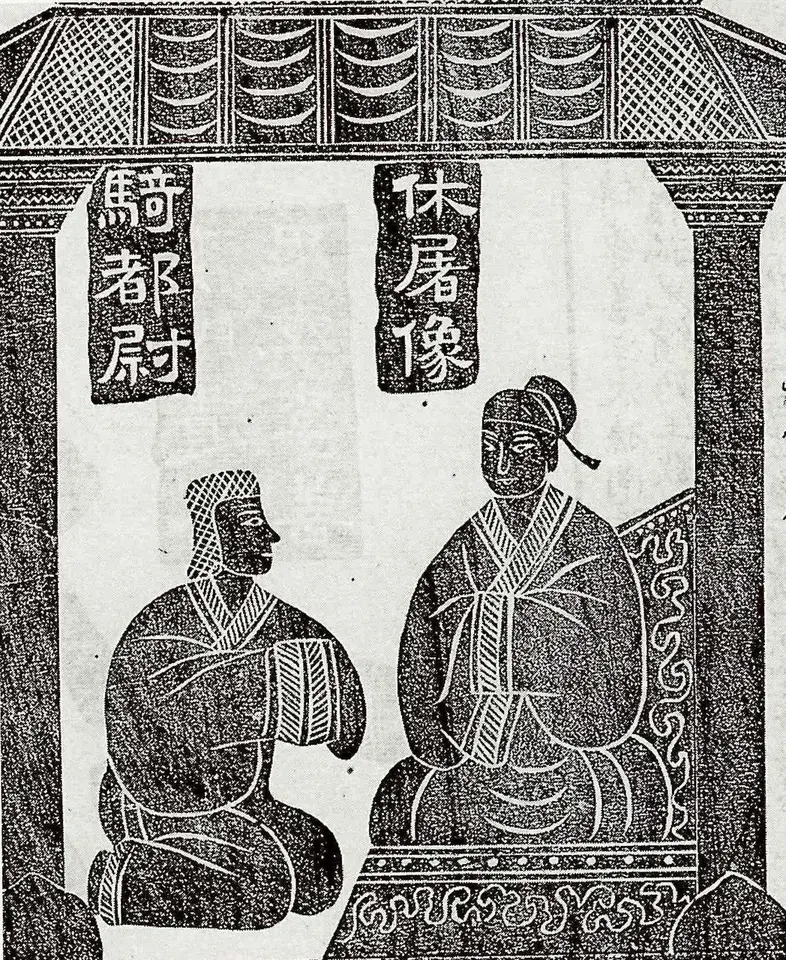
金日磾
Jin Midi (134–86 BCE), styled Wengshu, the crown prince of the Xiongnu Xiuchu King, was a celebrated statesman, trusted imperial confidant, and senior co-regent during the reigns of Emperors Wu and Zhao of the Western Han dynasty. In 121 BCE, during Huo Qubing's sweeping Hexi campaigns, the Xiuchu King was slain by his ally the Hunxie King following a disagreement over surrendering to Han; the fourteen-year-old Jin Midi,…
Jin Midi (134–86 BCE), styled Wengshu, the crown prince of the Xiongnu Xiuchu King, was a celebrated statesman, trusted imperial confidant, and senior co-regent during the reigns of Emperors Wu and Zhao of the Western Han dynasty. In 121 BCE, during Huo Qubing's sweeping Hexi campaigns, the Xiuchu King was slain by his ally the Hunxie King following a disagreement over surrendering to Han; the fourteen-year-old Jin Midi, along with his mother and younger brother Jin Lun, was taken to Chang'an and assigned to the imperial stables as a slave. When Emperor Wu inspected the horses during a court banquet, while other stable boys stared at the imperial concubines, Jin Midi maintained flawless dignity and averted his eyes; impressed by his commanding physical stature and the pristine condition of his horses, Emperor Wu promoted him to Stable Master, later advancing him to Palace Attendant (Shizhong), Chief Commandant of Equitation (Fuma Duwei), and Grand Master of Splendid Happiness. Raised under strict maternal discipline, Jin Midi personally executed his own beloved eldest son when the boy behaved insolently toward palace women, winning Emperor Wu's profound respect for his incorruptible integrity. In 88 BCE, Jin Midi thwarted an assassination attempt on Emperor Wu in the Ganquan Palace, physically tackling and disarming the dagger-wielding assassin Ma Heluo. On his deathbed in 87 BCE, Emperor Wu appointed Jin Midi alongside Huo Guang, Shangguan Jie, and Sang Hongyang as co-regents to assist the eight-year-old Emperor Zhao, investing him as Marquis of Tuo and General of Chariots and Cavalry. Passing away in 86 BCE at age forty-nine, Jin Midi was granted the posthumous title Marquis Jing and interred as an attendant tomb at Maoling, celebrated across Chinese history as the supreme exemplar of loyalty and filial piety.
Jin Midi was born as the crown prince of the Xiuchu King within the Xiongnu tribal lands in Hexi.
Huo Qubing conquered Hexi; after his father was killed, the fourteen-year-old Jin Midi was brought to Chang'an as an imperial stable slave.
During a palace equine inspection, Jin Midi's solemn decorum and magnificent horses caught Emperor Wu's attention, leading to his instant elevation to Stable Master.
When his favored eldest son acted improperly toward palace maidens, Jin Midi executed the youth with his own hands to preserve palace propriety.
Court Attendant Ma Heluo attempted to assassinate Emperor Wu; Jin Midi tackled the armed assassin to the floor, saving the sovereign's life.
On his deathbed, Emperor Wu appointed Jin Midi as General of Chariots and Cavalry and co-regent to Emperor Zhao, creating him Marquis of Tuo.
Jin Midi succumbed to severe illness at age forty-nine, receiving full state honors, the posthumous title Marquis Jing, and burial beside Maoling.
Jin Midi was born in the northern steppe as the eldest son and heir of the Xiuchu King, whose tribe held sway over the Wuwei region of the Hexi Corridor and safeguarded the sacred Golden Statue used in Xiongnu religious sacrifices. In the spring of 121 BCE, Emperor Wu commissioned Agile Cavalry General Huo Qubing to mount an offensive into Hexi. Huo Qubing struck through Yanzhi Mountain, capturing the sacred Golden Statue and routing nomadic forces. In the autumn of the same year, the Xiongnu Chanyu, enraged by repeated military debacles, resolved to execute both the Hunxie and Xiuchu Kings. Terrified, the two kings plotted to surrender to Han.
However, as the Han reception force drew near, the Xiuchu King wavered and attempted to pull back. Fearing that hesitation would invite imperial destruction, the Hunxie King launched a preemptive strike, murdering the Xiuchu King and absorbing his forty thousand followers before surrendering to Huo Qubing. The fourteen-year-old Jin Midi, his mother the Queen (Yanzhi), and his younger brother Jin Lun were taken to the imperial capital of Chang'an as captives. While tribal commoners were resettled in frontier protectorates, royal captives were placed under the Imperial Privy Purse, with Jin Midi and his brother assigned to the Yellow Gate Bureau to labor as stable grooms.
Enduring years of hard labor in the imperial stables, Jin Midi demonstrated neither bitterness nor resentment. His mother raised her sons with strict standards of decorum, modesty, and filial piety. By the time he reached early adulthood, Jin Midi had grown into a towering figure standing eight feet two inches tall, with an imposing physical presence and grave, dignified countenance.
During a grand court banquet at Weiyang Palace, Emperor Wu ordered dozens of fine horses paraded through the courtyard for the entertainment of his imperial consorts. As the magnificent animals were led past the imperial dais, the other stable grooms looked sideways to ogle the gathered palace concubines. Jin Midi alone walked with measured steps, holding the reins with solemn composure, his eyes fixed firmly forward, while his horses were noticeably sleeker and healthier than any others. Astonished by his singular presence, Emperor Wu halted the procession and questioned him. Upon discovering that the groom was the crown prince of the late Xiuchu King, Emperor Wu appointed him Stable Master on the spot.
Recognizing his unwavering honesty and competence, Emperor Wu rapidly promoted Jin Midi to Palace Attendant (Shizhong), Chief Commandant of Equitation (Fuma Duwei), and Grand Master of Splendid Happiness (Guangluxun). For decades, Jin Midi attended the emperor day and night, riding beside the imperial carriage during excursions and guarding the inner chambers during audiences, never committing the slightest ceremonial error. Emperor Wu lavished immense wealth and affection upon him, provoking the envy of imperial in-laws who complained about an outsider being granted such intimacy. Emperor Wu dismissed these criticisms, honoring him even further. When Jin Midi's mother passed away, Emperor Wu ordered her portrait painted on the walls of Ganquan Palace with the inscription "The Queen of Xiuchu." Whenever Jin Midi passed her portrait, he would adjust his robes, bow solemnly, and weep before departing.
Jin Midi's domestic discipline was as legendary as his public loyalty. His eldest son was a favorite playmate of Emperor Wu, who called the boy his "play-child" (Nong'er) and allowed him to jest freely in his presence. However, as the boy grew older, his behavior became increasingly irresponsible. One day, entering the palace corridors, Jin Midi caught his son flirting with and embracing a palace maidservant. Recognizing that unchecked arrogance within the inner court inevitably bred catastrophe, Jin Midi executed his son with a club on the spot.
Shocked and grieving, Emperor Wu summoned Jin Midi and demanded to know why he had slain his favorite youth. Jin Midi prostrated himself with tears, explaining: "The boy behaved insolently within the inner palace, defying decorum and breaking the law. I executed him before his corruption could endanger the imperial court!" Deeply moved by this extraordinary selflessness, Emperor Wu's respect for Jin Midi's moral purity reached profound new heights.
In the summer of 88 BCE, while Emperor Wu was recuperating from an illness at Ganquan Palace, Court Attendant Ma Heluo and his brothers, terrified that past associations with the witchcraft conspirator Jiang Chong would be uncovered, resolved to assassinate the emperor. Sensing their erratic movements, Jin Midi placed himself on high alert. One morning, as Emperor Wu rested in his bedchamber, Ma Heluo concealed a dagger in his sleeve and approached the imperial suite. Jin Midi, seized by an intuitive foreboding, rushed to the bedchamber entrance just as Ma Heluo reached the door. As Ma Heluo drew his dagger and lunged toward the imperial bed, Jin Midi threw himself forward, locked his arms around the assassin, and slammed him violently onto the flagstones, shouting: "Ma Heluo has rebelled!" Palace guards rushed in and seized the conspirator. Jin Midi's physical bravery preserved Emperor Wu's life at the ultimate hour.
In the spring of 87 BCE, Emperor Wu lay dying at the Wuzuo Palace, with the future Emperor Zhao only eight years old. Remembering the ancient precedent of the Duke of Zhou, Emperor Wu summoned Huo Guang, Jin Midi, Shangguan Jie, and Sang Hongyang to his bedside. He issued an imperial edict appointing Huo Guang as Commander-in-Chief and Jin Midi as General of Chariots and Cavalry, naming them co-regents to guide the child sovereign.
Emperor Wu had also intended to create Jin Midi Marquis of Tuo, but Jin Midi declined the honor, stating: "The young sovereign has just ascended the throne; as a foreign captive who has rendered no service to the new reign, I dare not accept a feudal marquisate." Only in 86 BCE, when Jin Midi became critically ill, did Huo Guang insist on formally bestowing the marquisate upon him while he was confined to his sickbed. The following day, Jin Midi passed away peacefully in Chang'an at the age of forty-nine. Emperor Zhao bestowed an imperial burial with full honors, granting him the posthumous title Marquis Jing and a privileged attendant tomb beside Emperor Wu's Maoling mausoleum.
Jin Midi's lineage maintained his standards of integrity for seven generations, producing scores of palace attendants, ministers, and feudal lords without suffering a single political disgrace. While the families of his fellow co-regents Huo Guang and Shangguan Jie were eventually eradicated for factional treason, the Jin family flourished, standing across Chinese history as an immortal testament to moral rectitude and multi-ethnic integration.
Jin Midi's heroic intervention against Ma Heluo at Ganquan Palace averted a catastrophic dynastic crisis. His vigilance and decisive physical courage thwarted a lethal regicide attempt in the emperor's private quarters, demonstrating an unshakeable bond of personal loyalty that preserved the continuity of the Han imperial line.
Rising from captive slave to supreme co-regent of the Western Han, Jin Midi achieved greatness through incorruptible virtue, self-restraint, and strict adherence to Ruist moral codes. By executing his own son to uphold palace discipline and declining royal honors out of modesty, he established an exemplary model of service that facilitated the peaceful transition of power during Emperor Zhao's minority and symbolized the harmonious integration of northern ethnic groups into the Han dynastic core.
FIGURES ASSOCIATED WITH THIS DYNASTY