Entering Officialdom
Recognized for talent in his youth, Sima Liang entered Wei service as Gentleman Attendant at the Yellow Gate, was created Village Marquis of Wangsui for Sima Yi's merits, and rose to Eastern Commander of the Household.
司马亮
Sima Liang (司马亮, ? – July 26, 291), courtesy name Ziyi, was a native of Wen County in Henei (present-day Wen County, Henan Province). He was a senior imperial prince and regent of the Western Jin dynasty, the fourth son of Emperor Xuan of Jin (Sima Yi), half-brother of Emperor Jing (Sima Shi) and Emperor Wen (Sima Zhao), uncle of Emperor Wu (Sima Yan), and the first prince to fall in the cataclysmic War of the Eight Princes.…
Sima Liang (司马亮, ? – July 26, 291), courtesy name Ziyi, was a native of Wen County in Henei (present-day Wen County, Henan Province). He was a senior imperial prince and regent of the Western Jin dynasty, the fourth son of Emperor Xuan of Jin (Sima Yi), half-brother of Emperor Jing (Sima Shi) and Emperor Wen (Sima Zhao), uncle of Emperor Wu (Sima Yan), and the first prince to fall in the cataclysmic War of the Eight Princes. Renowned in his youth for integrity, vigilance, and administrative competence, Sima Liang served Cao Wei in offices including Gentleman Attendant at the Yellow Gate, Eastern Commander of the Household, and General Guarding the West, enfeoffed as Earl of Qiyang. Following the founding of the Western Jin, he was created Prince of Fufeng and Commander-in-Chief of Military Affairs in Yong and Liang Provinces, later transferred to Prince of Ru'nan, and served as Minister of Finance, Grand General Pacifying the Army, and Grand Marshall, standing as the senior patriarch of the imperial Sima clan. On his deathbed, Emperor Wu intended Sima Liang to serve as co-regent alongside imperial in-law Yang Jun. However, Yang Jun secretly altered the imperial testament and expelled Sima Liang from the capital. In 291, Empress Jia Nanfeng allied with Prince of Chu Sima Wei to purge Yang Jun. Sima Liang returned to Luoyang as senior imperial patriarch, assuming the titles of Grand Tutor and Manager of the Affairs of the Masters of Writing to co-lead the central government with Grand Protector Wei Guan. In office, Sima Liang proved indecisive; seeking widespread approval, he issued mass promotions of over a thousand nobles and officials, eliciting public mockery, while growing severely estranged from the bellicose Sima Wei, who commanded the capital guards. In July 291, Empress Jia and Sima Wei forged an edict accusing Sima Liang of treason and surrounded his estate. Sima Liang surrendered without resistance and was slain at Mount Mang. The Jin court subsequently executed Sima Wei, rehabilitated Sima Liang's honor, and granted him the posthumous title Prince Wencheng.
Recognized for talent in his youth, Sima Liang entered Wei service as Gentleman Attendant at the Yellow Gate, was created Village Marquis of Wangsui for Sima Yi's merits, and rose to Eastern Commander of the Household.
Joined Sima Zhao's expedition against Zhuge Dan at Shouchun; dismissed after a tactical reversal, he was soon reinstated as General of the Left, Inspector of Military Affairs in Yuzhou, and Earl of Qiyang.
His nephew Emperor Wu of Jin established the Western Jin; Sima Liang was created Prince of Fufeng with a fief of ten thousand households and appointed Commander-in-Chief of Military Affairs in Yong and Liang Provinces.
Dismissed following setbacks during the Xianbei rebellion of Tufa Shujineng, he was soon reappointed Minister of Finance, transferred to Prince of Ru'nan, and tasked with supervising Yuzhou.
Advanced to Grand General Pacifying the Army and Palace Attendant; promoted to Grand Marshall and Grand Commander-in-Chief with the Yellow Axe, supervising Yuzhou and imperial clan affairs.
Emperor Wu fell mortally ill and planned to name Sima Liang co-regent with Yang Jun; Yang Jun forged the decree, expelling Sima Liang to Xuchang, preventing him from attending the imperial obsequies.
Empress Jia Nanfeng purged Yang Jun; Sima Liang was summoned to Luoyang as Grand Tutor and Manager of the Affairs of the Masters of Writing, co-governing with Grand Protector Wei Guan.
Clashing with Prince of Chu Sima Wei over military commands, Sima Liang was besieged on forged imperial orders issued by Empress Jia and Sima Wei; he refused to resist and was killed at Mount Mang.
Empress Jia executed Sima Wei for exceeding authority, posthumously rehabilitated Sima Liang, restored his high honors, and conferred the posthumous title Prince Wencheng.
Sima Liang descended from the prominent Sima clan of Wen County in Henei, being the fourth son of Sima Yi, the grand chancellor and foundational patriarch of the Western Jin, born to Lady Fu. From his youth, Sima Liang was noted within his family for his upright demeanor, quick intellect, and administrative talent. During the Zhengshi era of Cao Wei under the Prince of Qi Cao Fang, he entered the imperial bureaucracy as a Gentleman Attendant at the Yellow Gate. In recognition of his father Sima Yi's campaigns in Liaodong and political regency, Sima Liang was enfeoffed as Village Marquis of Wangsui. As the Sima house consolidated authority, he rose through promotions to Eastern Commander of the Household and District Marquis of Guangyang.
In 257, Zhuge Dan, General Who Conquers the East, launched an insurrection in Shouchun against the Sima regency. Sima Zhao led imperial armies to suppress the revolt. Serving as a detachment commander, Sima Liang suffered a minor operational setback and was dismissed by Sima Zhao to maintain strict military discipline. However, recognizing his lineage and practical abilities, Sima Zhao soon reinstated him as General of the Left, Palace Attendant, and Commander with Special Powers, stationing him to supervise military affairs in Yuzhou. In 264, when the five-rank aristocratic system was reconstituted, Sima Liang was created Earl of Qiyang and transferred to General Guarding the West.
In December 265, Sima Zhao's heir Sima Yan replaced Cao Wei and established the Western Jin dynasty as Emperor Wu. To protect the throne with imperial kin, Emperor Wu created senior relatives princes of regional commands. As the emperor's paternal uncle, Sima Liang was enfeoffed as Prince of Fufeng with ten thousand households, appointed Grand General Guarding the West, and designated Commander-in-Chief of Military Affairs in Yong and Liang Provinces, stationed at Chang'an to oversee the northwestern frontier.
Beginning in 270, the Xianbei chieftain Tufa Shujineng instigated widespread rebellions in Hexi, repeatedly defeating Jin commanders and shaking the frontiers of Qinzhou and Liangzhou. Stationed in Chang'an, Sima Liang failed to dispatch timely reinforcements to relieve subordinate general Liu Qi, leading to grave military deterioration. The imperial court dismissed him from command. Nevertheless, given his high imperial standing, he was soon reappointed Minister of Finance and General of the Imperial Guards. In 277, under Emperor Wu's kingdom redistribution policy, Sima Liang was transferred as Prince of Ru'nan with thirty thousand households, assigned to supervise Yuzhou, and elevated to Grand General Pacifying the Army, Palace Attendant, and Minister with Special Privileges.
In 289, Emperor Wu's health deteriorated rapidly. The emperor appointed Sima Liang Grand Marshall, Grand Commander-in-Chief with the Yellow Axe, and Grand General Guarding the South, directing military affairs in Yuzhou while managing the Court of the Imperial Clan. In his twilight months, Emperor Wu realized that his heir Sima Zhong was intellectually deficient and feared that state power would fall into the hands of ambitious in-laws. In early 290, Emperor Wu drafted a testament on his deathbed designating his uncle Sima Liang and imperial relative Yang Jun (father of Empress Dowager Yang Zhi) as co-regents.
Yang Jun was cunning and insecure, deeply dreading Sima Liang's moral prestige and imperial bloodline. Yang Jun colluded with clerks in the Secretariat to intercept and alter Emperor Wu's final edict, usurping sole regency powers. He issued a forged decree ordering Sima Liang to depart immediately for his garrison in Xuchang, forbidding imperial princes from lingering in the capital. Reaching Xingyang, Sima Liang realized that political intrigue had severed his path. In April 290, Emperor Wu died, and Emperor Hui ascended the throne with Yang Jun exercising absolute sway. Fearing ambushes, Sima Liang bowed and wept outside the Grand Marshall Gate of Luoyang but did not dare enter the inner palaces, retreating to Xuchang to await developments.
In March 291, Emperor Hui's ambitious consort, Empress Jia Nanfeng, plotted to break the Yang clan's monopolization of power. She secretly summoned Prince of Chu Sima Wei and Prince of Huainan Sima Yun with regional troops into the capital, launching a bloody palace coup that annihilated Yang Jun and his entire clan and deposed the Empress Dowager. Following the purge, to pacify the aristocracy and civil bureaucracy, Empress Jia summoned Sima Liang back to Luoyang, elevating him to Grand Tutor, Chancellor, and Manager of the Affairs of the Masters of Writing, granting sixty lictors and co-regency alongside Grand Protector Wei Guan.
As premier regent and clan elder, Sima Liang was expected to stabilize the dynasty and impose discipline. However, he was temperamentally lenient and politically indecisive. Seeking to appease factions scarred by Yang Jun's tyranny, Sima Liang adopted an unprincipled policy of mass patronage, conferring aristocratic titles and high offices upon 1,080 individuals in a single day. Nobles and commoners were dismayed by the debasement of imperial honors, prompting popular street ballads in Luoyang mocking that advancement required flattering Sima Liang. Furthermore, his excessive deference to Empress Jia allowed the imperial court to drift further into disarray.
As power realigned, Sima Liang came into irreconcilable conflict with the aggressive Prince of Chu Sima Wei, who commanded elite palace guards. Proud of his decisive role in purging Yang Jun, Sima Wei demanded greater honors and military authority. Distrusting Sima Wei's volatility, Sima Liang and Wei Guan repeatedly curtailed his authority and submitted memorials urging Emperor Hui to strip Sima Wei of his Northern Army commands and return him to his regional princedom in Jingzhou. Furious, Sima Wei allied with Empress Jia, who was equally anxious to eliminate the two senior statesmen blocking her ambitions.
On the night of July 26, 291, Empress Jia issued forged imperial decrees to Sima Wei, falsely accusing Grand Tutor Sima Liang and Grand Protector Wei Guan of treasonous designs to depose the emperor. Sima Wei surrounded Sima Liang's residence with capital guards. Sima Liang's household officers drew their weapons and implored him to resist or break out to plead his innocence. Sima Liang refused, affirming that he harbored total devotion to the dynasty and would not fight imperial troops if the emperor truly willed his demise, commanding his men to stand down.
The guards arrested Sima Liang and dragged him to Mount Mang north of Luoyang. Respecting him as Sima Yi's son and the elder of the dynasty, the soldiers hesitated to strike. At dawn, impatient with the delay, Sima Wei proclaimed from the city ramparts that whoever brought him Sima Liang's head would be rewarded with thirty bolts of silk. Enticed by the bounty, mutinous soldiers attacked Sima Liang, brutally slaying him beneath a carriage. Days later, Empress Jia turned on Sima Wei, executing him for unlawful bloodshed, while issuing an imperial proclamation exonerating Sima Liang, restoring his honors with the Yellow Axe, and granting the posthumous title Prince Wencheng.
Early in the Western Jin dynasty, Emperor Wu established regional princedoms to guard the imperial house, dispatching Sima Liang as Grand General Guarding the West to Chang'an. In this capacity, Sima Liang oversaw military affairs across Yong and Liang Provinces, fortified the Qin-Long frontier defenses, reorganized agricultural military settlements, and integrated displaced populations after the fall of Shu Han. Despite tactical reverses during the subsequent rebellion of Tufa Shujineng, his governance established deep personal prestige among the soldiers and civilians of the western passes, cementing his status as an indispensable pillar of the imperial clan.
In 290, when Emperor Wu lay dying, the succession hung by a thread. Knowing the heir was intellectually deficient, the emperor relied on his uncle Sima Liang to check external in-laws. When Yang Jun forged the testament and deployed palace loyalists to seize control, Sima Liang showed remarkable restraint. Rather than provoking a civil war in the capital with his personal retainers during the imperial funeral, he prudently withdrew to Xuchang, avoiding immediate urban conflict during the dynastic transition.
Following Yang Jun's downfall in 291, Sima Liang resumed authority as premier imperial statesman, directing state affairs alongside Wei Guan. He moved promptly to redress the political persecution inflicted during Yang Jun's regime, rehabilitating victimized officials and appointing celebrated literati, momentarily reviving civil governance. However, his indecisiveness and excessive reliance on title inflation weakened the authority of the throne, leaving him vulnerable to court intrigue.
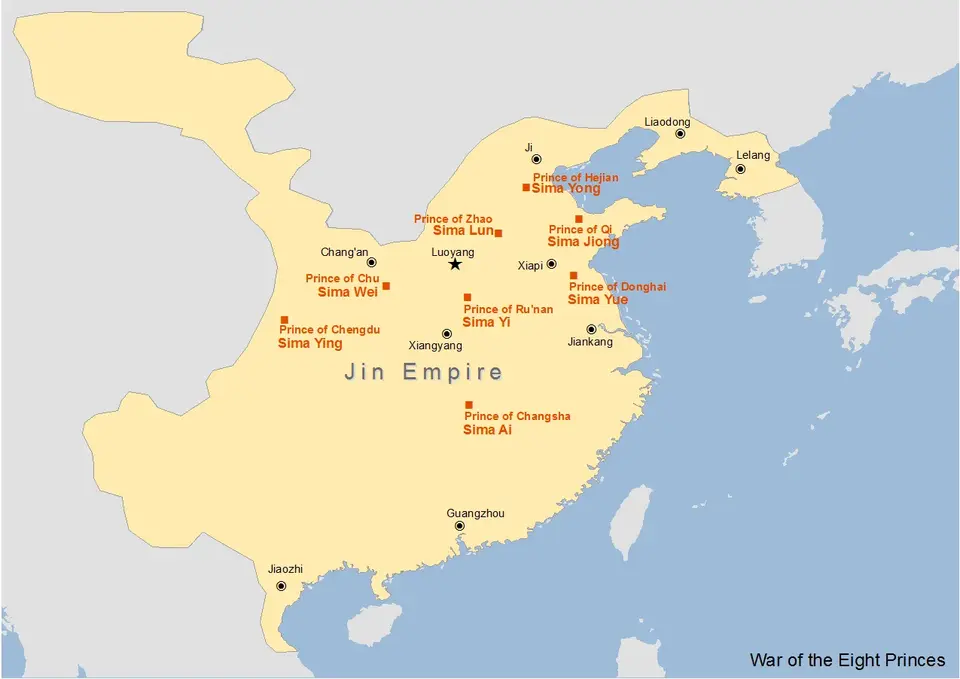
As the first imperial prince assassinated during the catastrophic sixteen-year War of the Eight Princes, Sima Liang's tragic demise marked a fateful turning point in Chinese history. His death destroyed the ideological facade of imperial family solidarity, establishing a precedent of dynastic princes using military force to murder senior regents and seize central power. His demise unchained successive bloody uprisings by princes of Chu, Zhao, Qi, Chengdu, Hejian, and Donghai, ultimately unraveling imperial defenses and paving the way for the Yongjia Turmoil and the collapse of the Western Jin.
FIGURES ASSOCIATED WITH THIS DYNASTY