Birth in Nanchang
Born in Yitangpo, Nanchang, displaying precocious intellect from early childhood.
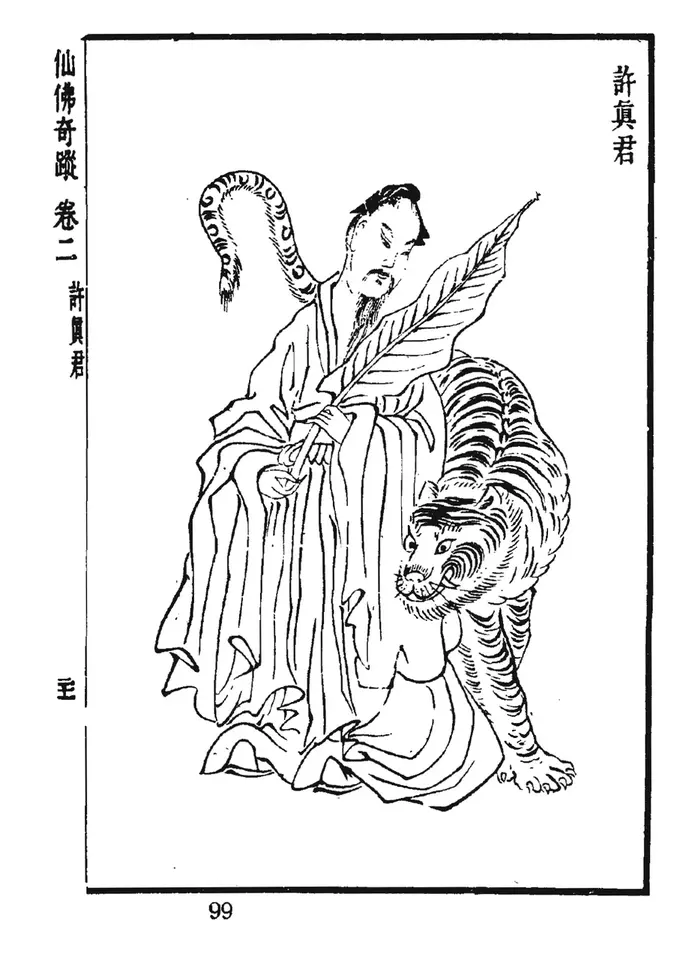
许逊
Xu Xun (许逊, 239–374), courtesy name Jingzhi, was a celebrated Daoist scholar and the foundational patriarch of the Jingming Dao (Way of Pure Brightness) tradition during the Jin dynasty. Hailing from Nanchang in Yuzhang, he is venerated alongside Zhang Daoling, Ge Xuan, and Sa Shoujian as one of Taoism's Four Celestial Masters and is popularly remembered as True Lord Xu or Xu of Jingyang. Endowed with profound learning…
Xu Xun (许逊, 239–374), courtesy name Jingzhi, was a celebrated Daoist scholar and the foundational patriarch of the Jingming Dao (Way of Pure Brightness) tradition during the Jin dynasty. Hailing from Nanchang in Yuzhang, he is venerated alongside Zhang Daoling, Ge Xuan, and Sa Shoujian as one of Taoism's Four Celestial Masters and is popularly remembered as True Lord Xu or Xu of Jingyang. Endowed with profound learning spanning the Confucian classics, astronomy, geography, and pharmacology, he studied esoteric doctrines under master Wu Meng before retreating to the Western Hills of Nanchang to cultivate virtue. In 280, following the reunification of the empire under Western Jin, Xu Xun accepted appointment as Magistrate of Jingyang in Sichuan. His decade-long tenure was distinguished by incorruptible administration, the mitigation of punitive statutes, and compassionate relief during severe floods and epidemics through the dispensing of medicinal herbal formulas. Foreseeing the catastrophic dynastic fragmentation of the War of the Eight Princes, he resigned from office in 290 and returned east. Across the Poyang Lake basin and adjacent provinces, he organized major hydraulic engineering efforts to control disastrous river floods. In 321, he established the Taiji Temple at Nanchang, formulating the doctrinal synthesis of filial piety and inner purity that defined Jingming Dao. In 374, he was believed to have attained immortality and ascended to heaven from Mount Xishan.
Born in Yitangpo, Nanchang, displaying precocious intellect from early childhood.
Received secret scriptures and pharmacological teachings from Daoist adept Wu Meng.
Traveled across famous southern peaks with polymath Guo Pu before secluding himself at Mount Xiaoyao.
Assumed office as Magistrate of Jingyang in Sichuan, implementing benevolent relief and medical cures.
Anticipated imperial convulsions, renouncing office to lead hydraulic flood relief around Poyang Lake.
Founded Taiji Temple in Nanchang, codifying the core doctrine of loyalty and filial piety.
According to hagiographical tradition, ascended to heaven with his entire household at age 136.
Xu Xun was born in the second year of Chiwu (239) in Yitangpo, Nanchang County, within Yuzhang Commandery. Exhibiting early scholarly brilliance, he engaged in comprehensive studies of classical texts, astronomical systems, physical geography, and traditional medicine.
In his youth, Xu Xun frequently engaged in equestrian hunting. On one expedition, he fatally wounded a pregnant doe, witnessing the dying mother desperately lick her fallen offspring before expiring. Overwhelmed with profound remorse over the destruction of life, Xu Xun shattered his crossbow on the spot, vowing never again to harm a living creature. Seeking spiritual transformation, he apprenticed himself to Wu Meng, a renowned local Daoist adept celebrated for mastering ancient ritual arts. Under Wu Meng's guidance, Xu Xun mastered the foundational esoteric teachings and medicinal secrets of the Daoist canon.
At age twenty, local magistrates nominated him as Filial and Incorrupt, but he repeatedly declined official appointment. When he was thirty-six, he formed a close intellectual bond with the literary master and commentator Guo Pu. Together, they explored prominent peaks throughout southern China. Following these travels, Xu Xun established a hermitage at Mount Xiaoyao in the western suburbs of Nanchang, devoting his days to quiet meditation, the recitation of scriptures, and the moral instruction of rural communities.
In the first year of Taikang (280), Emperor Wu of Jin conquered Eastern Wu, uniting China under Western Jin rule. In response to repeated imperial summonses, Xu Xun relented and accepted the post of Magistrate of Jingyang in modern-day Sichuan.
Upon arriving in Jingyang, Xu Xun initiated far-reaching administrative reforms aimed at eradicating corruption and reducing judicial cruelties. He simplified legal procedures, promoted filial harmony, and lowered burdensome levies. When an extraordinary inundation submerged low-lying paddies and wiped out harvests, Xu Xun opened municipal granaries and engaged displaced farmers on public estates through a food-for-work system, preserving countless livelihoods. Shortly thereafter, when a virulent pestilence spread across the county, Xu Xun drew upon his medical training to formulate curative broths, distributing treatments freely outside government offices.
The local populace revered him like a parent, composing a folk ballad praising his tenure: "No thieves prowl the streets, no clerks practice deceit; our magistrate brings the sick to life, rendering diseases void." Impoverished families from neighboring jurisdictions migrated to Jingyang in vast numbers, multiplying the local census. Throughout his ten-year magistracy, his integrity and selfless governance earned him the affectionate honorific "Xu of Jingyang."
In the first year of Taixi (290), Emperor Wu passed away, leaving the throne to Emperor Hui, whose cognitive infirmity triggered fierce violent contention among regent Yang Jun and imperial princes. Recognizing that civil strife was unavoidable, Xu Xun hung up his official cap and surrendered his magistracy to return home.
On the day of his departure, thousands of local residents lined the highways weeping, and many communities erected ancestral shrines bearing his portrait. Several dozen households disposed of their properties to accompany him on the arduous thousand-mile journey back to Jiangxi, settling near Mount Xishan and adopting his surname, creating a settlement known as the Xu Family Compound.
Upon reaching Yuzhang, Xu Xun discovered that the Poyang Lake drainage basin was plagued by recurring flash floods, which popular folklore attributed to malevolent water serpents. Organizing his senior disciples, including Gan Zhan and Shi Cen, Xu Xun systematically surveyed river channels, directed ditch excavation, and constructed protective embankments. His engineering and relief interventions extended beyond Jiangxi into modern Hunan, Hubei, and Fujian, winning widespread devotion among riverine populations.
In the fourth year of Daxing (321) under Eastern Jin Emperor Yuan, Xu Xun converted the former Meixian Shrine south of Nanchang into a Daoist academy named Taiji Temple, displaying a gateway plaque reading "Pure and Bright True Realm." Here, he formalized the Jingming Dao tradition, advocating the integration of Confucian filial ethics with Daoist inner purification.
According to religious hagiographies, Xu Xun attained the advanced age of 136. On the first day of the eighth month in the second year of Ningkang (374), he was said to have ascended into heaven in broad daylight from his residence at Mount Xishan. Subsequent imperial dynasties lavished honors upon his cult. In 1010, the Song imperial court elevated his shrine to the Yulong Temple, and in 1112 Emperor Huizong bestowed upon him the title "True Lord of Miraculous Salvation and Divine Merit," constructing the monumental Yulong Wanshou Palace in his honor. Prominent Northern Song chancellor Wang Anshi personally composed the commemorative inscription Record of the Shrine of Magistrate Xu of Jingyang.
FIGURES ASSOCIATED WITH THIS DYNASTY