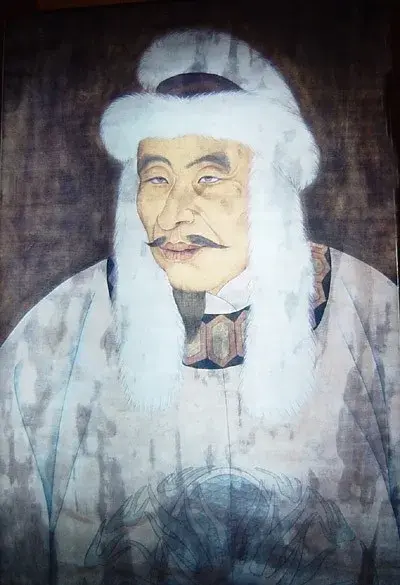
Life Story
Early Military Career and Frontier Battles
Puxian Wannu belonged to the Jurchen Puxian clan, an aristocratic lineage whose early familial background remains largely unrecorded in surviving dynastic annals. He entered imperial service during the reign of Emperor Zhangzong, serving as Director of the Imperial Stables with the civil-military rank of subordinate fifth grade, responsible for imperial herds and equine cavalry logistics. In 1206, the Southern Song Grand Councilor Han Tuozhou launched the massive Kaixi Northern Expedition to reclaim the central plains. Puxian Wannu was deployed as right-wing commander under Chief Commander Wanyan Saibu in Henan. When the Southern Song central column under Huangfu Bin reached the swollen Qin River, holding the river bridge in force, Puxian Wannu and Wanyan Dajibur were ordered to execute a synchronized nighttime river crossing under heavy darkness.
Attacking the Song positions at daybreak, the Jin strike force threw the enemy into complete disarray. Puxian pursued the fleeing Song columns toward Zhenyang, cutting off their retreat and joining other Jin contingents at Chenze to inflict twenty thousand casualties, capturing thousands of horses and supply wagons. This decisive victory collapsed the Song offensive along the Huai River, forcing the Southern Song court to negotiate the Jiading Peace Accord. For his battlefield bravery, Puxian was elevated in aristocratic rank. However, in 1211, when Genghis Khan launched the first Mongol invasion of the Jin Empire, Puxian was assigned as army supervisor under Wanyan Jiujin along the northern defense perimeter. At the Battle of Yehuling, tactical blunders by the Jin high command led to the complete encirclement and annihilation of their forces at Huan'erzui. Although Puxian managed to escape the slaughter, the destruction of the Jin field armies broke the dynasty's military spine.
Defeats in Liaodong and Ambitions of Independence
The collapse of Jin authority in the north triggered widespread insurrections across Manchuria. In 1213, the Khitan chiliarch Yelu Liuge led an anti-Jurchen rebellion that swiftly drew over one hundred thousand insurgent fighters across Liaodong. The Jin court dispatched Wanyan Chengyu with massive provincial armies to extinguish the uprising, with Puxian Wannu serving as a senior field commander. Sensing the formidable scale of the Jin forces, Yelu Liuge submitted to Genghis Khan and requested Mongol reinforcements. At Dijinao'er, near modern Changtu, combined Mongol-Khitan cavalry assaulted the Jin formations, inflicting a crushing defeat on Wanyan Chengyu and Puxian Wannu.
In late 1213, following the enthronement of Emperor Xuanzong in the midst of palace coups, Puxian was pardoned for his military failures and promoted to Pacification Commissioner of Xianping Circuit. Upon the death of Wanyan Chengyu, Puxian was elevated to Pacification Commissioner of Liaodong, becoming the supreme civil and military authority in Manchuria. Immediately upon taking office, he settled personal scores by executing Northeast Pacification Commissioner Wanyan Tiege, who had previously refused to supply him with troops. In 1214, Emperor Xuanzong ordered Puxian to mount a second campaign against Yelu Liuge. The opposing armies clashed along the North Xi River near Guiren; Puxian's demoralized conscripts broke upon impact, suffering another disastrous rout. Puxian fled with a handful of survivors to Liaoyang (the Eastern Capital), while Yelu Liuge occupied Xianping and consolidated control over southern Manchuria.
Proclaiming the Dazhen State and Retreat Eastward
Following the defeat at the North Xi River, Emperor Xuanzong abandoned the Central Capital of Zhongdu to flee southward to Bianjing, leaving the northern circuits cut off from imperial reinforcement. Recognizing that the Jin dynasty was careening toward total collapse, Puxian Wannu resolved to carve out an autonomous domain. He formed a secret alliance with Taiping, the Jin governor of the Supreme Capital, to ignore imperial commands. Loyal officials who discovered his treasonous intentions attempted to report him to the throne, but Emperor Xuanzong, overwhelmed by the defense of Henan, could only issue toothless exhortations urging unity.
In October 1215, Puxian Wannu openly renounced his allegiance to the Jin dynasty. At Liaoyang, he proclaimed himself Heavenly King, named his independent state Dazhen (widely designated in historical records as Eastern Xia), and inaugurated the reign era Tiantai. He organized provincial administrations and led troops to seize Xianping, Shenzhou, and Chengzhou. However, his initial expansion stalled when he was defeated in Posufu by Jin loyalist general Heshelie Huanduan, while his siege of the Supreme Capital was shattered by the heroic defense of female commander Wanyan Aluzhen. Concurrently, Yelu Liuge stormed Liaoyang in a surprise raid, capturing Puxian's wife, Lady Li Xian'e, and high-ranking officials. Facing imminent destruction, Puxian Wannu executed a strategic retreat, leading his surviving forces across the mountain passes into the rugged Helan and Xupin circuits (modern Yanbian and Maritime Manchuria), establishing his new capital at Nanjing.
Survival Diplomacy and Frontier Autonomy
In the winter of 1216, the Mongol grand commander Muqali swept through Liaodong. Isolated amidst the wilderness, Puxian Wannu submitted to Mongol suzerainty and dispatched his son, Puxian Tiege, as a hostage to Muqali's camp. Exploiting this temporary respite, Puxian extracted eighty thousand bushels of grain from neighboring Goryeo. In 1218, he dispatched his general Wanyan Ziyuan with twenty thousand troops to join Mongol commander Hazhen and Goryeo forces in besieging the rogue Khitan stronghold of Jiangdong City, sharing in the tribute and spoils after its fall.
In 1223, following Muqali's death and the absence of Genghis Khan on campaign in Central Asia, Puxian Wannu perceived an opportunity to throw off Mongol vassalage. He executed Yelu Nie'erge, the Mongol-appointed vice chancellor of Liaodong, and renounced his submission. In 1224, he changed his era name to Datong, dispatched envoys to Goryeo denouncing the rapacity of Mongol princes, and opened bilateral frontier markets at Qingzhou and Dingzhou. Over the next decade, plagued by food shortages, Eastern Xia raiders regularly crossed the Yalu and Tumen rivers to forage in northern Goryeo, maintaining a defiant regional sovereignty along the frontier.
The Mongol Eastern Expedition and Dynastic Destruction
In 1230, Ögedei Khan resolved to eliminate the lingering security threat on the northeastern flank, dispatching General Salita to pacify Liaodong and Goryeo while demanding Goryeo troops join in crushing Eastern Xia. However, Goryeo moved its capital to Ganghwa Island and mounted stiff resistance; Salita was slain by a stray arrow in battle, temporarily halting the Mongol encirclement.
In the spring of 1233, as Jin Emperor Aizong fled to Guide and Kaifeng surrendered, Jin rule collapsed completely. In February, Ögedei convened the imperial princes and ordered a massive eastern punitive campaign commanded by his eldest son, Prince Guyuk (later Emperor Dingzong of Yuan), and Prince Anqidai, guided by Yelu Liuge's son Yelu Xuedie. The Mongol host surged across the mountain ranges, laying tight siege to Nanjing. Despite desperate resistance by Eastern Xia infantry and cavalry, the citadel succumbed to Mongol elite cavalry and siege artillery. In September 1233, Guyuk captured Puxian Wannu alive and summarily executed him, dissolving the nineteen-year Eastern Xia realm and extinguishing the last remnants of Jurchen authority in the northeast.
Major Achievements
Establishing the Independent Eastern Xia Kingdom
Puxian Wannu's most notable historical accomplishment was his ability to carve out and maintain the autonomous Dazhen (Eastern Xia) state during the cataclysmic transition from the Jin to the Mongol Empire. Trapped between Mongol conquests and Jin collapse, he mobilized tens of thousands of displaced Jurchen, Khitan, Han, and Bohai refugees, leading them into the defensive mountain fastnesses of the Changbai Range and Tumen River basin.
For nearly two decades, he preserved an intact governmental administration modeled upon traditional Jurchen meng'an mouke and circuit structures, developing fortress cities such as Nanjing (modern Chengzi Mountain Fortress in Yanji) and Kaiyuan. His regime represented the final independent political manifestation of the medieval Jurchen people prior to their complete absorption into the Mongol imperial administrative framework.
Pragmatic Geopolitical Maneuvering
Confronting vastly superior adversaries on all frontiers—the Mongol steppe empire to the west, remaining Jin outposts to the south, and the Goryeo dynasty across the border—Puxian Wannu exhibited remarkable diplomatic opportunism. He shifted allegiances fluidly, submitting hostages to Muqali when Mongol military power was irresistible, cooperating in trilateral operations against Khitan bandits, and asserting sovereign independence the moment Mongol attention was diverted westward.
His calculated maintenance of frontier trade markets (quechang) with Goryeo enabled his regime to secure salt, textiles, and iron, allowing an isolated frontier community to endure prolonged economic blockades. The discovery of official bronze seals and cast coinage bearing his "Datong" era marks confirms the institutional resilience of his frontier statecraft.