Birth in Danyang
Born into a respected clan; his father served as magistrate of Yuyao; famed for chivalrous independence.
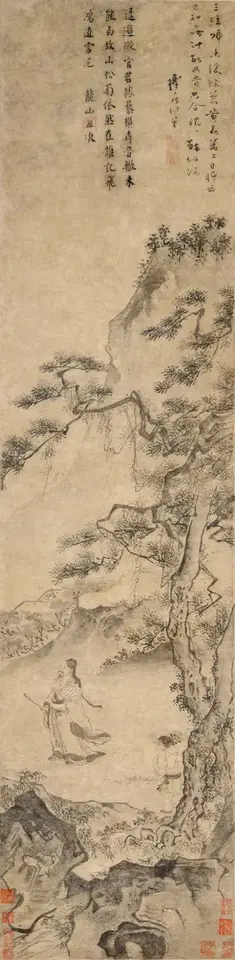
陶谦
Tao Qian (陶谦, 132–194), courtesy name Gongzu (恭祖), was a native of Danyang (modern Dangtu County, Anhui Province). He was a distinguished regional statesman and prominent warlord during the tumultuous disintegration of the late Eastern Han dynasty. Bold, outspoken, and fiercely independent in his youth, he won the admiration of the former Administrator of Cangwu, Master Gan, who took him as his son-in-law. Dedicating himself…
Tao Qian (陶谦, 132–194), courtesy name Gongzu (恭祖), was a native of Danyang (modern Dangtu County, Anhui Province). He was a distinguished regional statesman and prominent warlord during the tumultuous disintegration of the late Eastern Han dynasty. Bold, outspoken, and fiercely independent in his youth, he won the admiration of the former Administrator of Cangwu, Master Gan, who took him as his son-in-law. Dedicating himself to classical learning, Tao Qian passed the imperial evaluations as an abundant talent, rising through bureaucratic offices including Gentleman of the Masters of Writing, Magistrate of Shu and Lu counties, Inspector of Youzhou, and Consultant. In 185, he campaigned alongside Huangfu Song and Zhang Wen against northwestern Qiang rebels as Commandant of Martial Display. In 188, confronting widespread Yellow Turban insurgencies across the east, the imperial court appointed him Inspector of Xuzhou. Upon arriving in Xuzhou, Tao Qian enlisted bold commanders such as Zang Ba to crush the insurgent armies, restoring order across the province. He appointed Chen Deng as Agriculture Officer to establish agricultural colonies and expand irrigation, transforming Xuzhou into a prosperous sanctuary of peace that sheltered hundreds of thousands of refugees fleeing war-torn Guanzhong and the Central Plains. Following the disruption of Dong Zhuo, Tao Qian sent tributary embassies to Emperor Xian in Chang'an, receiving appointment as General Who Pacifies the East, Governor of Xuzhou, and Marquis of Liyang. In the broader warlord conflicts, he allied with Gongsun Zan and Yuan Shu against Yuan Shao and Cao Cao. In 193, when Cao Cao's father Cao Song was murdered while traveling through Xuzhou borderlands, Cao Cao launched two punitive invasions, capturing over a dozen cities and massacring civilian populations. Tao Qian resolutely held Tanxian, enlisting Liu Bei and Tian Kai to check the northern host. In late 194, suffering from physical exhaustion and illness, Tao Qian famously yielded the governorship of Xuzhou to Liu Bei on his deathbed, declaring that only Liu Bei could bring peace to the province. He passed away shortly thereafter at age sixty-three.
Born into a respected clan; his father served as magistrate of Yuyao; famed for chivalrous independence.
Married Master Gan's daughter, studied the Classics, and entered office as Gentleman of the Masters of Writing and magistrate.
Campaigned against the Qiang and Han Sui under Huangfu Song and Zhang Wen, serving as Commandant of Martial Display.
Appointed Inspector of Xuzhou, crushed regional Yellow Turban rebels, and instituted agricultural colonies.
Sent tributary envoys to Emperor Xian, receiving promotions as General Who Pacifies the East and Governor of Xuzhou.
Cao Cao's father was slain along the border; Cao Cao invaded Xuzhou and slaughtered civilians; Tao Qian held Tanxian.
Cao Cao invaded again before retreating; Tao Qian fell mortally ill and bequeathed Xuzhou to Liu Bei before dying at age sixty-three.
Tao Qian was born in 132 in Danyang. His father had previously served as the magistrate of Yuyao but died when Tao Qian was still young. As an adolescent, Tao Qian was celebrated for his bold and uninhibited spirit, frequently leading village youths on bamboo-horse military drills through the lanes. One day, Master Gan, the former Administrator of Cangwu, encountered young Tao Qian on the road. Struck by his imposing physique and commanding conversation, Gan invited him into his carriage, spoke with him at length, and resolved to betroth his daughter to him. When Gan's wife objected that Tao was reckless, Gan replied: "This youth possesses extraordinary presence; he is destined for great achievement."
Following his marriage, Tao Qian disciplined himself to classical scholarship, passing examination as an academy student and entering commandery administration. Recommended as an abundant talent, he was appointed Gentleman of the Masters of Writing and later Magistrate of Shu in Lujiang Commandery. During his tenure, his administrative superior, Administrator Zhang Pan, was an elder from his home commandery and a friend of his late father. However, Tao Qian refused to curry favor. At an official banquet, Zhang Pan pressed Tao Qian to rise and dance; Tao stood and danced but steadfastly refused to turn around. When Zhang asked why, Tao replied: "To turn is to yield dominance to others!" The two men parted in anger. Tao Qian maintained absolute financial integrity; when given five hundred cash left over from the celestial altar sacrifices, he abandoned his post rather than compromise his principles. He later governed Lu County, served as Inspector of Youzhou, and entered the central court as a Consultant.
In March 185, rebel Qiang and Hu tribal confederacies under Beigong Boyu, Han Sui, and Bian Zhang invaded the Three Fiefdoms around the western capital. Emperor Ling dispatched Left General of Chariots and Cavalry Huangfu Song to quell the rebellion, and Huangfu summoned Tao Qian to serve as Commandant of Martial Display. Tao Qian fought with distinction, routing rebel units in Liangzhou. Later that year, when Minister of Works Zhang Wen assumed supreme command, he invited Tao Qian to serve as his campaign consultant, treating him with lavish honors. However, Tao Qian despised Zhang Wen's military hesitation. At an imperial victory banquet, Tao publicly insulted Zhang Wen, refusing his wine. Although Zhang Wen initially prepared to banish him to the frontier, advisors persuaded Zhang to pardon him, showcasing Tao's unyielding nature.
In 188, remnants of the Yellow Turban rebels erupted across Xuzhou, seizing county seats and driving off imperial officials. Recognizing Tao Qian's administrative and martial talents, the court appointed him Inspector of Xuzhou. Arriving in the war zone, Tao Qian recruited local heroes including Zang Ba and Sun Guan, marshaling regional cavalry and infantry to crush the insurgent forces in pitched battles.
Following the restoration of peace, Tao Qian appointed scholar Chen Deng as Agriculture Officer to supervise comprehensive agricultural rehabilitation. He repaired irrigation dykes, promoted state-sponsored agricultural colonies, and protected regional granaries. While the Central Plains and Guanzhong collapsed into horrific famine and warfare following Dong Zhuo's usurpation, Tao Qian's Xuzhou remained prosperous, peaceful, and abundant in food, attracting over one hundred thousand civilian refugees seeking asylum.
In 1292, following the death of Dong Zhuo, chaotic infighting broke out among Li Jue and Guo Si in Chang'an, leaving Emperor Xian isolated. Regional warlords across the empire largely severed tributary ties with the central court to pursue territorial expansion. Guided by his counselors Wang Lang and Zhao Yu, Tao Qian insisted upon preserving the constitutional duty of an imperial minister, dispatching couriers through hazardous battlefields to present tribute to the emperor in Chang'an. Emperor Xian rewarded Tao Qian's steadfast loyalty by promoting him to General Who Pacifies the East and Governor of Xuzhou, investing him as Marquis of Liyang.
In the complex warlord diplomacy of eastern China, Tao Qian allied with Gongsun Zan of Youzhou and Yuan Shu of the Huai River basin to counter the hegemonic coalition of Yuan Shao and Cao Cao. In 193, Tao Qian advanced troops to Fagan to coordinate with Gongsun Zan's southern drive against Yuan Shao, deploying forces across Mount Tai and Rencheng to solidify his frontier buffer.
In the autumn of 193, catastrophe struck Xuzhou. Cao Cao's wealthy father, Cao Song, had been living in retirement in Langya. Once Cao Cao consolidated his authority in Yan Province, he sent an escort to bring his father and over one hundred family members to Mount Tai. As the massive baggage train passed through the borders of Xuzhou, Tao Qian dispatched his subordinate Zhang Kai with a cavalry unit to provide an armed escort. However, Zhang Kai and his soldiers were tempted by the immense treasure; they slaughtered Cao Song and his entire household, looted the caravans, and fled into Huainan.
Enraged by the murder of his family, Cao Cao held Tao Qian directly responsible and launched a punitive campaign against Xuzhou in late 193. The invading army captured more than ten cities, storming toward the provincial seat at Tanxian. Cao Cao ordered mass slaughter across the captured districts of Qulü, Suiling, and Xiachun, murdering hundreds of thousands of innocent men and women so that the Si River was choked with floating corpses and countryside settlements were completely depopulated. Tao Qian led his troops out to confront the invaders but suffered defeat, withdrawing behind the thick battlements of Tanxian to mount an unyielding defense. Depleted of grain, Cao Cao eventually withdrew his forces.
In the spring of 194, Cao Cao reorganized his armies and invaded Xuzhou a second time, taking Xiangben and slaughtering local populations with even greater savagery. Facing imminent annihilation, Tao Qian dispatched urgent appeals to Inspector Tian Kai of Qingzhou. Tian Kai and Liu Bei, who was then Chancellor of Pingyuan, marched south with several thousand elite cavalry and infantry to relieve the siege. Tao Qian immediately reinforced Liu Bei with four thousand veteran Danyang troops. Liu Bei stationed his force at Xiaopei, creating an interlocking defensive perimeter that stabilized the front.
Concurrently, regional magnates Chen Gong and Zhang Miao rebelled in Cao Cao's rear, welcoming Lü Bu into Yan Province. Fearing the loss of his territorial base, Cao Cao broke off the siege of Xuzhou to march back to Yan Province. Although the siege was lifted, two consecutive years of scorched-earth massacres had devastated Xuzhou's economy. Emotionally shattered by the loss of his people and physically broken by chronic illness, the sixty-two-year-old governor took to his deathbed.
In the winter of 194, Tao Qian's condition became terminal. Recognizing that his two sons, Tao Shang and Tao Ying, lacked the martial capacity to defend Xuzhou against future invasions, Tao Qian resolved to place the survival of the province above dynastic dynastic inheritance. Summoning his chief administrator Mi Zhu, Tao Qian made his solemn declaration: "None other than Liu Bei can bring peace to this province!" He handed the official seals of the governorship to Liu Bei. Tao Qian passed away peacefully in his residence shortly thereafter at age sixty-three. Honoring his final testament, the officials and populace of Xuzhou acclaimed Liu Bei as their new governor.
When Tao Qian arrived in Xuzhou in 188, the province was torn apart by tens of thousands of Yellow Turban insurgents who had sacked urban centers and routed local garrisons. Demonstrating high military competence, Tao Qian organized regional leaders like Zang Ba, defeating the rebel hosts in multiple engagements and restoring order across five commanderies.
Following the pacification, he appointed Chen Deng as Agriculture Officer, establishing state-managed agricultural colonies, dredging riverways, and encouraging grain cultivation. While the rest of eastern China suffered from catastrophic warfare and famine, Tao Qian's Xuzhou enjoyed half a decade of extraordinary agricultural abundance, serving as a sanctuary for hundreds of thousands of displaced refugees from the Central Plains.
Following Dong Zhuo's destruction of Luoyang, warlords throughout the empire ceased sending tax grain and tributary offerings to the Han court, focusing exclusively on personal military aggrandizement. Tao Qian stood out by maintaining strict constitutional allegiance to Emperor Xian.
Despite the perilous journeys across battle zones, Tao Qian repeatedly dispatched envoys to Chang'an, delivering formal memorials and regional tribute to the sovereign. His conduct reinforced the legitimate authority of the Han court during its darkest hours, earning him high honors from the emperor as General Who Pacifies the East.
During the two brutal invasions launched by Cao Cao in 193 and 194, Xuzhou faced genocidal massacres that depopulated entire commanderies. As other cities fell, Tao Qian refused to abandon his post or surrender his populace to executioners.
Gathering his core Danyang veterans within the walls of Tanxian, Tao Qian repulsed repeated assaults by Cao Cao's elite forces. His resolute defense held the provincial capital intact, buying vital time for relief forces under Tian Kai and Liu Bei to arrive and preserving the surviving population of Xuzhou.
The defining moment of Tao Qian's career was his decision on his deathbed to yield the governorship of Xuzhou to Liu Bei. In an era when warlords universally treated administrative posts and private armies as hereditary family property, often precipitating fratricidal ruin, Tao Qian showed extraordinary selflessness.
Recognizing that his own sons were ill-suited to govern in wartime, he bypassed dynastic nepotism to entrust the province's millions of residents to the virtuous Liu Bei. This visionary act provided Liu Bei with his first major territorial base and established a rare example of righteous governance during the Three Kingdoms era.
FIGURES ASSOCIATED WITH THIS DYNASTY