Birth in Kunshan
Born into a prominent literary family in Kunshan, Nanzhili, nurtured by the scholarly legacy of his great-grandfather Gui Youguang and father Gui Changshi.
归庄
Gui Zhuang (归庄, 1613–1673), originally named Zhuang and later renamed Zuoming, courtesy name Xuangong and art names Hengxuan and Jizhai, was a renowned late Ming and early Qing dynasty literatus, calligrapher, painter, and stalwart Ming loyalist from Kunshan, Jiangsu. Born into a prestigious scholarly lineage, he was the great-grandson of Gui Youguang, the preeminent prose master of the Ming dynasty, and the youngest son of…
Gui Zhuang (归庄, 1613–1673), originally named Zhuang and later renamed Zuoming, courtesy name Xuangong and art names Hengxuan and Jizhai, was a renowned late Ming and early Qing dynasty literatus, calligrapher, painter, and stalwart Ming loyalist from Kunshan, Jiangsu. Born into a prestigious scholarly lineage, he was the great-grandson of Gui Youguang, the preeminent prose master of the Ming dynasty, and the youngest son of the accomplished painter and seal carver Gui Changshi. Possessing extraordinary intellectual gifts, Gui read widely across classical and historical canons from youth. Joining the Fushe reform society alongside his lifelong friend Gu Yanwu, he cultivated an aloof and unyielding character, earning the joint contemporary epithet "Gui the Marvel and Gu the Eccentric" for their uncompromising integrity. Following the fall of Beijing and the southern advance of Qing armies in 1645, Gui responded to the draconian hair-cutting edicts by organizing an armed resistance movement in Kunshan alongside Gu Yanwu and Wu Qihang. After the catastrophic fall of the city, during which over forty thousand inhabitants perished and his family was decimated, Gui escaped in disguise and temporarily adopted the tonsure of a Buddhist monk to evade capture. Throughout the remainder of his life, he steadfastly refused to recognize the Qing dynasty, living in austere poverty in a dilapidated cottage he named "Jizhai" and sustaining himself by selling calligraphy and ink paintings. When Gu Yanwu was imprisoned and faced execution under trumped-up charges in 1655, Gui courageously orchestrated his rescue, forging a disciple letter to enlist the aid of Qian Qianyi. In his final years, Gui devoted his remaining strength to collecting and editing the complete works of his ancestor Gui Youguang before passing away in 1673 at the age of sixty-one.
Born into a prominent literary family in Kunshan, Nanzhili, nurtured by the scholarly legacy of his great-grandfather Gui Youguang and father Gui Changshi.
Formed a lifelong brotherhood with fellow townsman Gu Yanwu, joining the Fushe society and gaining fame as "Gui the Marvel and Gu the Eccentric."
Selected through an extraordinary civil recommendation list to serve at court, but declined the imperial summons due to endemic court corruption.
Older brother Gui Zhao died heroically defending the West Gate of Yangzhou alongside Shi Kefa; Gui risked his life to recover his remains.
In response to the Qing hair-cutting mandate, took up arms with Gu Yanwu and Wu Qihang, executing collaborating magistrates and defending Kunshan.
The city fell to Qing heavy artillery, followed by a massacre of forty thousand civilians; Gui escaped and assumed Buddhist monastic robes as Puming Toutuo.
Renamed himself Gui Zuoming to signify enduring devotion to the fallen Ming dynasty, while Gu Jiang renamed himself Gu Yanwu.
Accepted an invitation from scholar-artist Wan Shouqi to teach in Huaiyin, secretly liaising with anti-Qing resistance networks.
Returned to Kunshan to gather and bury seven deceased family members, erecting a modest thatch cottage named "Jizhai" where he vowed never to serve the Qing.
Gu Yanwu was framed and imprisoned on capital charges by hostile gentry; Gui orchestrated his rescue by enlisting the intervention of Qian Qianyi.
Traveled to Hailing to consult the extensive library of collector Ji Zhenyi, seeking rare manuscripts of Gui Youguang's writings.
Died in poverty and illness at his residence in Kunshan at age sixty-one; Gu Yanwu established a memorial altar in Shandong to mourn him.
Gui Zhuang was born in 1613 into an illustrious scholarly family in Kunshan, Suzhou Prefecture. His great-grandfather was Gui Youguang, revered throughout China as the greatest prose master of the Ming dynasty; his father was Gui Changshi, one of the celebrated Three Talents of Kunshan, who excelled in cursive calligraphy, seal carving, and bamboo painting. Immersed in this rich cultural atmosphere, Gui mastered the Confucian classics, historical chronicles, and poetic forms while still a youth, demonstrating rapid composition and penning essays thousands of characters long with effortless grace. Beyond traditional scholarship, he developed exceptional mastery of wild cursive calligraphy, producing brushwork of remarkable kinetic vigor.
In his youth, Gui was known for his sharp wit, outspoken nature, and intense contempt for the hypocrisies of late Ming officialdom. In 1629, at the age of seventeen, he encountered Gu Yanwu. Recognizing each other's profound moral resolve and literary brilliance, they established an unbreakable friendship and joined the Fushe (Restoration Society), an influential scholarly and political alliance dedicated to institutional reform. While Gu was methodical, scholarly, and austere, Gui was impulsive, fiercely humorous, and unconventional. Because neither conformed to the servile social etiquette of the local elite, their contemporaries dubbed them "Gui the Marvel and Gu the Eccentric." In 1640, when imperial authorities opened a special recruitment category to enlist uncorrupted talent, local magistrates nominated Gui. Recognizing that the dynasty was plagued by factional strife and frontier collapse, Gui adamantly declined the nomination.
In spring 1644, peasant armies under Li Zicheng captured Beijing, and the Chongzhen Emperor committed suicide on Coal Hill, followed by the Qing invasion. When the fragile Southern Ming Hongguang court was established in Nanjing, Gui's second older brother, Gui Zhao, served as a military aide to Grand Secretary Shi Kefa. In April 1645, Qing forces under Prince Dodo breached Yangzhou's defenses; Gui Zhao fought to the death at the city's West Gate. Upon receiving news of his brother's martyrdom and the subsequent murder of his uncle Gui Jideng in Zhejiang, Gui rode alone through war-ravaged countryside to retrieve their remains for proper burial.
Following the capture of Nanjing, the Qing court issued the infamous decree requiring all male subjects to adopt Manchu hairstyles and dress under penalty of death. When a newly appointed Qing magistrate arrived in Kunshan to enforce the order, former magistrate Yang Yongyan organized the townspeople to resist. Gui joined Gu Yanwu and Wu Qihang in leading the uprising, executing collaborating officials and declaring allegiance to the Southern Ming. Gui drafted impassioned declarations of resistance and stood watch along the city parapets, organizing supplies and directing civilian defense. In July 1645, Qing heavy artillery surrounded the isolated citadel. When the walls collapsed, Qing forces slaughtered over forty thousand citizens. Two of Gui's sisters-in-law threw themselves into wells to avoid dishonor, and his father succumbed to trauma and despair. Hunted by Qing troops, Gui slipped through the cordon under cover of darkness.
Hunted across Jiangnan, Gui took refuge among the marshes and remote monasteries of Lake Tai. To survive, he shaved his head and donned the robes of a wandering Buddhist monk, calling himself "Puming Toutuo" and adopting aliases such as "Yuanzhao" and "Mountain Man of Aojushan." His monastic disguise was purely a pragmatic shield to preserve his life, as his inner identity remained grounded in Confucian moral duty and unswerving loyalty to the fallen realm. He later remarked with characteristic irony that while he had assumed dozens of aliases to survive, his soul remained undivided.
When armed resistance subsided, Gui met secretly with Gu Yanwu. To cement their mutual pledge never to collaborate with the conquerors, Gu Jiang adopted the name Gu Yanwu, while Gui assumed the name Gui Zuoming—proclaiming his perpetual fidelity to the Ming dynastic mandate. In all his subsequent writings, Gui refused to write Qing imperial era names, dating his works exclusively by the sexagenary cycle or Chongzhen calendar years.
In 1652, the painter and loyalist Wan Shouqi invited Gui to teach at his academy in Huaiyin. Situated along the Grand Canal, Huaiyin provided Gui with a base to coordinate with anti-Qing literati across Jiangnan, relay intelligence regarding maritime fleets under Zheng Chenggong, and maintain correspondence with Gu Yanwu. In 1653, Gui returned to Kunshan. Witnessing his ancestral estate in ruins, he personally carried baskets of earth to rebury seven relatives who had perished in the sack of Kunshan, constructing a cenotaph for his brother Gui Zhao. Beside the ancestral graves, he built a primitive thatched hut and named it "Jizhai" (My Own Room). Drawing upon the historical precedent of He Yan, who marked out his own ground within the Wei palace to assert independence, Gui intended "Jizhai" to signify that this dwelling was his personal sovereign ground, utterly exempt from Qing jurisdiction.
Gui lived in extreme poverty at Jizhai. The gate could not shut against wind and rain, and his furniture was tied together with hemp rope, yet he remained cheerful, hanging a couplet that proclaimed: "Entering his room, all is empty; questioning the man, he answers with joyous clamor." He drew comfort from his devoted wife, nicknaming their inner chamber "Tuizailou," wittily explaining that the characters formed an anagram for "talented scholar and beautiful lady." Following the death of Wan Shouqi, Gui withdrew completely from society, surviving entirely on the meager income from selling calligraphy and bamboo paintings.
In 1655, Gu Yanwu became ensnared in a lethal legal trap in Kunshan. A former family bondservant named Lu En sought to seize the Gu ancestral estate by collaborating with local Qing collaborators and threatening to denounce Gu to the authorities for treasonous communication with offshore Ming loyalist fleets. Gu discovered the plot and drowned Lu En. In retaliation, Lu's confederates colluded with gentryman Ye Fangheng and the local magistrate, having Gu arrested, tortured in prison, and charged with treason and murder.
Confronting the immense influence of the conspirators, the local gentry abandoned Gu out of fear. Gui alone stepped forward to rescue his companion. He wrote a fierce letter of rebuke to Ye Fangheng, denouncing his treachery, and traveled between Suzhou and Changzhou to rally loyalist associates such as Lu Zepu. Recognizing that only a figure of immense political weight could overrule the corrupt local magistrates, Gui realized that Qian Qianyi, the former Ming Grand Secretary who had surrendered to the Qing and retained powerful connections in Beijing, was the only person capable of intervening.
However, Gu Yanwu took pride in his unblemished moral conduct and held Qian Qianyi's political surrender in utter contempt, refusing to appeal to him under any circumstances. Recognizing that adherence to punctilious pride would cost his friend's life, Gui made a daring decision: he forged a formal letter in Gu's handwriting requesting to become Qian Qianyi's disciple and personally delivered it to Qian's estate. Deeply flattered by the prospect of enlisting the brilliant Gu Yanwu as a disciple, Qian intervened with the provincial governor and circuit intendant, halting the torture and clearing Gu of treason. Following his release after months of confinement, Gu learned of the forged letter. Though momentarily conflicted over the compromise, Gu recognized that Gui had placed his own honor on the line to preserve his life. Urged by Gui to leave the treacherous environment of Jiangnan, Gu departed for northern China, dedicating his remaining decades to scholarship and frontier surveying, while Gui remained behind as his moral anchor in the south.
During the early Kangxi reign, Gui suffered devastating domestic tragedies. His mother and beloved wife died in quick succession, and his eldest son vanished after leaving home to seek a livelihood, later reported dead in distant lands. Deeply grieved, Gui sought solace in wine and poetry, roaming the waterways of Kunshan while singing sorrowful ballads that moved onlookers to tears. Local Qing officials repeatedly sought his company out of admiration for his literary genius, but Gui maintained rigid boundaries, refusing all patronage while freely helping destitute neighbors.
In his final decade, Gui dedicated himself to salvaging and publishing the complete writings of his great-grandfather Gui Youguang. During the wars of the dynastic transition, Youguang's manuscripts had been widely scattered and faced imminent loss. Supported by an introduction from poet Wu Weiye, Gui traveled to Hailing in 1668 to examine the private library of collector Ji Zhenyi, transcribing rare texts and compiling a meticulous chronological biography. By 1671, the definitive manuscript was ready for printing.
On New Year's Day of 1673, suffering from chronic infirmity, Gui composed a farewell poem that dated the year strictly by the traditional sexagenary cycle rather than the Kangxi reign, maintaining his loyalist defiance until the end. A few months later, he passed away quietly in a modest temple lodging in Kunshan at the age of sixty-one. When news of his death reached Gu Yanwu in Zhangqiu, Shandong, Gu broke into uncontrollable weeping, setting up a memorial altar facing south and composing four funeral elegies that praised Gui's unblemished virtue and singular heroism.
The 1645 defense of Kunshan stands as one of the most heroic episodes of civilian resistance during the Ming-Qing transition. In the face of overwhelming odds, Gui Zhuang stepped forward from private life to defend his community and traditional culture against foreign conquest. Alongside Gu Yanwu and Wu Qihang, he drafted fiery appeals to arms, organized civic defense, and held the city for months against heavy artillery. The subsequent martyrdom of his kinsmen cemented Gui's reputation as a leader who matched moral conviction with battlefield courage, establishing him as an enduring symbol of late Ming integrity.
Gui's successful intervention on behalf of Gu Yanwu represents one of the most extraordinary acts of friendship and cultural preservation in Chinese intellectual history. When Gu was imprisoned on capital charges, Gui risked arrest and social ostracism to organize his legal defense. By forging the disciple letter to Qian Qianyi, Gui exercised remarkable pragmatic wisdom, sacrificing formal etiquette to save the life of China's greatest emerging thinker. Without Gui's courageous intervention, Gu Yanwu's foundational works on evidential scholarship, statecraft, and historical geography—including the Rizhilu and Tianxia Junguo Libingshu—would never have been completed.
As the great-grandson of Gui Youguang, Gui Zhuang rendered an invaluable service to Chinese literature by rescuing his ancestor's scattered oeuvre from oblivion. Working under conditions of dire poverty, he spent years locating dispersed drafts, collating divergent copies, annotating obscure historical allusions, and establishing an accurate textual recension. His labor resulted in the complete and authoritative publication of the Zhenchuan Xiansheng Ji, preserving the foundational texts of the Tang-Song prose movement for subsequent generations of scholars.
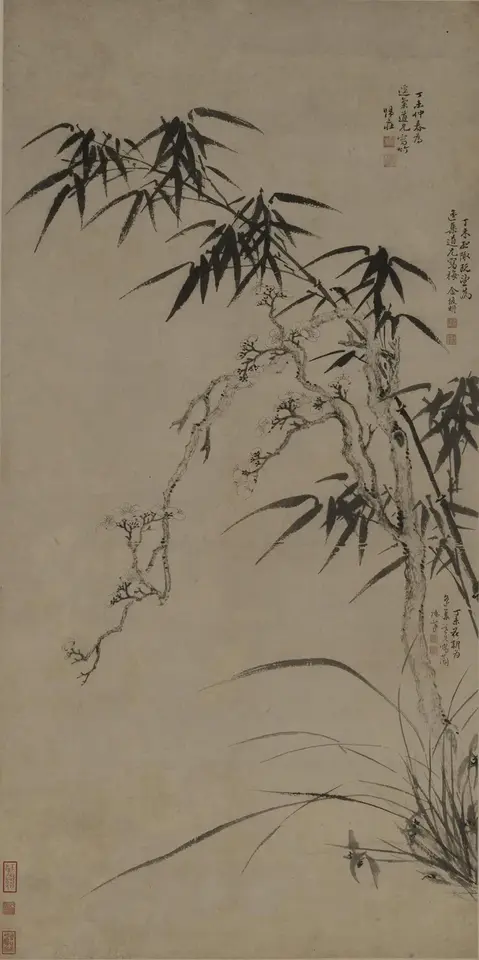
Gui was a literary and artistic innovator whose work captured the tragedy of a fallen civilization. Rejecting the sterile imitation that characterized much of late Ming writing, his poetry and essays resonated with genuine sorrow, acerbic satire, and indomitable courage. His celebrated dramatic suite Wangu Chouqu (Ballad of Eternal Sorrow) surveyed two thousand years of imperial history, delivering scathing critiques of dynastic mismanagement while lamenting the fall of the Ming with raw emotional power. In the visual arts, Gui's wild cursive calligraphy attained legendary status for its sweeping, turbulent energy, while his ink paintings of rugged bamboo and jagged rocks embodied the unbending spirit of the loyalist literati.
FIGURES ASSOCIATED WITH THIS DYNASTY