Entrance into the Palace
Introduced to Emperor Wu through Princess Pingyang after Li Yannian's performance of The Ballad of a Fair Lady; became the emperor's favorite consort.
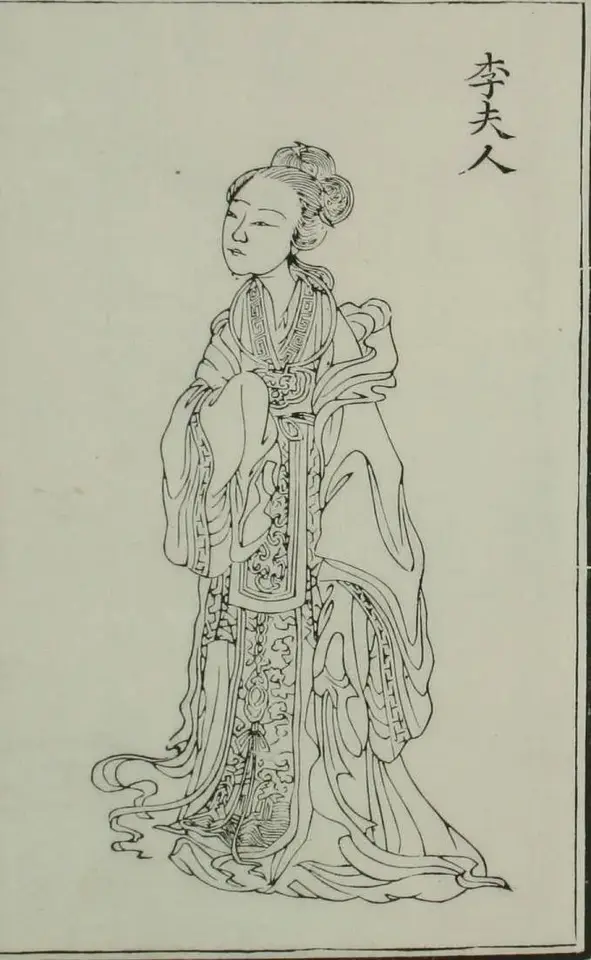
孝武李夫人
Lady Li (孝武李夫人, d. c. 100 BCE), posthumously honored as Empress Xiaowu, was an imperial consort of Emperor Wu of Han (Liu Che), the biological mother of Liu Bo, King Ai of Changyi, and the paternal grandmother of Liu He, the Marquis of Haihun. Hailing from a family of entertainers in Zhongshan Commandery, she was introduced to the imperial court after her brother, the court musician Li Yannian, performed the celebrated poem…
Lady Li (孝武李夫人, d. c. 100 BCE), posthumously honored as Empress Xiaowu, was an imperial consort of Emperor Wu of Han (Liu Che), the biological mother of Liu Bo, King Ai of Changyi, and the paternal grandmother of Liu He, the Marquis of Haihun. Hailing from a family of entertainers in Zhongshan Commandery, she was introduced to the imperial court after her brother, the court musician Li Yannian, performed the celebrated poem The Ballad of a Fair Lady (Jiaren Qu) before Emperor Wu. Enchanted by her transcendent grace, beauty, and virtuoso dancing, Emperor Wu inducted her into the imperial harem, granting her his supreme favor and affection. Possessing remarkable emotional foresight, Lady Li recognized that romantic affection founded exclusively on physical beauty was transient. When stricken by a mortal illness, she pulled her quilt over her face and resolutely refused to let Emperor Wu view her emaciated countenance, resolving that her memory in the sovereign's heart should remain forever unblemished, thereby securing dynastic protection and career advancement for her son and brothers. Following her premature demise, a grieving Emperor Wu interred her with the ceremonial protocol of an empress in the Yingling mausoleum, composed the elegiac Rhapsody on Lady Li, and commissioned Daoist adept Shao Weng to summon her spirit in a celebrated candlelight shadow ritual. In 87 BCE, following Emperor Wu's death, Grand General Huo Guang fulfilled the late monarch's enduring desire by posthumously ennobling her as Empress Xiaowu and installing her spirit tablet in the Imperial Ancestral Temple to share state sacrifices alongside Emperor Wu.
Introduced to Emperor Wu through Princess Pingyang after Li Yannian's performance of The Ballad of a Fair Lady; became the emperor's favorite consort.
Gave birth to Emperor Wu's fifth son, Liu Bo; formally invested as Consort (Lady Li), bringing rapid nobility to her family.
Her elder brother Li Guangli was appointed Ershi General to campaign against Dayuan, while Li Yannian was appointed Chief Commandant of Harmony.
Mortally ill, she covered her face with blankets and refused to allow Emperor Wu to view her sickbed, securing posthumous patronage for her lineage.
Passed away in the Weiyang Palace; buried with empress honors at Yingling; Emperor Wu engaged adept Shao Weng for the shadow-casting ritual and composed rhapsodies.
Following Emperor Wu's demise, Grand General Huo Guang posthumously elevated Lady Li to Empress Xiaowu, sharing sacrifices in the Imperial Ancestral Temple.
Lady Li was born into an ordinary family of professional performers and entertainers residing in Zhongshan Commandery. Her parents were accomplished folk musicians, and her siblings—elder brother Li Guangli, second brother Li Yannian, and younger brother Li Ji—were trained from early childhood in musical performance, singing, and choreography.
During the Yuanding era of Emperor Wu of Han, Li Yannian was convicted of a civil offense and sentenced to castration, subsequently assigned to serve in the imperial dog and horse stables within the palace. Endowed with exceptional artistic talent, Li Yannian composed novel folk harmonies integrated with western frontier melodies. His compositions attracted the attention of Emperor Wu, who appointed him director of musical instruments within the Bureau of Music (Yuefu).
During an imperial banquet, Li Yannian performed a dance while singing a newly composed verse: "In the north there lives a fair lady, peerless and independent of all the world. With a single glance she captivates a city; with a second glance she captivates an empire. Who does not know that cities and empires may fall? Yet a lady so rare can never be found again!" Emperor Wu was visibly moved by the poignant melody and sighed aloud, wondering whether such transcendent beauty truly existed in the human world.
Seated beside the throne, Emperor Wu's elder sister, Princess Pingyang, took the opportunity to recommend Li Yannian's younger sister, informing the emperor that the maiden possessed unearthly physical beauty and unparalleled grace in dance. Emperor Wu promptly summoned Lady Li to court. Upon witnessing her luminous complexion, delicate features, and enchanting dancing posture, Emperor Wu was immediately captivated, ushering her into the inner palace. Within weeks, Lady Li became the monarch's most cherished consort.
Shortly after entering the palace, Lady Li conceived and gave birth to Emperor Wu's fifth son, Liu Bo, who was subsequently enfeoffed as King of Changyi. Deeply enamored with both mother and child, Emperor Wu bestowed upon her the high title of Consort (Lady Li). Because Empress Chen had been deposed and Empress Wei Zifu had advanced in years, Lady Li's prestige and influence surpassed all other consorts within the inner palace.
Imperial favor was manifested in numerous romantic traditions. During an excursion to Lady Li's apartments, Emperor Wu felt a sudden itch on his scalp, casually plucking a white jade hairpin from Lady Li's coiffure to scratch his head. Learning of the incident, palace maidens and aristocratic women across Chang'an enthusiastically imitated the fashion by adorning their hair with white jade pins, causing the market price of jade in the capital to multiply manifold within months. Emperor Wu also gifted her exquisite luxuries such as an intricately woven ivory cooling mat, reserving the finest court treasuries for her enjoyment.
Simultaneously, the Li lineage rose from humble actors into prominent nobility. Li Yannian was elevated to Chief Commandant of Harmony (Xielü Duwei), receiving an annual stipend of two thousand bushels of grain and imperial authorization to enter the inner courts at all hours to direct religious and ancestral sacrificial scores.
In 104 BCE (Taichu 1), seeking to obtain the heavenly sweat-blood horses of Fergana (Dayuan) and establish Han hegemony across the Western Regions, Emperor Wu appointed Lady Li's eldest brother, Li Guangli, as supreme commander with the title Ershi General, mobilizing sixty thousand cavalrists and tens of thousands of infantrymen for an arduous expedition across the Tarim Basin. Emperor Wu deliberately entrusted this military enterprise to Li Guangli to provide him with the battlefield merit required by Western Han dynastic precedent to receive an aristocratic marquisate. Following a protracted multi-year siege, Li Guangli captured the capital of Dayuan, executed its king, and returned with three thousand prize steeds. Pleased with the outcome, Emperor Wu ennobled Li Guangli as Marquis of Haixi with a fief of eight thousand households.
At the pinnacle of imperial favor, Lady Li fell mortally ill. Emperor Wu dispatched the finest court physicians and bestowed priceless medicinal herbs, yet her physical condition deteriorated rapidly until death appeared imminent.
Distressed by her condition, Emperor Wu disregarded imperial etiquette and personally proceeded to Lady Li's bedchamber to pay a bedside visit. Approaching her bed, the emperor sought to comfort her and take her hand.
Seeing the monarch enter, Lady Li did not rise or uncover herself; instead, she pulled her silk coverlet over her head, burying her face beneath the quilts. From beneath the coverings, she wept and murmured: "I have been afflicted with illness for many months; my face is gaunt and my appearance withered. According to ancestral ritual decorum, an unkempt woman cannot face her sovereign. I dare not reveal my disordered visage to Your Majesty. I only pray that Your Majesty will compassionately care for my young son Liu Bo and protect my brothers!"
Anxious to look upon her, Emperor Wu pleaded: "Your illness is grave, and we may never converse again. If you allow me to see your face one final time and state your requests, my heart will be at peace, and I shall bestow a thousand pieces of gold and elevate your brothers to paramount ministries!"
Lady Li wept from under the coverlet: "The bestowal of noble office rests entirely with Your Majesty's sovereign will, not upon a single glance at my face!" When Emperor Wu attempted to pull the coverlet away by force, Lady Li turned her back toward the wall and wept inconsolably. Dismayed and offended by her obstinate refusal, Emperor Wu sighed and departed in frustration.
After the emperor left, Lady Li's sisters and attendants chastised her severely: "Why were you so unyielding? His Majesty humbled himself to visit your bedchamber! Why could you not grant him a single glance so that you could secure the future of your family? Now you have provoked imperial wrath, bringing ruin upon us all!"
Stifling her tears, Lady Li revealed her profound calculation: "None of you comprehend the ruthless realities of the inner palace! Born of a humble entertainer family, I achieved supreme imperial favor purely on account of my beautiful face. Since ancient antiquity, those who serve rulers based upon physical allure face abandonment when beauty fades; when attraction diminishes, royal devotion is extinguished forever!"
She continued: "The sovereign remembers me with longing solely because he envisions my youthful radiance. Were he to gaze upon my sunken eyes, sallow skin, and ghastly countenance, he would recoil with shock and disgust, destroying every tender recollection he harbors. Once revulsion replaces devotion, how could he ever feel compassion for my orphaned son Liu Bo, or continue to patronize my brothers after I am gone!" Listening to her cold assessment of human nature, her weeping attendants marveled at her strategic clarity.
Events following her passing substantiated Lady Li's foresight. Because Emperor Wu was denied a final view of her emaciated deathbed, her memory remained permanently crystallized as the peerless, radiant dancer of his youth. Emperor Wu was tormented by guilt and sorrow, convinced that he had failed his beloved consort.
Emperor Wu commanded that Lady Li be buried with the rituals of an empress in the Yingling tomb, five li northwest of Maoling. The monumental earthen mound rose twenty-eight meters in a tiered terraced design, encompassing over thirteen thousand square meters. Even while Empress Wei Zifu still officially occupied the imperial throne, Emperor Wu accorded Lady Li empress burial honors.
Unable to quell his longing, Emperor Wu commissioned royal artists to paint Lady Li's portrait based on memory, hanging the canvas in the grand hall of the Ganquan Palace, where the emperor wept before it daily.
At that time, Daoist adept Shao Weng of Qi claimed he possessed the occult ability to summon the soul of the deceased consort. Emperor Wu ordered an elaborate ritual arranged in the depths of Ganquan Palace. Curtains and sheer gauzes were suspended, wine and delicacies set forth, and candles lit within the chamber. Emperor Wu watched from an opposing pavilion. In the dim flickering candlelight, the graceful silhouette of an elegant woman emerged on the silk curtains, walking with the rhythmic cadence characteristic of Lady Li before slowly fading away.
Grief-stricken, Emperor Wu composed his famous lines: "Is it real, or is it not? I stand gazing from afar, yet why does she arrive so haltingly slow!" This sorrowful exclamation birthed the enduring Chinese idiom "arriving haltingly slow" (shanshan laichi), while folklorists trace the earliest origins of Chinese shadow puppetry to this imperial mourning ritual. Emperor Wu also composed the mournful Rhapsody on Lady Li, giving poetic immortality to his grief.
In the years following Lady Li's death, her younger brother Li Ji engaged in illicit affairs within the palace, prompting Emperor Wu to execute Li Ji and execute Li Yannian's entire lineage, sparing only Li Guangli because he was campaigning in Central Asia. In 90 BCE, Li Guangli and Chancellor Liu Qumao plotted to establish Lady Li's son, Liu Bo, as crown prince. The conspiracy was exposed; Liu Qumao was executed, Li Guangli defected to the Xiongnu, and the remaining Li relatives were executed in the capital.
Yet despite the treason of her surviving kin, Emperor Wu never diminished his profound veneration for Lady Li herself. Following Emperor Wu's passing in 87 BCE, the young Emperor Zhao of Han succeeded, with Grand General Huo Guang governing as regent.
Because Empress Chen had been deposed and Empress Wei Zifu had committed suicide during the witchcraft turmoil, the position of legal empress beside Emperor Wu's tomb remained vacant. Huo Guang and senior ministers evaluated Emperor Wu's life intentions and determined that Lady Li was the only consort who had received supreme lifelong affection and borne an imperial prince.
Huo Guang formally memorialized Emperor Zhao to bestow the posthumous title of Empress Xiaowu upon Lady Li, installing her ancestral tablet in the Imperial Ancestral Temple to partake in state sacrifices beside Emperor Wu. In the Maoling imperial necropolis, her Yingling tomb remains the sole empress mound sharing ancestral veneration. Through her acute insight into monarchical psychology, Lady Li made the extraordinary leap from a humble entertainer to the consecrated empress of the Western Han Dynasty.
Lady Li exerted an enduring influence on traditional Chinese literature and aesthetics. The poem The Ballad of a Fair Lady, composed for her by Li Yannian, established the standard poetic archetype for female beauty in East Asian literature, giving rise to the universal idiom "captivating cities and nations" (qingcheng qingguo). Her uncompromising assertion that "those who serve through physical allure face abandonment when beauty fades" has served as a foundational moral aphorism regarding power, beauty, and human relationships across two millennia.
The literary and folklore traditions surrounding Lady Li's death constitute a milestone in Chinese cultural history. Emperor Wu's Rhapsody on Lady Li and his lamentation on her halting arrival (shanshan laichi) established the imperial tradition of elegiac mourning literature, directly influencing Six Dynasties poetic forms. In popular folklore, the ceremonial scattering of grains and fruit during her wedding procession was adopted into Han marital rites as the traditional "curtain-scattering" (sazhang) custom, while the shadow ritual conducted by adept Shao Weng is widely celebrated by theatrical historians as the foundational prototype of Chinese shadow puppetry.
FIGURES ASSOCIATED WITH THIS DYNASTY