Birth Amid Tumult
Born on the 1st day of the 7th lunar month in Qiantang into an eminent literary lineage while his family took refuge from wartime chaos, returning to the city a month later.
洪昇
Hong Sheng (洪昇, August 21, 1645 – July 2, 1704), courtesy name Fangsi and art name Baiqi, was a native of Qiantang in Hangzhou, Zhejiang. He was a preeminent playwright and poet of the early Qing Dynasty during the Kangxi reign, celebrated alongside Kong Shangren as the twin pillars of Chinese classical drama under the moniker "Hong of the South and Kong of the North." Hailing from an illustrious lineage of scholars and…
Hong Sheng (洪昇, August 21, 1645 – July 2, 1704), courtesy name Fangsi and art name Baiqi, was a native of Qiantang in Hangzhou, Zhejiang. He was a preeminent playwright and poet of the early Qing Dynasty during the Kangxi reign, celebrated alongside Kong Shangren as the twin pillars of Chinese classical drama under the moniker "Hong of the South and Kong of the North." Hailing from an illustrious lineage of scholars and bibliophiles, Hong Sheng entered the Directorate of Education in Beijing as a student after failing repeated civil service examinations. His crowning masterpiece, the fifty-scene Kunqu chuanqi opera The Palace of Eternal Youth, took over ten years and three complete rewrites to finish. Intertwining the tragic romance of Emperor Xuanzong of Tang and Consort Yang Yuhuan with profound reflections on dynastic rise and fall during the An Lushan Rebellion, the play caused an immediate sensation across the empire. In 1689, because a performance of the opera was staged during the state mourning period for Empress Xiaoyi, Hong Sheng was impeached, imprisoned in the Ministry of Justice, and stripped of his imperial student status, shattering his political ambitions. In his later years, he wandered the lakes and hills of Jiangnan, living in proud poverty. In 1704, after attending a lavish three-day performance of The Palace of Eternal Youth hosted in Jiangning by Cao Yin, Hong Sheng drowned after drunkenly slipping into the canal at Wuzhen on his return voyage. His impeccable metric mastery and lyrical elegance mark the zenith of classical Chinese opera.
Born on the 1st day of the 7th lunar month in Qiantang into an eminent literary lineage while his family took refuge from wartime chaos, returning to the city a month later.
Married his maternal cousin Huang Lanci at age twenty, studying classical prose, poetry, and musical meters.
Enrolled as a student in the Directorate of Education in Beijing, but returned home in disappointment after failing to secure an official post.
Following family estrangement and parental repudiation, relocated to Beijing, living in modest lodging for seventeen years by composing literary pieces.
When his father was falsely accused and sentenced to border exile, Hong Sheng traveled barefoot and weeping to petition imperial princes, hastening home to accompany them until an imperial pardon was granted.
Finished the final fifty-scene recension of The Palace of Eternal Youth after ten years of meticulous rewriting, achieving immense literary fame.
Impeached by Supervising Censor Huang Liuhong for staging an opera during the imperial mourning for Empress Xiaoyi; imprisoned and expelled from the Directorate of Education.
Abandoned Beijing to return to Hangzhou, living in seclusion by West Lake, writing verses and drinking with literati friends.
Scholar Mao Qiling penned a preface for the printed edition indicating imperial clemency; the opera quickly regained popularity across the Jiangnan region.
Honored as guest of honor by Cao Yin in Nanjing for a three-day continuous staging; drowned after accidentally falling into the river at Wuzhen during his drunken return journey at age sixty.
Hong Sheng was born on August 21, 1645, just as the Qing forces advanced south across the Yangtze River. The Hong clan had flourished in Qiantang for generations, renowned for their vast family library that locals compared to an ocean of learning. His father was an erudite scholar who later served under the Qing, while his maternal grandfather, Huang Ji, was an influential statesman who rose to Minister of Punishments and Grand Secretary of the Wenhua Hall. In his youth, Hong Sheng received rigorous instruction from noted Jiangnan scholars such as Lu Fanchao, Mao Xianshu, and Zhu Zhijing. These mentors imparted classical Confucian virtues alongside a profound sense of historical pathos inherited from Ming loyalist traditions. Hong was remarkably precocious, gaining renown in poetic circles by age fifteen and composing exquisite rhapsodies and lyrics by age twenty.
In 1664, Hong Sheng married his cousin Huang Lanci. Seeking to fulfill family expectations, he journeyed to Beijing in 1668 to study at the Directorate of Education. However, in an imperial capital crowded with ambitious examination candidates, he failed to gain an appointment after a year of struggle and returned home empty-handed. Shortly thereafter, at age twenty-seven, a painful family rupture occurred. Manipulated by domestic slanders, his parents expelled him from the ancestral household. Hong Sheng was forced to establish an independent residence with his wife and child, enduring periods of severe poverty where his household lacked daily grain.
Unable to sustain himself in Hangzhou, Hong Sheng traveled north to Beijing in the winter of 1673, beginning a grueling seventeen-year residence in the imperial capital. Relying on writing inscriptions, prefaces, and essays for patrons, he barely kept hunger at bay. Yet he remained uncompromising and haughty, often leaning back nonchalantly at aristocratic feasts and outspokenly condemning social hypocrisy. In the winter of 1679, his father was falsely accused and sentenced to frontier military servitude, with his mother ordered to accompany him. Upon hearing this catastrophe, Hong Sheng rushed weeping between palaces to plead with high ministers, then journeyed over three thousand li through sleet and snow back to Hangzhou to escort his frail parents north until a general imperial pardon freed them. This grueling ordeal severely emaciated him, but his filial virtue won widespread acclaim among scholars.
Following his exoneration from the border banishment case, Hong Sheng's aging parents were stripped of their livelihood, leaving the impoverished scholar to shoulder the entire financial burden of supporting eight household dependents. He was forced to make repeated, exhausting journeys between Beijing and Hangzhou, traveling endlessly along the Jianghuai Grand Canal and the rugged roads of Shandong. Exposed to biting cold, hunger, and destitution, Hong Sheng experienced firsthand the harsh vicissitudes of common existence, pouring his sorrows into deeply felt traveler's elegies.
These years of itinerant wandering sharpened Hong Sheng's artistic sensitivity toward the suffering of ordinary people. Traversing Shandong, Zhili, and Zhejiang, he witnessed agricultural desolation and famine-ravaged fields in the wake of natural disasters and civil strife, penning landmark realistic poem cycles such as Miscellaneous Thoughts East of the Capital and Ten Poems of Quzhou. Concurrently, in satirical verses such as Chang'an, he scathingly criticized factional infighting and bureaucratic corruption among high court elites, demonstrating profound historical insight and uncompromising moral conscience.
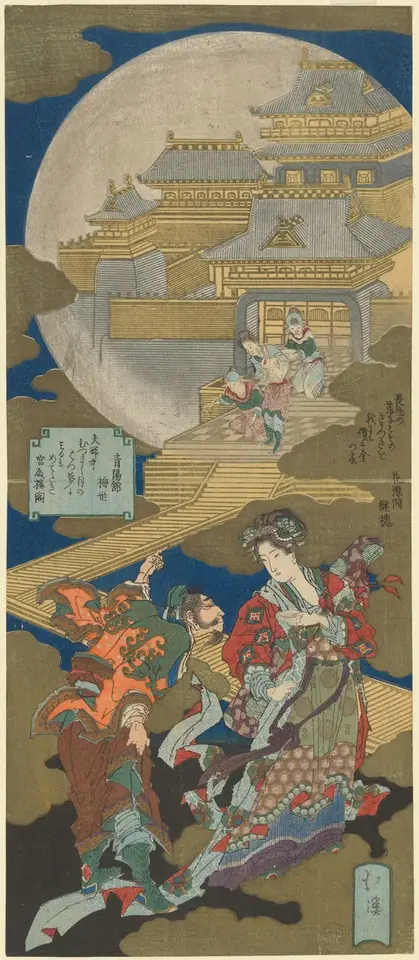
Throughout his years of financial distress, Hong Sheng channeled his historical reflections and artistic passion into theatrical composition. Working from an early play about Li Bai (Chenxiang Pavilion) to an intermediate version focused on Li Mi (Dancing the Rainbow Skirt), he spent ten full years perfecting his masterwork, The Palace of Eternal Youth, completed in 1688. The opera chronicled the legendary romance between Emperor Xuanzong and Consort Yang against the catastrophic backdrop of the An Lushan Rebellion. Its emotional profundity, intricate scene structures, and musical elegance captivated Beijing instantly. Aristocratic households and theater troupes competed eagerly to stage the work, making Hong Sheng's name celebrated from royal residences to city taverns.
In August 1689, tragedy struck. While the court was still observing state mourning for Empress Xiaoyi, Hong Sheng convened leading actors to stage a private performance of The Palace of Eternal Youth at his residence, attended by distinguished scholars such as Zhao Zhixin and Zhu Dian. At the time, fierce factional strife raged between Northern faction bureaucrats led by Grand Secretary Mingju and Southern Han scholars led by Xu Qianxue. Because Hong was intimately connected with Southern faction luminaries, and because his opera touched upon sensitive dynastic themes of foreign rebellion, Supervising Censor Huang Liuhong seized the occasion to impeach Hong for grave irreverence. Hong Sheng was cast into the prison of the Ministry of Justice. Although spared capital punishment by Emperor Kangxi, he was expelled from the Imperial Academy, while his guests lost their official posts. The disaster abruptly extinguished Hong's hopes of official career advancement.
Deeply disillusioned by bureaucratic hostility, Hong Sheng retired to Hangzhou in 1691. Living near West Lake as the "Woodcutter of South Screen," he withdrew from worldly ambitions, finding solace in boating, writing poetry, and consuming wine with close literati friends. In 1695, his friend Mao Qiling contributed a preface to the first printed edition of The Palace of Eternal Youth, clarifying that the emperor harbored no lingering animosity. Performances quickly resumed throughout Jiangnan, championed by high provincial officials such as Jiangsu Governor Song Luo.
In 1704, at age sixty, Hong Sheng experienced the final grand theatrical tribute of his life. Cao Yin, the Textile Commissioner of Jiangning and an accomplished connoisseur of opera, invited Hong to Nanjing for an unprecedented gathering of Northern and Southern literati. Cao seated Hong as the primary guest of honor and directed his household troupe to perform all fifty scenes of The Palace of Eternal Youth continuously over three days and nights. Cao and Hong sat side by side, each holding a promptbook to verify musical rhythms against every phrase. Following this triumphant celebration, Hong embarked on his voyage home to Qiantang. On July 2, 1704, while anchored at Wuzhen in northern Zhejiang, an intoxicated Hong Sheng slipped from the boat gangway into the deep canal waters and drowned before help could reach him, bringing an abrupt and poetic close to a turbulent life at age sixty.
The creation of The Palace of Eternal Youth stands as one of the most rigorous compositional journeys in classical Chinese theater. Hong Sheng first drafted Chenxiang Pavilion in 1673, focusing on poet Li Bai composing verses under imperial command. Realizing this plot followed conventional tropes, he revised the draft in 1679 into Dancing the Rainbow Skirt, replacing Li Bai with the statesman Li Mi assisting Emperor Suzong in subduing rebellion. Finally, in 1688, perceiving that imperial rulers rarely achieved transcendent love, he chose to concentrate entirely on the fateful bond between Xuanzong and Consort Yang, refining the text into fifty tightly knit scenes. This persistent structural evolution produced an opera unparalleled in thematic coherence and dramatic balance.
In his explanatory remarks to the play, Hong Sheng proclaimed that his purpose was to express dynastic rise and fall through the vicissitudes of human romance. While the surface narrative traces the vows, separation, and celestial reunion of Xuanzong and Yang Yuhuan, the true core is a searing historical tragedy. In the scene "Delivering the Lychees," the horrifying exhaustion and death of postal couriers rushing fruits from the south is starkly juxtaposed with the frivolous indulgence of the imperial court. In "Pawnshop Omens," General Guo Ziyi laments the arrogant rise of border warlords while drinking alone in a tavern. In "Singing the Ballad," the aged imperial musician Li Guinian wanders Jiangnan as a blind minstrel, mourning the collapse of the golden age with his lute. Hong Sheng warned that boundless imperial self-indulgence invariably breeds national ruin, offering a veiled meditation on the Ming-Qing transition.
Educated by masters of phonetic prosody such as Mao Xianshu, Hong Sheng possessed exceptional mastery over the musical modes and rhymes of Southern and Northern drama. Every scene in The Palace of Eternal Youth conforms strictly to the tonal constraints of Kunqu melodies, achieving absolute harmony between lyric pronunciation and instrumental cadences. The opera avoided pedantic obscurities, synthesizing the direct vitality of Yuan drama with the refined lyricism of Ming romances. Classic individual scenes—such as "The Betrothal," "The Feast," "The Rebellion," "Cursing the Traitor," "Listening to the Bells," and "Singing the Ballad"—became permanent staples of Kunqu performance, setting the standard for vocal delivery and stage blocking.
Beyond his monumental chuanqi opera, Hong Sheng demonstrated notable innovation in short-form theater with his four-act zaju suite Four Fair Maidens. Emulating the free-spirited style of Ming dramatist Xu Wei's Four Cries of the Gibbon, each act celebrates a legendary female intellectual from Chinese history: Xie Daoyun chanting poetry on falling snow, Lady Wei practicing elegant calligraphy, Li Qingzhao matching epigraphic games over tea with her husband, and Guan Daosheng painting ink bamboo in the wind. The suite is celebrated for its graceful tone and genuine admiration for women's artistic intellect, challenging traditional patriarchal condescension.
Hong Sheng was equally renowned as a gifted poet, leaving behind collections such as The Baiqi Anthology and Anthology of Howling at the Moon. Modeling his verses after High Tang masters, his style was marked by unadorned directness and deep melancholic sincerity. Unlike many contemporaries who indulged in ornate escapism, Hong produced powerful social poetry based on his wanderings. In Reflections East of the Capital and Ten Poems on Quzhou, he documented the plight of ordinary people enduring floods, famines, and warfare, infusing his work with heartfelt compassion and moral indignation.
Within the history of Qing literature, Hong Sheng and his contemporary Kong Shangren of Qufu are venerated as "Hong of the South and Kong of the North." While Hong distilled the sorrow of the Tang golden age with southern melodic grace in The Palace of Eternal Youth, Kong dramatized the collapse of the Southern Ming dynasty with northern historical vigor in The Peach Blossom Fan. Together, these two masterworks elevated Chinese chuanqi drama to unprecedented heights of aesthetic refinement and philosophical depth, marking the golden age of Kunqu as a living theatrical art.
FIGURES ASSOCIATED WITH THIS DYNASTY