Birth in Chenliu
Born into the Buddhist Guan clan in Kaifeng, Chenliu, later fleeing south during the Disaster of Yongjia.
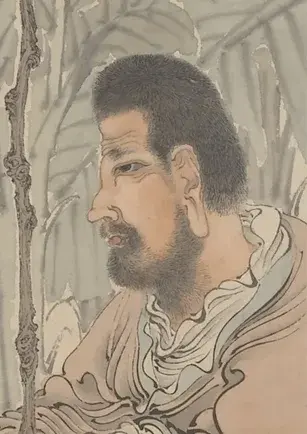
支遁
Zhi Dun (支遁, 314–366), courtesy name Daolin, secular surname Guan, was an eminent Buddhist monk, philosopher, and poet of the Eastern Jin dynasty. Born into a prominent Buddhist family in Chenliu, he migrated south of the Yangtze River during the northern civil strife of the late Western Jin, living as a recluse in the Yuhang Mountains. At age twenty-five, he took formal monastic vows and subsequently founded temples in Mount…
Zhi Dun (支遁, 314–366), courtesy name Daolin, secular surname Guan, was an eminent Buddhist monk, philosopher, and poet of the Eastern Jin dynasty. Born into a prominent Buddhist family in Chenliu, he migrated south of the Yangtze River during the northern civil strife of the late Western Jin, living as a recluse in the Yuhang Mountains. At age twenty-five, he took formal monastic vows and subsequently founded temples in Mount Zhixing near Wu and Mount Shicheng in Shan County, where he lectured extensively on Buddhist scriptures. Renowned for his intellectual mastery of the Zhuangzi, Laozi, and the Perfection of Wisdom Sutra, Zhi Dun founded the Matter-as-Such School among the Six Schools and Seven Sects of early Chinese Prajñā philosophy. He formulated the doctrine that physical phenomena are inherently empty because they lack independent intrinsic nature, significantly advancing the sinicization of Mahayana emptiness. In Xuanxue discourse, his innovative commentary on the "Free and Easy Wandering" chapter of the Zhuangzi discarded the standard interpretations of Guo Xiang by distinguishing between innate instincts and spiritual transcendence, winning the deep admiration of prominent literati including Wang Xizhi, Xie An, Sun Chuo, and Xi Chao. Summoned to the imperial capital Jiankang by Emperor Ai of Jin, he resided at Dong'an Temple for three years before returning to Mount Shan, passing away in 366 at the age of fifty-three. Combining Buddhist metaphysics with Neo-Daoist discourse and Confucian ethics, Zhi Dun stood as a central architect of the intellectual synthesis between Buddhism and Chinese philosophical traditions.
Born into the Buddhist Guan clan in Kaifeng, Chenliu, later fleeing south during the Disaster of Yongjia.
Formally ordained as a Buddhist monk at age twenty-five, adopting the monastic surname Zhi and dharma name Dun.
Established Zhishan Temple at Mount Zhixing in Wu, lecturing on Prajñā scriptures to growing assemblies.
Traveled to Kuaiji, meeting calligrapher Wang Xizhi at Lingjia Temple and earning his lifelong friendship through philosophical dialogue.
Summoned by Emperor Ai of Jin to Jiankang, taking up residence at Dong'an Temple to preach Mahayana doctrine.
Petitioned the throne to leave the crowded capital, receiving generous imperial gifts and warm send-offs from high ministers.
Passed away peacefully at Qiguang Temple on Mount Shicheng in Shan County at age fifty-three, mourned by monastics and literati.
Zhi Dun was born into the venerable Guan clan of Chenliu, a household with generations of devotion to Mahayana Buddhism, which provided him with profound early immersion in religious devotion and classical learning. During his childhood, the central plains were ravaged by the Disaster of Yongjia, prompting his family to migrate south across the Yangtze River along with other northern gentry houses. Settling in Jiangnan, Zhi Dun sought seclusion in the forested valleys of the Yuhang Mountains, where he devoted himself to intensive study of early Chinese translations of Prajñā scriptures, notably the Perfection of Wisdom Sutra in 8,000 Lines and Perfection of Wisdom Sutra in 25,000 Lines, while mastering the metaphysical works of Laozi and Zhuangzi.
In his youth, Zhi Dun visited the Eastern Jin capital of Jiankang. His intellectual agility, refined aristocratic comportment, and consummate artistry in cursive and clerical calligraphy swiftly captured the attention of leading imperial scholars. When the prominent statesman Wang Meng first encountered Zhi Dun, he was astonished by the young man's penetrating metaphysical insights, observing that his spiritual clarity and unworldly bearing were unmatched. Renowned thinker Yin Rong engaged Zhi Dun in extensive debates on metaphysical cosmology; Zhi Dun responded with such rigorous logic and eloquent prose that all gathered scholars expressed deep admiration, establishing his standing within the cultural elite.
In 338, having reached the age of twenty-five, Zhi Dun resolved to renounce secular honors and took formal vows as a Buddhist monk. In accordance with early monastic customs, he took the clerical surname Zhi, adopting the dharma name Dun and courtesy name Daolin. Following ordination, he adhered strictly to the monastic vinaya, maintaining ascetic contemplative habits and dwelling in mountain retreats. He soon relocated to Wu Commandery, where he selected Mount Zhixing (subsequently named after his sobriquet) as his sanctuary, designing and founding Zhishan Temple.
At Zhishan Temple, Zhi Dun erected meditation quarters and established a grand lecture hall, regularly expounding the Perfection of Wisdom Sutra and Indian meditation treatises. Scholarly monks and prominent gentry traveled from across Jiangnan to hear his lectures, with audiences frequently exceeding several hundred listeners. Zhi Dun excelled at elucidating dense Sanskrit metaphysical paradoxes through vivid and elegant Chinese phrasing. During this fertile creative period, the initial draft of his masterpiece, Treatise on the Wandering of the Mysterious in Matter-as-Such, took form, firmly establishing his reputation as a pioneering doctrinal master.
During the Yonghe era, Zhi Dun traveled to Shan County (modern Shengzhou, Zhejiang), an area renowned for its serene peaks and gathering of elite literati. Passing through Kuaiji Commandery, he met the celebrated calligrapher and regional administrator Wang Xizhi. Wang Xizhi had initially suspected that Zhi Dun was merely a fashionable monastic courtier of superficial intellect. However, when Wang invited him to Lingjia Temple to discuss Daoist metaphysics, Zhi Dun articulated fresh philosophical perspectives on the Zhuangzi, speaking for hours with sublime eloquence. Deeply moved, Wang Xizhi cast aside his skepticism, bowed to the monk as an intellectual guide, and formed an enduring personal friendship with him.
At a gathering hosted by Prince of Kuaiji Sima Yu, Zhi Dun served as principal lecturer on the Vimalakīrti Sutra, while famed literatus Xu Xun acted as chief interrogator. Whenever Zhi Dun explicated a doctrinal point, the audience listened in breathless reverence; whenever Xu Xun posed a subtle philosophical objection, the gathered scholars erupted in applause. Their dynamic exchanges represented the zenith of Eastern Jin pure conversation culture. Around this time, future prime minister Xie An, then serving as Commandery Administrator of Wuxing, wrote to Zhi Dun to express deep personal longing and earnest desire to wander together through the mountain retreats.
Zhi Dun's personality was characterized by expansive magnanimity and refined aesthetic sensibilities. He maintained an abiding affection for fine horses and cranes. When someone presented him with a magnificent steed, critics remarked that keeping horses was improper for an ascetic monk; Zhi Dun replied serene that he admired the animal's untamed vitality and noble spirit as an aid to contemplative tranquility. On another occasion, an admirer gifted him a pair of cranes. Fearing they would fly away, Zhi Dun clipped their primary flight feathers. Yet upon observing the cranes gaze sorrowfully at their crippled wings with hanging heads, he felt profound contrition, lamenting that creatures born with the grace to soar to the clouds should never be reduced to domestic playthings. He nursed them until their feathers grew back and released them into the wilderness.
In Shan County, Zhi Dun chose the secluded ridges of Mount Wozhou to construct a new monastery, drawing more than a hundred resident disciples who sought instruction under his guidance. To counter complacency among his younger followers, he authored the Admonitions for the Seat, composed of austere moral maxims that urged diligent cultivation. When a reclusive hermit criticized him by alleging that ancient sages like Chao Fu and Xu You had never purchased mountain lands to practice reclusion, Zhi Dun retorted with witty detachment, asking whether the critic truly believed the sages needed to buy mountains, showcasing his refusal to be trapped by conventional labels.
Later, Zhi Dun moved deeper into Mount Shicheng, where he oversaw the construction of Qiguang Temple. Dwelling in rustic simplicity amidst whispering pines and clear mountain streams, he consumed wild fruits and natural spring water, cultivating deep internal peace. During this period, he composed commentaries on the Anban Shouyi Jing (Mindfulness of Breathing Sutra) and authored the Preface to the Origin of the Four Dhyānas, systematically integrating Indian breath meditation with Mahayana emptiness theory.
In 362, Emperor Ai of Jin, who possessed a keen interest in Buddhist and Daoist philosophy, ascended the imperial throne. Hearing of Zhi Dun's moral authority and unmatched philosophical prestige, the emperor issued repeated imperial decrees inviting him to the imperial capital. Moved by the court's sincerity, Zhi Dun journeyed to Jiankang and took up residence at Dong'an Temple. Emperor Ai visited the temple in state and convened great assemblies, requesting Zhi Dun to ascend the dharma throne to expound the Perfection of Wisdom Sutras.
During his tenure at Dong'an Temple, members of the imperial family, senior ministers, and young nobles attended his lectures. Senior officials like Xi Chao and Wang Tanzhi approached him with deep deference, consulting him on the reconciliation of Buddhist ethics with Confucian ritual norms. Though treated with imperial honors, Zhi Dun remained indifferent to worldly ambition, finding the vanity of court politics exhausting and yearning for his eastern mountain retreat. In 365, he formally submitted a memorial requesting permission to return to Shan County. Reluctantly acceding, Emperor Ai granted lavish travel stipends and gifts, while the court elite gathered in an immense procession outside the capital gates to bid him farewell.
In the autumn of 365, Zhi Dun returned to Qiguang Temple on Mount Shicheng. Now over fifty years of age, he spent his remaining months in quiet monastic contemplation, leading his disciples in daily devotions, expounding impermanence, and cultivating meditation amid the peaks of Wozhou. He used his final days to revise his major philosophical works, including the Treatise on the Wandering of the Mysterious in Matter-as-Such and Precepts for Learning the Way, entrusting his theoretical legacy to his foremost disciples.
On the fourth day of the fourth lunar month in 366, recognizing that his earthly life was ending, Zhi Dun arranged his monastic robes in the meditation hall of Qiguang Temple and passed away peacefully in a seated posture at the age of fifty-three. His followers and the local gentry erected a commemorative stupa on Mount Shicheng. Leading official Xi Chao authored a biographical memoir, while literary masters Yuan Hong and Zhou Tanbao composed funerary eulogies, lamenting the passing of a visionary master who had unified Buddhist dharma with Chinese philosophical discourse.
Zhi Dun's foremost achievement in Chinese intellectual history was his founding of the Matter-as-Such School, one of the influential Six Schools and Seven Sects of early Chinese Prajñā studies. During the third and fourth centuries, early Chinese interpreters struggled to comprehend the Mahayana concept of śūnyatā (emptiness). Early thinkers often relied on Daoist notions of "non-being giving birth to being", falling into ontological reification, or reduced emptiness to mere mental detachment without addressing the status of external reality.
In his groundbreaking work, Treatise on the Wandering of the Mysterious in Matter-as-Such, Zhi Dun advanced the core thesis that "matter is fundamentally empty". He argued that physical forms do not exist independently by their own intrinsic nature; since all forms arise dependent on causal conditions, they are devoid of enduring self-nature, and are thus empty in their very phenomenal manifestation. This formulation captured the authentic meaning of Madhyamaka emptiness, transforming Chinese Buddhism from rudimentary conceptual borrowing into an autonomous, sophisticated philosophical tradition.
Within the realm of Xuanxue, Zhi Dun transformed the intellectual landscape through his revolutionary reading of the "Free and Easy Wandering" chapter of the Zhuangzi. During the Western Jin, commentator Guo Xiang had established the orthodox view that wandering freely meant merely fulfilling one's innate nature, implying that both the majestic Peng bird and the humble sparrow achieved equivalent freedom as long as they acted according to their natural dispositions.
Zhi Dun challenged Guo Xiang's stance in public debates, arguing that if fulfilling one's natural instincts constituted spiritual freedom, then notorious tyrants like Jie and bandits like Zhi, who followed their natural violent inclinations, would also have to be recognized as perfected beings. In his Commentary on the Free and Easy Wandering, Zhi Dun contended that genuine spiritual freedom required transcending worldly attachments and base passions, attaining an unconditioned state of spiritual autonomy through wisdom and virtue. By infusing the Buddhist ideal of the detached bodhisattva into the Zhuangzi, he redirected Chinese metaphysics toward ethical and spiritual liberation.
In the development of Buddhist praxis, Zhi Dun proposed the groundbreaking theory of "minor sudden enlightenment". Drawing from the Ten Stages Sutra, he postulated that while a bodhisattva advances through the initial six stages via gradual cultivation, upon reaching the seventh stage (the Far-Reaching Stage), an abrupt intuitive leap takes place, yielding sudden realization of the truth of non-arising. This insight served as the direct intellectual precursor to Zhu Daosheng's later doctrine of sudden enlightenment, providing early conceptual foundations for the future Chan (Zen) tradition.
Furthermore, Zhi Dun was an early pioneer of devotional Pure Land Buddhism, engaging in veneration of Amitābha Buddha decades before Huiyuan formed the White Lotus Society at Mount Lu. At Qiguang Temple, he commissioned a gilded bronze statue of Amitābha and composed the Eulogy to the Image of Amitābha Buddha with Preface, extolling the sublime virtues of the Western Paradise and articulating earnest vows to be reborn in the Pure Land through meditative visualization, significantly popularizing Pure Land devotion among the literati elite.
In church-state relations, Zhi Dun played an essential role in bridging the gap between monastic transcendence and secular Confucian order. Throughout the Eastern Jin, tensions repeatedly flared over whether Buddhist clergy should perform ritual prostrations before secular monarchs, with conservative courtiers arguing that monasticism undermined filial piety and civil loyalty.
Zhi Dun addressed this crisis in treatises such as Precepts for Learning the Way and Treatise on the Sage Not Debating Knowledge, arguing that Buddhist moral precepts reinforced rather than subverted secular social ethics. He articulated the concept that monastics assisted imperial governance by educating the populace in compassion and moral restraint, thereby cultivating civic virtue. His balanced apologetics relieved tensions between monastic communities and aristocratic clans, establishing a framework for Buddhist institutional coexistence within the imperial state.
In literature and aesthetics, Zhi Dun was an influential master of the metaphysical poetry movement of the Eastern Jin. His extant poems, preserved in anthologies such as Guang Hongming Ji, feature exquisite philosophical reflection expressed through refined natural imagery, exerting a profound stylistic influence on the landscape poetry of later southern writers like Xie Lingyun.
Additionally, Zhi Dun was a founding figure in Chinese Buddhist tea culture. During his residence at Mount Zhixing and Mount Shicheng, he cultivated tea plants around his monastic hermitage, using freshly brewed tea to dispel fatigue and support extended sitting meditation. In his poetry, he celebrated the tea plant as a sacred herb, regarding its clear green infusion and subtle sweetness as a physical embodiment of meditative clarity. His integration of tea cultivation with contemplative discipline earned him commemoration in Lu Yu's Classic of Tea, establishing his legacy as a patriarch of Chan tea aesthetics.
FIGURES ASSOCIATED WITH THIS DYNASTY