Birth in Ireland
Born on October 3 at Mount Pottinger, outside Belfast, Ireland, into a distinguished political and military family.
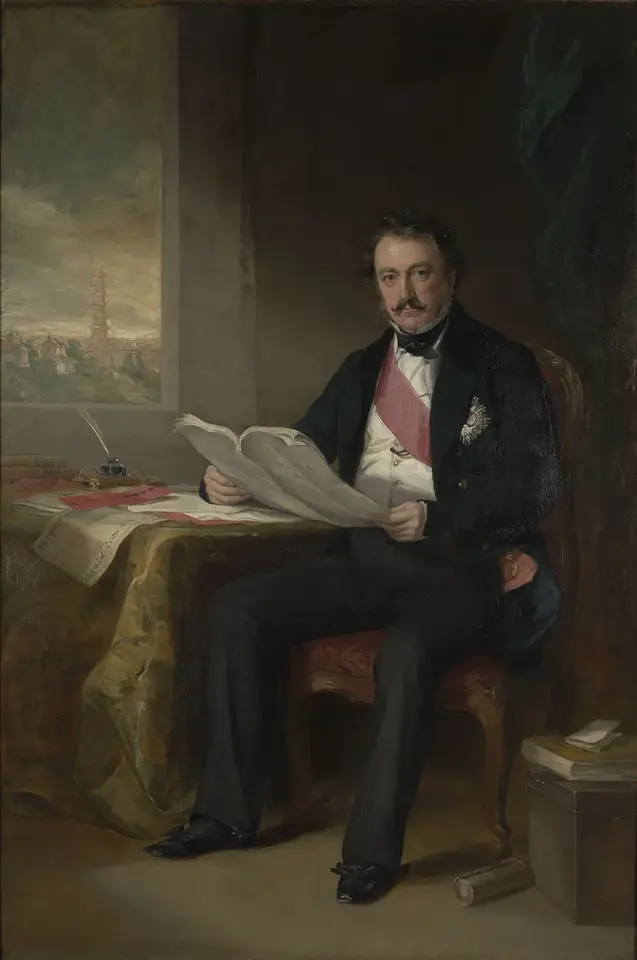
璞鼎查
Sir Henry Pottinger (璞鼎查, 1789–1856), 1st Baronet, also transliterated as Bodingcha or Botingjie in Chinese historical records, was a British military officer, colonial administrator, and diplomatic envoy. Early in his career, he joined the East India Company and spent nearly four decades in India, Sindh, and Persia engaging in colonial expansion and reconnaissance, acquiring vast administrative experience and being created a…
Sir Henry Pottinger (璞鼎查, 1789–1856), 1st Baronet, also transliterated as Bodingcha or Botingjie in Chinese historical records, was a British military officer, colonial administrator, and diplomatic envoy. Early in his career, he joined the East India Company and spent nearly four decades in India, Sindh, and Persia engaging in colonial expansion and reconnaissance, acquiring vast administrative experience and being created a baronet. In 1841 (21st year of Daoguang), the British government, dissatisfied with Charles Elliot's Chuenpi Convention, recalled Elliot and appointed Pottinger as Plenipotentiary and Chief Superintendent of Trade in China to expand the First Opium War. Leading the expeditionary fleet northward, Pottinger captured Xiamen, Tinghai (Dinghai), Zhenhai, Ningbo, Wusong, and Zhenjiang, positioning British warships before the walls of Nanjing. On August 29, 1842, aboard HMS Cornwallis, he forced Qing imperial commissioners Qiying and Yilibu to sign the Treaty of Nanking, China's first unequal treaty, which ceded Hong Kong Island and extracted substantial indemnities. From 1843 to 1844, Pottinger served as the first Governor of Hong Kong, establishing early colonial governing institutions. After leaving China, he served as Governor of the Cape Colony and Governor of Madras, rising to Lieutenant General before dying on the island of Malta in 1856.
Born on October 3 at Mount Pottinger, outside Belfast, Ireland, into a distinguished political and military family.
Traveled to British India to enlist in the military in Sindh, entering the British colonial apparatus.
Joined the East India Company service; fought in the Maratha War and subsequently undertook clandestine explorations disguised as a merchant.
Appointed political agent in Sindh and later resident at Hyderabad, directing regional British territorial expansion.
Returned to Britain on sick leave; created 1st Baronet of Richmond by Queen Victoria.
Appointed Plenipotentiary and Chief Superintendent of Trade in China in April, replacing Charles Elliot to escalate the Opium War.
Arrived in Macau in August; commanded British forces in capturing Xiamen, Dinghai, Zhenhai, and Ningbo.
Captured Wusong and Baoshan in June; seized Zhenjiang in July, severing Grand Canal transport, and sailed to Nanjing in August.
Forced Qiying to sign the Treaty of Nanking aboard HMS Cornwallis on August 29, China's first modern unequal treaty.
Exchanged treaty ratifications with Qiying in Hong Kong on June 26 following the Royal Charter, becoming the first Governor of Hong Kong.
Compelled the Qing government to sign the General Regulations of Trade in July and the Treaty of the Bogue in October.
Resigned as Governor of Hong Kong in May and returned to Britain; appointed Privy Councilor with an annual lifetime pension.
Appointed Governor of the Cape Colony in South Africa, overseeing frontier colonial administration.
Transferred to serve as Governor of the Madras Presidency in British India for six years.
Promoted to the rank of Lieutenant General in the British Army.
Passed away on the Mediterranean island of Malta on March 18 at the age of sixty-six.
Henry Pottinger was born on October 3, 1789, at Mount Pottinger on the outskirts of Belfast, Ireland. His family possessed a proud administrative tradition, with an ancestor having served as the first sovereign of Belfast in the seventeenth century. Pottinger attended the Royal Belfast Academical Institution, but financial difficulties forced him to withdraw early. In 1804, at the age of fourteen, Pottinger and several brothers sailed east to British India to seek their fortunes.
Upon his arrival, Pottinger enlisted in the armed forces in Sindh and entered the military service of the British East India Company in 1806. During the Maratha War of 1809, he served as an infantry lieutenant, displaying sharp tactical and administrative acumen. Following the conflict, he was selected for perilous reconnaissance missions into uncharted territory. Shaving his head and adopting Islamic merchant attire, he journeyed through the Indus valley, the Baluchistan plateau, and eastern Persia.
Over years of travel across inhospitable deserts and rugged mountain passes, Pottinger mapped strategic corridors, documenting tribal confederations, water resources, and local fortifications. In 1816, he published his observations in Travels in Beloochistan and Sinde, which became a foundational manual for British geopolitical maneuvers in Central Asia. Appointed political agent in Sindh in 1820 and later resident at Hyderabad, he spent two decades consolidating colonial authority. In 1840, after returning to Britain on medical leave, Queen Victoria rewarded his service by creating him a baronet.
In 1840, Britain launched the First Opium War. Although British Plenipotentiary Charles Elliot captured Dinghai and advanced near Tianjin, his negotiation of the draft Chuenpi Convention with Viceroy Qishan in early 1841 drew sharp rebuke from London. Foreign Secretary Lord Palmerston condemned the financial terms as negligible and dismissed the ceded island of Hong Kong as "a barren rock with hardly a house upon it." Determined to enforce commercial dominance, the British cabinet replaced Elliot with Pottinger, charging him with expanding military operations.
Arriving in Macau in August 1841, Pottinger repudiated the Chuenpi compromises, declaring that the Qing court must grant comprehensive indemnities, island cessions, open treaty ports, and the abolition of the Cohong monopoly. Leading an expeditionary fleet of thirty-six warships and thousands of soldiers, Pottinger initiated an aggressive northern campaign.
On August 26, British warships bombarded coastal batteries at Xiamen, killing garrison commander Jiang Jiyun and seizing the island. In September, Pottinger assaulted Dinghai, where generals Ge Yunfei, Zheng Guohong, and Wang Xipeng fell after days of fighting in torrential rain. Zhenhai fell shortly thereafter, prompting Liangjiang Viceroy Yuqian to drown himself, and British forces occupied Ningbo in October. When Emperor Daoguang dispatched his nephew Yijing as commander to mount a counteroffensive, the poorly equipped Qing armies suffered severe defeats across eastern Zhejiang.
Having shattered coastal defenses in Zhejiang, Pottinger devised a lethal operational strategy. Recognizing that Beijing's fiscal survival relied on southern grain shipped along the Grand Canal, he chose to strike directly at the heart of the Yangtze River network rather than lingering along southern shores.
On June 16, 1842, British forces attacked the Wusong forts at the mouth of the Yangtze. Veteran commander Chen Huacheng fought courageously at the West Fort, inflicting damage on British vessels before being killed in action, leading to the capture of Baoshan and Shanghai. Pottinger then sailed upriver toward Zhenjiang, the strategic intersection of the Yangtze and the Grand Canal. On July 21, Manchu banner commander Hailing and fifteen hundred defenders mounted fierce street fighting against British troops, with Hailing setting himself on fire as the city fell.
The fall of Zhenjiang severed the Grand Canal, choking off grain shipments to northern China. In early August, Pottinger brought over seventy warships before Nanjing, training naval guns on the city and threatening total bombardment if the court rejected British terms. Terrified by the imminent destruction of the southern capital, Emperor Daoguang abandoned resistance and ordered imperial commissioners Qiying and Yilibu to accept peace at any cost.
Pottinger adopted an unyielding diplomatic stance during negotiations at the Jinghai Temple in Nanjing, refusing any adjustments to British indemnities or territorial cessions.
On August 29, 1842, aboard the British flagship HMS Cornwallis anchored in the Yangtze, Pottinger forced Qiying and Yilibu to sign the Treaty of Nanking, China's first modern unequal treaty. The pact ceded Hong Kong Island to Britain; extorted twenty-one million silver dollars for destroyed opium, military expenditures, and commercial debts; opened Guangzhou, Xiamen, Fuzhou, Ningbo, and Shanghai as treaty ports; dissolved the Cohong monopoly; and stipulated that tariffs be jointly fixed.
The Treaty of Nanking severely undermined Chinese territorial and judicial sovereignty. In October 1842, Pottinger proclaimed Hong Kong a free port open to international commerce. On April 5, 1843, Queen Victoria issued the Royal Charter declaring Hong Kong a crown colony.
On June 26, 1843, Pottinger and Qiying exchanged treaty ratifications in Hong Kong, and Pottinger took the oath of office as the first Governor of Hong Kong, Chief Superintendent of Trade, and Commander-in-Chief. In December, he received the Knight Grand Cross of the Order of the Bath (GCB). Utilizing sustained military pressure, Pottinger compelled Qiying to sign the General Regulations of Trade in July 1843 and the Treaty of the Bogue in October, securing extraterritoriality and most-favored-nation status for Britain.
As Governor of Hong Kong, Pottinger established the colony's central governing institutions under the Royal Charter. He formed the Executive Council, the Legislative Council, and the Supreme Court. In the first Legislative Council, convened in August 1843, only three colonial officials were appointed alongside the governor, concentrating executive, legislative, and judicial power in his hands.
However, Pottinger's administration soon encountered fierce friction. Military officers resented his interference in garrison command, while British opium merchants, led by Jardine, Matheson and Company, clashed with him over trade enforcement. In an effort to stabilize treaty port commerce under the Treaty of Nanking, Pottinger banned British vessels from smuggling opium outside designated treaty ports. Enraged by threats to their illicit profits, British merchants petitioned the Foreign Office to remove him.
Confronted by hostility from military and mercantile circles, Pottinger resigned on May 7, 1844, concluding an administration of less than a year. Upon his return to Britain, he was celebrated by imperial elites for opening the Chinese market. He was appointed a Privy Councilor in May 1844, and Parliament voted him a lifetime annual pension of 1,500 pounds in 1845.
Pottinger continued to serve in the British colonial apparatus, becoming Governor of the Cape Colony in 1847 and Governor of Madras from 1848 to 1854. Promoted to Lieutenant General in 1851, he retired to the island of Malta, where he died on March 18, 1856, at the age of sixty-six. In Hong Kong, Pottinger Street in Central remains named in his memory.
Pottinger served as supreme British civil and military leader during the decisive second phase of the First Opium War. Discarding the cautious coastal probing of his predecessor, he executed Foreign Secretary Palmerston's gunboat policy by driving directly into the Yangtze River.
Under his direction, British forces captured critical garrisons at Xiamen, Dinghai, Zhenhai, Ningbo, Wusong, and Zhenjiang, dismantling Qing coastal and fluvial defenses. His seizure of Zhenjiang severed the Grand Canal, strangling the grain supply to Beijing and forcing the imperial court to capitulate under gunboat pressure outside Nanjing.
Pottinger was the principal architect of Britain's initial unequal treaty structure with China. He negotiated and signed the Treaty of Nanking, the General Regulations of Trade, and the Treaty of the Bogue, establishing legal frameworks that compromised Qing sovereignty.
These agreements ceded Hong Kong Island, exacted twenty-one million silver dollars in indemnities, opened five treaty ports, and introduced extraterritoriality and fixed tariff duties. These treaties permanently altered China's geopolitical landscape and initiated the modern treaty-port system in East Asia.
As the first Governor of Hong Kong, Pottinger established the legal and structural foundations of British colonial governance on the island. Acting under the Royal Charter and Royal Instructions, he instituted an executive-led administration, created the Executive and Legislative councils, established the Supreme Court, and enacted the colony's initial statutory ordinances.
He designated Hong Kong a free port exempt from transit duties, encouraging entrepot trade while enforcing administrative control over local Chinese inhabitants, creating the blueprint for British colonial administration in East Asia.
FIGURES ASSOCIATED WITH THIS DYNASTY