Imperial Birth
Born in the Forbidden City in Beijing as the seventh son of the Daoguang Emperor
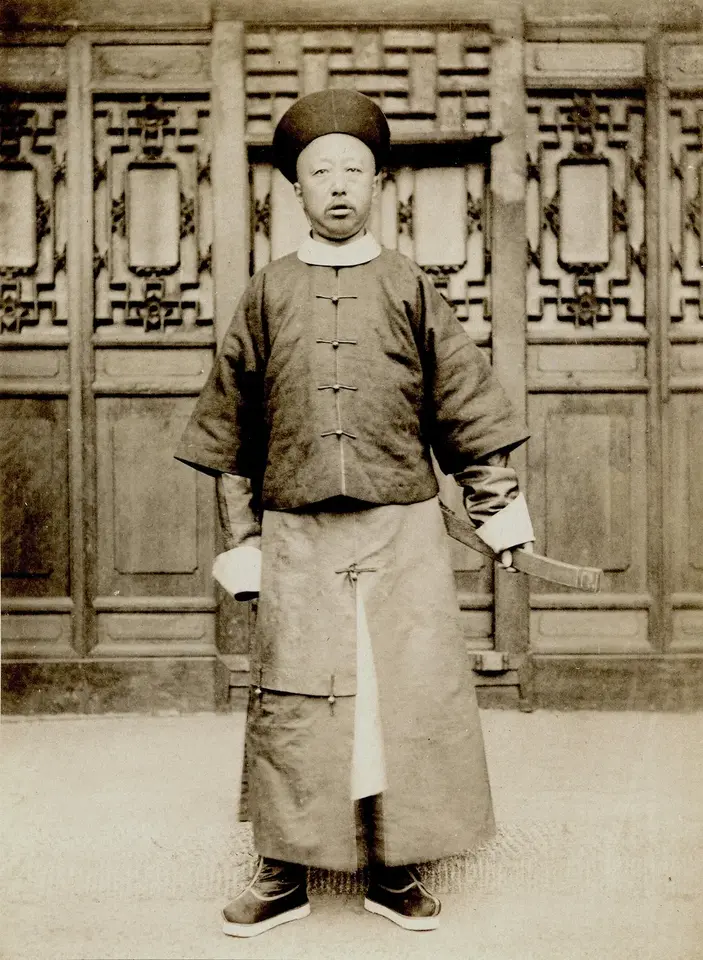
爱新觉罗·奕譞
Aisin-Gioro Yixuan (爱新觉罗·奕譞, October 16, 1840–January 1, 1891), styled Po'an, was an exalted Manchu imperial prince belonging to the Bordered Yellow Banner. He was the seventh son of the Daoguang Emperor, a younger half-brother of the Xianfeng Emperor, the biological father of the Guangxu Emperor, and the grandfather of Puyi (the Xuantong Emperor). In 1850, upon the accession of the Xianfeng Emperor, he was ennobled as Prince…
Aisin-Gioro Yixuan (爱新觉罗·奕譞, October 16, 1840–January 1, 1891), styled Po'an, was an exalted Manchu imperial prince belonging to the Bordered Yellow Banner. He was the seventh son of the Daoguang Emperor, a younger half-brother of the Xianfeng Emperor, the biological father of the Guangxu Emperor, and the grandfather of Puyi (the Xuantong Emperor). In 1850, upon the accession of the Xianfeng Emperor, he was ennobled as Prince Chun of the Second Rank. Following Xianfeng's demise at the Chengde Mountain Resort in 1861, Yixuan served as Commandant of the Gendarmerie and seized the military authority of Beijing. He collaborated with Prince Gong (Yixin) and the Empresses Dowager Ci'an and Cixi to execute the Xinyou Coup, personally riding to Gubeikou to arrest Regent Sushun and establish the regency of the Dowager Empresses. Throughout the Tongzhi reign, Yixuan commanded the elite firearm-equipped Shenji Battalion, being elevated to Prince Chun of the First Rank in 1872. In 1875, following the premature death of the childless Tongzhi Emperor, Empress Dowager Cixi unilaterally installed Yixuan's four-year-old son Zaitian as the Guangxu Emperor. Apprehensive of palace suspicion surrounding his status as the sovereign's biological father, Yixuan collapsed in tears before the throne and immediately resigned all substantive offices. In 1884, amid military setbacks during the Sino-French War, Cixi purged Prince Gong in the Jiashen Shift and appointed the deferential Yixuan to direct Grand Council affairs. In 1885, upon the establishment of the Admiralty Office, Yixuan served as its first Comptroller-General, collaborating with Li Hongzhang to construct naval bases at Port Arthur and Weihaiwei and commission the ironclads Dingyuan and Zhenyuan, culminating in the formal founding of the Beiyang Fleet in 1888. He passed away in Beijing in 1891 at the age of fifty and was granted the posthumous title Xian.
Born in the Forbidden City in Beijing as the seventh son of the Daoguang Emperor
Ennobled as Prince Chun of the Second Rank by his elder brother, the Xianfeng Emperor
Assigned his independent residence at Taiping Lake while attending inner palace duties
Commanded the capital gendarmerie, arrested Sushun at Gubeikou, and enabled the regency of Cixi
Bestowed the ceremonial title of Prince of the First Rank for commanding the Shenji Battalion
Fully promoted to Prince Chun of the First Rank on the occasion of Tongzhi's imperial nuptials
His biological son Zaitian became the Guangxu Emperor; Yixuan wept and resigned all offices to avert suspicion
Appointed by Cixi to oversee the Grand Council following the dismissal of Prince Gong
Appointed Comptroller-General of the newly created Admiralty Office to oversee national naval development
Conducted an imperial inspection tour across Dagu, Port Arthur, and Weihaiwei naval fortifications
Formally commissioned the Beiyang Fleet; diverted naval funding toward the reconstruction of the Summer Palace
Passed away at his palace residence in Beijing at age fifty; honored with the posthumous title Xian
Yixuan was born on October 16, 1840, in the Forbidden City, the son of the Daoguang Emperor and Imperial Noble Consort Zhuangshun of the Uya clan. Following the accession of his fourth elder brother as the Xianfeng Emperor in 1850, Yixuan was granted the title of Prince Chun of the Second Rank in accordance with their father's testamentary decree. In 1859, the court granted him an official residence near Taiping Lake inside Beijing's Xuanwu Gate. Despite establishing an independent household, Yixuan remained an attendant in the Inner Court, regularly advising on imperial security and clan affairs.
In 1860, as Anglo-French expeditionary forces advanced upon Beijing, Yixuan accompanied the imperial entourage fleeing to the Chengde Mountain Resort. When the Xianfeng Emperor passed away in August 1861, he appointed an eight-man regency council led by Prince Duanhua, Prince Zaiyuan, and Sushun. The regents sought to monopolize administrative power, sidelining both Dowager Empresses Ci'an and Cixi, as well as Prince Gong in Beijing. Working covertly with Prince Gong, the Dowager Empresses appointed Yixuan as Lieutenant-General of the Bordered Yellow Chinese Banner and General Commandant of the Gendarmerie, thereby securing complete command of the capital's military forces. On October 6, 1861, acting on secret imperial instructions, Yixuan led elite cavalry units north to Gubeikou, surprising and arresting Sushun at a roadside post station, successfully executing the Xinyou Coup.
Following the victory of the coup, the two Dowager Empresses initiated their co-regency behind the silk curtain, with Prince Gong directing the Grand Council. As a reward for his decisive military role, the young Tongzhi Emperor excused Yixuan from formal kowtowing during palace audiences and permitted him to submit imperial memorials without appending his personal name. In 1862, the throne established the Shenji Battalion, an elite palace garrison equipped with modern Western artillery and repeating rifles, placing Yixuan in supreme command of its training and logistics.
In 1864, upon the Qing reconquest of Nanjing and the destruction of the Taiping Heavenly Kingdom, Yixuan was honored with the rank of Prince of the First Rank. When Prince Gong's political influence was curtailed in 1865 following accusations of arrogance, Yixuan's unfailing modesty and subservience won Cixi's enduring trust. In 1872, he was formally elevated to Prince Chun of the First Rank. However, in January 1875, the nineteen-year-old Tongzhi Emperor died without an heir. To preserve her political hegemony, Cixi bypassed senior dynastic princes and selected Yixuan's four-year-old son Zaitian as the new emperor (Guangxu). Terrified of the extreme perils awaiting the biological father of a ruling monarch, Yixuan collapsed in grief on the marble floor of the Yangxin Hall, begging to be stripped of all administrative authority and allowed to retire quietly to his mansion.
In the spring of 1884, as hostilities escalated during the Sino-French War over Tonkin, Qing land and naval forces suffered serious setbacks at Fuzhou and along the northern Vietnamese border. Seizing upon widespread dissatisfaction with the war's conduct, Empress Dowager Cixi launched the Jiashen Shift in April 1884, dismissing Prince Gong and the entire membership of the Grand Council on grounds of administrative lethargy.
To prevent any single prince from consolidating independent power, Cixi recalled the obedient Yixuan, commanding that all crucial imperial state affairs be submitted to him for joint consultation. Mindful of Prince Gong's disgrace, Yixuan functioned with extraordinary deference. He scrupulously deferred to Cixi on all military and diplomatic policies, refusing to take decisive actions without prior imperial sanction. His presence at the pinnacle of the bureaucracy effectively subordinated the machinery of the Qing state to Cixi's undivided political will.
Following the Sino-French War, the Qing leadership recognized that provincial fragmentation had crippled coastal defense. In October 1885, the imperial court established the Admiralty Office as the paramount central organ responsible for modern naval expansion. Cixi appointed Prince Chun as Comptroller-General of the Admiralty, assigning Li Hongzhang, Zuo Zongtang, and Yan Jingming as associate ministers. Recognizing Li Hongzhang's organizational genius in Westernized military affairs, Yixuan shielded him from factional attacks launched by conservative court moralists.
In May 1886, accompanied by Li Hongzhang and Manchu General Shanqing, Yixuan conducted an inspection tour of naval installations across Dagu, Port Arthur, and Weihaiwei aboard the steamer Haiyan. This represented the first time an imperial prince of the blood had personally inspected modern maritime defense works. Yixuan boarded the armored ironclads Dingyuan and Zhenyuan, observed live-fire gunnery drills, and inspected the construction of dry docks at Port Arthur, vastly bolstering naval morale. In the winter of 1888, Yixuan submitted the formal Charter of the Beiyang Fleet to the throne, marking the establishment of China's first modern navy.
As the Guangxu Emperor approached majority, Cixi faced the statutory obligation of imperial retirement. Reluctant to relinquish supreme authority, she insisted upon the complete restoration of Qingyiyuan (renamed the Summer Palace, Yiheyuan) as an imperial retreat. Facing empty central coffers, Yixuan sought to demonstrate loyalty to Cixi and protect his family's position by proposing that naval development funds be diverted to finance palace construction under the pretext of establishing a naval academy at Kunming Lake.
This fiscal diversion drained critical resources away from the Beiyang Fleet between 1888 and 1894, preventing the purchase of modern rapid-fire ordnance and swift cruisers, directly precipitating the catastrophic naval defeat in the First Sino-Japanese War. Exhausted by political stress and physical illness, Yixuan's health deteriorated rapidly in late 1890. He passed away at his Taiping Lake residence on January 1, 1891, at the age of fifty. The Guangxu Emperor attended the funeral in deep mourning, and Cixi conferred the posthumous title Xian, ordering his ancestral tablet enshrined in the Imperial Ancestral Temple.
During the succession crisis at Chengde in 1861, Prince Chun demonstrated decisive military resolve by taking command of the capital's gendarmerie and blocking key transit corridors. His personal leadership in riding to Gubeikou to arrest the head of the regency council, Sushun, eliminated a powerful aristocratic faction that threatened the Qing throne. His decisive actions secured the authority of the two Dowager Empresses and Prince Gong, laying the indispensable administrative and political foundations for the suppression of domestic rebellions and the initiation of the Tongzhi Restoration.
As the inaugural Comptroller-General of the Admiralty Office, Yixuan unified China's fragmented provincial maritime commands into a standardized national defense architecture. Leveraging his imperial prestige, he protected Li Hongzhang's modernization initiatives against conservative bureaucratic opposition, securing the procurement of first-class German ironclads and British cruisers. Under his direction, the empire constructed the Port Arthur naval dry dock and Weihaiwei naval fortress, culminating in the promulgation of the Beiyang Fleet Regulations in 1888 and providing China with its first modern blue-water naval force.
FIGURES ASSOCIATED WITH THIS DYNASTY