Birth in Qiao Commandery
Born into an illustrious lineage originally named Xi that relocated from Shangyu to the vicinity of Mount Ji in Zhi County, adopting Ji as their surname.
嵇康
Ji Kang (嵇康, 224–263), courtesy name Shuye, was a native of Zhi County in Qiao Commandery (modern Suixi, Anhui Province). He was an illustrious philosopher, writer, and musician of the late Cao Wei period during the Three Kingdoms era, widely revered as the spiritual leader of the "Seven Sages of the Bamboo Grove" and a foremost proponent of Neo-Daoist Xuanxue philosophy. Born into an official family, he lost his father in…
Ji Kang (嵇康, 224–263), courtesy name Shuye, was a native of Zhi County in Qiao Commandery (modern Suixi, Anhui Province). He was an illustrious philosopher, writer, and musician of the late Cao Wei period during the Three Kingdoms era, widely revered as the spiritual leader of the "Seven Sages of the Bamboo Grove" and a foremost proponent of Neo-Daoist Xuanxue philosophy. Born into an official family, he lost his father in early youth but achieved profound mastery over classical canons, Daoist philosophy of Laozi and Zhuangzi, musical prosody, and self-cultivation arts. Standing seven feet eight inches tall with an imposing physical presence, he married the Changle Tingzhu, granddaughter of Prince Lin of Pei (son of Cao Cao), receiving appointments as Gentleman of the Household and Grandee of the Center. Following the Sima clan's usurpation of court authority, Ji Kang withdrew in disgust to Shanyang, retreating among bamboo groves with companions such as Ruan Ji, Shan Tao, and Xiang Xiu, enjoying metalworking beneath willow trees to shun bureaucratic sycophancy. When high minister Zhong Hui visited in grand attire, Ji Kang treated him with icy indifference. Later, when Shan Tao recommended him as his successor in the civil personnel ministry, Ji Kang composed his celebrated Letter Breaking Off Friendship with Shan Juyuan, openly proclaiming to "transcend orthodox moral teachings and follow nature" while repudiating tyrannical conventions. In 263, implicated in the legal prosecution of his friend Lü An, Ji Kang was slandered by Zhong Hui and imprisoned by Sima Zhao. Despite three thousand imperial academy scholars petitioning to make him their master, Ji Kang was condemned to execution. At the execution ground in eastern Luoyang, he serenely performed the masterpiece Melody of Guangling on his zither before submitting to the blade at age forty.
Born into an illustrious lineage originally named Xi that relocated from Shangyu to the vicinity of Mount Ji in Zhi County, adopting Ji as their surname.
Raised by his widowed mother and elder brother Ji Xi, reading broadly in ancient histories, Daoist scriptures, and musical theory.
Married Lady Changle, granddaughter of Cao Cao's son Cao Lin, receiving appointment as Gentleman of the Household and later Grandee of the Center.
Sima Yi seized control of the realm and executed Cao Shuang; repulsed by palace slaughter and political hypocrisy, Ji Kang retired to Shanyang in Henan.
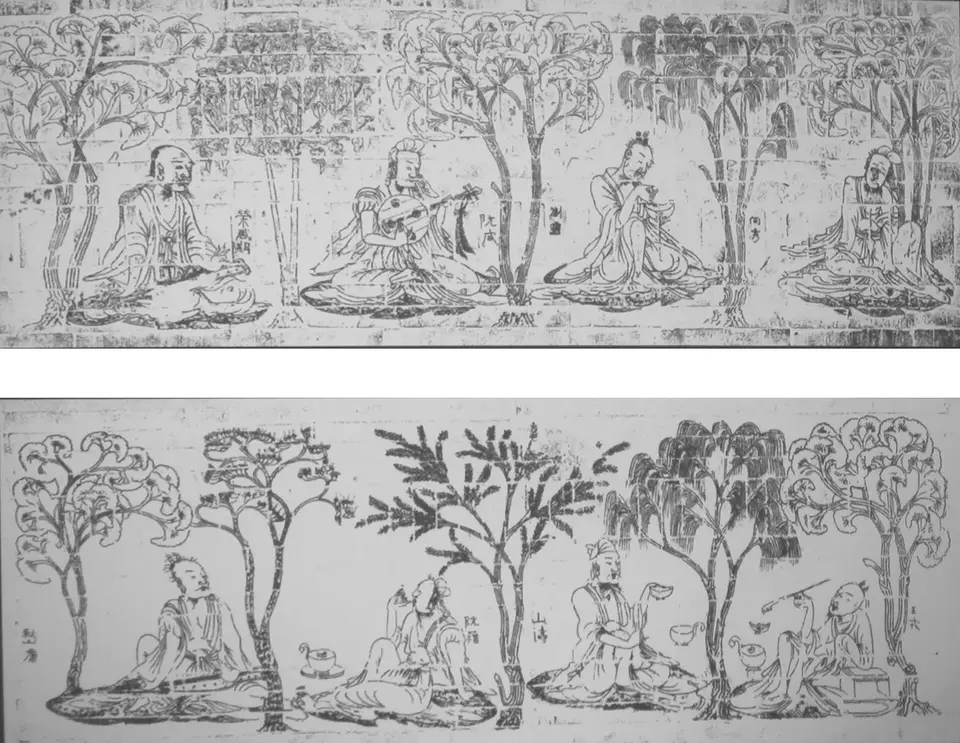
Formed the renowned literary circle with Ruan Ji, Shan Tao, Xiang Xiu, Liu Ling, Ruan Xian, and Wang Rong, composing poetry, drinking wine, and forging iron beneath willow trees.
Resided in the mountains of Jijun for three years with hermit Sun Deng, who presciently warned him against displaying excessive talent in a treacherous age.
When Sima Zhao's lieutenant Zhong Hui visited Shanyang in state, Ji Kang continued hammering iron without uttering a word, sowing fatal enmity.
Composed the Letter Breaking Off Friendship with Shan Juyuan, definitively rejecting Shan Tao's recommendation to enter Sima Zhao's bureaucracy.
Testified on behalf of friend Lü An against false charges of unfilial conduct; imprisoned on trumped-up charges of subverting public morals.
Petitioned by three thousand academy students in vain; played the Melody of Guangling one final time at the eastern market of Luoyang before his execution at age forty.
Ji Kang's ancestors were originally surnamed Xi and resided in Shangyu County within Kuaiji Commandery. Toward the end of the Western Han dynasty, fleeing from local blood feuds, the family migrated west to Zhi County in Qiao Commandery. Establishing their homestead near Mount Ji, they adopted the mountain's name as their dynastic surname. Ji Kang's father, Ji Zhao, served during the reign of Emperor Wen of Wei as Supervising Attendant Censor for Military Grain, earning a distinguished administrative reputation. His elder brother, Ji Xi, entered military service as an imperial scholar and later rose under Western Jin to high positions, including Minister of the Imperial Clan and Inspector of Yangzhou.
Tragedy struck early when his father died during Ji Kang's childhood. He was raised under the maternal guidance of his mother and the guardianship of his elder brother. Possessing an exceptional intellect and an innate aversion to narrow pedantry, Ji Kang immersed himself in canonical texts, Daoist metaphysics, medical treatises, and musical prosody. Unlike conventional contemporaries who pursued career advancement through slavish memorization of dynastic statutes, Ji Kang embraced the spontaneous freedom of Laozi and Zhuangzi. Physical descriptions recorded his height as seven feet eight inches, with a natural grace described as solitary as an unhewn pine standing before mountain cliffs.
During the mid-Zhengshi era, recognizing the esteemed standing of the Ji lineage, the Cao Wei imperial house gave Lady Changle, the granddaughter of Cao Cao's son Cao Lin (Prince Mu of Pei), in marriage to Ji Kang. Elevating him as an imperial consort, the court appointed him Gentleman of the Household and later Grandee of the Center. However, in January 249, Regent Sima Yi staged the Gaoping Tombs coup, massacring Cao Shuang's faction and reducing the Cao clan to figureheads.
Horrified by the bloodshed and moral degradation of the imperial court, Ji Kang refused to align himself with the ascendant Sima clan. Resigning his appointments, he abandoned the capital of Luoyang and moved his household to the countryside of Shanyang in Henan Commandery. In Shanyang, he sought serenity in nature, spending his days wandering hills, gathering medicinal herbs, playing his zither, and refusing all correspondence with high officials.
While living in Shanyang, Ji Kang journeyed to the Jijun mountains to visit the reclusive Daoist sage Sun Deng, who resided in an earthen cavern and was famous for his whistling and zither playing. Ji Kang lived alongside him for three years, studying internal alchemy and acoustics. Before Ji Kang departed, Sun Deng perceived his unbending pride and offered a grave warning: "Fire possesses brightness, but if it knows not how to direct its radiance, it consumes its own substance; metal possesses luster, but if it fails to hide its sheen, it melts away in the forge. You possess boundless genius yet lack defensive wisdom; in this treacherous era, escape from peril will be difficult indeed!"
Returning to Shanyang, Ji Kang coalesced with like-minded scholars: Ruan Ji, Shan Tao, Xiang Xiu, Liu Ling, Ruan Xian, and Wang Rong. Known as the "Seven Sages of the Bamboo Grove," they met frequently among the bamboo thickets of Shanyang to drink wine, play string instruments, and explore metaphysical riddles. Ji Kang was recognized by all as the indisputable intellectual heart and moral exemplar of the fellowship.
Beside a sprawling willow tree in his Shanyang courtyard, Ji Kang erected a forge and anvil, making iron forging his primary recreation. During the sweltering heat of midsummer, he stripped to the waist, hammering red-hot iron while drawing cold spring water to quench the blades, with his friend Xiang Xiu working the bellows beside him. This deliberate embrace of heavy manual labor was a radical rejection of the precious gentility of the aristocratic elite, demonstrating his philosophy of following natural instincts without regard for social rank.
Around 260, Zhong Hui, an influential lieutenant of Sima Zhao and a vain intellectual from an aristocratic house, traveled to Shanyang accompanied by a grand entourage of courtiers to pay homage to Ji Kang. Upon their arrival, Ji Kang ignored the visitors entirely, continuing to strike iron with powerful strokes while Xiang Xiu pumped the bellows. After enduring prolonged awkward silence, Zhong Hui turned to leave. Only then did Ji Kang break the silence with a cold query: "What did you hear that made you come, and what have you seen that makes you leave?" Zhong Hui retorted bitterly: "I came having heard what I heard, and I leave having seen what I saw!" This encounter transformed Zhong Hui into a vindictive enemy.
When Shan Tao prepared to transfer from Director of the Civil Appointments Bureau to Cavalier Attendant-in-Ordinary, he formally recommended Ji Kang to succeed him. Ji Kang reacted with profound fury, viewing Shan Tao's patronage as an attempt to coerce him into serving the Sima regime. He immediately penned his celebrated Letter Breaking Off Friendship with Shan Juyuan. The epistle bluntly enumerated his personal flaws—his love of sleeping late, wandering the mountains, and disdain for ceremonial flattery—while fearlessly declaring his refusal to serve a usurping dynasty.
Around this time, his close friend Lü An came to visit him in Shanyang. Finding Ji Kang away from home, his brother Ji Xi came out to welcome the guest. Disdaining Ji Xi's worldly ambitions, Lü An refused to cross the threshold. Picking up a piece of charcoal, Lü An wrote the single character for phoenix on the gate before leaving with a laugh. While Ji Xi flattered himself that the guest had praised him as an auspicious bird, Lü An had actually broken down the character into two words meaning "common bird," illustrating the haughty disdain of Ji Kang's circle toward careerist officials.
Ji Kang's uncompromising integrity precipitated his destruction. His intimate companion Lü An had an elder brother, Lü Xun, who had allied with the Sima regime. Lü Xun committed adultery with Lü An's wife and then falsely accused Lü An of unfilial violence against their mother to silence him. When Lü An was thrown into prison, Ji Kang intervened out of loyalty, publicly severing ties with Lü Xun and testifying on Lü An's behalf.
The Sima faction seized on this intervention to eliminate Ji Kang. Sili Colonel Zhong Hui exploited the situation, urging Sima Zhao to arrest Ji Kang for abetting filial crimes and subverting court morality. Zhong Hui argued: "Ji Kang is a sleeping dragon who previously sought to support Guanqiu Jian's rebellion; if you do not eliminate him now, he will become an insurmountable danger!" Sima Zhao signed the execution decree. From prison, Ji Kang composed his fifty-six-line Poem of Sorrow and Indignation, mourning his compromised ideals and the tragic fate of his friends.
The announcement of Ji Kang's impending death sparked an unprecedented public outcry. Three thousand students from the Imperial Academy gathered before the palace gates, petitioning for his pardon and offering to make him their grand tutor. However, this overwhelming public support only deepened Sima Zhao's fear of his charismatic authority, sealing his doom. On the eve of his execution, Ji Kang entrusted his young son Ji Shao to his old friend Shan Tao, telling the boy: "As long as Uncle Shan lives, you will never be an orphan."
In 263, Ji Kang was escorted to the eastern marketplace of Luoyang. Facing the executioner, his composure was absolute. Observing that the sun had not yet touched the horizon, he calmly requested his zither from his brother Ji Xi. Before thousands of weeping spectators, he performed the majestic and tragic Melody of Guangling. The powerful notes resonated across the execution field like rolling thunder. Completing the piece, he set the zither aside and sighed: "In the past, Yuan Xiaoni begged to learn this tune from me, but I constantly refused him; now, the Melody of Guangling is extinct forever!" He stretched out his neck to the blade, meeting death with serene dignity at age forty. Sima Zhao soon expressed deep regret for executing him, but the loss of this singular genius remained an unhealable wound in Chinese intellectual history.
Ji Kang was the premier philosopher of the Zhengshi era Xuanxue movement. Observing that the Sima faction cynically used traditional Confucian moralism to justify usurpation and political purges, Ji Kang formulated his revolutionary philosophical principle: "transcend orthodox moral teachings and follow nature." In treatises such as On the Natural Love of Learning and Discourse on the Eradication of Self-Interest, he demonstrated that true human virtue springs spontaneously from the Dao rather than artificial institutional coercion. He called for stripping away the hypocritical veneers of official morality to recover untainted spiritual authenticity, igniting an enduring tradition of intellectual independence among Chinese intellectuals.
Within the history of world music, Ji Kang's association with the ancient zither piece Melody of Guangling represents a sublime convergence of artistic genius and tragic heroism. Unlike the restrained harmony encouraged by orthodox Confucian court music, this composition—originally titled Nie Zheng Assassinating the King of Han—was renowned for its fierce dynamic contrasts and stormy martial pathos. Legend claimed that Ji Kang acquired the piece from an immortal spirit while resting at Yuehua Pavilion. By choosing to conclude his earthly life with this complex masterpiece beneath the executioner's blade, Ji Kang transformed the phrase "the Melody of Guangling is extinct" into an eternal cultural metaphor for irreplaceable artistry and unyielding moral defiance.
Ji Kang's Letter Breaking Off Friendship with Shan Juyuan remains a foundational monument of Chinese classical prose. Replying to Shan Tao's well-meaning recommendation for government service, Ji Kang transformed a private epistolary response into an uncompromising philosophical manifesto against authoritarian conformity. Analyzing his own temperament with brutal candor, he articulated his famous "seven intolerables and two impossibles," demonstrating why an authentic spirit cannot tolerate the performative obsequiousness required by court life. Written with breathtaking rhetorical vitality and structural rigor, the text established an enduring standard for the defense of individual moral autonomy.
In the domains of medicine, Daoist physiology, and life preservation, Ji Kang's On Nurturing Life and Reply to Objections on Nurturing Life laid the theoretical groundwork for classical Chinese longevity practices. He argued that cultivating health requires nurturing both physical vitality and mental tranquility. Warning against the destructive pursuits of wealth, sensory excess, and political ambition, he advocated meditative breathing, balanced nourishment, and emotional equanimity. When Xiang Xiu penned a rebuttal defending worldly pleasures, Ji Kang countered systematically, demonstrating that external attachments exhaust vitality while spiritual detachment preserves human essence, providing profound inspiration for later Daoist alchemy and traditional medicine.
Ji Kang's philosophical treatise On the Non-Inherence of Music stands as an astonishing masterpiece in the history of global aesthetics. Challenging the millennia-old Confucian dogma that musical tones inherently carry specific moral emotions and political omens, Ji Kang proved that acoustic sounds are objective physical phenomena defined solely by pitch, tempo, and resonance. He argued that emotions such as sorrow and joy reside entirely within the listener's subjective consciousness, evoked by circumstantial psychology rather than intrinsic qualities of the sound. By separating acoustic art from political moralism, Ji Kang founded objective musical aesthetics in ancient China.
In the genre of instrumental literature, Ji Kang's Rhapsody on the Zither is universally recognized as the greatest classical tribute to musical performance ever written. The text chronicles the logging of ancient tung trees from precipitous crags, the craftsmanship of master instrument makers, and the intricate finger techniques of virtuosic players. He depicted how zither music evokes the sweeping transitions of seasonal cycles and the cosmic energies of heaven and earth, concluding that true music relies on unadorned simplicity to harmonize humanity with the cosmos.
Ji Kang's poetry carried forward the martial vitality of the Jian'an masters while infusing it with the introspective philosophical depth of Zhengshi literature. His extant corpus of over fifty poems, particularly his four-character and five-character verses such as Poem of Sorrow and Indignation and Presenting to My Brother on Entering the Army, blended Daoist metaphysics with profound autobiographical grief. Liu Xie praised his writing in The Literary Mind and the Carving of Dragons as soaring and fierce, establishing Ji Kang alongside Ruan Ji as the twin pinnacles of early medieval Chinese poetic expression.
FIGURES ASSOCIATED WITH THIS DYNASTY