Birth into an Official Family
Born into the prominent Luo clan of Wushang; his father Luo Jun served as Chancellor of Chen.
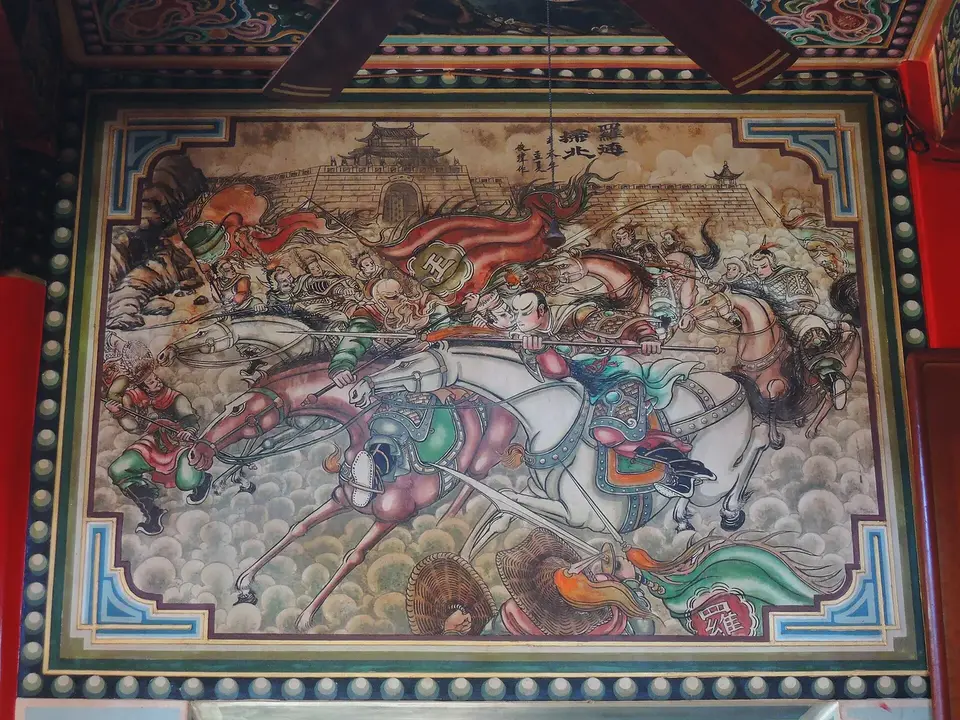
骆统
Luo Tong (骆统, 193–228 AD, courtesy name Gongxu), a native of Wushang in Kuaiji Commandery (modern Yiwu, Zhejiang Province), was an eminent military general, statesman, scholar, and legendary remonstrator of Eastern Wu during the Three Kingdoms Period. The son of Luo Jun, Chancellor of Chen during the late Eastern Han dynasty who was assassinated by Yuan Shu, Luo Tong rose to the ranks of General of the Division and Area…
Luo Tong (骆统, 193–228 AD, courtesy name Gongxu), a native of Wushang in Kuaiji Commandery (modern Yiwu, Zhejiang Province), was an eminent military general, statesman, scholar, and legendary remonstrator of Eastern Wu during the Three Kingdoms Period. The son of Luo Jun, Chancellor of Chen during the late Eastern Han dynasty who was assassinated by Yuan Shu, Luo Tong rose to the ranks of General of the Division and Area Commander of Ruxu, being enfeoffed as the Marquis of Xinyang Pavilion. Renowned for profound filial piety, benevolent local administration, strategic foresight, and fearless moral rectitude, he was an indispensable pillar in consolidating Sun Quan's early rule across Jiangdong. At the young age of twenty, Luo Tong was appointed Chancellor of Wucheng, where his enlightened and compassionate governance won universal praise across a jurisdiction exceeding ten thousand households. Recognizing his administrative talents, Sun Quan summoned him to headquarters as Section Officer, gave him concurrent duties as Acting Cavalry Commandant, and betrothed the daughter of his cousin Sun Fu to him. Diligent in identifying administrative shortcomings, Luo Tong urged Sun Quan to honor scholars, inquire into the well-being of his subordinates during banquets, and cultivate reciprocal loyalty. He later commanded elite guards as Household Director Who Establishes Loyalty, eventually assuming command of the elite forces of the late general Ling Tong. Witnessing population depletion caused by endless conscription and epidemics, Luo Tong authored the renowned Memorial on the Depletion of Households, arguing that a ruler depends upon his people as a boat depends upon water, fiercely protesting oppressive levies, infant abandonment, and abusive recruiting practices. In 222 AD, Luo Tong served under Grand General Lu Xun at Yiling, defeating Liu Bei's invasion and earning promotion to General of the Division. When Liu Bei retreated to Baidicheng, Luo Tong and Lu Xun correctly predicted Cao Wei's impending treachery, advocating immediate withdrawal to defend the Yangtze. That same year, when Cao Ren assaulted Ruxu and sent Chang Diao on a nocturnal amphibious raid against the central shoals, Luo Tong fought heroically alongside Yan Gui, shattering the Wei assault and earning the title Marquis of Xinyang Pavilion before assuming command of Ruxu fortress. In 224 AD, when Zhang Wen was framed and stripped of office amidst imperial fury, Luo Tong alone submitted a fearless memorial of several thousand words to clear his colleague's name. Luo Tong died in office in 228 AD at age thirty-six, leaving behind a celebrated ten-volume literary collection.
Born into the prominent Luo clan of Wushang; his father Luo Jun served as Chancellor of Chen.
His father Luo Jun was assassinated by Yuan Shu's agent; at age eight, he bade farewell to his remarried mother without looking back to ease her sorrow.
Appointed Chancellor of Wucheng at age twenty; governed ten thousand households with benevolence, earning promotion to Section Officer.
Appointed Household Director Who Establishes Loyalty; inherited and drilled the elite troops of the deceased general Ling Tong.
Submitted his famous memorial urging tax relief and an end to harmful recruiting, expounding the principle that people are the foundation of statecraft.
Aided Lu Xun in routing Liu Bei at Yiling; repulsed Cao Ren's assault at Ruxu and was created Marquis of Xinyang Pavilion.
Assumed command as Area Commander of Ruxu; boldly submitted a multi-thousand-word memorial defending the slandered minister Zhang Wen.
Passed away from overwork at the Ruxu military front at age thirty-six, mourned deeply throughout Jiangdong.
Luo Tong was born into a distinguished scholarly lineage in Wushang, Kuaiji Commandery. His father, Luo Jun, was a revered scholar-official who served as Chancellor of Chen during the closing decades of the Eastern Han dynasty. In 197 AD, when warlord Yuan Shu exhausted his logistical provisions in Huainan, he demanded grain from Chen. Luo Jun steadfastly refused to supply the rebel warlord, prompting Yuan Shu to dispatch a secret assassin named Zhang Kai to murder him. Luo Tong was thus left fatherless at a tender age.
In 200 AD, Luo Tong's biological mother, left without support, remarried as a secondary wife to the eminent scholar Hua Xin. Eight-year-old Luo Tong was compelled to return with his ancestral relatives to their native home in Wushang. At the moment of separation, his weeping mother escorted his carriage along the road. Luo Tong bowed respectfully, boarded the vehicle, and kept his gaze firmly fixed forward, refusing to turn around. His mother wept bitterly behind the carriage. When the driver remarked that his mother was still standing in tears, eight-year-old Luo Tong held back his tears and explained that he deliberately looked away so as not to compound his mother's sorrow and attachment.
Upon returning to Wushang, Luo Tong served his father's primary wife and clan elders with consummate filial piety and humility. During those years, severe famine gripped Jiangdong, reducing local gentry and fleeing refugees to starvation. Deeply affected by their suffering, Luo Tong drastically reduced his own daily grain rations to distribute food to starving neighbors, becoming frail and emaciated.
His elder sister, a virtuous and compassionate widow living in the family compound without children, was heartbroken by his deterioration and repeatedly questioned him. Luo Tong sighed and replied: "When honorable scholars cannot even obtain husks and chaff to fill their bellies, how could I have the heart to eat to my fill alone?" Deeply moved, his sister wept and offered her personal grain stores to Luo Tong, informing their mother of his actions. Impressed by his virtue, their mother opened the family granaries for public distribution, spreading Luo Tong's renown for filial benevolence throughout the region.
In 212 AD, Sun Quan, then holding the title of General Who Subdues Bandits concurrently with Grand Administrator of Kuaiji, learned of Luo Tong's exceptional moral character and appointed the twenty-year-old youth as Chancellor of Wucheng. Wucheng was a crucial Jiangnan urban center encompassing over ten thousand households, featuring powerful local magnates and complex litigation. Luo Tong instituted benevolent, transparent governance, lightening corvee duties, administering impartial justice, and restraining regional bullies, earning universal acclaim from the populace.
Sun Quan was immensely pleased with his administrative record, summoning Luo Tong to headquarters as Section Officer with concurrent rank as Acting Cavalry Commandant, and betrothing the daughter of his imperial cousin Sun Fu to him. In office, Luo Tong dedicated himself to rectifying policy oversights. Whenever he identified abuses in provincial administration, he drafted memorials that very night, never allowing grievances to languish unresolved until the morning.
Recognizing that Sun Quan was consolidating regional authority, Luo Tong repeatedly advised his master on leadership ethics: "The art of rule lies in venerating worthy scholars and seeking diverse perspectives. Whenever the state convenes celebratory banquets to reward civil officials and commanders, Your Lordship should grant individual audiences to each guest, asking after their personal comfort and daily circumstances to convey genuine warmth. Simultaneously, you should guide them with patience to voice their honest thoughts, observing their true character and aspirations. Thus, every man will be filled with gratitude and bound by an unyielding desire to serve with his life." Sun Quan enthusiastically adopted Luo Tong's advice, fostering the cohesive loyalty that underpinned Eastern Wu's statecraft.
Sun Quan later appointed Luo Tong Household Director Who Establishes Loyalty, granting him command of three thousand archers. In 217 AD, when legendary general Ling Tong passed away, Sun Quan mourned deeply. Knowing that Luo Tong governed troops with strict discipline and compassionate care, Sun Quan assigned Ling Tong's veteran units to Luo Tong's direct command, where they flourished under his leadership.
As warfare against Cao Wei and Liu Bei intensified, taxation and military conscription became ruinously heavy across Jiangdong, compounded by devastating epidemics. Observing empty counties, abandoned fields, and widespread human suffering, Luo Tong submitted his historic Memorial on the Depletion of Households, which remains one of the greatest humanitarian documents of ancient Chinese political thought.
Luo Tong articulated a profound philosophy of popular sovereignty: "Your servant has heard that those who govern empires consider expanding territory as wealth, wielding authority as honor, shining moral virtue as glory, and perpetuating lineage as blessing. Yet all material wealth derives from the labor of the common people; martial strength relies upon their sinews; sovereign majesty rests upon their collective power; and dynastic prosperity depends upon their demographic reproduction. The Classic of History proclaims: 'Without a sovereign, the multitude cannot enjoy peace; without the multitude, the sovereign has no domain to govern.' Rulers find peace through their people, and the people stand sustained by the state. This is an immutable law of heaven and earth. Today, our adversaries remain undefeated, and military frontiers demand endless vigils. Prolonged extractions, combined with deadly pestilence, have hollowed out our commanderies. Across our cities, households diminish daily, leaving only the elderly and infirm while sturdy men vanish. Witnessing this, your servant's heart burns with anguish."
He then laid bare the devastating toll of endless conscription: "The common folk cherish their ancestral soil. Yet those conscripted into the army endure bitter cold and hunger while alive, and their unburied bones rot in alien soil when dead. Thus, civilians view distant military service as equivalent to a death sentence! In every levy, docile and impoverished households are drafted first, while wealthier families exhaust their fortunes in bribes, and reckless youths flee into mountain wilderness to join bandit gangs. Destitute and desperate, farmers cease cultivation, and starving civilians turn toward rebellion."
Most tragically, Luo Tong exposed widespread infanticide: "Your servant learns that among common families, unless a household has sufficient wealth to sustain itself, newborn infants are abandoned and killed. Even among garrison soldiers on state farms, impoverished troops frequently discard their own flesh and blood! Heaven gives life, yet parents destroy their offspring, violating cosmic harmony and bringing down divine wrath! A ruler's foundation depends upon demographic vitality, yet our population declines while newborn generations are extinguished. How can an empire endure? The populace is to the state as water is to a vessel: calm water preserves the boat, while turbulent currents capsize it! Commoners may be humble, but they cannot be deceived; they may be weak, but they cannot be crushed by force. Upright magistrates should govern through benevolence rather than ruthless extraction. One must treat a disease before it turns terminal, and remove peril before it spreads. I implore Your Majesty to find leisure amidst state affairs to nurture the surviving populace."
Deeply moved, Sun Quan gave serious heed to the memorial and alleviated several burdensome levies. Luo Tong subsequently challenged the exploitative system of private recruitment (zhanmu), pointing out that private recruiting empowered magnates to conceal taxable households, corrupted public morality, and fomented rebellion. Following intense debate, Sun Quan abolished the abusive system in accordance with Luo Tong's counsel.
In 222 AD, Liu Bei launched a massive invasion of Eastern Wu, sending armies cascading down the Yangtze. Luo Tong led his troops westward under Grand General Lu Xun. During the decisive Battle of Yiling in Yidu, Luo Tong fought at the front of his men, coordinating with Lu Xun's fire attacks to shatter the Shu vanguard, decapitating thousands of enemy troops. For his distinguished battlefield merits, he was promoted to General of the Division.
Following Liu Bei's retreat to Baidicheng, senior Wu commanders including Xu Sheng, Pan Zhang, and Song Qian clamored to pursue the fleeing emperor, claiming that Liu Bei was trapped and that Western Shu could be conquered in a single stroke. Sun Quan hesitated, seeking counsel from his frontline generals.
Luo Tong demonstrated profound geopolitical acumen. Collaborating with Lu Xun and Zhu Ran, he forcefully opposed the pursuit: "Cao Pi has assembled massive armies in central China, marching south under the guise of aiding Wu against Shu, yet harboring deceitful intentions to assault our undefended rear! If our armies march deep into the gorges, the Wei forces will strike our heartland unchecked!" Sun Quan realized the danger and ordered an immediate withdrawal. Within days, three Wei armies descended upon Wu, but Jiangdong stood fortified and survived the crisis.
In the autumn of the same year, Cao Wei Grand General Cao Ren led tens of thousands of infantry and cavalry against the fortress of Ruxu. Feigning a frontal assault on the main fortifications, Cao Ren secretly dispatched commanders Chang Diao and Zhuge Qian with five thousand elite troops on a midnight amphibious assault against the central shoals, where Wu families and logistical depots were garrisoned. In the face of imminent disaster, Luo Tong and subordinate commander Yan Gui reacted with extraordinary poise. Marshaling their naval vessels and elite assault squads, they engaged the Wei forces in fierce hand-to-hand combat along the riverbanks, slaying Chang Diao, capturing Zhuge Qian, and annihilating several thousand enemy troops. Sun Quan celebrated the victory, elevating Luo Tong to Marquis of Xinyang Pavilion and subsequently appointing him Area Commander of Ruxu to oversee the empire's premier frontier fortress.
Assuming command of Ruxu, Luo Tong reinforced defensive ramparts, drilled riverine fleets, and continued submitting dozens of insightful policy memorials to the court. Generous and chivalrous, he never hesitated to defend wronged colleagues against injustice.
Earlier, Grand Administrator of Lingling Xu Ling had served with celebrated integrity before dying in poverty. Local bullies subsequently usurped Xu's family estates and enslaved his servants, leaving his son Xu Ping destitute. Upon discovering this, Luo Tong intervened forcefully, demanding the restoration of the family lands and submitting a moving memorial to Sun Quan praising Xu Ling's past services. Touched by the appeal, Sun Quan appointed Xu Ping to official service, where he fought with distinction, eventually rising to Left Area Commander of Wuchang.
In 224 AD, the political storm surrounding Zhang Wen erupted. Appointed envoy to Shu Han, Zhang Wen had publicly praised Zhuge Liang's administration upon his return. Sun Quan was privately displeased. Shortly thereafter, when Selection Director Ji Yan committed suicide following controversial administrative reforms, political rivals slandered Zhang Wen as Ji Yan's factional accomplice, fabricating treasonous charges and alleging military delinquency. Infuriated, Sun Quan stripped Zhang Wen of office and imprisoned him.
Terrified of imperial wrath, courtiers fell silent, not daring to speak on Zhang Wen's behalf. Stationed at the distant Ruxu front, Luo Tong was outraged. Knowing that intervening would endanger his own career and life, he drafted a fearless, multi-thousand-word memorial titled Memorial Defending Zhang Wen.
Luo Tong dissected every accusation with meticulous logic, proving that Ji Yan's initial appointment was supported by collective consensus, not Zhang Wen alone; that praising Shu during a diplomatic mission was standard international etiquette that had secured Deng Zhi's reciprocal embassy; and that allegations of military delay were baseless fabrications. Luo Tong concluded with breathtaking defiance: "Your servant has not corresponded with Zhang Wen for years. I plead for him today not out of private friendship, but for the sacred integrity of our state and the wisdom of our sovereign! If Zhang Wen is to suffer punishment before the throne, your servant Luo Tong stands willing to share his dismissal and humiliation in his wake!" Although Sun Quan's stubborn pride prevented a full reversal of the verdict, Luo Tong's fearless defense echoed across the realm.
Exhausted by constant military responsibilities at Ruxu and relentless anxiety over state governance, Luo Tong's health deteriorated rapidly. In 228 AD, he passed away in the military camp at Ruxu at the untimely age of thirty-six. Sun Quan wept bitterly upon receiving the news and provided generous pensions to his family. Luo Tong's writings were compiled into the ten-volume Luo Tong Collection. Historian Chen Shou praised him in the Records of the Three Kingdoms as a minister who "championed great righteousness with urgent eloquence and impeccable logic," while Song dynasty philosopher Ye Shi sighed in admiration: "In his singular devotion, Luo Tong alone understood the primacy of the people; where else can one find such words of wisdom!"
Appointed Chancellor of Wucheng at age twenty, Luo Tong governed ten thousand households with enlightened compassion, reducing burdens and fostering peace.
Promoted to Section Officer, he urged Sun Quan to honor worthy scholars and hold personal audiences during banquets, cementing elite cohesion during Wu's formative years.
Witnessing population collapse caused by wars and epidemics, Luo Tong authored the Memorial on the Depletion of Households, declaring that "the people are to the state as water is to a vessel."
He passionately condemned infant abandonment, forced conscription, and abusive recruiting practices, persuading Sun Quan to alleviate levies and protect demographic vitality.
At Yiling in 222 AD, Luo Tong fought heroically alongside Lu Xun to crush Liu Bei's invasion, subsequently warning against pursuing the enemy and averting a surprise attack by Cao Wei.
At Ruxu that same year, he repulsed Cao Ren's midnight assault against the central shoals, slaying general Chang Diao and securing the Yangtze perimeter, earning the title Marquis of Xinyang Pavilion.
When Zhang Wen was falsely framed amidst imperial fury, the entire court was paralyzed with fear, yet Luo Tong submitted a multi-thousand-word memorial from the Ruxu front.
He dismantled each slanderous charge with rigorous logic and declared his willingness to share dismissal alongside Zhang Wen, embodying the highest standard of Confucian ministerial rectitude.
Serving as Area Commander of Ruxu, Luo Tong fortified border defenses, trained disciplined riverine units, and authored ten volumes of political and military treatises.
His unyielding vigilance secured the northern frontier of Eastern Wu against repeated Wei offensives until his untimely demise at age thirty-six.
FIGURES ASSOCIATED WITH THIS DYNASTY