Birth and Childhood
Born into an illustrious and wealthy lineage in Jiaxing, Zhejiang, nurtured early in art and epigraphy.
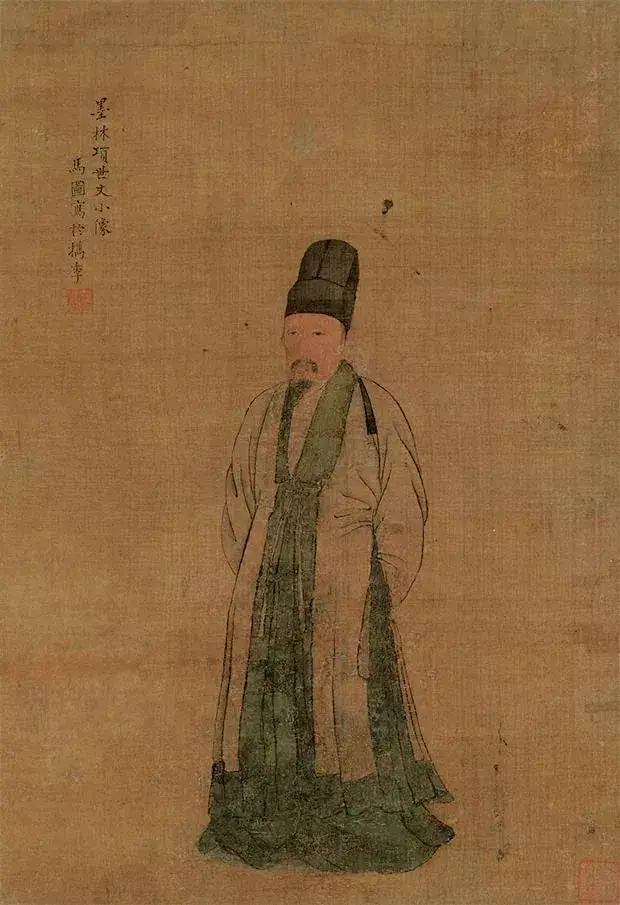
项元汴
Xiang Yuanbian (1525 – 1590), courtesy name Zijing, art name Molin, and alternative sobriquets Xiangyan Jushi and Master of Tuimizhai, was a native of Jiaxing County, Jiaxing Prefecture, Zhejiang. A celebrated connoisseur, collector, calligrapher, painter, and scholar during the Jiajing and Wanli reigns of the Ming dynasty, he hailed from an eminent and extraordinarily wealthy family in Jiaxing. Though holding the status of a…
Xiang Yuanbian (1525 – 1590), courtesy name Zijing, art name Molin, and alternative sobriquets Xiangyan Jushi and Master of Tuimizhai, was a native of Jiaxing County, Jiaxing Prefecture, Zhejiang. A celebrated connoisseur, collector, calligrapher, painter, and scholar during the Jiajing and Wanli reigns of the Ming dynasty, he hailed from an eminent and extraordinarily wealthy family in Jiaxing. Though holding the status of a National University student (guozijiansheng), he was indifferent to civil service examinations, dedicating his life and vast fortune to amassing, verifying, and safeguarding classical Chinese calligraphy, paintings, ancient bronzes, jade artifacts, and rare editions. He constructed the world-famous treasure house "Tianlai Pavilion" (Pavilion of Heavenly Music), which housed an art collection unmatched in China, including the Tang traced copy of Eastern Jin painter Gu Kaizhi's Admonitions of the Court Instructress, Wang Xizhi's Ping'an Tie, Tang painter Han Huang's Five Oxen, Huaisu's Autobiography, and divine masterpieces by Song and Yuan masters. Xiang was a master of artistic connoisseurship, establishing a unique system of impressing personal collector seals, recording purchasing prices, and numbering works using the Thousand Character Classic, which profoundly shaped the history of Chinese art collecting. Artistically, he excelled in painting landscapes, bamboo, rocks, and ink plum blossoms, characterized by sparse elegance, while his calligraphy followed Ouyang Xun and Zhao Mengfu. In his later years, late Ming artistic titan Dong Qichang studied Jin and Tang masterpieces inside Xiang's Tianlai Pavilion as a young tutor, receiving crucial artistic enlightenment that enabled him to become a foundational master. Xiang passed away in 1590 at the age of sixty-six.
Born into an illustrious and wealthy lineage in Jiaxing, Zhejiang, nurtured early in art and epigraphy.
Acquired the ancient Jin dynasty zither "Qing Tianlai," constructing Tianlai Pavilion to house masterpieces.
Spent vast wealth to acquire Jin and Tang masterpieces, adding Han Huang's Five Oxen and ancient scrolls.
Befriended the young Dong Qichang, inviting him into Tianlai Pavilion to copy Jin, Tang, Song, and Yuan masterpieces.
Meticulously recorded purchase prices and collection lineages, compiling art treatises such as Jiaochuang Jiulu.
Painted Ink Bamboo and flower scrolls, maintaining close artistic ties with Wen Zhengming's sons Wen Peng and Wen Jia.
Passed away at Tianlai Pavilion in Jiaxing at sixty-six.
Xiang Yuanbian was born in 1525 (the fourth year of the Jiajing reign) into an illustrious and wealthy gentry family in the city of Jiaxing, Zhejiang. The Xiang family was among the wealthiest lineages in southeastern China, possessing extensive commercial operations and vast agrarian estates. His father Xiang Gang and eldest brother Xiang Yuanqi were celebrated Jiangnan literati devoted to antiquarianism. Naturally brilliant and nurtured by a scholarly household, Xiang viewed eight-legged examination studies with indifference. Though holding the status of student at the Directorate of Education, he adamantly refused to enter the civil service race for office, channeling his lifelong passion into the collection and authentication of ancient calligraphy, paintings, ritual bronzes, jade, inkstones, and scholar's rocks.
In his youth, relying on his extraordinary aesthetic intuition and discerning eye, Xiang began acquiring antiquities across Jiangsu and Zhejiang. He acquired the legendary ancient zither "Qing Tianlai," once owned by Western Jin hermit Sun Deng. Cherishing this instrument, he named his towering multi-storied library in Jiaxing "Tianlai Pavilion" (Pavilion of Heavenly Music). He also constructed the Tuimi Studio and Tianbi Hall, specialized chambers designed for storing, examining, and restoring ancient scrolls. Tianlai Pavilion welcomed antiquities from across the realm; whenever prominent families facing hardship or warfare dispersed their ancestral heirlooms, Xiang acquired them with generous sums.
From the mid-Jiajing to early Wanli eras, the commercial economy of Jiangnan experienced rapid growth, and the pursuit of ancient art became widespread among scholar-officials and urban merchants. Relying on his connoisseurship and immense financial resources, Xiang swiftly elevated Tianlai Pavilion into China's largest and most refined private art museum. His collections spanned Shang and Zhou bronze vessels, Han and Wei seals, Jin and Tang calligraphy, and Song and Yuan landscape paintings.
Within Tianlai Pavilion gathered numerous transcendent masterpieces of Chinese art history: Tang traced copies of Wang Xizhi's Ping'an Tie and Kuaixue Shiqing Tie; the Tang traced copy of Gu Kaizhi's Admonitions of the Court Instructress; Sui dynasty painter Zhan Ziqian's Strolling About in Spring; Han Huang's Five Oxen; Huaisu's genuine calligraphic scroll Autobiography; Li Bai's Ascending Mount Yangtai; Northern Song master Li Tang's Plucking Ferns; Mi Fu's Shusu Tie; and authentic paintings by Yuan masters Zhao Mengfu, Huang Gongwang, Wu Zhen, Ni Zan, and Wang Meng. Residing in the pavilion, Xiang examined paper, ink, colophons, and seals for every scroll, recording provenance on mounting borders, filling visitors with boundless admiration.
Though possessing colossal wealth and empire-wide renown, Xiang was gentle, modest, and generous. Tianlai Pavilion was not a locked, private vault, but the most elevated cultural salon for Jiangnan literati. Wu School masters Wen Peng and Wen Jia, alongside Tu Long, Wang Daokun, and Xie Zhaozhe, were frequent guests at the pavilion, lodging there for extended periods to view antiquities and compose poetry.
The event of greatest significance for later art history was Xiang's patronage of the young Dong Qichang. During the Wanli reign, before passing the imperial examinations, Dong resided at the Xiang family mansion as a household tutor. Recognizing Dong's extraordinary genius, Xiang made an unprecedented exception, granting him free access to Tianlai Pavilion and displaying hundreds of genuine Jin, Tang, Song, and Yuan masterpieces for him to copy and study. Immersing himself in the collection for years, Dong's aesthetic horizons expanded dramatically, enabling him to synthesize ancient methods and become a monumental painter and theorist. In his later years, Dong repeatedly expressed tearful gratitude for Xiang's generosity.
Beyond collecting, Xiang was an accomplished painter, calligrapher, and writer. Calling himself "Molin Shanren" in his later years, his landscape, bamboo, and rock paintings captured the spare elegance of Yuan masters, accompanied by graceful inscriptions. He authored Jiaochuang Jiulu and Shufa Yayan, summarizing his principles for evaluating ancient calligraphy, painting, and craft objects. In 1590 (the eighteenth year of the Wanli reign), Xiang passed away peacefully at Tianlai Pavilion at sixty-six.
Following his death, his collections were divided among his descendants. In 1645 (the second year of the Shunzhi reign), Qing armies captured Jiaxing, unleashing brutal warfare across Jiangnan. Qing garrison commander Wang Liurong permitted his soldiers to sack Tianlai Pavilion. A collection amassed over a century was plundered, scattered, or burned overnight, representing an immense catastrophe in Chinese cultural history. Nevertheless, the surviving calligraphy and paintings reassembled during the Kangxi and Qianlong reigns inside the Qing imperial palace, forming the core foundation of the imperial catalog Shiqu Baoji, ensuring that Xiang Yuanbian's collector seals would be immortalized in Chinese art history.
Xiang Yuanbian's foremost contribution to Chinese cultural history was single-handedly constructing the largest, most rigorous, and highest-quality private art collection in late imperial China. Tianlai Pavilion housed thousands of calligraphic works and paintings spanning from the Wei and Jin dynasties to the mid-Ming, encompassing almost every monumental masterpiece in ancient Chinese art history. Confronted with the hazards of social upheaval and cultural dispersal in Ming Jiangnan, Xiang utilized his connoisseurship and vast fortune to perform the archival functions of a national museum, ensuring that unique masterpieces by Gu Kaizhi, Wang Xizhi, Han Huang, Huaisu, Li Tang, and Zhao Mengfu survived turbulent times.
In art collecting practice, Xiang established a distinctive recording system. On every acquired masterpiece, he impressed multiple exquisite personal seals, commonly including "Xiang Yuanbian Yin," "Zijing," "Xiang Zijing Jia Zhencang," "Molin Shanren," "Tianlai Ge," "Ji'ao," and "Tuimi." Uniquely, Xiang frequently inscribed the purchasing price in tiny regular script on trailing margins or paper corners (such as "Original price: several tens of silver taels") and numbered works sequentially according to characters from the Thousand Character Classic (such as the sequence "Tian, Di, Xuan, Huang"). Although criticized by some later literati as displaying commercial vulgarity, this practice objectively provided modern art historians with invaluable primary documentation regarding ancient art markets, artwork valuations, Ming monetary economics, and provenance authentication.
Tianlai Pavilion served not merely as a treasure vault, but as an academy that nurtured masters of late Ming art. Breaking away from the selfish secrecy common among elite lineages, Xiang opened his collection to promising scholars. Young Dong Qichang encountered authentic works by Wang Xizhi, Yang Ningshi, Dong Yuan, Juran, and Huang Gongwang in Tianlai Pavilion, providing the empirical foundation for his "Northern and Southern Schools" theory of landscape painting. Not only Dong, but key figures of the Huating School such as Chen Jiru and Mo Shilong were nurtured by Tianlai Pavilion's collection. Through his generosity and cultural vision, Xiang served as an indispensable catalyst propelling late Ming painting and calligraphy to its historical zenith.
FIGURES ASSOCIATED WITH THIS DYNASTY