Rise of Consort Kin
Daughter Yang Zhi enthroned as Empress to Emperor Wu; Yang Jun rapidly promoted to General of Chariots and Cavalry and Marquis of Linjin.
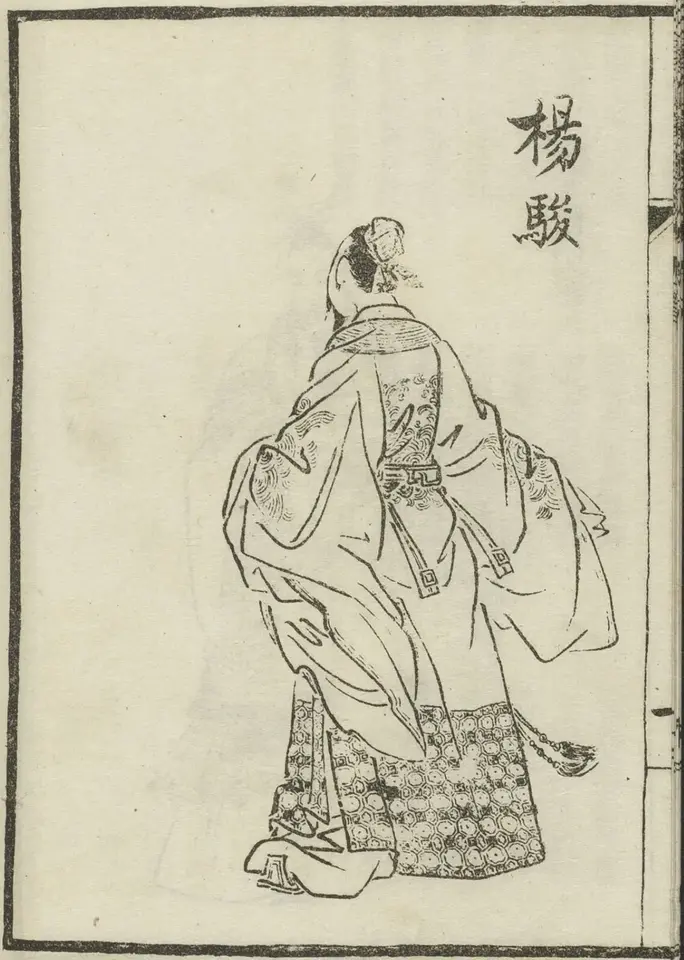
杨骏
Yang Jun (杨骏, ?–291), courtesy name Wenchang, native of Huayin in Hongnong (modern Huayin, Shaanxi), was an imperial consort clan regent and Grand Preceptor during the Western Jin dynasty, descending from the distinguished Han Dynasty Grand Commandant Yang Zhen. Yang Jun held minor local and military staff posts during his early career. In 276, his eldest daughter Yang Zhi was invested as empress to Emperor Wu of Jin…
Yang Jun (杨骏, ?–291), courtesy name Wenchang, native of Huayin in Hongnong (modern Huayin, Shaanxi), was an imperial consort clan regent and Grand Preceptor during the Western Jin dynasty, descending from the distinguished Han Dynasty Grand Commandant Yang Zhen. Yang Jun held minor local and military staff posts during his early career. In 276, his eldest daughter Yang Zhi was invested as empress to Emperor Wu of Jin (Sima Yan), catapulting the Yang clan into supreme court nobility. Yang Jun was rapidly promoted from General of the Garrison Army to General of Chariots and Cavalry and enfeoffed as Marquis of Linjin. Together with his younger brothers, Prefect of the Masters of Writing Yang Yao and Grand Tutor to the Crown Prince Yang Ji, they were colloquially known as the "Three Yangs," dominating central authority. During the late reign of Emperor Wu, imperial administration deteriorated into self-indulgence, leaving civil governance largely in the hands of the Yang consort faction. In 290, as Emperor Wu lay dying, the emperor initially intended to draft a joint regency between Prince of Ru'nan Sima Liang and Yang Jun. However, Yang Jun exploited his intimate access to the imperial bedchamber to conceal the imperial decree, orchestrating a forged testament with Empress Yang to seize undivided regency. Upon the accession of the developmentally impaired Emperor Hui, Yang Jun was appointed Grand Preceptor, Grand Commander-in-Chief, Bearer of the Yellow Battle-Ax, and Manager of Affairs of the Masters of Writing. Lacking statesmanship and moral prestige, Yang Jun governed with petty autocracy, alienating imperial princes, purging capable ministers, and distributing unearned titles to curry private favor. In the third month of 291, Empress Jia Nanfeng conspired with court officers Meng Guan and Li Zhao to stage a palace coup, mobilizing troops under Prince of Chu Sima Wei. Caught in indecision and panic, Yang Jun fled into a stable behind the imperial arsenal, where he was stabbed to death with halberds by insurgent guards. His lineage was exterminated to three degrees, with thousands executed, precipitating the devastating War of the Eight Princes.
Daughter Yang Zhi enthroned as Empress to Emperor Wu; Yang Jun rapidly promoted to General of Chariots and Cavalry and Marquis of Linjin.
Jin unified China; Yang Jun and his brothers Yang Yao and Yang Ji accumulated pervasive influence across the metropolitan administration.
With Emperor Wu dying, Yang Jun intercepted and suppressed the decree appointing Sima Liang; forged an edict to secure sole regency.
Emperor Hui enthroned; Yang Jun invested as Grand Preceptor, Grand Commander-in-Chief, and Bearer of the Yellow Battle-Ax, garrisoning the palace.
Placed imperial princes under surveillance; installed maternal nephews Duan Guang and Zhang Shao in key commands, alienating the court.
Empress Jia and Prince of Chu Sima Wei staged a nocturnal coup; palace troops attacked the estate and speared Yang Jun to death in his stable.
Yang Jun belonged to the celebrated Yang clan of Hongnong, tracing his descent from Yang Zhen, the famous Grand Commandant of the Later Han, through his grandfather Yang Zhong, who had served as Prefect of Donglai and Marquis of Mouting. In his early years, Yang Jun entered the Western Jin civil bureaucracy, holding modest appointments such as Magistrate of Gaolu and adjutant in the guard commands of Agile Cavalry and Garrison Army. Within elite literati circles, he was considered mediocre in ability, petty in disposition, and deficient in strategic vision. In 276, as Emperor Wu's first consort, Empress Yang Yan, lay dying, she feared that an empress from an unrelated clan would jeopardize the succession of her dim-witted son, Crown Prince Sima Zhong. She therefore extracted a dying promise from the emperor to elevate her younger cousin, Yang Jun's daughter Yang Zhi, to the imperial throne.
Following Yang Zhi's investiture as empress, Yang Jun was elevated through imperial favoritism. Breaking normal meritocratic channels, Emperor Wu promoted him directly to General of the Garrison Army, subsequently advancing him to General of Chariots and Cavalry and enfeoffing him as Marquis of Linjin. Discerning statesmen expressed profound concern over the appointment. Censors pointed out that feudal fiefs were meant to serve as bulwarks for the imperial house, whereas the title "Linjin" symbolically signified looking down upon and overshadowing the House of Jin—an omen of dynastic calamity. High ministers including Guo Yi and Chu Dui repeatedly memorialized against Yang Jun, warning that his narrow temperament and lack of administrative competence rendered him entirely unfit for supreme ministerial authority. Absorbed in lavish indulgence during his later years, Emperor Wu disregarded their warnings. Yang Jun, alongside his talented brothers Yang Yao (Prefect of the Masters of Writing) and Yang Ji (Grand Tutor to the Crown Prince), formed a dominant triumvirate known as the "Three Yangs," dominating central patronage and policy.
Between 289 and 290, Emperor Wu fell critically ill. Most of the founding meritocratic statesmen of Western Jin, such as Jia Chong, Yang Hu, and Du Yu, had already passed away, leaving the court uneasy and disoriented. Exploiting his position as the reigning empress's father, Yang Jun excluded regular ministers from the inner chambers and maintained exclusive attendance at the emperor's bedside. He utilized this proximity to dismiss seasoned officials and replace them with personal partisans. During a brief rally in his condition, Emperor Wu observed these arbitrary personnel shifts and severely reprimanded Yang Jun: "How can state affairs be handled in such a reckless manner!" Aware of Crown Prince Sima Zhong's intellectual infirmities, Emperor Wu drafted a secret imperial edict instructing the Secretariat to summon the elder imperial prince, Prince of Ru'nan Sima Liang, to govern the empire jointly with Yang Jun.
Upon discovering the edict, Yang Jun was gripped by panic, fearing that Sima Liang's presence would dilute his authority. He borrowed the document from the Secretariat under false pretenses and concealed it in his residence. Director of the Secretariat Hua Ne demanded the document in person, but Yang Jun adamantly refused to surrender it. Two days later, as Emperor Wu lapsed into comatose delirium, Empress Yang petitioned the sovereign to designate Yang Jun sole regent; the dying emperor vaguely nodded. Seizing the moment, Empress Yang summoned Hua Ne and Imperial Secretary He Shao, dictating a forged testament that compared Yang Jun to the ancient sage-regents Yi Yin and Huo Guang. The forged edict conferred upon Yang Jun the titles of Grand Commandant, Grand Tutor to the Crown Prince, Bearer of the Imperial Tally, Commander-in-Chief of Internal and External Military Affairs, and Manager of Affairs of the Masters of Writing, assigning him a private force of four thousand elite soldiers and permitting armed guards inside the imperial halls. Two days later, Emperor Wu passed away, and Emperor Hui ascended the throne. During the royal encoffining ceremony, while the imperial consorts wept, Yang Jun remained proudly seated upon the dais of the Taiji Hall surrounded by a hundred armed guards, making his autocratic ambitions blatant to the entire court.
With the accession of Emperor Hui, Yang Jun advanced to Grand Preceptor, Grand Commander-in-Chief, Bearer of the Yellow Battle-Ax, and Manager of Affairs of the Masters of Writing, consolidating supreme civil and military jurisdiction in his own hands. Aware of his thin reputation and fearful of subversion, he placed his maternal nephews Duan Guang and Zhang Shao as imperial attendants beside Emperor Hui. All imperial edicts were required to pass through Empress Dowager Yang and Yang Jun before implementation. Recognizing the fierce and volatile nature of Empress Jia Nanfeng, Yang Jun placed the inner palaces under strict surveillance while concentrating metropolitan garrison commands among his kinsmen, banishing imperial princes to their regional estates.
Yang Jun lacked historical learning and administrative acumen, repeatedly contravening dynastic protocol. Within months of Emperor Wu's death, he rushed to alter the imperial era name, inviting widespread literati condemnation for violating the classical Spring and Autumn Annals injunction against changing era names prior to the new sovereign's first full calendar year. The court was forced to strike the premature change from official records, reinstituting it the following spring. To court popularity, Yang Jun imitated an old precedent from Emperor Ming of Wei, dispensing indiscriminate noble ranks and bureaucratic promotions across civil and military hierarchies. His younger brothers, Yang Yao and Yang Ji, recognized the impending catastrophe and repeatedly pleaded with him to yield power and conciliate the imperial princes. Enraged by their counsel, Yang Jun rebuked them, forcing his brothers to retire to their private residences to avoid association with his downfall.
Sun Chu, the Governor of Fengyi and a personal associate, offered a solemn warning: "As a consort relative occupying the office of Yi Yin and Huo Guang, you must emulate the modesty of the Duke of Zhou. Throughout history, no consort clan has monopolized authority without meeting destruction. The imperial princes are currently militarily formidable; yet you alienate them, nurture private factions, and sow suspicion. Disaster will arrive before long!" Similarly, Palace Attendant Kuai Qin bluntly rebuked Yang Jun's blindness. Yang Jun dismissed all advice, deepening his estrangement from upright statesmen.
Yang Jun's domineering control aroused the implacable hatred of Empress Jia Nanfeng, who chafed under the constraints imposed by Yang Jun and Empress Dowager Yang. Empress Jia secretly allied with the eunuch Dong Meng and disgruntled palace officers Meng Guan and Li Zhao. Li Zhao initially approached Prince of Ru'nan Sima Liang to launch a coup; when Sima Liang demurred, Li Zhao contacted the bold and ambitious Prince of Chu, Sima Wei, who held military command in Jingzhou. Sima Wei accepted the plan and requested an audience in Luoyang. Long intimidated by Sima Wei's military reputation, Yang Jun granted permission, hoping to place him under surveillance in the capital.
On the night of the eighth day of the third month of 291, the conspiracy unfolded. Meng Guan and Li Zhao informed Emperor Hui that Yang Jun was staging high treason, prompting the pliable emperor to issue an emergency edict declaring metropolitan martial law. The edict stripped Yang Jun of his offices, demoting him to Marquis of Linjin. Prince of Dong'an Sima Yao mobilized four hundred palace guard troops, marching directly upon Yang Jun's residence south of the imperial arsenal. In the palace, Duan Guang prostrated himself before Emperor Hui, pleading that Yang Jun was an elderly man without surviving sons who possessed neither motive nor means to rebel. The emperor offered no reply. Awakened by the tumult, Yang Jun hastily summoned his staff officers to deliberate a response.
Adjutant Zhu Zhen presented a bold counter-offensive plan: "The palace is in revolt, undoubtedly engineered by eunuchs acting on behalf of Empress Jia. You must immediately torch the Yunlong Gate to intimidate the palace, throw open the Wanchun Gate to bring in eastern palace troops and metropolitan reserves, and personally escort the Crown Prince into the imperial halls to demand the execution of the conspirators. The court will yield, and you will be saved!" Paralyzed by indecision and timidity, Yang Jun pedantically rejected the proposal, protesting: "The Yunlong Gate is a magnificent monument constructed by Emperor Ming of Wei; how could we possibly set it on fire!" Disgusted by Yang Jun's vacillation, Attendant Fu Zhi feigned an excuse to inspect the palace and departed, prompting the remaining staff to scatter in panic.
Moments later, palace troops set fire to Yang Jun's compound and posted archers atop adjacent towers, raining arrows into the courtyard. The private retainers were slaughtered. Terrified and deserted, Yang Jun fled into a stable behind the residence, hiding beneath hay feed inside a horse manger. The insurgent soldiers discovered him and repeatedly thrust halberds through his body, killing him on the spot. Under Empress Jia's secret orders, a sweeping purge was launched against the Yang family: Yang Yao, Yang Ji, Duan Guang, Zhang Shao, Wu Mao, Li Bin, and the famed general Wen Yang were exterminated along with their clans to the third degree, resulting in thousands of deaths. Empress Jia ordered Li Zhao to incinerate all documents in Yang Jun's residence to obliterate all traces of Emperor Wu's original testamentary wishes. For days, Yang Jun's corpse lay exposed in the open, until a former subordinate, Attendant Yan Zuan, risked death to recover and bury his remains. Yang Jun's usurpation of high office and catastrophic demise served as the violent prologue to sixteen years of devastating fraternal civil war during the Western Jin dynasty.
In 290, during the terminal illness of Emperor Wu, Yang Jun exploited his intimate access as imperial father-in-law to conceal the secret imperial edict instructing joint regency with Prince of Ru'nan Sima Liang. By coordinating with Empress Yang to promulgate a forged testament, he monopolized the highest executive commands as Grand Preceptor and Manager of Affairs of the Masters of Writing.
During his brief regency, Yang Jun attempted to compensate for his lack of legitimacy by arbitrarily conferring indiscriminate aristocratic ranks upon metropolitan and provincial officials. He placed his maternal nephews and private partisans in control of the palace guard and confidential archives, severely destabilizing dynastic administrative norms.
Yang Jun's autocratic arrogance and strategic incompetence alienated both the regional imperial princes and the inner court under Empress Jia. When the palace coup struck in 291, his hesitance in battle cost him his life in a stable, triggering the mass purge of his clan and igniting the devastating internal warfare of the War of the Eight Princes.
FIGURES ASSOCIATED WITH THIS DYNASTY