Birth in Wuxi
Born on October 13 into an honorable scholarly family in Wuxi County, Zhili.
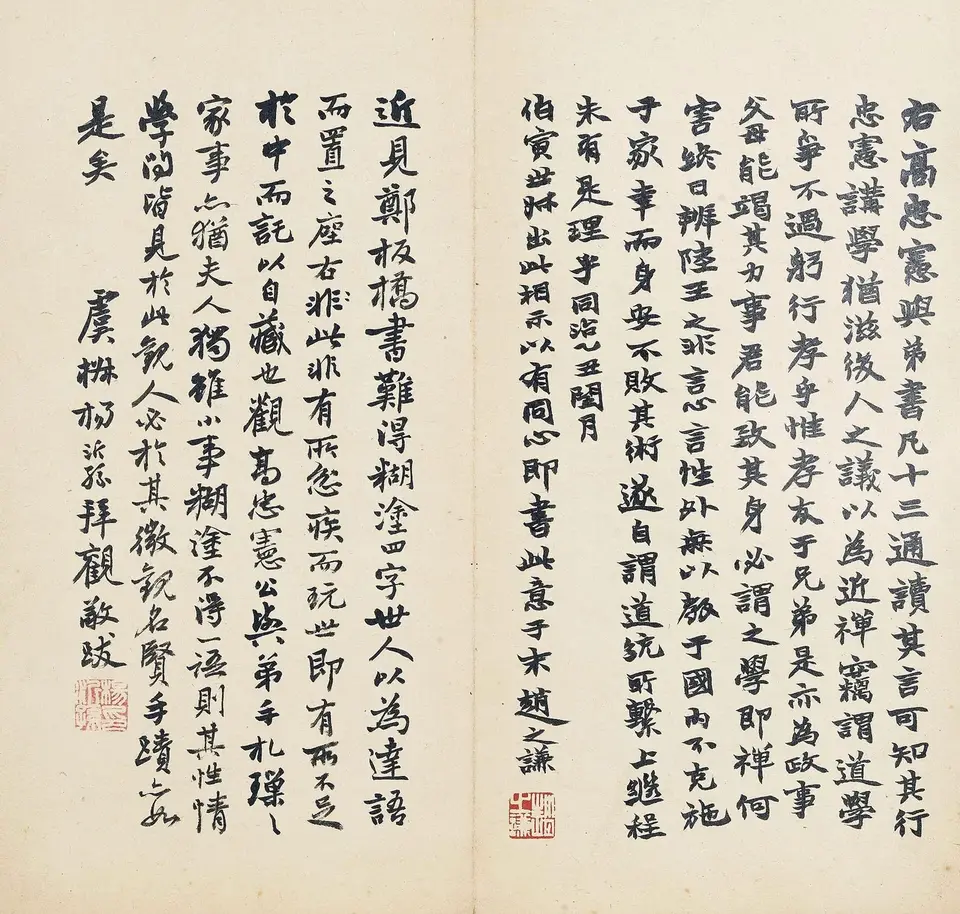
高攀龙
Gao Panlong (October 13, 1562 – April 17, 1626), courtesy name Cunzhi and literary name Jingyi, respectfully addressed by scholars as Master Jingyi, was a native of Wuxi County, Changzhou Prefecture, Zhili (present-day Wuxi, Jiangsu Province). He was an illustrious statesman, Neo-Confucian philosopher, and moral leader of the late Ming Dynasty, serving as a co-founder and central leader of the Donglin Academy alongside Gu…
Gao Panlong (October 13, 1562 – April 17, 1626), courtesy name Cunzhi and literary name Jingyi, respectfully addressed by scholars as Master Jingyi, was a native of Wuxi County, Changzhou Prefecture, Zhili (present-day Wuxi, Jiangsu Province). He was an illustrious statesman, Neo-Confucian philosopher, and moral leader of the late Ming Dynasty, serving as a co-founder and central leader of the Donglin Academy alongside Gu Xiancheng, celebrated collectively as 'Gao-Gu,' and later revered as one of the 'Seven Donglin Gentlemen.' In his youth, Gao Panlong studied under the renowned Neo-Confucian scholar Gu Xiancheng, passing the imperial examinations as a Jinshi in 1589 (17th year of the Wanli era) and being appointed Assistant Director in the Court of the Imperial Stud. In 1593, when Senior Grand Secretary Wang Xijue arbitrarily manipulated bureaucratic evaluations to expel upright officials, Gao Panlong courageously submitted the celebrated memorial Rectifying the Sovereign's Mind to Align Heavenly Governance, directly denouncing cabinet despotism and ministerial sycophancy. Enraged, the Wanli Emperor demoted Gao Panlong to police officer in remote Jieyang County, Guangdong. In Jieyang, Gao Panlong practiced quiet sitting and achieved a profound philosophical awakening regarding innate moral goodness, an event famous in Chinese philosophy as the 'Jieyang Enlightenment.' Shortly thereafter, he resigned his post and returned to Wuxi, where he collaborated with Gu Xiancheng to rebuild the historic Donglin Academy in 1604. For nearly thirty years, Gao Panlong presided over the Donglin scholarly assemblies, advocating practical statecraft, public virtue, and civic criticism of autocratic abuses. Following the accession of the Taichang and Tianqi emperors, Donglin scholar-officials were recalled to government service. Gao Panlong successively served as Assistant Minister of the Court of Imperial Entertainments, Vice Minister of Justice, and ultimately Left Censor-in-Chief in 1624, with the added honor of Grand Protector of the Crown Prince. In the Censorate, he rigorously purged corrupt officials and revitalized bureaucratic discipline, courageously supporting Yang Lian and Zuo Guangdou in their impeachment of the powerful eunuch dictator Wei Zhongxian. Facing intense retaliation from the eunuch faction, Gao Panlong resigned in late 1624. In the spring of 1626, Wei Zhongxian dispatched imperial secret police (Tiji) to arrest Gao Panlong. Rather than submitting to humiliating torture, Gao Panlong maintained ministerial dignity, composed a farewell memorial pledging loyalty to the dynasty, and drowned himself in a pond in his garden, aged sixty-three. Following the fall of the eunuch clique, Emperor Chongzhen rehabilitated Gao Panlong, posthumously conferring the title Minister of War and the posthumous name Zhongxian.
Born on October 13 into an honorable scholarly family in Wuxi County, Zhili.
Attained the Jinshi degree, initially appointed Messenger and later Court Assistant.
Submitted the memorial Rectifying the Sovereign's Mind, denouncing cabinet autocracy and flattery.
Demoted to police officer in Jieyang, Guangdong; achieved the famous 'Jieyang Enlightenment.'
Resigned his minor provincial office and returned to Wuxi, living in seclusion for nearly three decades.
Partnered with Gu Xiancheng to reconstruct the Donglin Academy, launching major academic conferences.
Following Gu Xiancheng's passing, assumed sole leadership over Donglin assemblies, guiding southern gentry.
Reappointed under Emperor Tianqi, serving as Vice Minister of the Court of Judicial Review and Justice.
Appointed Left Censor-in-Chief, restoring supervisory discipline and confronting Wei Zhongxian's clique.
Slandered by corrupt partisan Cui Chengxiu, surrendered his seals of office and returned to Wuxi in October.
Besieged by imperial secret police, composed his final testament and drowned himself in his pond on April 17.
Emperor Chongzhen vindicated Donglin martyrs, granting Gao Panlong the posthumous title Zhongxian.
Gao Panlong was born on October 13, 1562 (17th day of the 9th lunar month, 41st year of the Jiajing era) in Wuxi County, Changzhou Prefecture, into an esteemed lineage of scholar-officials. His great-grandfather Gao Biao had served as Vice Director in the Ministry of Justice, while his grandfather Gao Dehan was a dedicated classical scholar. From early childhood, Gao Panlong demonstrated intense intellectual focus and upright moral rectitude, vowing in his teenage years to pursue the moral perfection of classical sagehood rather than superficial worldly honors. In his youth, he became a devoted student of his fellow townsman Gu Xiancheng, mastering the moral philosophy of the Cheng brothers while discarding rhetorical frivolities in favor of authentic self-cultivation.
In 1589 (17th year of the Wanli era), Gao Panlong passed the imperial civil service examinations, earning the Jinshi degree. He was initially assigned as a Messenger in the Messenger Office, where he carried out official diplomatic and courier duties with impeccable incorruptibility, refusing to accept personal gifts or local perquisites. In 1591, he was promoted to Assistant Director in the Court of the Imperial Stud. Observing the Wanli Emperor's growing neglect of governance and the arbitrary manipulation of imperial edicts by grand councilors Shen Shixing and Wang Xijue, Gao Panlong grew profoundly alarmed by the erosion of administrative integrity, resolving to defend the public interest at all costs.
In the spring of 1593, during the triennial metropolitan evaluation (Jingcha), Vice Minister of Personnel Zhao Nanxing systematically demoted incompetent, sycophantic, and corrupt officials. Aggrieved courtiers appealed to Senior Grand Secretary Wang Xijue, who prevailed upon the Wanli Emperor to overturn the evaluations and dismiss Zhao Nanxing. Outraged by this subversion of institutional procedure, the thirty-two-year-old Gao Panlong submitted his famous memorial Rectifying the Sovereign's Mind to Align Heavenly Governance. In trenchant language, Gao Panlong declared that the senior ministers substituted personal favoritism for imperial justice, warning the throne that if the sovereign failed to rectify his own mind and heed righteous remonstrance, the dynasty would succumb to irreversible decay.
Gao Panlong's courageous memorial infuriated Wang Xijue and provoked the Wanli Emperor, who summarily demoted him several ranks to serve as a lowly police officer (Dianshi) in Jieyang County, Chaozhou Prefecture, Guangdong. Far from despairing at this remote banishment to a malarial frontier infested with pirates, Gao Panlong departed Lin'an in the spring of 1594 with serene composure. In Jieyang, he assisted the county magistrate in pacifying refugees, repairing defensive fortifications, and establishing rural schools. During moments of leisure, he practiced quiet meditation. One evening, during deep contemplation in a riverside lodge, Gao Panlong experienced a profound spiritual awakening, perceiving that the transcendent moral principle of Heaven was fully present and active within the self. This transformative experience, celebrated in Neo-Confucian history as the 'Jieyang Enlightenment,' provided the bedrock of his lifelong psychological fortitude.
In 1595, disgusted by the venality of the bureaucracy, Gao Panlong resigned his post in Jieyang and returned to Wuxi. For the next twenty-six years, he declined all official solicitations, building a simple waterside retreat which he named Jingyi ('Serene Recluse') and dedicating himself to philosophical writing. In Wuxi, he reconnected with Gu Xiancheng, Qian Yiben, and An Xifan. Mourning the moral collapse of court governance, they resolved to restore the ancient academy where Song philosopher Yang Shi (Master Guishan) had once taught.
Supported by local magistrates and gentry patrons, the reconstructed Donglin Academy opened in 1604. Gu Xiancheng and Gao Panlong drafted the academy covenants, famously declaring: 'The sound of wind, the sound of rain, the sound of reading books—every sound enters the ear; the affairs of the family, the affairs of the state, the affairs of the world—every affair concerns the heart.' The academy held biannual general assemblies and monthly seminars, attracting thousands of scholars from across the empire. The lecturers promoted rigorous self-cultivation alongside fearless public commentary on court policy, fiscal abuses, and eunuch mining commissions. Following Gu Xiancheng's death in 1612, Gao Panlong shouldered sole directorship of the academy for over a decade, functioning as the moral compass of the late Ming reformist gentry.
Following the passing of the Wanli Emperor and the brief reign of Emperor Taichang, the young Emperor Tianqi ascended the throne in 1620, issuing sweeping edicts recalling dismissed reformist scholars to stabilize the empire. In 1621, the fifty-nine-year-old Gao Panlong was summoned to the capital as Assistant Minister of the Court of Imperial Entertainments. In the wake of the catastrophic Battle of Sarhu and the loss of Liaodong to Nurhaci's Later Jin armies, Gao Panlong submitted practical defense memorials, earning successive promotions to Vice Minister of the Court of Judicial Review and Right Vice Minister of Justice.
In the summer of 1624, Gao Panlong was appointed Left Censor-in-Chief of the Censorate, with the added rank of Grand Protector of the Crown Prince. As head of the empire's supreme investigatory organ, Gao Panlong acted swiftly to restore ethical standards among the circuit censors and supervising secretaries, admonishing them that censorial offices existed to preserve public justice rather than curry favor with court factions. He instituted rigorous merit audits, eliminating bribery and impeaching dozens of venal magistrates, briefly restoring feared authority to the central supervisory apparatus.
By mid-1624, however, the imperial court was falling under the despotic grip of the eunuch dictator Wei Zhongxian. Colluding with the emperor's wet nurse Madame Ke, Wei Zhongxian built a ruthless political machine known as the Eunuch Faction (Dang), backed by opportunistic outer-court allies led by Cui Chengxiu. In June 1624, Deputy Censor-in-Chief Yang Lian bravely submitted his monumental memorial impeaching Wei Zhongxian for twenty-four capital crimes, backed by Assistant Censor-in-Chief Zuo Guangdou. Gao Panlong threw his full authority behind Yang Lian and Zuo Guangdou, openly confronting the eunuch cabal.
Cui Chengxiu, who had accumulated vast illicit fortunes through extortion while serving as Grand Coordinator of Huaiyang, was formally impeached by regional censors. Terrified of prosecution, Cui Chengxiu visited Gao Panlong's private residence at night with heavy bribes, kneeling in tears to beg for mercy. Gao Panlong indignantly ejected him, declaring: 'The Censorate is the sacred sanctuary of dynastic law; how dare you attempt bribery! Begone!' Gao Panlong immediately recommended Cui Chengxiu's dismissal. Driven by revenge, Cui Chengxiu became Wei Zhongxian's foremost executioner, orchestrating smear campaigns that accused Gao Panlong of factional nepotism. Recognizing that the court was beyond salvation, Gao Panlong surrendered his seals of office in October 1624 and retired to Wuxi.
Following Gao Panlong's departure, Wei Zhongxian unleashed a reign of terror against the Donglin movement. In 1625, Wei forged imperial decrees arresting the 'Six Donglin Gentlemen'—Yang Lian, Zuo Guangdou, Yuan Huazhong, Zhou Chaorui, Wei Dazhong, and Gu Dazhang—torturing them to death in the Embroidered Uniform Guard prisons. In the spring of 1626, fabricating fraudulent bribery confessions through the Wang Wenyan trial, the eunuch clique issued arrest warrants for senior leaders including Gao Panlong, Zhou Qiyuan, and Zhou Shunchang, dispatching imperial secret police (Tiji) to execute their arrests.
On the night of April 17, 1626 (21st day of the 3rd lunar month, 6th year of the Tianqi era), dozens of armed secret police arrived in Wuxi and violently surrounded Gao Panlong's mansion. Remaining completely calm, Gao Panlong ordered his servants to serve refreshments to the officers while he retreated to his chambers to bathe and don ceremonial robes. In his study, he drafted his final memorial to the throne, stating: 'Although humble, your servant held the rank of senior minister. An imperial minister cannot submit to the indignity of arrest by secret police slaves. My sovereign has been dishonored; my duty is to die!' Stepping calmly into his garden, Gao Panlong drowned himself in his lotus pond, aged sixty-three.
In August 1628, Emperor Chongzhen ascended the throne and crushed the eunuch faction, rehabilitating the Donglin martyrs. Gao Panlong was posthumously awarded the title Minister of War, granted state funeral honors, and given the posthumous name Zhongxian ('Loyal and Exemplary').
Gao Panlong was the spiritual and intellectual anchor of the Donglin school during its most turbulent period. In the late Wanli era, Ming governance was crippled by imperial absenteeism, abusive eunuch mining commissions, and military collapse on the northeastern frontier. While many intellectuals retreated into Chan Buddhist quietism or frivolous literary games, Gao Panlong collaborated with Gu Xiancheng to resurrect the Donglin Academy, establishing a powerful intellectual movement that reunited philosophical ethics with active civic responsibility.
At the academy, Gao Panlong taught that self-cultivation was meaningless if detached from the moral duty to serve society (Jingshi Zhiyong). He required scholars to study agrarian taxation, water management, military logistics, and frontier defense, transforming the academy into a formidable platform for independent political critique. Under his leadership, the Donglin movement galvanized public opinion, establishing an enduring legacy of principled dissent and civic courage in premodern Chinese history.
Gao Panlong made an original and influential contribution to late Ming Neo-Confucian philosophy through his practice of quiet meditation (Jingzuo). Banished to the remote frontier of Jieyang in 1594, he engaged in intensive self-examination, discovering that mental tranquility dissolved petty desires, allowing the pure moral principle of Heaven to emerge naturally within consciousness.
In foundational treatises such as On Quiet Sitting (Jingzuo Shuo) and Investigation of the Great Learning (Daxue Sanyi), Gao Panlong distinguished his practice from Buddhist Chan meditation. He argued that quiet sitting was not an escape from worldly reality, but a method to purify the mind so that one could act decisively and justly in public affairs. This synthesis of contemplative serenity and heroic social action was celebrated by Huang Zongxi in Ming Confucian Records (Mingru Xue'an) as the premier philosophical achievement of the Donglin tradition.
During his tenure as Left Censor-in-Chief in 1624, Gao Panlong directed the central supervisory organs with fearless rectitude. He confronted the endemic bribery and factional sycophancy that had paralyzed the Censorate, enforcing strict auditing procedures and forbidding censors from extracting extortionate gifts from provincial prefectures.
His unyielding refusal to shelter the corrupt Grand Coordinator Cui Chengxiu demonstrated his commitment to institutional justice. Under his rigorous leadership, honest officials found firm institutional backing, and corrupt courtiers were held accountable, briefly restoring moral dignity to the imperial bureaucracy during an era of profound institutional decay.
Gao Panlong's heroic death in 1626 represents one of the most sublime examples of moral martyrdom in Chinese history. When Wei Zhongxian's secret police surrounded his ancestral home, Gao Panlong refused to allow an imperial minister to be degraded, chained, and tortured by corrupt eunuch underlings. His suicide was not an act of despair, but a calculated defense of ministerial dignity and constitutional principle.
His parting declaration—'An imperial minister cannot submit to the indignity of arrest by secret police slaves'—served as a rallying cry for the moral resistance of the Jiangnan gentry. His martyrdom ignited massive popular protests in Suzhou and Wuxi, directly inspiring commoner resistance against secret police tyranny and etching his name alongside ancient martyrs Qu Yuan and Wen Tianxiang.
Gao Panlong was a prolific author whose scholarly output encompassed classical exegesis, political essays, and metaphysical inquiries. His major works include Posthumous Works of Master Gao (Gaozi Yishu), Simple Explanations of the Book of Changes (Zhouyi Yijian Shuo), Delineation of Master Kong's Spring and Autumn Annals (Chunqiu Kongshi Bian), and Expositions on the Great Learning (Daxue Sanyi).
His prose was celebrated for its austere clarity, solemn dignity, and passionate civic concern, eschewing the ornate mannerisms of contemporary literary cliques. His academy covenants and administrative records became primary sources for understanding late Ming intellectual networks and public discourse, preserved across subsequent dynasties and collected into the Siku Quanshu during the Qing Dynasty.
In the History of Ming (Ming Shi), biographers praised him: "Gao Panlong was pure, profound, and steadfast, with an integrity entirely rooted in righteousness. From youth he aspired to sagehood, and through trials and perils his spirit grew ever firmer. At court he defended great principles; in his village he preserved moral order. When engulfed by the catastrophe of the eunuchs, he embraced death with serene composure, looking upon demise as returning home. In his heroic virtue, how could even the most celebrated loyalists of antiquity surpass him!"
In the rehabilitation edict of 1628, Emperor Chongzhen declared: "The late Left Censor-in-Chief Gao Panlong stood firm as an unyielding pillar amidst collapsing waves. His memorials confronting treason possessed righteousness that shook like thunder; his steadfast martyrdom shone with sincerity brighter than the sun and moon. We bestow the posthumous name Zhongxian and confer the title Minister of War to illuminate righteous governance."
The philosopher Huang Zongxi concluded in Ming Confucian Records (Mingru Xue'an): "Master Gao's learning was grounded in quiet sitting and fulfilled in moral principle. Following his enlightenment in Jieyang, his mind was clear as an autumn moon in an ice flask, moving and resting in perfect harmony with natural order. Leading the Donglin movement, he stood as an immovable pillar in midstream. When he met death with serene dignity, drowning himself in the pure pond, his magnificent spirit inherited the heroism of Zhou Dunyi and Wen Tianxiang—truly a monumental titan of our culture!"
Modern historians honor Gao Panlong as the finest embodiment of late imperial Chinese scholar-official ethics. Combining philosophical profundity with courageous public service, he demonstrated the ultimate power of moral conviction in resisting totalitarian terror, providing an enduring symbol of intellectual integrity and civic sacrifice.
FIGURES ASSOCIATED WITH THIS DYNASTY