Birth in Europe
Born on March 3 into a Catholic family in Douai, Flanders.
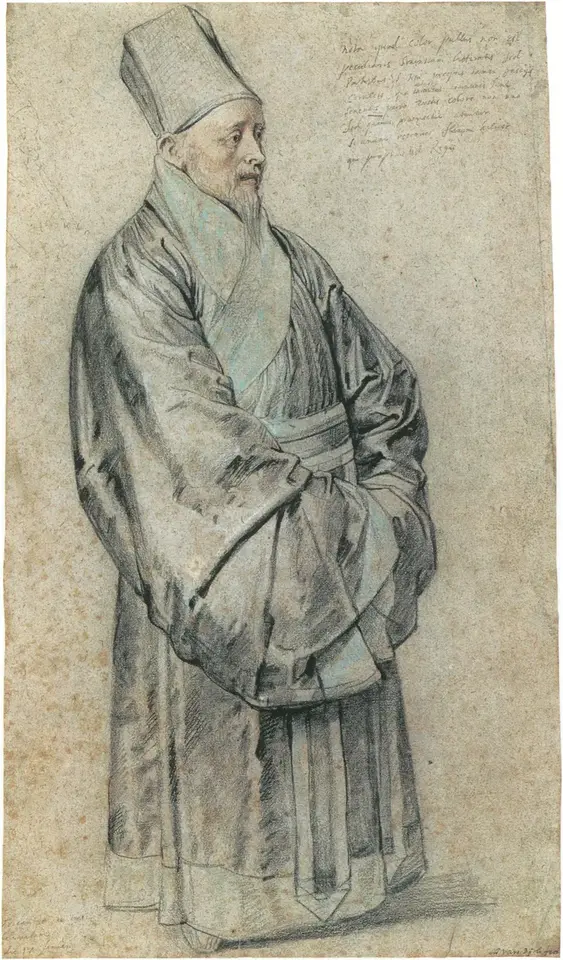
金尼阁
Nicolas Trigault (March 3, 1577 – November 14, 1628), known in Chinese as Jin Nige and courtesy name Sibiao, was born in Douai in Spanish Netherlands (later part of France). A prominent Jesuit missionary, Sinologist, and linguist during the late Ming dynasty, he joined the Society of Jesus in 1594 and reached Macao in the autumn of 1610. The following year, he traveled to Nanjing to begin his missionary work, studying Chinese…
Nicolas Trigault (March 3, 1577 – November 14, 1628), known in Chinese as Jin Nige and courtesy name Sibiao, was born in Douai in Spanish Netherlands (later part of France). A prominent Jesuit missionary, Sinologist, and linguist during the late Ming dynasty, he joined the Society of Jesus in 1594 and reached Macao in the autumn of 1610. The following year, he traveled to Nanjing to begin his missionary work, studying Chinese language and Confucian classics alongside Lazzaro Cattaneo and Alfonso Vagnoni, subsequently journeying to Hangzhou with Li Zhizao to open a mission and guiding eminent scholar Yang Tingyun to baptism. In 1613, dispatched by mission superior Niccolò Longobardo, Trigault returned to Rome to report to Pope Paul V, securing papal authorization for Chinese clergy to conduct the Catholic liturgy in Chinese and translate the Holy Scriptures into Chinese. While in Europe, he translated and compiled Matteo Ricci's journals into the monumental Latin work De Christiana expeditione apud Sinas (China in the Sixteenth Century: The Journals of Matthew Ricci), igniting an intellectual craze for China across Europe. In 1618, Trigault departed Europe leading outstanding missionaries including Johann Adam Schall von Bell, Johann Schreck (Terrenz), and Giacomo Rho, carrying over seven thousand European scientific and humanistic volumes (historically celebrated as the "7,000 Western Books"). During the Tianqi reign, assisted by Chinese Christian scholar Wang Zheng, he compiled the three-volume Xiru Ermu Zi in 1626, pioneering the systematic transcription of Chinese characters using the Latin alphabet and standing as the founding father of Chinese Romanized pinyin schemes. In 1628, he passed away from illness in Hangzhou and was interred in the Dafangjing Catholic cemetery.
Born on March 3 into a Catholic family in Douai, Flanders.
Formally entered the Society of Jesus, receiving rigorous training in theology, humanities, and classical languages.
Completed theological studies, ordained a priest, and departed Lisbon by ship for missionary work in the Far East.
Arrived in Macao via Goa, commencing systematic studies of Chinese spoken language, writing, and societal customs.
Accompanied Li Zhizao from Nanjing to Hangzhou to open a mission, facilitating Yang Tingyun's baptism into the Catholic Church.
Dispatched back to Europe by Longobardo to report on the China mission, recruit scholars, and collect Western books.
Published the Latin edition of Ricci's journals in Augsburg, creating an intellectual sensation throughout Europe.
Departed Lisbon leading over twenty Jesuits including Schall von Bell and Schreck, carrying 7,000 Western books and scientific instruments.
Reached Nanjing and Beijing, traveling to Nanchang, Kaifeng, and Jiangzhou in Shanxi to preach.
Collaborated with scholar Wang Zheng in Xi'an, completing the pioneering three-volume Romanization work Xiru Ermu Zi.
Passed away from illness while writing in Hangzhou on November 14 at fifty-two, buried in Dafangjing cemetery.
Nicolas Trigault was born on March 3, 1577, in Douai in the Flanders region of the Spanish Netherlands. Displaying remarkable linguistic talent and religious zeal in his youth, he formally entered the Society of Jesus at Tournai in November 1594 at seventeen. He spent thirteen years at the universities of Douai and Leuven undergoing rigorous scholastic philosophy, theology, Latin, Greek, and natural science education. Ordained a priest in 1607 upon completing his theological training, Trigault resolved to preach in the Far East. Embarking from Lisbon, he sailed past the Cape of Good Hope and crossed the Indian Ocean, reaching Macao in the autumn of 1610, just as Matteo Ricci passed away in Beijing.
After studying basic spoken Chinese and ritual etiquette in Macao, Trigault journeyed to the auxiliary capital Nanjing in early 1611, studying Chinese language and culture under Lazzaro Cattaneo and Alfonso Vagnoni. At that time, Li Zhizao, Vice Minister of the Court of the Imperial Stud, was serving in Nanjing and formed a close friendship with Trigault. In April 1611, when Li took leave to return to Hangzhou for his father's funeral, he invited Cattaneo, Trigault, and Chinese novice Zhong Mingren to establish a mission in Hangzhou with Longobardo's approval. On May 8, 1611, Trigault celebrated Hangzhou's first Catholic Mass at Li's residence near Lingyin Temple. He then took up residence at the estate of prominent scholar Yang Tingyun; initially a devout Buddhist, Yang engaged in extensive theological debates with Trigault and was baptized the following month, becoming one of the celebrated "Three Pillars of Chinese Catholicism."
With the mission expanding rapidly across China, Longobardo chose to dispatch an erudite and energetic emissary to the Papal Curia in Rome to present an exhaustive report on Chinese missionary policy and resolve critical administrative obstacles. Entrusted with this mission due to his diplomatic skill, Trigault sailed west from Macao in February 1613. During the long, perilous voyage, Trigault worked on Ricci's Italian journals, translating and polishing them into elegant Latin while incorporating his own firsthand observations of Chinese politics, geography, imperial examinations, Confucian ethics, and customs.
In 1615, Trigault arrived in Rome and received a solemn audience with Pope Paul V. Dressed in the silk robes of a Confucian literatus, Trigault addressed the Pope and Cardinals, expounding on China's deep civilization and urging the Holy See to accommodate Chinese realities. Pope Paul V issued a papal decree granting permission for Chinese priests to celebrate the Mass and sacraments in Chinese, recite the Divine Office in Chinese, and translate the complete Bible into Chinese, representing an unprecedented breakthrough in Catholic history. That same year, Trigault published De Christiana expeditione apud Sinas (The Christian Expedition to China, or Ricci's China Journals) in Augsburg. The work caused a sensation across European intellectual circles, swiftly translated into French, German, Spanish, Italian, and English, becoming the most authoritative seventeenth-century European text introducing Chinese civilization.
Another core mission of Trigault's journey to Europe was recruiting specialized scholars and raising funds and scientific libraries across European cultural capitals to establish a grand modern library in Beijing. Sponsored by Pope Paul V and Duke Maximilian I of Bavaria, Trigault visited Italy, France, Germany, the Low Countries, Spain, and Portugal, purchasing and receiving donations of over 7,000 finely bound European classical works valued at over 10,000 gold coins. The collection spanned ancient Greek and Roman classics to Renaissance astronomy, mathematics, mechanics, geography, medicine, philosophy, theology, and the arts, including epochal scientific masterworks such as Copernicus's De revolutionibus orbium coelestium and Kepler's Epitome Astronomiae Copernicanae.
Simultaneously, Trigault recruited twenty-two brilliant young Jesuits, including Johann Schreck (Terrenz), Giacomo Rho, Johann Adam Schall von Bell, and François Furtado. In April 1618, Trigault led this grand expedition from Lisbon carrying the 7,000 Western books and precision instruments. The voyage was grueling; epidemics struck the fleet, claiming the lives of several Jesuits, including Trigault's younger brother. In July 1619, the surviving expedition reached Macao. Chinese historian Xiang Da likened this achievement to Xuanzang retrieving Buddhist sutras from India, infusing China's scientific history with a fountainhead of modern Western knowledge.
In the spring of 1620, Trigault transported the library inland to Nanjing, Hangzhou, and Beijing. Amid political volatility, the 7,000 books were stored temporarily in Nanchang, Hangzhou, and Beijing. Recognizing that no single person could translate such a vast collection, Trigault formulated translation projects with Chinese scholars such as Xu Guangqi, Li Zhizao, Yang Tingyun, and Wang Zheng, while traveling to establish new dioceses. In 1621 he inspected Jiangxi and Guangdong; in 1623 he preached in Kaifeng, Henan; in 1624 he traveled to Jiangzhou in Shanxi, building Shanxi's first Catholic church.
In 1625, transferred to Xi'an, Shaanxi, Trigault met mechanical scholar Wang Zheng. Observing the difficulties Western missionaries faced in learning Chinese characters and the obstacles Chinese characters encountered in phonological communication due to the absence of an alphabet, Trigault collaborated with Wang Zheng and Han Yun to formalize Ricci's earlier romanization ideas. After months of intensive work, Trigault completed the landmark linguistic work Xiru Ermu Zi in three volumes in 1626, using twenty-five Latin letters and five tone marks to construct a comprehensive Romanization scheme for all Chinese characters.
In 1627, Trigault returned to Hangzhou to focus on writing and woodblock printing. He worked on translating the Chinese Five Classics into Latin and collaborated with Chinese scholar Zhang Geng to translate selections from Aesop's Fables into Chinese as Kuangyi, introducing Aesop to China. Exhausted by decades of travels and writing, Trigault passed away in Hangzhou on November 14, 1628, at fifty-two. He was interred in the Dafangjing cemetery beneath Taoyuan Ridge in Hangzhou's western suburbs. Though his early death prevented the full translation of the 7,000 Western books, they served as an indispensable intellectual reservoir for Xu Guangqi's Chongzhen Lishu and the broader transmission of Western learning to China.
One of Trigault's paramount contributions to Sino-Western cultural exchange was translating and publishing De Christiana expeditione apud Sinas (The Journals of Matteo Ricci). Ricci had kept detailed diaries in Italian that remained unedited at his death. During his return to Europe, Trigault translated these manuscripts into scholarly Latin, expanding them with his own decade of travels to provide detailed accounts of the Ming administrative apparatus, scholar-bureaucracy, civil examinations, Confucian classics, social etiquette, and geographic landscape. Published in Augsburg in 1615, the work sparked intense European respect for Chinese civilization, directly stimulating modern European Sinology and establishing the baseline image of China in the Western imagination.
Over several years across Western European cities, Trigault assembled and brought to China the famous "7,000 Western Books" alongside astronomical and mathematical instruments. Representing a comprehensive miniature of contemporary European academic libraries, the collection encompassed scholastic philosophy by Thomas Aquinas, Copernicus's De revolutionibus, Kepler's astronomical tables, Euclid's Elements, and cutting-edge works in anatomy, mechanics, and hydraulics. Trigault also brought top scholars like Schall von Bell, Schreck, and Rho, providing the core textual foundation when Xu Guangqi directed the compilation of the Chongzhen Lishu and when Li Zhizao and Wang Zheng translated Western scientific works, celebrated as the most magnificent book importation in late Ming history.
In 1626, working in Xi'an with Chinese scholar Wang Zheng, Trigault published the phonological masterwork Xiru Ermu Zi in three volumes (Volume 1: Key to Translation, Volume 2: Rhyme Tables, Volume 3: Character Tables). Building upon initial schemes by Ricci and Cattaneo, Trigault applied Western phonetic theory to deconstruct traditional Chinese fanqie spelling, creating a Latinized pinyin system combining twenty-five Latin letters with five tone diacritics. The work established clear rules for spelling Chinese syllables with alphabetic letters, providing Western missionaries with an efficient tool for learning Chinese while standing as the first systematic Latin alphabet phonetic scheme in Chinese phonological history, offering pioneering inspiration for late Qing spelling reforms and modern Hanyu Pinyin.
FIGURES ASSOCIATED WITH THIS DYNASTY