Birth into a Scholarly Household
Born on February 23 in Chakeng Village, Xinhui County, displaying precocious intellect in classical learning.
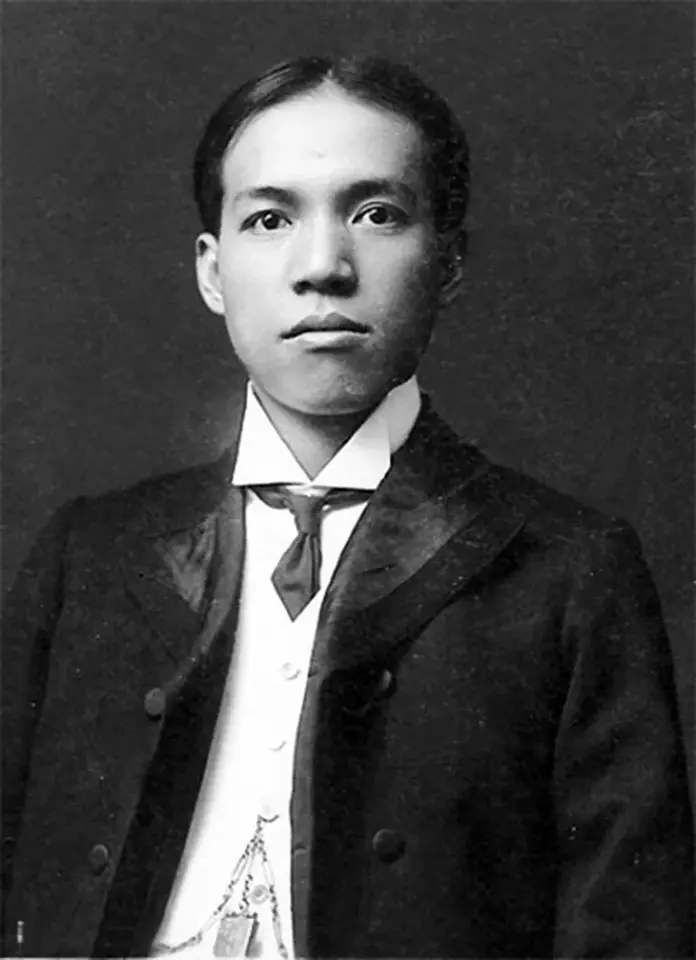
梁启超
Liang Qichao (梁启超; February 23, 1873 – January 19, 1929), courtesy name Zhuoru and art name Rengong (also known as the Master of the Ice-Drinker's Studio), was a native of Chakeng Village, Xinhui County, Guangdong Province. He was one of the paramount intellectual architects, statesmen, educational pioneers, historians, and literary giants of modern China, revered as the intellectual powerhouse of the 1898 Hundred Days'…
Liang Qichao (梁启超; February 23, 1873 – January 19, 1929), courtesy name Zhuoru and art name Rengong (also known as the Master of the Ice-Drinker's Studio), was a native of Chakeng Village, Xinhui County, Guangdong Province. He was one of the paramount intellectual architects, statesmen, educational pioneers, historians, and literary giants of modern China, revered as the intellectual powerhouse of the 1898 Hundred Days' Reform and celebrated as the foremost public intellectual of early twentieth-century China. Exhibiting prodigious intellect in youth, Liang obtained the provincial graduate degree at age sixteen before becoming the foremost disciple of Kang Youwei at the Wanmu Caotang Academy. Following the catastrophe of the First Sino-Japanese War, he co-initiated the "Gongche Memorial" and directed seminal organs including Chinese and Foreign News and The Chinese Progress (Shiwu Bao), where he published the epochal treatise General Discussion on Reform (Bianfa Tongyi). During the Hundred Days' Reform, he managed the Imperial Translation Bureau before fleeing into Japanese exile following the conservative coup. Over fourteen years abroad, Liang published The China Discussion (Qingyi Bao) and the New Citizen Journal (Xinmin Congbao), serializing On the New Citizen (Xinmin Shuo), pioneering the "New Prose Style" (xinmin ti), translating Western enlightenment philosophy, and launching the modern Fiction Revolution. Upon returning to Republican China, Liang championed constitutional democracy and rule of law, serving as Minister of Justice and Minister of Finance. Confronting Yuan Shikai's imperial restoration, he published Strange Indeed, the So-Called Question of State System (Yi Zai Suowei Guoti Wenti Zhe) and orchestrated the National Protection War to preserve the Republic. In his later years, he withdrew from politics to spearhead modern higher education, lecturing at Tsinghua University's Academy of Chinese Learning alongside Wang Guowei, Chen Yinke, and Zhao Yuanren. His vast intellectual corpus, collected in the fourteen-million-word Collected Works from the Ice-Drinker's Studio (Yinbingshi Heji), permanently transformed modern Chinese civic consciousness, historiography, and language.
Born on February 23 in Chakeng Village, Xinhui County, displaying precocious intellect in classical learning.
Passed the Guangdong provincial examination as the eighth-ranked juren; Chief Examiner Li Duanfen betrothed his cousin Li Huixian to him.
Enrolled at the Wanmu Caotang in Guangzhou to study under Kang Youwei, embracing Western thought and institutional reform.
Following the defeat against Japan, rallied civil examination candidates in Beijing; established the Society for the Study of Self-Strengthening and Chinese and Foreign News.
Assumed the editorship of The Chinese Progress in Shanghai, serializing General Discussion on Reform to national acclaim.
Appointed Chief Chinese Instructor at the School of Current Affairs in Changsha, instructing future leaders such as Cai E.
Appointed to manage the Imperial Translation Bureau; fled to Japan on a Japanese warship following the Wuxu Coup.
Published On the New Citizen and The New Historiography in the New Citizen Journal (Xinmin Congbao), remodeling modern civic identity.
Organized the Progressive Party in Parliament and served as Minister of Justice in Xiong Xiling's Cabinet, championing judicial independence.
Published Strange Indeed, the So-Called Question of State System and secretly mobilized the National Protection War alongside Cai E.
Traveled through post-war Europe to observe the Paris Peace Conference, recording his reflections in Record of Travel Impressions in Europe.
Appointed one of the Four Great Tutors at the Tsinghua Academy of Chinese Learning, training a generation of modern historians.
Passed away on January 19 at the age of fifty-five; interred near the Wofo Temple in Beijing's Western Hills.
Liang Qichao was born on February 23, 1873, in Chakeng Village, Xinhui County, Guangzhou Prefecture, Guangdong. His grandfather Liang Weiqing was a holder of the licentiate degree who oversaw his earliest moral education, while his father Liang Baoying conducted a private village academy. Endowed with extraordinary mental faculties, Liang began reciting Confucian canons at age four, composed cohesive classical essays at age eight, and passed the county examination to become a licentiate (xiucai) at twelve, earning widespread acclaim as a child prodigy.
In 1889, at the youthful age of sixteen, Liang passed the provincial civil examination in Guangzhou, achieving the rank of eighth provincial graduate (juren). The presiding imperial examiner, Li Duanfen (Senior Vice Minister of Rites), was so captivated by the youth's dazzling literary power and clear intellectual logic that he arranged for Liang to marry his cousin, Li Huixian. Li Duanfen remained a dedicated political patron who later introduced Liang into the highest councils of the imperial court.
In the spring of 1890, having failed his first attempt at the metropolitan examination in Beijing, Liang acquired Xu Jiyu's landmark geographical treatise Brief Records of the World (Ying Huan Zhi Lüe) in Shanghai, awakening to global geopolitics and the rise of Western nations. Later that autumn, he was introduced to Kang Youwei in Guangzhou. Kang challenged traditional imperial scholasticism through Gongyang evolutionary philosophy and universalist ethics, dismantling Liang's conventional prejudices. Renouncing his pride as an imperial graduate, Liang formally became Kang's disciple at the Wanmu Caotang. There, he voraciously absorbed pre-Qin philosophies, Neo-Confucian statecraft, and Western sciences, assisting Kang in compiling A Study of the Forged Classics of the Xin Period (Xin Xue Wei Jing Kao) and A Study of Confucius as a Reformer of Institutions (Kongzi Gaizhi Kao).
In spring 1895, Liang joined Kang Youwei in Beijing for the metropolitan examination just as the Treaty of Shimonoseki ceded Taiwan and imposed staggering indemnities. Outraged by dynastic submission, Liang mobilized examinees from eighteen provinces, assisting Kang in drafting an eighteen-thousand-character petition demanding institutional reform, capital relocation, and modernized military resistance. Over 1,300 scholars signed the historic "Gongche Memorial" in Beijing, shattering ancestral prohibitions against gentry political participation.
Following the petition, Liang remained in the imperial capital to assist Kang in founding Review of the Times (1895 reformist Wanguo Gongbao), later reconstituted as Chinese and Foreign News (Zhongwai Jiwen), while organizing the Society for the Study of Self-Strengthening (Qiangxuehui). When conservative ministers suppressed the society, Liang relocated southward to Shanghai under Li Duanfen's protection.
In August 1896, Liang launched The Chinese Progress (Shiwu Bao) in Shanghai as chief editorial director. There he serialized his monumental political manifesto, General Discussion on Reform (Bianfa Tongyi). Writing with electrifying vigor, Liang declared that change is the universal law governing all human society, advocating the abolition of civil examination essays, the establishment of constitutional institutions, and the nationwide adoption of modern sciences. Circulation quickly exceeded ten thousand copies across China and Southeast Asia, transforming Liang into the foremost publicist of Chinese institutional modernization.
In autumn 1897, Governor Chen Baozhen and Judicial Commissioner Huang Zunxian recruited Liang to direct the School of Current Affairs (Shiwu Xuetang) in Changsha. Partnering with Tan Sitong and Tang Caichang, Liang restructured the curriculum. Alongside classical exegesis, he introduced students to the political philosophies of Jean-Jacques Rousseau and Montesquieu, directing fiery critiques against monarchical despotism. The school trained legendary figures such as Cai E, but conservative gentry led by Wang Xianqian launched hostile campaigns accusing Liang of heresy, forcing him to return to Shanghai in early 1898.
On June 11, 1898, the Guangxu Emperor issued the imperial decree initiating the Hundred Days' Reform. On July 3, the emperor granted Liang an imperial audience in the Summer Palace. Impressed by his strategic analysis, Guangxu conferred upon him the Sixth Rank and appointed him director of the newly established Imperial Translation Bureau, tasked with translating Western treatises on law, administration, and science. Throughout that turbulent summer, Liang labored tirelessly, drafting reform memorials advocating the establishment of the Imperial University of Peking and the eradication of sinecures.
On September 21, 1898, Empress Dowager Cixi launched a reactionary coup d'etat, imprisoning the Guangxu Emperor and ordering the execution of the reformist leaders. Guided by Japanese diplomats Hayashi Gonsuke and Mori Ohachi, Liang sought temporary refuge inside the Japanese Legation in Beijing before being escorted to Tanggu, where he boarded the Japanese warship Oshima to escape to Tokyo.
In Japanese exile, Liang refused to succumb to despair. Benefiting from Japan's flourishing publishing industry, he established The China Discussion (Qingyi Bao) in Yokohama in late 1898, followed in 1902 by the seminal New Citizen Journal (Xinmin Congbao). Rapidly learning to read Japanese, he immersed himself in translated European scholarship, devouring the works of Immanuel Kant, G.W.F. Hegel, Jeremy Bentham, Adam Smith, Montesquieu, and Herbert Spencer.
In the New Citizen Journal (Xinmin Congbao), Liang serialized On the New Citizen (Xinmin Shuo), arguing that the transformation of the populace into self-governing modern citizens was the paramount prerequisite for national sovereignty. His passionate, lucid prose forged the "New Prose Style" (xinmin ti), which captivated an entire generation of Chinese youth. Between 1899 and 1902, Liang engaged in extensive dialogues with Sun Yat-sen regarding anti-Qing collaboration, but Kang Youwei's stern intervention and Liang's own preference for evolutionary stability ultimately kept him committed to constitutional monarchy.
In 1905, the revolutionary Chinese Tongmenghui was established in Tokyo, launching Min Bao (People's Journal). Over the following two years, a fierce theoretical polemic erupted between Min Bao (People's Journal) (represented by Wang Jingwei, Hu Hanmin, and Zhang Taiyan) and Liang's New Citizen Journal (Xinmin Congbao). The debate centered on whether violent revolution or constitutional reform was appropriate for China.
Liang advocated "enlightened absolutism" leading toward gradual constitutionalism. He cautioned that a violent racial revolution in an empire lacking democratic experience would invite regional warlordism and imperialist intervention. While the revolutionary tide ultimately overtook his position, Liang's exhaustive political treatises popularized the fundamentals of representative governance, constitutionalism, and civil liberties across China.
Concurrently, as Beijing announced preparations for constitutional rule, Liang secretly organized the Political Information Society (Zhengwenshe), orchestrating three massive nationwide petition movements demanding the immediate convocation of a national parliament. He drafted constitutional models and administrative charters that directly shaped the newly established provincial assemblies.
Following the 1911 Xinhai Revolution, Liang returned to China in November 1912 after fourteen years of exile, receiving a triumphant welcome. Reorganizing constitutional factions into the Progressive Party (Jinbudang), he served as Minister of Justice in Xiong Xiling's Cabinet in 1913, striving to establish judicial independence and codified modern procedure. Disillusioned by President Yuan Shikai's despotic maneuvers, he resigned in early 1914.
In summer 1915, when Yuan Shikai orchestrated a monarchical campaign to declare himself emperor, Liang rejected lavish bribes and death threats, publishing the celebrated manifesto Strange Indeed, the So-Called Question of State System. The essay systematically demolished Yuan's monarchical pretensions, galvanizing national resistance.
Concurrently, Liang orchestrated the armed insurrection. He coordinated the covert escape of his disciple General Cai E from Beijing to Yunnan. In December 1915, Cai E proclaimed Yunnan's independence, initiating the National Protection War. Disguised as a merchant, Liang sailed through Hong Kong and French Indochina to reach Guangxi, persuading Military Governor Lu Rongting to join the uprising. Isolated and humiliated, Yuan revoked the monarchy and died in June 1916, securing the survival of the Republic.
In 1917, during the First World War, Liang passionately championed China's entry into the war alongside the Allied Powers, foreseeing that participation would allow China to recover German concessions in Shandong and terminate unequal treaties. In July 1917, after General Zhang Xun attempted to restore the Qing Emperor Puyi, Liang assisted Premier Duan Qirui in crushing the restoration, briefly serving as Minister of Finance and Director-General of the Salt Administration. However, disgusted by warlord factionalism, he permanently resigned from government office in November 1917.
In late 1918, Liang traveled to Europe as an unofficial advisor to the Chinese Delegation at the Paris Peace Conference, accompanied by scholars Jiang Baili, Zhang Junmai, and Ding Wenjiang. Touring battlefields such as Verdun, Liang was deeply sobered by the catastrophic spiritual and material devastation wrought by modern industrial warfare and materialistic scientism.
Upon returning, he published Record of Travel Impressions in Europe (Ouyou Xinyinglu), cautioning Chinese intellectuals against uncritically embracing Western materialism. He advocated a creative synthesis that revitalized traditional Chinese humanistic ethics to complement Western scientific progress, providing the philosophical foundations for modern Chinese cultural conservatism and Contemporary Neo-Confucianism.
Dedication to higher education and rigorous academic research defined the final decade of Liang's life. He lectured widely at Peking University, Nankai University, and Nanjing Higher Normal School on pre-Qin political thought and historical research methodology.
In 1925, Tsinghua School established its renowned Academy of Chinese Learning (Guoxue Research Institute), appointing Liang, Wang Guowei, Chen Yinke, and Zhao Yuanren as professors, popularly celebrated as the "Four Great Tutors." Liang instructed graduate fellows in Confucianism, Daoism, Mohism, and documentary criticism, integrating Western empirical analysis with traditional philology to train an illustrious cohort of scholars including Wang Li and Xie Guozhen. During this period, he produced landmark treatises including An Introduction to Qing Scholarship (Qingdai Xueshu Gailun), Chinese History of the Last Three Hundred Years (Zhongguo Jin Sanbainian Xueshu Shi), and Methods for the Study of Chinese History (Zhongguo Lishi Yanjiufa).
In early 1926, suffering from severe hematuria, Liang was admitted to Beijing Union Medical College Hospital, where his right kidney was surgically excised. When post-operative examination revealed the lesion was benign and bleeding persisted, intense public criticism erupted against Western surgery. Demonstrating profound public responsibility, Liang published an open letter in the Morning Post defending Western scientific medicine, urging the public not to impede scientific progress due to an isolated clinical misadventure.
Despite deteriorating health, Liang continued scholarly research until succumbing to illness at Beijing Union Medical College Hospital on January 19, 1929, at the age of fifty-five. He was laid to rest at the foot of the Western Hills near Wofo Temple, mourned across the nation as an intellectual giant of modern China.
In 1895, following China's defeat by Japan, Liang spearheaded the historic "Gongche Memorial" in Beijing, mobilizing over 1,300 provincial scholars to petition the throne. This collective action shattered centuries-old imperial bans prohibiting literati from organizing political protests, transitioning elite discourse from passive scholasticism into active nationwide agitation.
Through the founding of the Society for the Study of Self-Strengthening and the publication of Chinese and Foreign News, Liang introduced the imperial court and scholarly gentry to global political developments, constitutional statecraft, and scientific modernization. By transforming reformism from an isolated intellectual curiosity into a national imperative, he established the organizational and ideological foundation for the 1898 Reform Movement.
In 1896, Liang assumed the directorship of The Chinese Progress (Shiwu Bao) in Shanghai, publishing his epochal series General Discussion on Reform (Bianfa Tongyi). In this work, he dismantled the rigid constraints of traditional parallel prose and archaic classical syntax, creating the celebrated "New Prose Style" (xinmin ti).
This revolutionary journalistic prose harmonized classical vocabulary, colloquial idioms, and newly coined philosophical, legal, and political terms from Japan and the West (such as "civil rights," "liberty," "constitution," "evolution," and "society"). Written with dramatic clarity, emotional intensity, and formidable logical cohesion, Liang's essays captivated hundreds of thousands of readers across the empire. He established modern Chinese political journalism, serving as the unrivaled progenitor of modern Chinese essay writing.
During his Japanese exile, Liang published On the New Citizen (Xinmin Shuo) in the New Citizen Journal (Xinmin Congbao), exerting an incomparable formative influence upon modern Chinese civic identity. Analyzing the psychological scars left by centuries of monarchical absolutism, Liang identified China's existential vulnerability not merely in backward technology or deficient institutions, but fundamentally in the passive, subservient character of its subjects.
He demonstrated that traditional Confucianism stressed "private morality" toward family and sovereign while lacking "public virtue" toward society. Liang launched an impassioned crusade for spiritual transformation, championing public virtue, national consciousness, individual rights, personal liberty, enterprising adventure, local self-governance, and the rule of law. Calling the creation of a "New Citizen" the supreme task of modern state-building, On the New Citizen provided the foundational philosophical framework for modern Chinese citizenship, inspiring both the 1911 Revolution and the May Fourth generation.
In 1902, Liang published The New Historiography (Xin Shixue) and A Brief Discussion on Chinese History (Zhongguo Shi Xulun), revolutionizing traditional historiography. He scathingly condemned official imperial chronicles as mere genealogies of emperors and generals that completely erased the living reality of the populace, castigating dynastic histories for knowing only dynasties rather than nations, individuals rather than collectives, and past antiquities rather than present necessities.
Introducing evolutionary sociology into historical study, Liang defined history as the scientific investigation of human social evolution and its universal laws, aiming to foster civic patriotism and national cohesion. He divided Chinese history into three expansive epochs: "China of China" (antiquity to Qin unification), "China of Asia" (Han through mid-Qing), and "China of the World" (the modern era). In his subsequent masterpieces Methods for the Study of Chinese History and its supplementary volume, he codified rigorous empirical methodologies for source evaluation, comparative analysis, and causal explanation, transitioning Chinese historical inquiry from dynastic annals into modern scientific historiography.
Recognizing that popular literature held immense power to educate the masses, Liang launched the modern literary reform movement. In 1902, he published On the Relationship Between Fiction and the Governance of the Masses (Lun Xiaoshuo Yu Qunzhi Zhi Guanxi), proclaiming that to renew the people of a nation, one must first renew its fiction, moral ideals, religious ethics, and social customs.
He founded the magazine New Fiction (Xin Xiaoshuo) and authored the pioneering political utopian novel The Future of New China (Xin Zhongguo Weilai Ji), depicting a prosperous constitutional China hosting world expositions decades later. Concurrently, he advocated the "Poetry Revolution" (shijie geming), urging poets to incorporate modern concepts and scientific realities into traditional metrics. Preceding the May Fourth New Literature Movement by nearly two decades, Liang's literary crusades established vernacular storytelling as a potent vehicle for civic enlightenment.
Throughout the final decade of the Qing Dynasty, Liang functioned as the supreme theoretical strategist of the constitutional movement. Operating the Political Information Society from abroad, he authored millions of words elucidating the separation of powers, bicameral parliaments, cabinet responsibility, and legislative oversight.
His strategic guidance directed three massive gentry petitions that forced the imperial court to convene provincial assemblies (ziyiju) and the national consultative bureau (zizhengyuan). Liang's exhaustive constitutional scholarship laid the legal and procedural foundations for the Provisional Constitution of the Republic of China (Zhonghua Minguo Linshi Yuefa) and the development of modern parliamentary democracy in early twentieth-century China.
In 1915, confronting Yuan Shikai's imperial usurpation, Liang demonstrated extraordinary civic bravery. Spurning massive financial inducements and death threats, he authored Strange Indeed, the So-Called Question of State System, exposing Yuan's restoration as a treasonous regression against popular sovereignty.
Beyond political commentary, Liang orchestrated the military uprising. He facilitated General Cai E's escape to Yunnan and traversed hazardous maritime routes through French Indochina to persuade southern military leaders to join the campaign. By combining rhetorical moral authority with decisive strategic leadership, Liang helped crush Yuan's monarchical ambitions and preserve the Republican legal order.
Liang's 1918–1920 European tour produced a pivotal reorientation in modern Chinese thought. Observing the post-war devastation of Europe, he published Record of Travel Impressions in Europe, warning that unchecked scientism, rampant materialism, and social Darwinism had stripped Western civilization of spiritual and moral anchors.
Liang urged Chinese thinkers to avoid blind, wholesale Westernization. Instead, he called for rediscovering the humanistic benevolence of Confucianism, the self-sacrificing compassion of Mohism, and the spiritual transcendence of Buddhism, integrating these Eastern ethical principles with Western scientific rigor. This visionary critique laid the intellectual groundwork for modern Chinese cultural conservatism and Contemporary Neo-Confucian philosophy.
In his academic masterpieces An Introduction to Qing Scholarship (Qingdai Xueshu Gailun) and Chinese History of the Last Three Hundred Years (Zhongguo Jin Sanbainian Xueshu Shi), Liang established modern Chinese intellectual history. Departing from traditional bibliographic compendiums, he analyzed Qing scholarship through the dynamic framework of the European Renaissance.
He delineated Qing intellectual currents across four rigorous developmental phases: the dawn of empirical statecraft (Gu Yanwu, Huang Zongxi, Wang Fuzhi), the zenith of Qianlong-Jiaqing evidential philology (Dai Zhen, Hui Dong), the revival of Changzhou Gongyang new text studies (Gong Zizhen, Wei Yuan), and the culmination in late Qing reformism (Kang Youwei and Liang himself). His systematic analysis founded the modern discipline of Chinese intellectual history.
As one of the "Four Great Tutors" of the Tsinghua Academy of Chinese Learning, Liang dedicated his final years to modernizing Chinese higher education. Synthesizing Western departmental methodologies with traditional academy mentorship, he trained students in primary textual criticism, philosophical comparative analysis, and macroscopic historical modeling.
Under his guidance emerged a galaxy of eminent scholars, including the philologist Wang Li and the Ming-Qing historian Xie Guozhen. His pedagogical leadership permanently anchored classical Chinese studies within the international academic community, establishing an enduring monument in modern university education.
FIGURES ASSOCIATED WITH THIS DYNASTY