Birth in Baisha
Born on the twenty-first day of the tenth month in Duhuai Village, Xinhui County, Guangzhou Prefecture, later relocating to Baishali; showed extraordinary natural intellect.
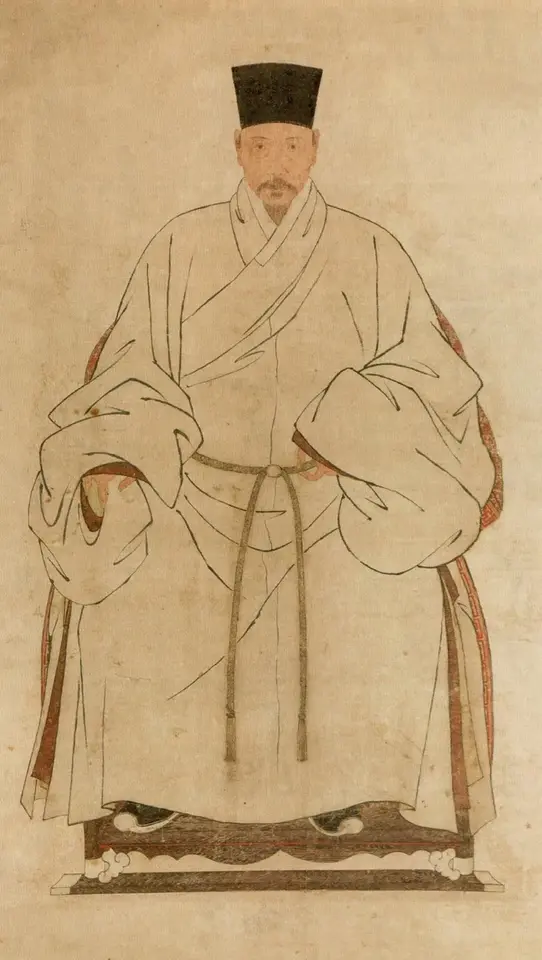
陈献章
Chen Xianzhang (陈献章, 1428–1500), courtesy name Gongfu, pseudonym Shizhai, and popularly revered as Master Baisha, was a native of Xinhui in Guangdong. He was an eminent middle-Ming philosopher, thinker, educator, calligrapher, and poet, the pioneering founder of the Ming School of Mind (Xinxue), and the progenitor of the Lingnan School of thought. Revered by later generations as a True Confucian of the Sacred Era and the…
Chen Xianzhang (陈献章, 1428–1500), courtesy name Gongfu, pseudonym Shizhai, and popularly revered as Master Baisha, was a native of Xinhui in Guangdong. He was an eminent middle-Ming philosopher, thinker, educator, calligrapher, and poet, the pioneering founder of the Ming School of Mind (Xinxue), and the progenitor of the Lingnan School of thought. Revered by later generations as a True Confucian of the Sacred Era and the Southern Patriarch of the Sacred Way, he was the sole native Cantonese philosopher enshrined in the Confucian Temple during the Ming and Qing eras. Having achieved the provincial degree in his youth, he subsequently met with repeated setbacks in the metropolitan examinations, leading him to abandon the civil service path. He traveled across mountain ranges to Linchuan in Jiangxi to study under the renowned Neo-Confucian master Wu Yubi. Finding that conventional textual philology failed to enlighten his mind, he returned home to construct the Chunyang Platform in Baisha Village, engaging in prolonged silent meditation until achieving the breakthrough realization that the universe resides within oneself and that mind is identical with the Way. Chen Xianzhang shattered the rigid scholasticism and stagnant commentary culture of early Ming Cheng-Zhu Neo-Confucianism, championing the doctrines that learning values doubt and that inner moral sprouts must be nurtured in stillness. Inheriting the core insights of Lu Jiuyuan's philosophy of mind, he directly inspired Zhan Ruoshui and Wang Yangming, forming the critical bridge in the transition of Song-Ming thought from the School of Principle to the School of Mind. In 1483, Emperor Xianzong summoned him to the imperial capital and conferred upon him the post of Investigating Compiler in the Hanlin Academy; Chen promptly submitted a memorial requesting leave to care for his aging mother, spending the remainder of his life in his home village teaching disciples who flocked from across the realm. In artistic pursuits, he invented the thatch-dragon brush (Maolong brush) made from wild coastal thatch grass, creating a vigorous, rugged calligraphic style; his poetry celebrated uninhibited spiritual intuition, establishing him as an early precursor of the expressive school of poetry. Passing away in 1500 at age seventy-three, he was enshrined in the Confucian Temple during the Wanli era and posthumously honored with the name Wengong.
Born on the twenty-first day of the tenth month in Duhuai Village, Xinhui County, Guangzhou Prefecture, later relocating to Baishali; showed extraordinary natural intellect.
Passed the provincial examination in Guangzhou at age twenty, ranking ninth; placed on the supplementary list in the metropolitan examination the following year.
Failed the metropolitan examination for the second time; convinced that civil examination prose was useless for moral cultivation, renounced worldly ambition.
Traveled to Linchuan in Jiangxi to study Neo-Confucianism under master Wu Yubi, combining manual labor with classical study before returning to Guangdong.
Built Chunyang Platform in Baisha Village, withdrawing completely from worldly affairs for over a decade to pursue silent meditation and achieve enlightenment.
Entered the Imperial College in Beijing upon the urging of Qian Pu; Chancellor Xing Rang lauded his poetry, proclaiming that an authentic Confucian master had emerged.
Suffered a third metropolitan examination setback; returned serenely to Xinhui to establish the Lingnan School, attracting crowds of dedicated disciples.
Recommended by Provincial Administration Commissioner Peng Shao; summoned to Beijing and appointed Hanlin Investigating Compiler, but returned home to nurse his mother.
Donned imperial robes on the tenth day of the second month to bow toward the north before sitting peacefully until his death at age seventy-three.
Emperor Shenzong issued an imperial edict enshrining Chen Xianzhang in the Western Wing of the Confucian Temple; posthumously titled Wengong in 1609.
Chen Xianzhang was born on the twenty-first day of the tenth month in the third year of the Xuande era of Emperor Xuanzong of Ming (1428) in Duhuai Village, Xinhui County, Guangzhou Prefecture, later moving with his family to Baishali. Raised in an agrarian family with literary traditions, he displayed keen perception and memory from early childhood, memorizing classical passages after a single reading. His father died during his early infancy, leaving his upbringing entirely in the hands of his grandfather Chen Huaifan and his mother Lady Lin. Lady Lin was a disciplined maternal figure who held her son to high standards of moral conduct, constantly recounting stories of ancient sages to inspire him to cultivate a generous, noble character.
In 1446, at the age of nineteen, Chen Xianzhang entered the Xinhui county school, earning high acclaim from the respected local scholar Liang Yi and being inducted as a government student. The following year (1447), twenty-year-old Chen participated in the Guangdong provincial examination, placing ninth among all candidates and making his name celebrated across the southern province. In the spring of 1448, filled with youthful ambition to serve the dynasty, he journeyed to Beijing to take the metropolitan examination. Although he missed the top rank necessary for the palace examination, his outstanding essays placed him on the supplementary roster, granting him eligibility for admission into the Imperial College in Beijing. He remained in the capital for some time, reading classical works.
In 1451, twenty-four-year-old Chen Xianzhang sat for the metropolitan examination once more, but again met with failure. Experiencing two consecutive examination defeats caused him to scrutinize the prevailing civil service examination culture, which treated memorizing commentaries and composing eight-legged essays as its ultimate end. He realized that spending a lifetime parsing external texts could never reveal the moral nature of the self or bring peace to society. After deep contemplation, he severed his attachment to official advancement, abandoning civil examinations to focus entirely on investigating the principles of human nature and classical mind philosophy.
In 1454, twenty-seven-year-old Chen Xianzhang learned that the eminent Neo-Confucian scholar Wu Yubi in Linchuan, Jiangxi, advocated experiential moral cultivation and maintained a rigorous pedagogical community. Leaving his mother and home behind, Chen made the arduous journey across the Nanling mountain ranges to Chongren in Linchuan to study under Wu. Wu Yubi placed primary emphasis on combining intellectual study with physical toil, leading his disciples in field labor during daytime hours while spending evenings analyzing the classical texts of Zhou Dunyi, Cheng Hao, Cheng Yi, Zhang Zai, and Zhu Xi. Chen immersed himself in Wu's academy, forming a close bond of mutual respect with his teacher, whom he praised as an extraordinary figure of the age.
Yet, after several months of intensive study, Chen observed that Wu's instructional methods remained confined to parsing the exact phrases of Song Dynasty commentaries. This scholastic fixation created an insurmountable chasm between the inner mind and universal principle. Concluding that he had not yet found the true gateway to sagehood, Chen politely took leave of his master and returned home to Baisha. Back in his village, Chen attempted to break through the philosophical impasse by reading relentlessly. He confined himself to his residence, expanding his reading from the Confucian classics to Daoist scriptures, Buddhist sutras, and unofficial histories, studying late into the night. Nevertheless, after months of exhausting labor, he found himself burdened with intellectual confusion.
Chen Xianzhang engaged in rigorous self-reflection, recognizing that the Way of the sages was straightforward. Relying on ancient texts and searching externally for moral truths scattered his mental focus, reducing him to a servant of dead words. Books recorded merely the residues of earlier thinkers, whereas the authentic moral substance and creative vitality of the cosmos had to be experienced directly within the human heart. The more complex one's external searching became, the further removed one remained from the true inner self.
In 1455, twenty-eight-year-old Chen Xianzhang constructed a modest thatch retreat in Baisha Village, christening it the Chunyang Platform. He took a solemn oath to abstain from worldly socializing, refusing to step into commercial markets or municipal offices for over a decade. Concluding that the traditional method of encyclopedic reading led to confusion, Chen pioneered an introspective practice centered upon silent meditation. Sitting upright on the Chunyang Platform day and night, he regulated his respiration, quieted his mental faculties, and eradicated worldly desires, intellectual prejudices, and textual distractions.
Through sustained introspection, Chen began to perceive the serene balance of the mind before feelings are aroused. In the early Chenghua era, after more than a decade of uninterrupted meditative immersion, his understanding suddenly broke through like a clear mirror unveiled, revealing the vivid vitality of universal creation. He attained a profound enlightenment: the mind is the Way, and heaven and earth stand through me, myriad transformations emerge from me, and the cosmos resides within me. He realized that human nature innately possesses the principles of creation, and that true learning must arise spontaneously from within, rooted in quietude to attain spontaneous moral ease. This breakthrough established the foundational framework of the Baisha School of Mind, giving birth to the Lingnan School.
In 1466, thirty-nine-year-old Chen Xianzhang led his disciples in practicing classical archery rituals in the countryside, which drew slanderous accusations from conventional provincial gentry. Qian Pu, a prominent Hanlin Academician inspecting educational institutions in Guangdong, urged Chen to travel to the capital to demonstrate his learning and silence critics. Following this advice, Chen traveled to Beijing to enroll in the Imperial College. The Chancellor of the Imperial College, Xing Rang, was an intellectual authority of the realm. One day, Xing asked all imperial students to compose verses echoing Northern Song philosopher Yang Shi's poem This Day Will Not Return.
Chen Xianzhang composed his poem spontaneously, exhibiting an ethereal grace and philosophical depth. Reading the lines, Xing Rang was stunned, striking his desk and exclaiming that Chen's verse surpassed even Yang Shi himself. Xing publicly proclaimed that a true Confucian sage had reappeared, recommending Chen to the Grand Secretariat and imperial ministries. Chen became an overnight sensation in the capital; prominent statesmen and intellectuals including Luo Lun, Zhuang Chang, and He Qin sought his acquaintance, while imperial students considered meeting Master Baisha the greatest honor. However, under the rigid bureaucratic regulations of the period, the Imperial College assigned him merely to serve as a probationary clerk in the Bureau of Personnel Records of the Ministry of Personnel.
Chen accepted this minor clerical post without complaint, reporting to his office punctually each morning and handling routine archives with diligence. Vice Minister of Personnel Yin Man, hearing of his reputation, repeatedly attempted to place his son under Chen's tutelage, but Chen declined six or seven times because of Yin's political motives. Deeply humiliated, Yin harbored bitter resentment against Chen. Meanwhile, the censor He Qin, inspired by Chen's unbending moral integrity, resigned his official post, donned plain robes, and served as Chen's resident disciple, performing prostrations daily. In 1467, Chen resigned his probationary post and returned home.
In the autumn of 1468, urged by scholar-friends and southern students, forty-one-year-old Chen Xianzhang traveled to Beijing once more to take the metropolitan examination. His essays demonstrated penetrating philosophical analysis, winning acclaim from fellow candidates. However, during the final grading process, his examination papers were maliciously dropped into a water basin in the examination hall, dissolving the ink and causing his failure. Public opinion attributed this outrage to covert retaliation by powerful officials connected to Yin Man, inciting anger among Beijing intellectuals and university students.
Faced with this injustice, Chen Xianzhang reacted with calm detachment, laughing it off. He understood that the civil examinations had devolved into a venal arena of corruption, incapable of sustaining genuine moral integrity. After the results were posted, Chen gathered his belongings and sailed south. Stopping in Nanjing, he was warmly received by eminent scholars Luo Lun, Zhuang Chang, and Zhang Mao, who sailed along the Qinhuai River discussing the cultivation of moral nature. Later, he detoured through Qinghai to visit his aging master Wu Yubi for an affectionate farewell. Returning to Baisha, Chen formally announced his permanent retirement from the civil examinations, resolving to remain a commoner dedicated to educating the realm.
Back in Baisha, Chen Xianzhang opened his doors to instruction. Aspirants journeyed across waterways from across the empire, filling his academy with hundreds of students. Chen taught with gentle encouragement, instructing students to clear mental clutter through silent meditation and encouraging them to realize moral principle in daily life. In 1470, Hanlin Junior Compiler Chen Yin petitioned the throne to appoint Chen as a court remonstrator, but Emperor Xianzong took no action. In 1481, when the White Deer Grotto Academy in Jiangxi was restored, court envoys arrived bearing lavish gifts inviting Chen to serve as head of the academy, but he declined.
In 1482, Guangdong Provincial Administration Commissioner Peng Shao visited the Baisha academy, overwhelmed by Chen's scholarly stature and integrity. Peng submitted an imperial memorial praising Chen as a paragon of Confucian virtue, warning that neglecting such a sage would be an enduring disgrace. Emperor Xianzong summoned Chen to Beijing. In 1483, fifty-six-year-old Chen arrived in the capital while suffering from chronic illness. Leading courtiers came to greet him with reverence.
However, the Ministry of Personnel insisted that he undergo formal examinations before receiving an appointment. Chen's health worsened due to the journey, and his chronic leg ailment rendered him bedridden, forcing him to request examination deferrals. At that moment, he received news from home that his elderly mother Lady Lin was gravely ill. Tormented by filial longing, Chen drafted his Memorial Requesting Leave to Nurse My Mother to Emperor Xianzong, expressing his desire to care for his parent in retirement. Deeply moved, Emperor Xianzong granted him the title of Investigating Compiler in the Hanlin Academy on the fourth day of the ninth month of 1483, permitting him to ride postal relay horses home to care for his mother.
Returning to Baisha, Chen attended to his mother with devotion until she passed away at age ninety. He continued writing and lecturing in Baisha for over a decade, consistently declining court appointments pleading illness. In the second month of 1500, seventy-three-year-old Chen fell gravely ill. On the tenth day of the second month, retaining full mental clarity, he ordered his disciples to set up an incense altar, put on his formal imperial robe and cap, faced north, performed five bows and three kowtows, murmured his farewell to the sovereign, and passed away serenely. The entire province of Guangdong went into deep mourning.
In 1567, court censors petitioned for Chen's enshrinement in the Confucian Temple. In 1573, Emperor Shenzong ordered the construction of an ancestral hall in his honor. In the eleventh month of 1584, Emperor Shenzong issued an imperial edict enshrining Chen Xianzhang in the Western Wing of the Confucian Temple, alongside Song masters Yang Shi and Hu Anguo. Chen was one of the few Ming masters alongside Wang Yangming to receive this honor, and the only Cantonese scholar to achieve this distinction. In 1609, the court posthumously bestowed upon him the title Wengong.
Chen Xianzhang occupies a seminal position in Chinese intellectual history as the primary link transitioning Song-Ming philosophy from Zhu Xi's School of Principle to Wang Yangming's School of Mind. After the founding of the Ming Dynasty, the institutionalization of Zhu Xi's commentaries as the sole basis for imperial examinations reduced classical studies to fragmented memorization, deadening intellectual inquiry. Chen broke through this orthodoxy, shifting the metaphysical center of philosophy from external heavenly principle to the subjective human mind.
Chen proposed an ontological philosophy: heaven and earth stand through me, myriad transformations emerge from me, and the cosmos resides within me. He held that the mind is the Way, encompassing the cosmos, and that the universe unfolds through the awakening of the mind. In cultivation, he championed relying primarily on quietude, cultivating sprouts of virtue in stillness, and pursuing spontaneous inner discovery. By sitting in quiet introspection, one clears worldly attachments, allowing the original mind to manifest and leading to spontaneous harmony with the Way. Historian Huang Zongxi observed that Ming thought achieved true subtlety with Baisha, noting that Chen made quietude the core, harmonizing mind and principle and pioneering a new path that later philosophers could not transcend. Chen's philosophy directly inspired his disciple Zhan Ruoshui to found the Ganquan school and provided the foundation for Wang Yangming's doctrine of extending innate moral knowledge.
With Baisha Village as his center, Chen Xianzhang established the Lingnan School, one of the most influential regional intellectual movements of the Ming Dynasty. Prior to his emergence, Guangdong was perceived by northern elites as a cultural hinterland; Chen's lectures reshaped the cultural geography of southern China, transforming Lingnan into a national capital of mind philosophy, celebrated as the Southern Patriarch of the Sacred Way.
In educational theory, Chen pioneered the pedagogical principle that learning values doubt. He asserted that inquiry requires doubt: small doubts yield small progress, while great doubts yield great progress, for doubt is the catalyst of enlightenment. He warned disciples never to accept classical texts blindly, urging them to cultivate critical inquiry and uncover underlying doubts before achieving authentic understanding. In classroom practice, he avoided rigid memorization and physical punishments, advocating teaching according to natural aptitude like gentle spring rain. Under his guidance, the Lingnan School produced brilliant thinkers, including Zhan Ruoshui, who rose to Minister of Rites and Minister of Personnel, becoming an intellectual peer of Wang Yangming, along with Li Chengji, Lin Ji, and He Qin.
Beyond philosophy, Chen Xianzhang was an innovative master in Ming calligraphy. In his later years in Baisha, the local shores yielded abundant sea-thatch grass (haimao), known for its coarse, stiff fibers. Because fine rabbit-hair and goat-hair brushes from Jiangnan were expensive and difficult to obtain, Chen harvested this native grass, subjecting it to soaking, pounding, scraping, and trimming to invent the thatch-dragon brush (Maolong brush).
The Maolong brush possessed thick, fibrous bristles with low ink capacity, generating high frictional resistance that baffled conventional calligraphers. Chen utilized his internal meditative focus to master the brush, creating the celebrated Baisha Maolong calligraphic style. His brushwork displayed immense strength, alternating between dry ink and moist flow, producing strokes resembling gnarled iron vines, soaring waterfalls, and rugged crags. Ming calligraphic theorist Feng Fang remarked that Master Baisha's use of the Maolong brush produced an extraordinary, unworldly strength, opening an independent aesthetic domain reminiscent of ancient wisteria vines and soaring swordsmanship. The craft of the Maolong brush is preserved as a National Intangible Cultural Heritage of China.
In the evolution of Ming poetry, Chen Xianzhang was an early pioneer in dismantling the dull conventions of early Ming bureaucratic poetry and the rigid archaism of the Early and Latter Seven Masters. His poetic output emerged from his inner philosophical realizations, maintaining that poetry originates from authentic human nature and must express the genuine inner life of the author rather than artificial phrasing.
Chen left over one thousand surviving poems depicting rural scenery, mountains, waters, scholarly gatherings, and internal self-examination. His verses were clear, straightforward, detached, and lingering with philosophical meaning, capturing a transcendent serenity reminiscent of Tao Yuanming. The Comprehensive History of Chinese Poetry notes that Chen marked a watershed in Ming poetry, serving not only as a turning point in Ming intellectual history but also as the pivotal moment when poetry shifted from archaic imitation to the expression of the human spirit, securing his place as a founding figure of the expressive school of poetry.
Chen Xianzhang's philosophy of mind was never an exercise in disengaged quietism; it was integrated into personal ethics and community transformation. His ethical framework was anchored in universal benevolence encompassing heaven and earth. He believed benevolence represented the spontaneous flowing of principle within the heart; a truly benevolent person considers the cosmos one body, feeling compassion for humanity while maintaining an untroubled mind.
In socio-political ethics, Chen advocated people-centered benevolent governance. In letters to court officials, he emphasized that government requires both talent and virtue, arguing that authorities must minimize labor duties and taxes to let the populace recuperate. In domestic life, he exemplified filial devotion, nursing his mother with care and choosing a frugal lifestyle centered on personal integrity. By translating profound philosophy into everyday practice, Chen transformed the customs of Lingnan, fostering an enduring regional tradition valuing learning, propriety, and moral duty.
Chen Xianzhang dedicated his life to teaching, employing flexible instructional techniques that reshaped traditional academy conventions. At Chunyang Platform and Baisha Academy, he avoided imposing mechanical rules, stressing natural maturation through unhurried contemplation. He frequently took students boating on the West River or walking along scenic bluffs, using daily interactions to reveal the nature of the mind. For impatient students, he prescribed quiet contemplation; for slower pupils, he offered steady encouragement.
Under this tailored pedagogy, the Baisha school produced distinguished scholars. His chief disciple, Zhan Ruoshui, developed the Ganquan school of mind, serving as Chancellor of the Imperial College and Minister of Rites and Personnel in Nanjing, with academies spread across northern and southern provinces. Another disciple, Li Chengji, mastered the classics, declining official appointments to maintain scholarly integrity in the south. He Qin resigned his censorship post to serve Chen, spreading Baisha thought across Shaanxi and Gansu. This widespread dispersion ensured that the Lingnan intellectual tradition took root across the empire, demonstrating remarkable academic longevity.
FIGURES ASSOCIATED WITH THIS DYNASTY