Birth in Venice
Born into a prominent merchant family in Venice, trained in mercantile arithmetic and navigation.
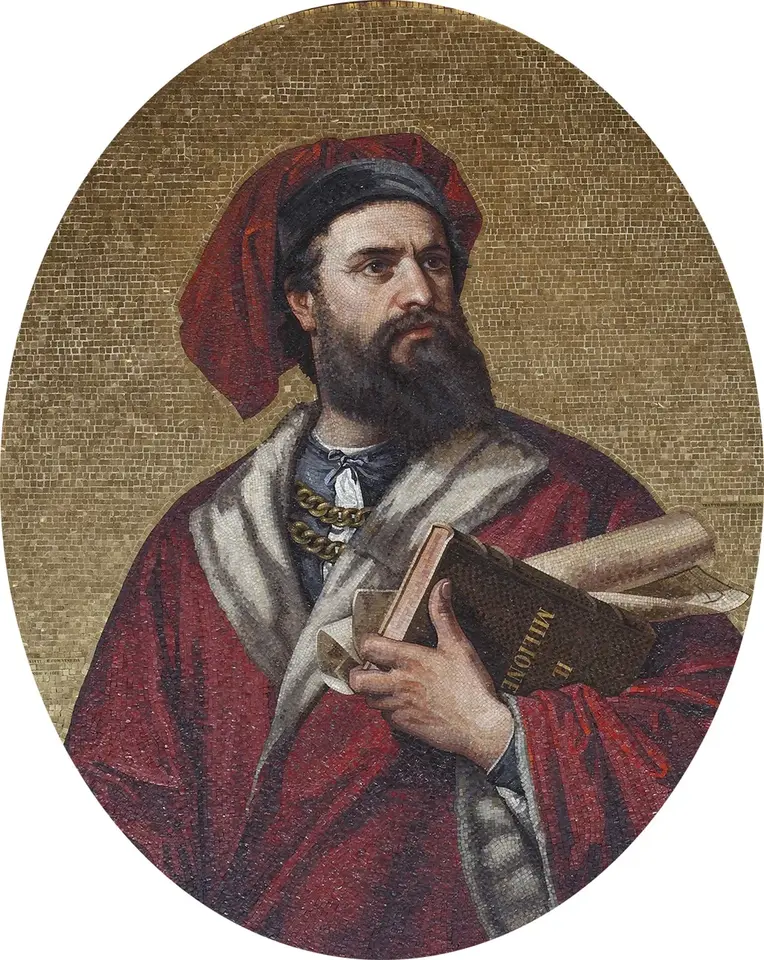
马可·波罗
Marco Polo (马可·波罗, 1254–1324) was an illustrious Venetian merchant, traveler, and pioneering explorer who served as a vital bridge between Western and Eastern civilizations during the thirteenth century. In 1271, at the age of seventeen, Marco accompanied his father Niccolo and uncle Maffeo on an arduous transcontinental journey from Venice. Traversing the Levant, Persia, the Pamir Mountains, and the perilous Silk Road across…
Marco Polo (马可·波罗, 1254–1324) was an illustrious Venetian merchant, traveler, and pioneering explorer who served as a vital bridge between Western and Eastern civilizations during the thirteenth century. In 1271, at the age of seventeen, Marco accompanied his father Niccolo and uncle Maffeo on an arduous transcontinental journey from Venice. Traversing the Levant, Persia, the Pamir Mountains, and the perilous Silk Road across Central Asia, the expedition reached the Mongol summer capital of Shangdu in 1275, where they were granted an imperial audience with Kublai Khan. Impressed by Marco's acute intelligence and linguistic adaptability, Kublai Khan retained him in imperial service for seventeen years. Serving as a trusted diplomatic emissary, Marco traveled extensively throughout northern and southern China, southwestern borderlands, and Southeast Asian tributaries. In 1291, the Polos were commissioned to escort Princess Kököchin on a maritime expedition to Persia to wed the Ilkhanate ruler Arghun. Returning by sea, they reached Venice in 1295 after an absence of twenty-four years. Captured during a naval engagement between Venice and Genoa, Marco was imprisoned in Genoa, where he dictated his extensive travels to romance writer Rustichello da Pisa, producing the seminal Travels of Marco Polo (The Description of the World). The book presented medieval Europe with its first systematic, comprehensive panorama of the immense wealth, advanced administration, and urban grandeur of China, profoundly inspiring the European Age of Discovery. He died in Venice in 1324 at the age of seventy.
Born into a prominent merchant family in Venice, trained in mercantile arithmetic and navigation.
Departed Venice with his father and uncle, carrying credentials from Pope Gregory X to the Mongol court.
Arrived at Shangdu after four grueling years of land travel, presenting papal letters to Emperor Shizu.
Dispatched on an imperial inspection tour across Sichuan, Yunnan, and the borderlands of Burma.
Appointed to oversee regional salt administration and water transport offices in Yangzhou for three years.
Set sail from the port of Quanzhou with a large fleet to escort Mongol Princess Kököchin to the Ilkhanate.
Arrived safely in Venice with immense riches in gemstones and silk after twenty-four years of travel.
Commanded a Venetian galley against the Genoese at the Battle of Curzola, was captured and imprisoned.
Released following the Venice-Genoa peace treaty; wed Donata Badoer and prospered as a leading merchant.
Passed away in Venice at the age of seventy, emancipating his Tatar servant in his final will.
Marco Polo was born in 1254 into an established patrician merchant family in the Republic of Venice. Shortly after his birth, his father Niccolo and uncle Maffeo departed on an extensive commercial voyage through Constantinople and the Crimea, eventually traveling along the northern Silk Road to the court of Kublai Khan in China.
Marco grew up in Venice under the care of his mother and extended family, acquiring essential training in Latin, commercial bookkeeping, commodity appraisal, and Mediterranean maritime geography. His mother died while he was still a youth.
In 1271, Niccolo and Maffeo returned to Venice bearing imperial letters from Kublai Khan addressed to the Pope. Learning of the election of Pope Gregory X, the elder Polos secured papal letters and holy oil from Jerusalem before preparing to return to China, taking the seventeen-year-old Marco with them.
The expedition sailed from Acre across the eastern Mediterranean into Lesser Armenia, proceeding through Tabriz and the arid Iranian plateau toward Hormuz on the Persian Gulf. Finding the native ships frail and unseaworthy, they abandoned the sea route and journeyed across eastern Persia, ascending the formidable heights of the Pamir plateau, the "Roof of the World." They braved the treacherous sands of the Taklamakan Desert, resting at oasis outposts such as Kashgar, Yarkand, and Khotan before proceeding through the Hexi Corridor. In 1275, after four years of relentless physical hardship and perils from bandits, they reached Shangdu, the summer residence of the Great Khan.
Upon arrival, Niccolo and Maffeo presented the papal messages and sacred gifts to Kublai Khan, introducing young Marco to the throne. Delighted by Marco's physical vigor, humility, and evident quickness of mind, Kublai Khan welcomed the youth warmly, retaining him within the imperial household and granting him court emoluments.
Marco displayed exceptional linguistic talent. Within a short period, he mastered Mongolian, Persian, Turkic, and administrative idioms current throughout the Mongol realm, acquiring intimate familiarity with court protocols and imperial etiquette.
Recognizing that Marco was observant, candid, and attentive to ordinary life, Kublai Khan utilized him as a trusted special envoy for inspection tours across the empire.
Marco was dispatched on an extensive investigative mission to the remote southwestern frontiers, passing through Shaanxi, Sichuan, and eastern Tibet into Yunnan, the former realm of the Dali Kingdom, and reaching the borders of Burma. He compiled meticulous reports on regional ethnic tribes, cowrie shell currencies, gold-toothed peoples, and unusual mineral wealth. Later, he inspected central provinces and coastal ports, presenting the emperor with comprehensive descriptions far more insightful than routine bureaucratic memorials.
During his seventeen-year residence in the Yuan Empire (1275–1292), Marco Polo witnessed the culmination of Kublai Khan's conquest of the Southern Song dynasty and the consolidation of continental unification. In his memoirs, he expressed profound astonishment at the architectural grandeur and geometric planning of the imperial capital of Dadu (modern Beijing), declaring the imperial palace complex to be without equal in the entire world.
He documented Dadu's orderly grid avenues, night curfew systems, and the immense volume of raw silk, jade, and porcelain imported daily from all corners of the earth.
Marco was particularly intrigued by advanced institutions unfamiliar to Western Christendom, such as the empire-wide circulation of paper banknotes, the universal consumption of "black stones" (coal) for domestic heating and metallurgy, and the expansive postal relay system consisting of tens of thousands of courier stations connecting remote frontiers with the central government.
Traveling through the southern Yangtze delta, Marco described Hangzhou (which he called Kinsay, "The Heavenly City") as the most splendid and luxurious metropolis on earth. He documented its tranquil West Lake, thousands of stone bridges, thirteen vast market squares, thriving silk weaving manufactories, and the refined manners of its affluent citizenry. Historical traditions further record that Marco was commissioned to govern the flourishing commercial city of Yangzhou for three years (1282–1285), overseeing tax administration and granary distribution along the Grand Canal.
As Kublai Khan approached an advanced age, the Polos grew anxious that a succession crisis might imperil their safety. They repeatedly requested permission to return home, but the emperor, deeply attached to their companionship, continuously declined.
In 1291, three Persian ambassadors arrived in Dadu from Arghun Khan, ruler of the Ilkhanate, requesting a bride from the Mongol royal clan following the demise of his principal wife. Kublai Khan selected the seventeen-year-old princess Kököchin. Because overland transit across Central Asia was blocked by civil conflict among Mongol princes, the envoys requested maritime passage, pleading with the emperor to permit the experienced Venetian navigators to escort them. Kublai Khan relented, equipping a fleet of fourteen large multi-masted junks provisioned for two years.
The fleet sailed from the vibrant international port of Quanzhou, navigating the South China Sea, Champa (southern Vietnam), Sumatra, and Ceylon, before rounding the southern tip of the Indian subcontinent. After more than two years of perilous navigation, during which more than half the crew succumbed to fever and maritime tempests, the expedition reached Hormuz in 1293. As Arghun Khan had already died, Princess Kököchin was wed to his son Ghazan Khan.
Having discharged their imperial duty, the Polos crossed Armenia to Trebizond on the Black Sea, boarded ships for Constantinople, and arrived back in Venice in 1295 after a twenty-four-year odyssey.
Upon their return to Venice, the Polos were initially unrecognized by their relatives, having adopted foreign Tatar dress and forgotten much of their Venetian dialect. Their identity was confirmed only when they invited their kin to a banquet and unstitched their coarse coats, pouring cascades of rubies, emeralds, diamonds, and pearls across the tables.
In 1298, full-scale naval warfare erupted between the maritime republics of Venice and Genoa for commercial supremacy in the Mediterranean. Marco Polo financed and commanded a war galley. At the fierce Battle of Curzola, the Venetian fleet was routed; Marco was captured while fighting bravely and transported in chains to a Genoese prison.
To relieve the monotony of his confinement, Marco recounted his Eastern adventures to a fellow inmate, the romance writer Rustichello da Pisa. Rustichello transcribed the narratives in Franco-Italian prose, titling the compilation The Description of the World (Le Devisement du Monde).
In 1299, a peace treaty between Venice and Genoa resulted in Marco's liberation. Returning home, he married Donata Badoer, fathered three daughters, and prospered as a distinguished merchant. On January 8, 1324, Marco Polo died in his home at the age of seventy and was buried in the church of San Lorenzo.
Before the appearance of the Travels, European impressions of Asia were clouded by mythological monsters and biblical allegories. Marco Polo was the first Western observer to provide a systematic, empirical description of a powerful, unified civilization featuring sophisticated centralized government, flourishing urban commerce, complex maritime networks, and universal paper currencies.
His vivid accounts of the palaces of Dadu, the markets of Hangzhou, the maritime harbors of Quanzhou, and the porcelain workshops of Jiangxi shattered western misconceptions, serving as a landmark milestone in Western geographic and anthropological knowledge of China.
The descriptions in the Travels of the vast wealth of Asia, particularly the fabled riches of Cipangu (Japan) and the Southeast Asian spice islands, ignited a burning desire among European monarchs and merchants for maritime trade routes.
In the late fifteenth century, Christopher Columbus studied Marco Polo's text intently, inscribing more than seventy handwritten annotations in the margins of his personal copy. Convinced by Polo's geographic descriptions that sailing westward across the Atlantic would reach the Asian mainland, Columbus undertook his historic 1492 voyage, accidentally discovering the Americas. Navigators such as Vasco da Gama and Ferdinand Magellan drew profound inspiration from the same source. Marco Polo's journey fundamentally accelerated the dawn of the Age of Discovery and early globalization.
During the unique historical window of the Pax Mongolica, when Mongol rule linked the Pacific Ocean to the Black Sea, Marco Polo fulfilled an irreplaceable role as a cultural intermediary. He served Kublai Khan while recording the multifaceted languages, customs, and technologies of the Yuan realms.
His overland expedition and subsequent maritime return pioneered coordinated communications along both the terrestrial and maritime Silk Roads, connecting Europe and East Asia through durable historical memory for centuries to come.
FIGURES ASSOCIATED WITH THIS DYNASTY