Life Story
Early Life and Spiritual Evolution
Öljaitü was born in 1280 into the ruling Borjigin golden lineage of the Mongol Empire, the third son of the fourth Ilkhan, Arghun Khan, and great-grandson of Hulagu Khan. His mother, Uruk Khatun, was a devout adherent of the Church of the East (Nestorian Christianity). In his early childhood, she had him baptized under the Christian name Nicholas. Endowed with an inquisitive intellect, the young prince developed a keen interest in theological debate, languages, and regional statecraft.
In 1295, his elder brother Ghazan launched a successful coup to claim the throne and made the historic decision to convert to Islam to secure the loyalty of the Persian sedentary majority. Öljaitü followed his brother's conversion, adopting the Turco-Mongol name Kharbanda. Appointed military governor of the critical frontier province of Khorasan, Öljaitü spent years defending the northeastern borders against incursions from the Chagatai Khanate. In Khorasan, he engaged deeply with Islamic jurists of both the Hanafi and Shafi'i schools. Later, under the philosophical influence of the renowned Shia scholar Jamal al-Din al-Hilli, Öljaitü embraced Twelver Shia Islam with fervent devotion, adopting the Arabic regnal title Muhammad Khodabandeh ("Servant of God").
Imperial Enthronement and Foundation of Sultaniyya
In May 1304, Ghazan Khan died prematurely without male issue, leaving a will designating Öljaitü as his rightful successor. Öljaitü swiftly advanced from Khorasan to Azerbaijan, crushed a conspiracy by Prince Alafrang, and convened a kurultai on the Ujan plains on July 21, 1304, ascending the throne as the eighth Ilkhan.
Determined to escape the political influence of conservative nomadic factions in Tabriz, Öljaitü initiated the construction of a new imperial capital on the Zanjan plateau in northwestern Iran. Named Sultaniyya ("The Imperial City"), the metropolis was laid out across a circumference of sixteen kilometers, furnished with expansive fortified walls, imperial palaces, grand mosques, hospitals, colleges (madrasas), and vast caravanserais designed to accommodate trans-continental merchants. Within a decade, Sultaniyya blossomed into one of the wealthiest commercial hubs of the medieval world, serving as a vital nexus connecting the Italian city-states of Venice and Genoa with the Great Yuan capital of Dadu.
Religious Policies and Military Campaigns
Öljaitü's religious governance marked a major turning point in the history of the Middle East. Frustrated by bitter sectarian strife between Sunni legal schools, Öljaitü formally decreed Twelver Shia Islam as the official religion of the Ilkhanate in 1310. He replaced the names of the early caliphs on imperial coinage with the venerated names of the Twelve Imams and financed magnificent shrines for Shiite holy figures. Although this transition sparked resistance among conservative Sunni amirs, Öljaitü's patronage firmly rooted Shiite culture and theological institutions within the Iranian plateau.
On the military front, Öljaitü demonstrated energetic command. In 1307, he led an imperial expedition across the Alborz mountain passes, successfully conquering the densely forested Caspian coastal province of Gilan that had resisted foreign domination for centuries. He subsequently quelled rebellions in Herat and launched offensive campaigns into Syria against the Mamluk Sultanate. Uniquely combining steppe mobility with intellectual patronage, Öljaitü organized an elite "mobile academy," consisting of scholar-tents and library wagons pulled by hundreds of camels that accompanied the royal camp on progress across the realm.
Diplomatic Ties with Eurasia and Final Years
Öljaitü maintained a deep reverence for the Great Khan in China, preserving the geopolitical unity of the Mongol Commonwealth. Following the general peace concluded under Emperor Chengzong between the Yuan dynasty, the Chagatai Khanate, and the Ilkhanate, high-level diplomatic embassies traveled freely between Tabriz and Dadu. Emperor Wuzong presented Öljaitü with a prestigious imperial gold seal carved with Chinese seal script reading "Seal of the True Mandated Emperor for Concord with All Peoples," an imprint which Öljaitü prominently stamped upon all official diplomatic letters sent to Western monarchs. He dispatched embassies to King Philip IV of France, King Edward II of England, and Pope Clement V proposing joint anti-Mamluk military alliances, profoundly expanding European awareness of Asian statecraft.
On December 16, 1316, Öljaitü passed away from sudden illness in his palace at Sultaniyya at the age of thirty-six. His remains were interred in the magnificent royal mausoleum that he had constructed within the new capital. Succeeded by his twelve-year-old son Abu Sa'id, Öljaitü's death marked the end of the Ilkhanate's golden age of administrative stability and architectural splendor.
Major Achievements
Construction of the Dome of Soltaniyeh
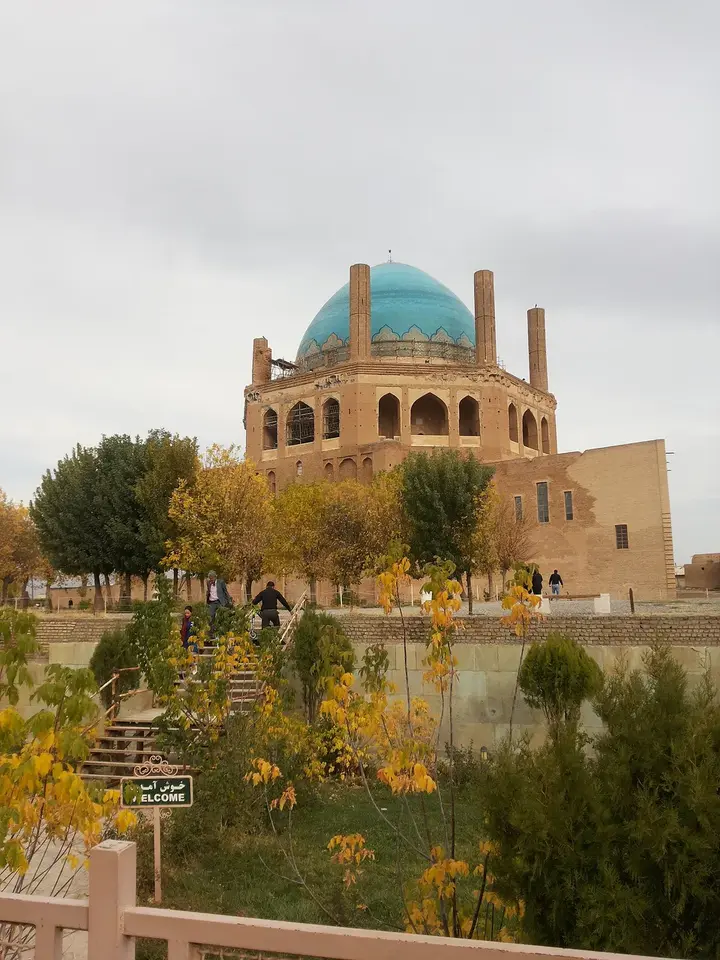
Öljaitü's most extraordinary material achievement is his majestic mausoleum at Sultaniyya, erected between 1305 and 1313. Dominating the Iranian plateau, the brick structure rests on an octagonal ground plan flanked by eight minarets, crowned by a brilliant turquoise-glazed ceramic dome rising fifty meters into the air.
Structurally, the mausoleum is the earliest surviving example of a double-shelled dome in the Islamic world, representing a revolutionary breakthrough in architectural physics and brickwork masonry. Its intricate stucco reliefs, lapis lazuli mosaics, and Quranic calligraphy established the stylistic foundation for later Timurid architecture in Samarkand and Safavid monuments in Isfahan. Recognized by international historians as an architectural forerunner to the Taj Mahal and Florence Cathedral, the mausoleum and the Sultaniyya archaeological site were inscribed as a UNESCO World Heritage site in 2005.
Patronage of Rashid al-Din's Universal History
Öljaitü performed an incomparable service to world historiography by subsidizing Grand Vizier Rashid al-Din in compiling the celebrated Compendium of Chronicles (Jami' al-tawarikh). Expanding upon the initial genealogical project conceived under Ghazan, Öljaitü commanded Rashid al-Din to expand the work into an all-encompassing universal history of known civilization.
Inviting Chinese scholars, Kashmiri Buddhist masters, Frankish Catholic monks, and Persian-Turkic genealogists to Sultaniyya, Öljaitü provided royal archives and vast funds to translate and harmonize the histories of China, India, Europe, the Islamic caliphate, and the steppe nomads into a unified historical narrative. Completed during his reign, the Compendium of Chronicles stands universally acknowledged as the world's first true universal history, providing modern historians with an indispensable documentary window into the Mongol Empire.