Selection for the Eastern Palace
Entered the service of Crown Prince Chen Shubao on account of her beauty and musical talents.
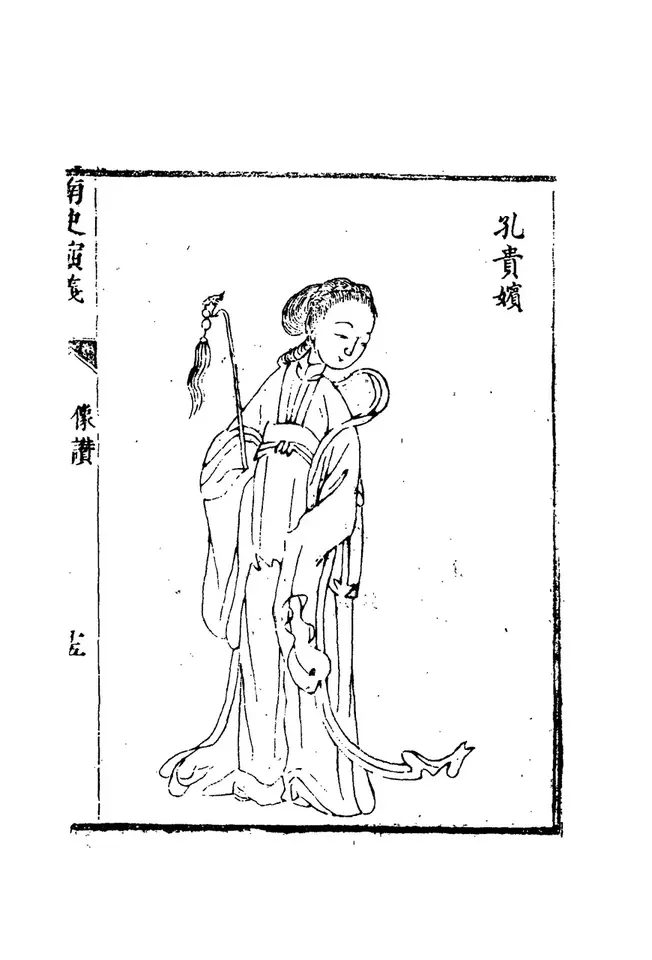
孔贵嫔
Kong Guipin (孔贵嫔, d. 589), personal name unrecorded, was a favored imperial consort of Chen Shubao (the Last Ruler of Chen) during the Southern Dynasties period. Renowned across Jiangnan for her dignified physical beauty and refined artistic talents, she was elevated to the rank of Imperial Noble Consort (Guipin) upon Chen Shubao's accession to the throne in 582. In 584, Chen Shubao constructed three luxurious towers of…
Kong Guipin (孔贵嫔, d. 589), personal name unrecorded, was a favored imperial consort of Chen Shubao (the Last Ruler of Chen) during the Southern Dynasties period. Renowned across Jiangnan for her dignified physical beauty and refined artistic talents, she was elevated to the rank of Imperial Noble Consort (Guipin) upon Chen Shubao's accession to the throne in 582. In 584, Chen Shubao constructed three luxurious towers of aromatic eaglewood: Linchun, Jieqi, and Wangxian. While the emperor resided in Linchun and his paramount favorite Zhang Lihua occupied Jieqi, Kong Guipin resided in Wangxian Pavilion, connected by soaring overhead skywalks. Beyond her physical charm, she was accomplished in poetic composition and musical performance, notably playing a prized pipa named Huaifeng (Embracing the Wind). Sharing imperial favor with Zhang Lihua, Kong Guipin exerted extensive political influence by establishing an alliance with sycophantic minister Kong Fan, whom she claimed as an adopted brother. Operating from within the palace, they manipulated bureaucratic promotions and received immense bribes. In the final years of the dynasty, she joined the emperor and court literati in nightly banquets that produced decadent musical ballads such as The Jade Trees and Flowers of the Rear Courtyard. Following the conquest of Jiankang by Sui forces in 589, Sui senior commander Gao Jiong ordered her execution alongside Zhang Lihua at the Qingxi Palisade as a warning against dynastic corruption.
Entered the service of Crown Prince Chen Shubao on account of her beauty and musical talents.
Elevated to the rank of Imperial Noble Consort (Guipin) following Chen Shubao's enthronement as emperor.
Took up residence in the newly constructed Wangxian Pavilion, enjoying imperial favor alongside Zhang Lihua.
Formed an alliance with influential minister Kong Fan as adopted siblings, manipulating court patronage and appointments.
Accompanied the emperor in ceaseless banquets, harmonizing pentasyllabic poetry with ministers while Sui forces massed along the Yangtze.
Captured by Sui forces under Han Qinhu and He Ruobi after Chen Shubao fled into a dry well with his consorts.
Condemned and decapitated alongside Zhang Lihua at the Qingxi Palisade on the orders of Sui chief of staff Gao Jiong.
The early background and familial ancestry of Kong Guipin remain unrecorded in formal dynastic histories. During the mid-to-late Taijian era under Emperor Xuan of Chen, she was selected into the palace household of Crown Prince Chen Shubao on account of her dignified beauty, elegant bearing, and refined artistic sensibilities. She quickly distinguished herself among the crown prince's concubines through her quick wit, musical training, and understanding of courtly literature.
In the first month of 582, Emperor Xuan passed away. Prince Chen Shuling attempted a violent coup, attacking Chen Shubao with a sword during the funeral rites. Rescued by loyal commanders, Chen Shubao suppressed the rebellion and ascended the throne as the Last Ruler of Chen. Following his accession, the new emperor reorganized his harem, formally elevating Lady Kong to the position of Imperial Noble Consort (Guipin). Under the court ranking system of the Chen dynasty, the rank of Guipin stood at the head of the Three Ladies, carrying status second only to Empress Shen Wuhua.
In 584, the second year of the Zhide era, having recovered from his physical wounds and consolidated his imperial position, Chen Shubao abandoned state governance to indulge in extreme luxury. In front of the Guangzhao Hall, he mobilized state revenues to erect three soaring towers: Linchun, Jieqi, and Wangxian. Constructed of fragrant eaglewood and adorned with pearls, gold leaf, and silk curtains, these towers rose dozens of meters into the sky.
In the residential layout of these pavilions, Chen Shubao occupied Linchun Pavilion, his paramount favorite Noble Consort Zhang Lihua resided in Jieqi Pavilion, and Kong Guipin shared Wangxian Pavilion alongside the favored Consort Gong. Overhead covered skywalks linked the three towers, allowing the emperor and his favorites to move freely between their private apartments without touching the ground. While Empress Shen lived in quiet seclusion in the outer palace, Kong Guipin and Zhang Lihua received daily imperial visits, their combined influence dominating the inner palace.
Recognizing that imperial favor was precarious without external political support, Kong Guipin forged an alliance with the influential courtier Kong Fan. Kong Fan was a skilled flatterer who catered to the emperor's literary vanity. Although they shared no genuine biological lineage, Kong Guipin and Kong Fan claimed to be brother and sister, establishing a coordinated network connecting the inner quarters with the outer court.
Relying on Kong Guipin's private persuasion in the bedchamber and Kong Fan's sycophancy in ministerial meetings, the Kong faction rapidly expanded its control over state affairs. Official promotions, judicial reprieves, and military assignments were routinely traded for vast bribes channeled into Wangxian Pavilion. Even Zhang Lihua, when seeking to replace Crown Prince Chen Yin with her own son Chen Shen, found it necessary to cultivate a partnership with Kong Guipin and Kong Fan to secure their joint backing. Dynastic records noted that the power of the Zhang and Kong factions radiated throughout the realm, leaving senior ministers helpless and dismantling the administrative coherence of the Chen dynasty.
By 588, the second year of the Zhenming era, the newly unified Sui dynasty under Emperor Wen had completed comprehensive military preparations to conquer southern China. While hundreds of thousands of Sui soldiers assembled north of the Yangtze, Chen Shubao, Kong Guipin, and Zhang Lihua continued their nightly revels in the fragrant pavilions of Jiankang. The emperor assembled over a thousand singing girls and court musicians, seating nine favored consorts alongside ten literary courtiers, including Minister Jiang Zong and Kong Fan.
During these banquets, men and women feasted together without customary separation, composing pentasyllabic love poems late into the night. Kong Guipin's elegance inspired courtiers to write romantic verses celebrating eternal youth, contributing to the compilation of The Jade Trees and Flowers of the Rear Courtyard. In the first month of 589, Sui armies commanded by Han Qinhu and He Ruobi crossed the Yangtze and took the palace city of Jiankang. Chen Shubao hid inside the dry well of Jingyang Palace alongside Kong Guipin and Zhang Lihua, but Sui soldiers discovered them and pulled them up with ropes. When Prince Yang Guang showed interest in sparing the beautiful consorts, Sui chief of staff Gao Jiong insisted that they must be executed to prevent dynastic corruption, ordering both Kong Guipin and Zhang Lihua to be beheaded at the Qingxi Palisade.
During the final years of the Southern Dynasties, Kong Guipin's elevation established her as one of the two dominant figures of the Chen imperial court. Installed in the eaglewood Wangxian Pavilion in 584, she formed an influential pair with Zhang Lihua. Contemporary chronicles distinguished her by her dignified and classical beauty, contrasting with Zhang Lihua's dramatic, cascading dark hair and vivacious manner. By sharing exclusive imperial favor, Kong Guipin occupied a prominent place in the palatial aesthetics and private life of the Last Ruler of Chen.
Kong Guipin played a pivotal political role by constructing an alliance with the court official Kong Fan. By assuming the fictional identity of brother and sister, they created a powerful patronage network that bypassed traditional ministerial checks. Through Kong Guipin's private access to the emperor, Kong Fan undermined senior military commanders such as Xiao Mohe, while officials seeking advancement funneled fortunes in gold and silk to Wangxian Pavilion. This corruption undermined the morale and readiness of the Southern Dynasties military apparatus on the eve of the Sui invasion.
Possessing advanced musical training, Kong Guipin was an accomplished performer of the pipa lute. Chen Shubao bestowed upon her instrument the poetic title Huaifeng (Embracing the Wind), drawn from a classical verse by Southern Qi poet Wang Rong. In the nightly feasts held in the three pavilions, she regularly joined the emperor and court literati in poetic composition. Her beauty was repeatedly immortalized in the imagery of southern court poetry, leaving an enduring imprint on the decadent musical and poetic repertoire of the late Southern Dynasties.
FIGURES ASSOCIATED WITH THIS DYNASTY